Alternative to a Tack Horn

Part of reefing is getting the tack cringle onto the tack horn, it’s how you secure the tack of the sail while reefing! How else would you do it? 

The struggle with this old method is that the horns can hook and poke holes in the luff of your sail as you raise the sail, and you have to get your tack cringle over the horn in foul weather. When you combine the situation of high winds, a flapping sail, and a pitching deck; suddenly getting a little ring over a little horn doesn’t sound like a fun idea. 

Alternatives exist, where a strap with rings on the ends will be sewn through the cringle, so that you can simply place the ring on the strap over the horn, as the strap is easier to manage than the stiff luff of the sail. 

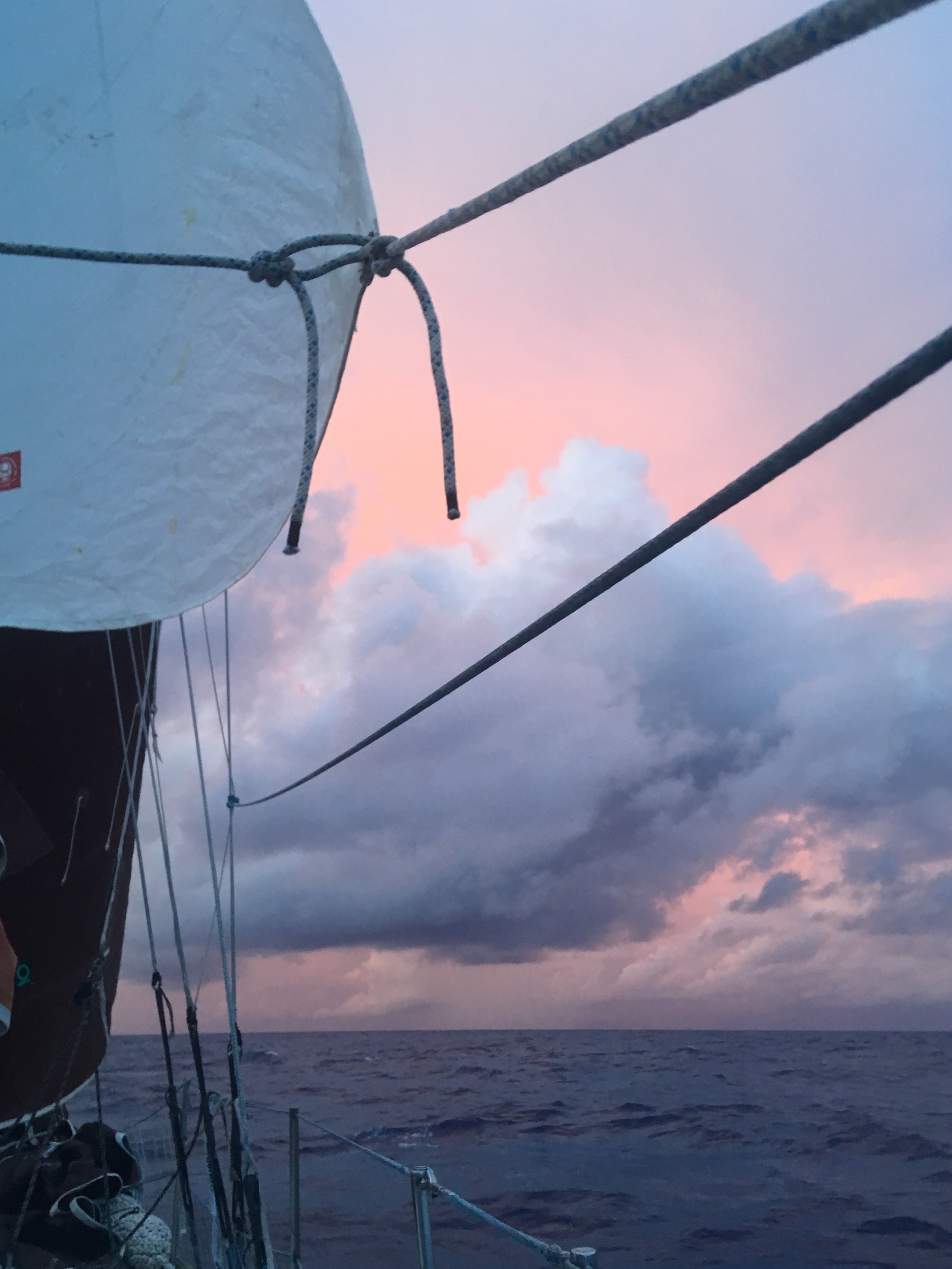
All this got me thinking about alternatives to this debacle. What about taking a very strong dyneema line and simply tying the tack in place? 

FullSizeRender.jpg

I used a 7mm length of SK-78 dyneema with an alpine butterfly hitch tied in the middle to give the tack line an appropriate purchase point. The line simply passes through the tack webbing, through the bight, back through the tack webbing and back through the bight, then through the webbing one more time to tie off just below the alpine butterfly hitch.

Having a long length of line means that I can reach the tack webbing with ease from a distance, and the purchase system lets me pull the tack down tightly.  The dyneema is very strong and able to hold the forces of the sail with ease.

It is imperative that the tack line run down and forward to keep the forces mostly vertical on the luff of the sail. If the tack line does not have a forward component to it’s pull, the luff of the sail will be pulled aft with no countering and it will rip your luff off the luff track.

What we do is tie the tack line, tension the halyard with the winch, then set the clew line for the reef. This way, the clew line is acting on an already tensioned and set tack, resulting in a stable reef setup with zero risk to the sail during sail raising. 

Weather Helm and Lee Helm

Sailboats have two rudders steering them, not just one!

IMG_2250.JPG

The first one is the one everyone thinks of when you they hear the word “rudder”. This is the appendage that hangs off the back of the yacht that is controlled by the wheel or tiller and is the primary method for controlling a yachts direction.  

IMG_2734.JPG

The second one is exclusive to sailboats, as powerboats do not have this second rudder, the sails. As wind hits the sails and gives the sailboat power to drive through the waves, it also influences the direction the yacht will go as it moves through the waves. 

If the sails are all at the back of the yacht, the wind will hit them and push the back of the yacht downwind and the bow upwind. This is known as weather helm. 

If the sails are all at the front of the yacht, the wind will hit them and push the front of the yacht downwind and the stern of the yacht upwind. This is known as lee helm. 

Having the right balance of sails, front and back, is necessary to cause the yacht to be pushed evenly and to avoid this urge to rotate. 

The urge caused by the wind can be felt in the helm, and can lead to crew fatigue if you are counting on the rudder to compensate for unbalanced sails.  When the yacht wants to turn upwind, simply turning the helm to leeward will make the yacht sail in a straight line, but you will have conflicting events happening. The sails want it to turn upwind while the rudder is dragging through the water trying to turn the yacht back to leeward. The result is these forces will cancel out and the yacht will sail straight! But the cost of these conflicting forces will be loss of speed as the rudder and sails need to cancel out their opposing forces instead of all moving forward in harmony.

Trimming each sail to optimum performance by following the tell tales will give you maximum performance out of each sail, but not optimum performance out of the entire system. If you sacrifice pure performance and instead focus on minimizing weather and lee helm, you will actually sail faster and with less drag.

Thinking of the sails as a second rudder, almost as an air rudder, will be advantageous in your seamanship abilities. Instead of setting the sails for power, and then adjusting your course with the rudder, it would behoove you to set the sails based on the winds and point of sail you wish to be on, then fine tune your heading with the rudder. Thinking of the sails as your primary steering method, more of a macro rudder, and your rudder as a fine tuning steering method, more of a micro rudder, will let you sail most efficiently and effortlessly. 

FullSizeRender.jpg

Controlling Weather Helm while on a Run

Weather helm is a phenomenon where the force on the sails wants to turn the yacht up and into the wind. This is caused by having the Center of Effort (CE) of a sail aft of the Center of Lateral Resistance (CLR) of the underwater profile. Balancing the sails is simply the act of playing around with the CE to get it to be directly in line with the CLR. ​

If the CE is ahead of the CLR, the boat will have lee helm and will want to turn downwind. If the CE is aft of the CLR, the boat will have weather helm and will want to turn upwind. Only when the CE and CLR are directly over each other will the sailboat be balanced and sail straight, not venturing upwind or downwind.​

Balancing the sails is not the same as trimming the sails for maximum performance. A lot of time, you will need to have your sail working at less than peak performance to properly balance out the whole setup. This is easy when you are sailing on a beam reach, where all the forces acting on the yacht are coming from the side, but what about on a run?​

To be on a run, you need to ease your mainsail all the way out so that it can act as a large drag to the apparent wind and be pulled along, likewise pulling your yacht along with it.​ Here is where it gets tricky.

FullSizeRender.jpg

As you ease your sail out, the CE of the sail will not only move forward, which will help give you lee helm and pull your yacht downwind, but it will also move the CE laterally and outboard. This long and very powerful lever arm, also known as your boom, will act on the mast and try to turn your yacht opposite of the direction you have eased the sail. In this case, with the boom eased to port, the force on the sail will try to turn the yacht to starboard. This may feel and act like weather helm, but it is not caused by the aft movement of the CE, instead it is caused by the leverage of the mainsail held out by the boom.

The further outboard the clew of the sail is, the longer the lever arm is that is acting on the yacht, and more leverage the sail will have to turn the yacht in the opposite direction. 

Your options here are simple, either you can move the clew further in or not ease the sail as far. Moving the clew inboard is effective at reducing this torquing. This can be achieved by either reefing the sail or simply not easing the clew past the beam of the boat. Obviously, these options seem counterintuitive as the apparent wind while on a run is less than the true wind; more sail would seem logical!

Instead of reefing, and dealing with the boom on a run, an alternative is to raise the trysail. 

IMG_2737.JPG

The trysail has no boom, so the foot will curl more easily when the sail is eased. As you ease the sail, the clew will tend to move directly forward from the sheeting point, and as such will stay inboard of the beam of the yacht. 

The sail is also smaller but when eased will fill up and provide a great amount of drive downwind. Since the sail will curl up, the majority of the sail will be right along the mast, in the middle of the rig, further keeping the CE close to the midline of the yacht. 

Being a small sail, it also won’t block the wind from reaching your headsail. This will increase the headsails effectiveness which will then aid in keeping the bow of the ship pointed downwind.  

IMG_2265.JPG

Having a trysail up on a wonderful day may not seem intuitive, but it really does help take out the weather helm while sailing downwind. This will balance your sailplan and let your yacht sail more balanced towards your downwind destination.

Wood Rot

The head refit began as an elective procedure. We felt the space in the head was used inefficiently, and so we wanted to make better use of that space. We began by tearing out the cabinets and some small rotten corners were noted on the cabinet itself, but nothing structural. 

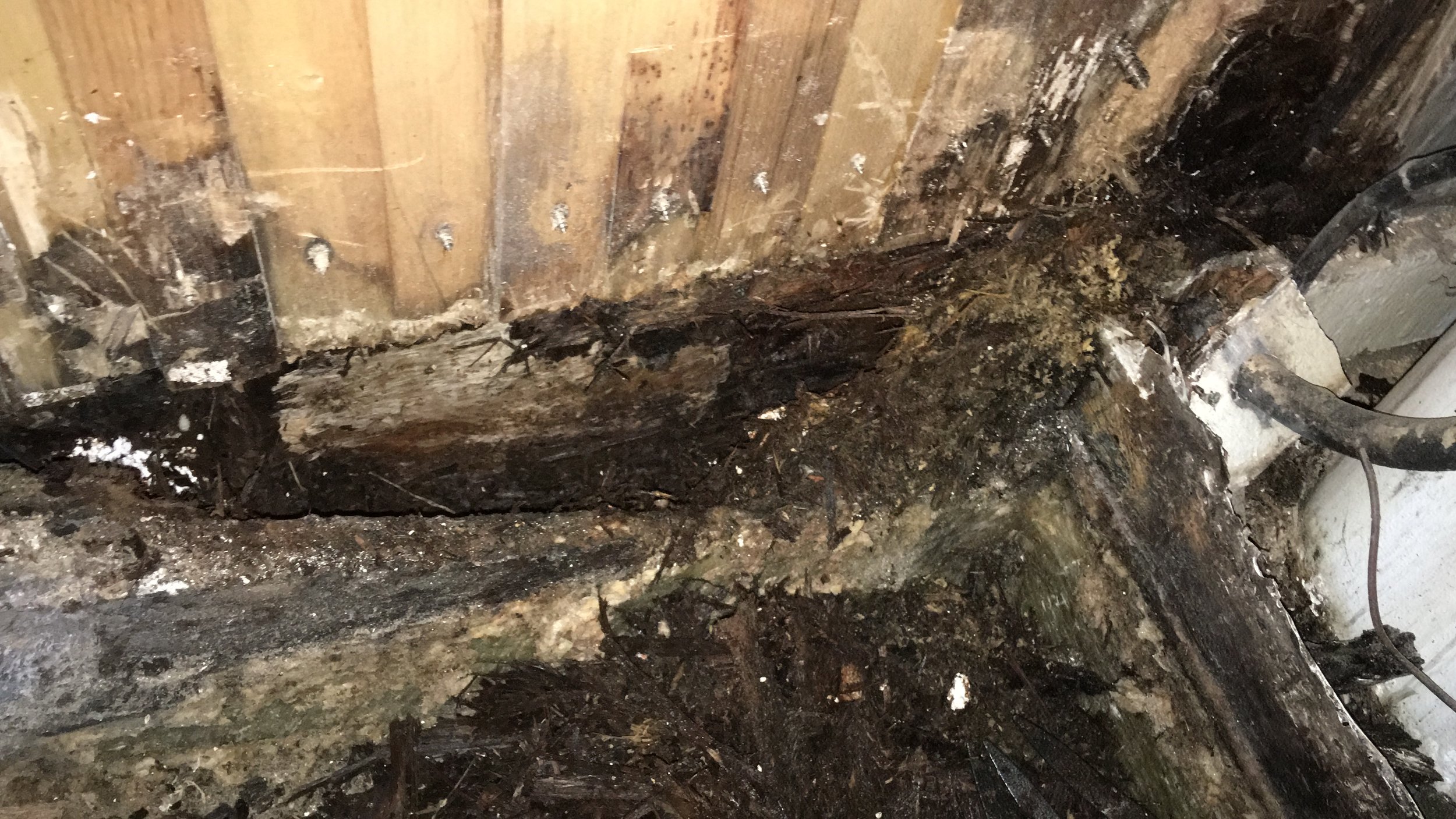
Then I removed the old shower floor, and this is what I found! 

FullSizeRender.jpg

Under the shower was foam, to take up the dead space. The foam was sprayed in between the floors and keel so that water would not collect in there under the shower. The problem with this plan is: water will always find a way!

The foam quickly became a dry sponge that yearned for the moisture above it, and as small bits of water crept past the bedding compound used to hold the shower floor in place, the foam would soak it up and hold it there forever! 

Fast forward a few decades and you have waterlogged plywood that has never dried out. It rotted away to mulch!  The floors under the shower are completely gone, only the fiberglass tabbing that held them to the hull remains!

Where the bulkhead came down to meet the shower also rotted away completely. The bulkhead is two sheets of 3/4 inch plywood, and the entire bottom section rotted away.  

To access the rot, I first sanded away the paint so I could see how far up the wood was discolored. Then I took a small circular saw and cut a 3/4” deep cut to remove the afflicted wood. 

FullSizeRender.jpg

With the bulkhead cut back to healthy and unaffected wood, I was then left with the vertical finishing boards of the salon. The entire lower portion of the bulkhead had rotted away because it was abutting the shower floor. 

IMG_3791.JPG

The rotten wood, which had turned into mulch was simply removed by scooping it up and throwing it out. With all the wet and rotten wood out of there, the remaining wood will be left open to dry for the next month. 

IMG_3790.JPG

What looks like mulch is actually the remains of the bottom of the bulkhead. This wood will need to be replaced in a more sound manner that way this issue doesn’t repeat itself in a few more decades. 

At the moment, I am debating whether to replace the lost bulkhead material with close cell foam or with new plywood. Either way, the new head will be fully glassed to the walls so that the entire thing is a fiberglass shell that won’t leak water into the timbers of this old boat. 

Butcher Block Galley Countertops

While on the hard in Terceira, we decided to take care of some boat projects that we had been toying with tackling “someday”. First was repaint the whole boat, second was refit the head, third is refit the galley, and fourth is re-finish the entire inside of the boat (a lot of varnish to do this one). 

The boat is being painted, the head is under deconstruction, so it’s time to get the wood for the galley! 

FullSizeRender.jpg

The plan is to replace the Formica and plywood countertops with edge grain mahogany butcher block. In the Azores, the prices all seem rediculously low, which is what spurred our desire to tackle the refit here, even though our visa to be there and work on the boat only grants us 90 days in a 180 day period. 

FullSizeRender.jpg

Oddly enough, there is no logging on the island, and all their wood is imported from Africa. As a result, wonderful African hardwoods are readily available at a very low price! We ended up paying €250 for all of this wood, including the delivery and milling! 

Sadly, the quality of the woodworking on the island does not match the quality of the wood that they import, so finding the right kind of wood glue for the project proved impossible. I want to use Titebond III because it is waterproof and permanent. I have used it before in the construction of Tooth II, and those seams had zero leaks! 

When I asked around for wood glue, I was offered Elmers Glue and local wood glue that specifically said “temporary holding, not for items that will get moist”. When I told them I need something that is waterproof, they offered me Silicone. I promptly left that establishment and began to worry about what all wooden construction on the island was glued together with!

I looked into special ordering a proper wood glue but the cost of delivery and limited time left on this visa proved to be too much. So, the wood for the galley will remain on the cabin sole until we January, when we return and begin the reconstruction phase of the refit.