Morty is Happy

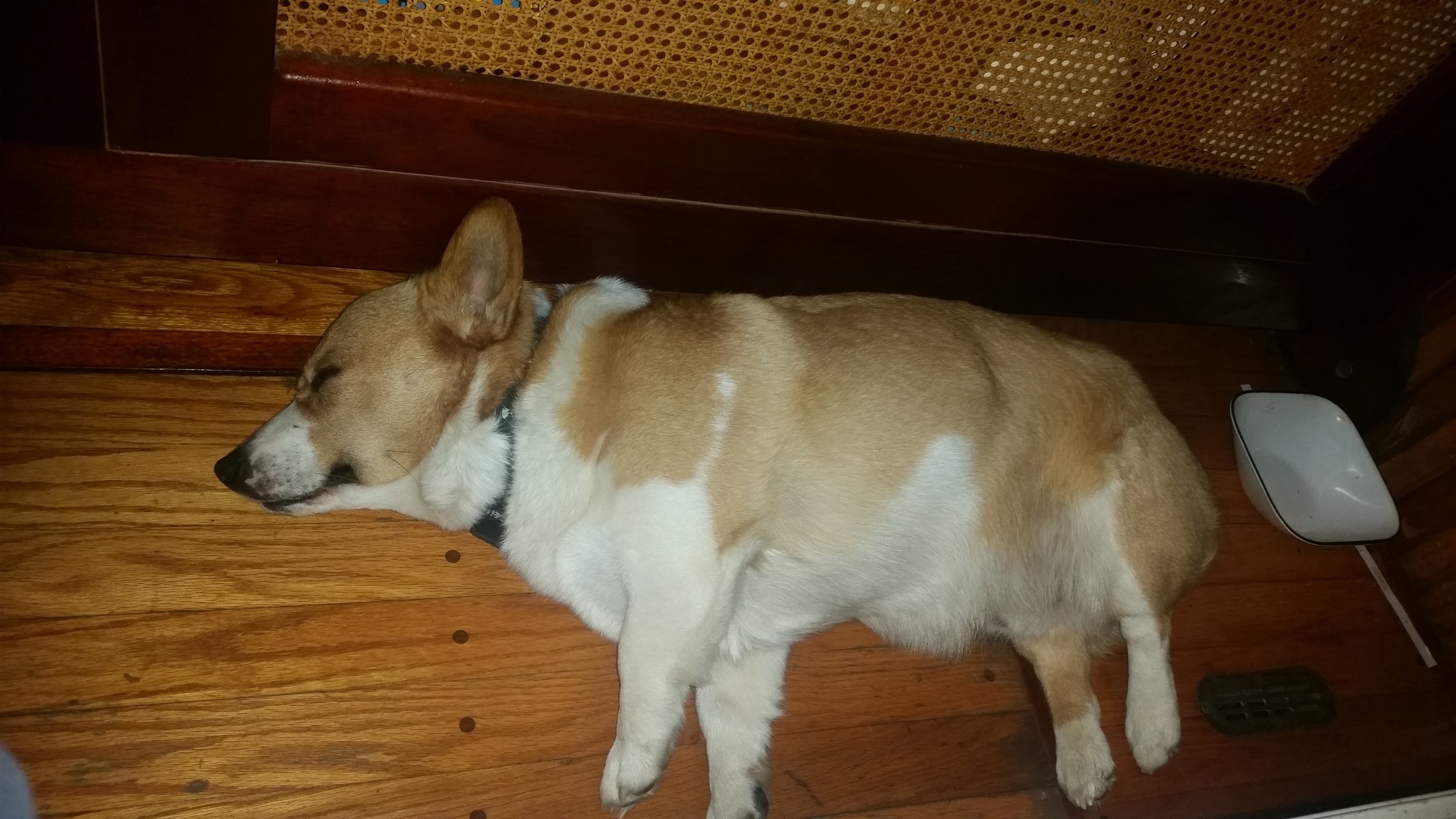
Morty had a good day. He got to play with many dogs and play fetch until he was too tired to keep playing. When we returned to the boat, Maddie had made a big pot of rice and beans with sausages for dinner. 

Instead of regular dog food, Morty was surprised by a nice bowl of rice and beans instead of dry dog food.

With a full belly and tired little legs, Morty laid on his side and went to sleep under the table. His short little legs were not able to reach the cabin sole as he laid on his side, so his legs simply stuck straight out as he slumbered away, waiting for us to take him to bed with us. Another good day for Morty!

Handy Tiny Circular Saw

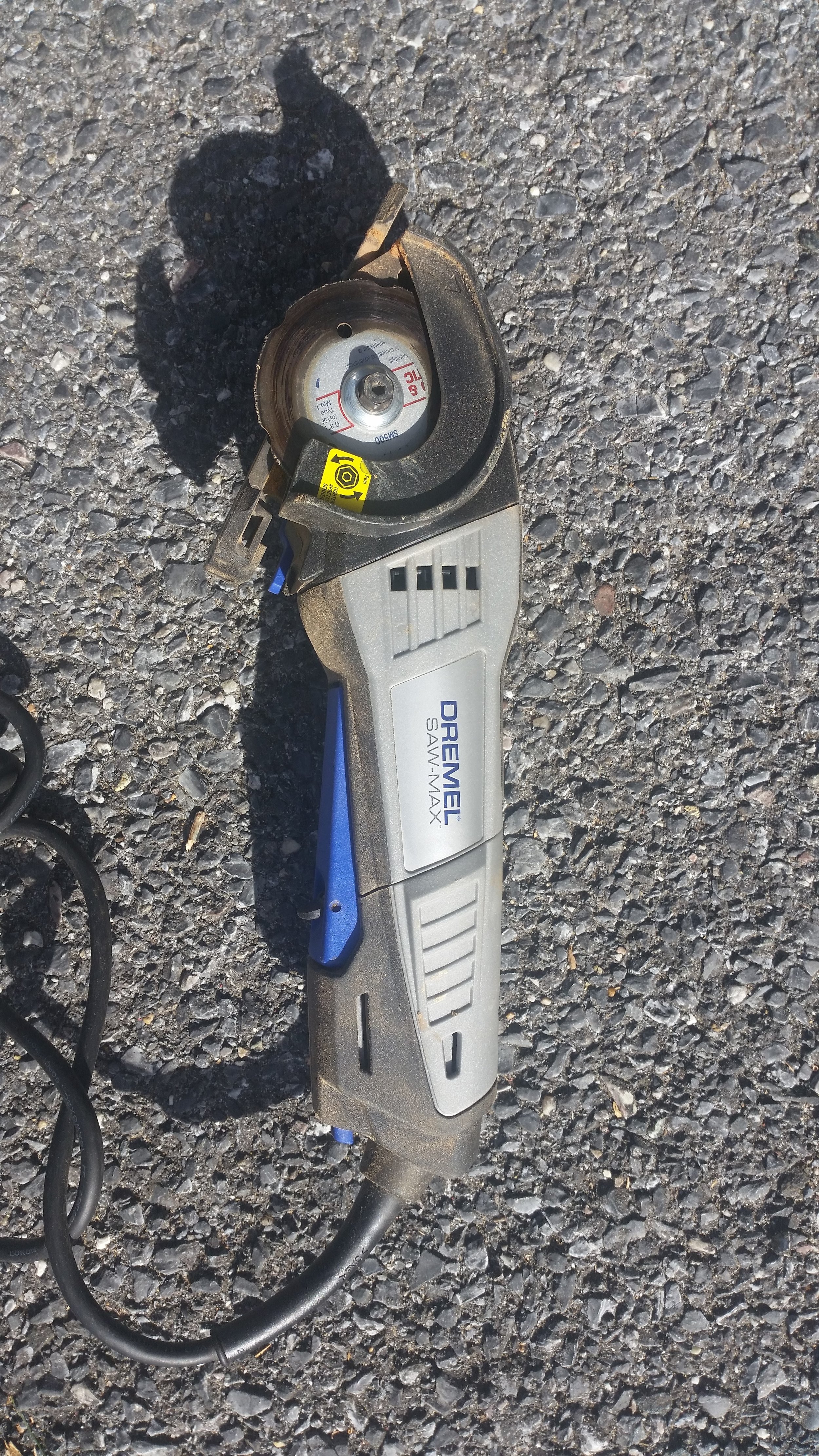
When you need to trim through a lot of wood in a very tight or small area, a handsaw simply wont fit and a circular would be too dangerous for such delicate work. This is when the handy Saw-Max by Dremel comes into play.

Instead of a standard toothed blade, the saw max uses an abrasive blade the grinds away at the wood like a tiny file. There is virtually no kerf, so very little wood is lost in the process. Since the entire unit is very small and light weight, it can easily be placed right into tight spots and allows you to cut right on the mark!

Using the Saw-Max, I am able to achieve finishing cuts without fear of grain tear out or accidentally damaging another part of the hull. I can also keep a close eye on what I am cutting as there is very little particulate matter that is ejected from the cutting process. A smaller kerf (width of the blade) means that less wood is turned to dust which means less dust being thrown all over the place.

Walking to the Car

A common question I get asked when I someone finds out I live aboard, especially in the winter, is how do I get to my car. I think they imagine me anchored miles from shore in the middle of the ocean. 

The truth is, walking to the car is just part of the routine. While people who keep their vehicles in attached garages might think this is an extremely uncomfortable way to live, it's really not that different from people who live in row houses in cities. With a row home or town home, you need to find street parking. Sometimes the street parking is blocks away from your house, and you will need to walk a bit of a distance to get from home to your car. 

The biggest difference between a town home and a boat home is the walk from a town home is down city side walks while the walk from a boat home is down a pier. In the winter, when the wind is blowing harder and the frigid wind cuts through your coat, it may seem a bit extreme! Moments like this simply teach you to dress properly so that you can stay warm on your walk down the pier. Once you have the basics covered, walking to your car to go to work in the morning becomes part of the awesome routine that is living aboard!

How to Tell if the Shrouds are Tight Enough

Adjusting the standing rigging may seem straight forward, simply tighten the stays until the mast is in column and in the correct order that way everything lines up and works well together. The problem is, how tight is tight enough?

You don't want to over tighten the stays because the additional stress is just that, additional stress. This stress is transmitted to the spar, the mast tanks, the chainplates, the hull, pretty much everything that is involved with the rigging will now be subjected to unnecessary additional stress.

There are two ways to check the tightness of the rigging, one is at the dock, the second is while sailing.

The dockside check is rather simple, all you need to do is feel how tight the cap shrouds are. They should be tight enough that when you push or pull on them, they don't want to jiggle around too much. If they feel loose or floppy, you need to tighten them further. 

Once the cap shrouds are set, the rest of the shrouds simply follow in sequential order with none of them being tighter than the cap shrouds.

The second method, and the preferred method, is to sail test the rigging. This will subject the yacht to the real loads that it is expected to perform under. If the mast is not in column while sailing, the windward shrouds are too loose and need to be tensioned further. If the mast is in column but the leeward shrouds are floppy, the leeward shrouds need to be tightened to remove the slack.

Eventually, rigging perfection will be reached where the shrouds are the perfect tightness. The mast remains in column on all points of sail and the shrouds never go dangling slack. 

The reason really slack leeward shrouds are a hazard are all due to the practical effects they can have on the rigging. 

If the cap shroud were to slip out of the spreader tip, it would then be too loose and the spreader would no longer be working. The mast would bend violently to leeward as the overlong cap shroud is over stressed. This is why the spreader tip needs to be tied to the cap shroud, that way it won't fall out of place, even when slack.

The second reason really slack shrouds are a danger is made apparent during tacking and especially during jibing. The slack rigging is under no tension while on the leeward side. Should your yacht undergo an accidental jibe, the leeward shrouds would quickly become the windward shrouds in a violent display of force.

The slack shrouds will be shock loaded, and these shock loads can be tremendously greater than what the stay is able to withstand. An accidental jibe could actually snap a stay, which results in overloading the remaining stays and potentially bringing down the mast.

If the leeward shrouds are kept in slight tension, they will not go from slack to fully loaded in an instant and the rigging will have a better chance of surviving a fierce accidental jibe. 

Danger of Relying on Electronics

Electronic charts are great, they offer volumes of information in a tiny concise package! Paper charts need to be purchased, printed, stored, and retrieved individually; whereas electronic charts can be downloaded for free and searched quickly and easily. 

Most electronic charts will change to lower scale charts as you zoom in automatically, saving you the trouble of finding the chart inset and relocating your position on the new page. Since electronic charts are so easy to manage and carry, it is easy to keep your chart collection up to date with the most current charts, all in an easy to carry and read electronic device. 

One favorite seems to be the iPad. These little computers have incredible battery lives and a wealth of programs that load seamlessly into the unit. I can sync the iPad to my Delorme InReach and see our exact position on the most current chart of the area. When we are leaving for new waters, we just need to download the latest charts for our intended destination and any other points of interest along the way (in case we get side tracked). There is no trip to the chandler or payment for tubes containing our paper charts, and best of all, no cost!

Each paper chart usually costs around $20. Most programs that will display navigational charts are free! Those that are not free are still only a few dollars, and then you have the ability to display any and every chart. Technology really is amazing!

While technology is great, it is also fragile. I keep the iPad in a protective case to prevent accidental damage to the unit, but that only goes so far. One morning, I was carrying a block of wood that I had been working on out the companionway. A wake hit the boat and the block of wood slipped out of my hand and fell straight onto the iPad. Luckily, the screen didn't crack from the impact (thanks to the protective case it lives in) but the screen did die.

When I turned it on, half the screen was gray bands while the other half was static. I know that the unit was still functioning because the clock appeared at the top of the monitor. Sadly, the time will not tell me all I need to know about the waters I am cruising in. Because we also carry paper charts, the loss of the iPad was not as detrimental of a loss. We were still able to navigate the waters and sail without questioning where we are.

The take home message is that electronic gizmos are great, but you still need to carry a paper backup in the event that the electronic device were to fail.