Life Aboard

Solar Panel Wiring

Now that the solar panels are perched to collect the suns solar energy, it is time to write the system up and feed our electrical needs. 
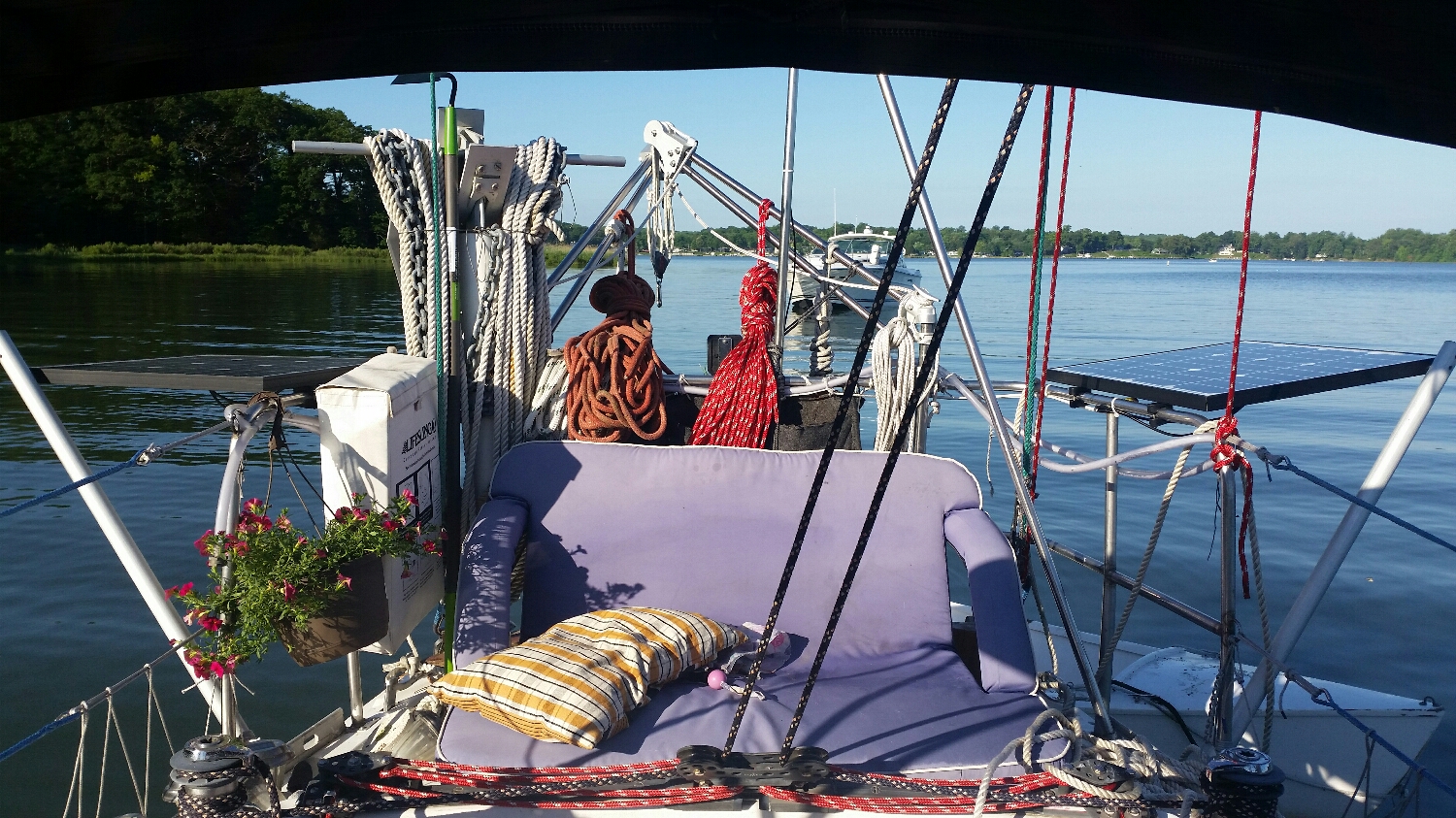
upload.jpg

I ran the wires from the panels to the battery switch, and then let my friend Bob Blood do the electrical connections. Bob Blood is an ABYC certified electrician and does gorgeous work that lasts! 

The solar panels lead to the charge controllers, which then feed the battery banks. These charge controllers are by Genasun and are significantly less expensive than other brands. They are made in the USA and have a reputation for being work horses, but they don't have the fancy display screens of other brands.  

Instead they have a single LED light that blinks. Slow, for ready; fast, for charging; stay, for charged; red, for fault. 

The solar panels are able to feed the house bank (315 amp hours and 12V DC) as well as the electric motor bank (210 amp hours and 48V DC).

The electric motor produces its own power while we sail, up to 4 amps at 48V DC! When we need to charge up the motor bank, we simply sail on a beam reach and bring up its charge! 

The solar panels are the equivalent of a trickle charge for the motor bank, but they can help float the batteries while at anchor for a long time.  

On the house side of our electrical system, the biggest consumer is our fridge. The fridge is 14.5 cubic feet with a freezer section and consumes a lot of amps! With the solar panels off, the house bank will drop to 11V when the refrigerator compressor turns on. With the solar panels on, the voltage stays at 12.3V with the fridge on and 13.3V with the fridge off (in between compressor cycles).

While we only have 100W of solar panels (at 12V DC), we also only have meager electrical needs. Our cabin lights and running lights are LED, and don't consume much electricity at all. Our other electrical needs are to power a small garmin chart plotter, depth sounder, and VHF radio. The only big consumer is our massive refrigerator. 

upload.jpg

By keeping the systems in the boat simple, we are also able to keep our demands low, which allows us to spend less money on solar panels to power these electrical conveniences. 

Honeymoon in Belize

For our honeymoon, we wanted to travel someplace warm where we could relax on a beach and go swimming. Coco Plum became our destination of choice. It's a small reef island with a few huts on it. 

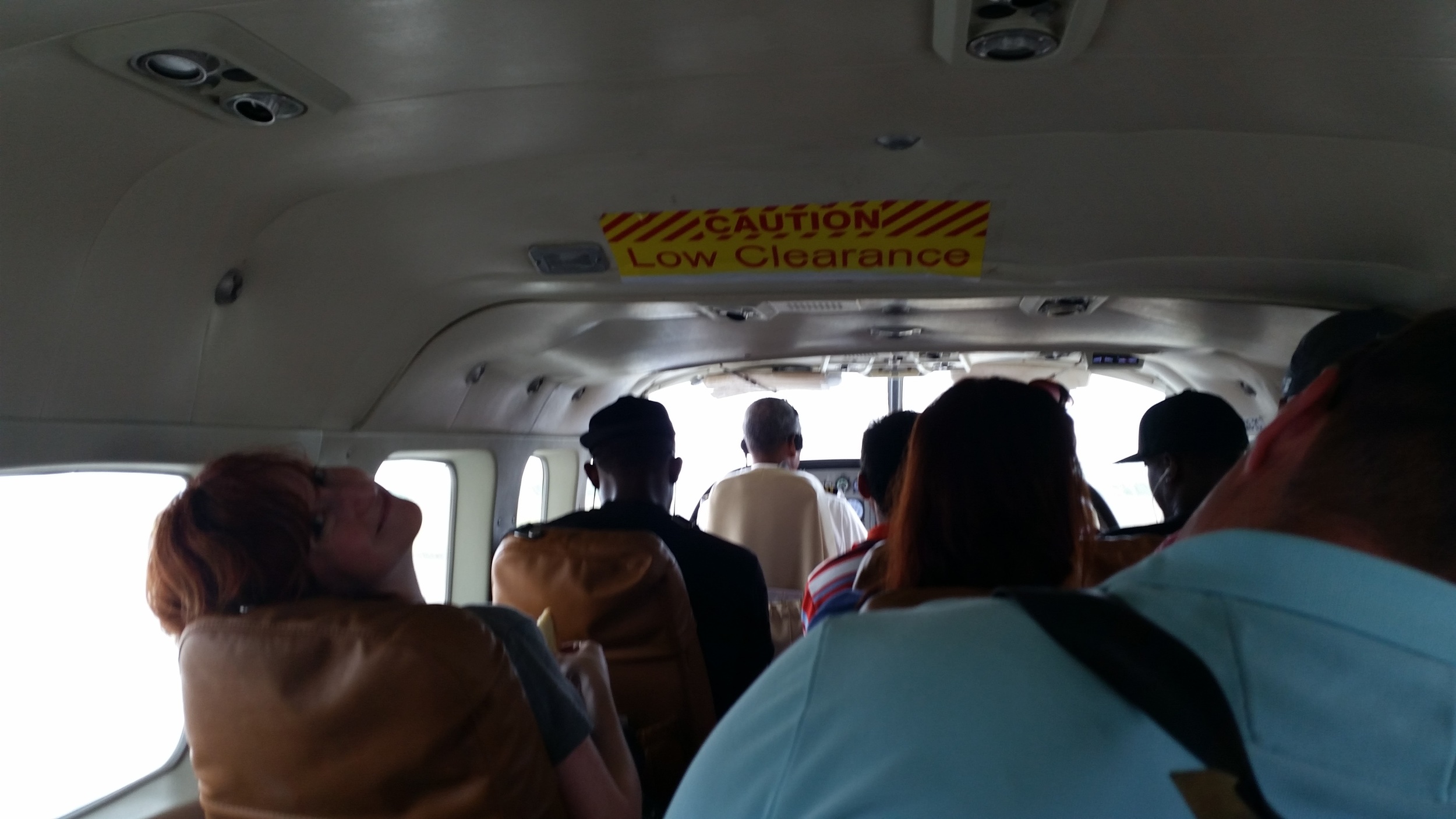
The only issue is getting to this remote island. 2 jets, a tiny propeller plane and a boat ride to get here!

Maddie was a trooper, hopping onto the smallest commercial plane she had ever been on to get there. She is used to large organized airports with different terminals and pathways to get you to your plane, but she went along with the relaxed attitude in Belize where you walk out onto the tarmac to find your small propeller plane. 

My favorite part of this was the local security inspection:

Security officer: "Do you have anything you shouldn't have?"

Me: "Nope."

Security officer: "Ok."

No hassle with metal detectors or strip searches, just walk into the airplane and hold on for the flight! We will be spending a week on these reef islands, relaxing and enjoying the tropical waters for our honeymoon.

Deck Lights

Illuminating the deck is crucial on dark nights. I am not a fan of harsh bright spreader lights that blind away your night vision and turn the deck into daylight since they also eat away at your batteries precious amps.

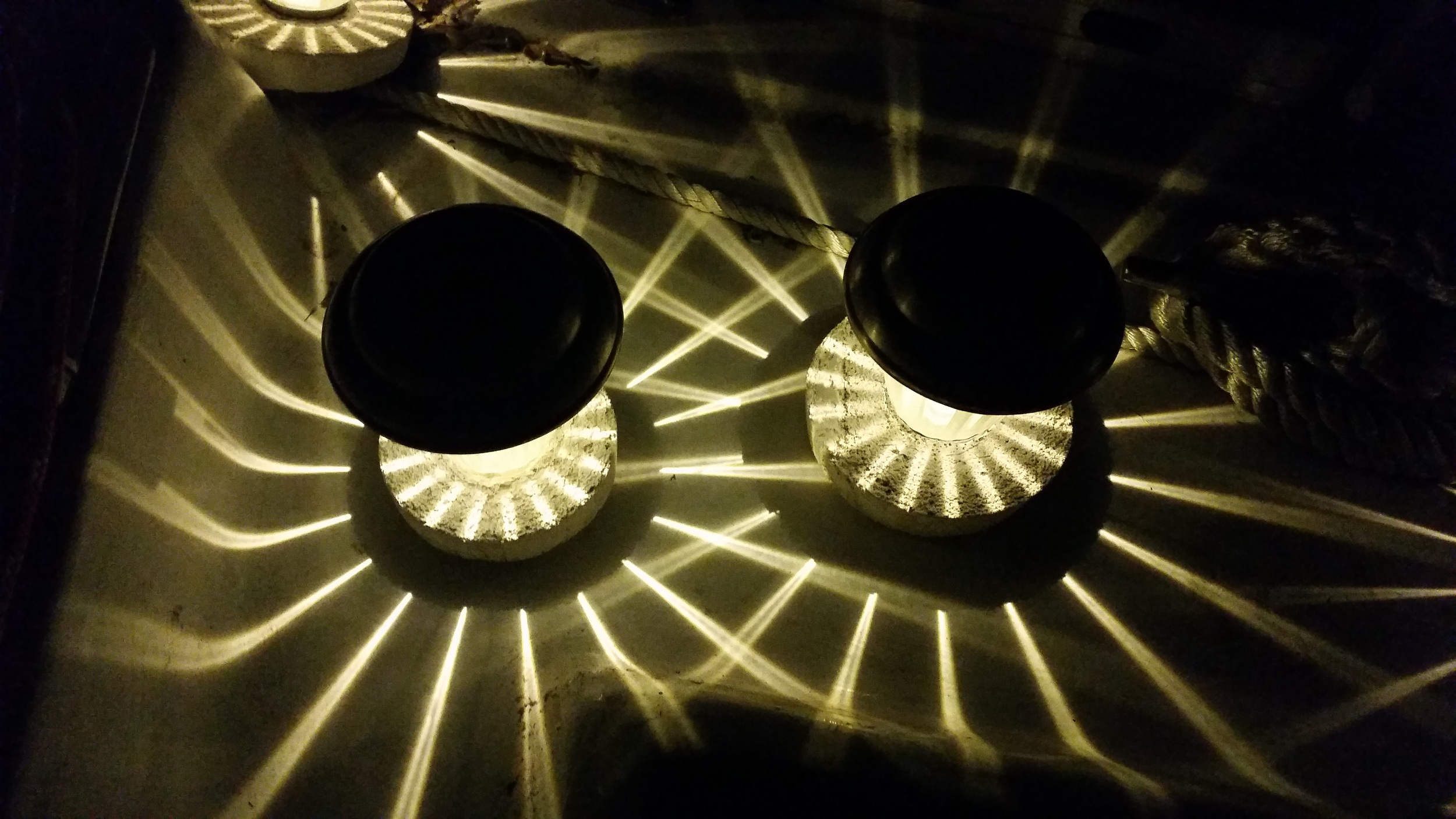
My alternative is to use solar powered yard lights from Home Depot! They do not draw on the batteries and provide a gentle light that will not kill your night vision. They also stay on all night long, letting other boats know that you are anchored and the mast head anchor light is not a star in the sky!

I removed the grass stake and set the lens into a tupperware filled with plaster. As the plaster set, the light was trapped in the stone and properly weighted to keep them from falling over while sailing.

I made a bunch of these a few years back and they have worked very well! They do not slide around on deck and best of all, do not fall overboard!

When we anchor, we spread them around the deck to provide a gentle light and to let other boats know the length of our boat (marking the bow and stern with lights). When morning comes, we collect the lights and set them in the stern where the solar panels charge their AA battery for tomorrow nights illumination.

Marina Community

Maddie and I got married on June 4th, and during the toasts I realized something.

Many of the people from the marina were present at the wedding because they are like family. We might not be related by blood, but we love each other, take care of each other, and look out for each other. I have never experienced this type of close nit community on land, where neighbors seem to keep to themselves and avoid interactions with one another.

In the marina, we all hang out together on the docks and in each others boats. If you are inside and hear people having a good time, you come out and join in the fun!

I had taken this sense of community for granted all these years until my neighbors began giving toasts at the wedding. These people have known me from the first day I arrived in the marina. I just bought Wisdom and brought her into her slip, giving everyone a spectacle as I had no experience reversing a full keel boat into a slip!

They helped me situate the dock lines and position fenders, they gave me pointers and were always available to lend a hand when I was coming or going. I took this for "friendly boat neighbors" and didn't realize that this is because we are all family in the marina.

We connect on a much deeper level! We go through the same struggles and we are always around to help in time of need. 

When Maddie came into my life, everyone noticed how I had changed. I was much more open, and they all said I seemed so much happier; and they were happy to see this change in me. 

It was very touching to see how much everyone cares about us in the marina. It is a bond that I have never had on land, and it's a special bond between liveaboards.


Planning Out the New Dinghy

We have finally begun the planning process for our new dinghy. This dinghy will be stored on deck, between the mast, boom, and dodger while on long voyages. This will reduce the drag associated with towing a dinghy behind us.

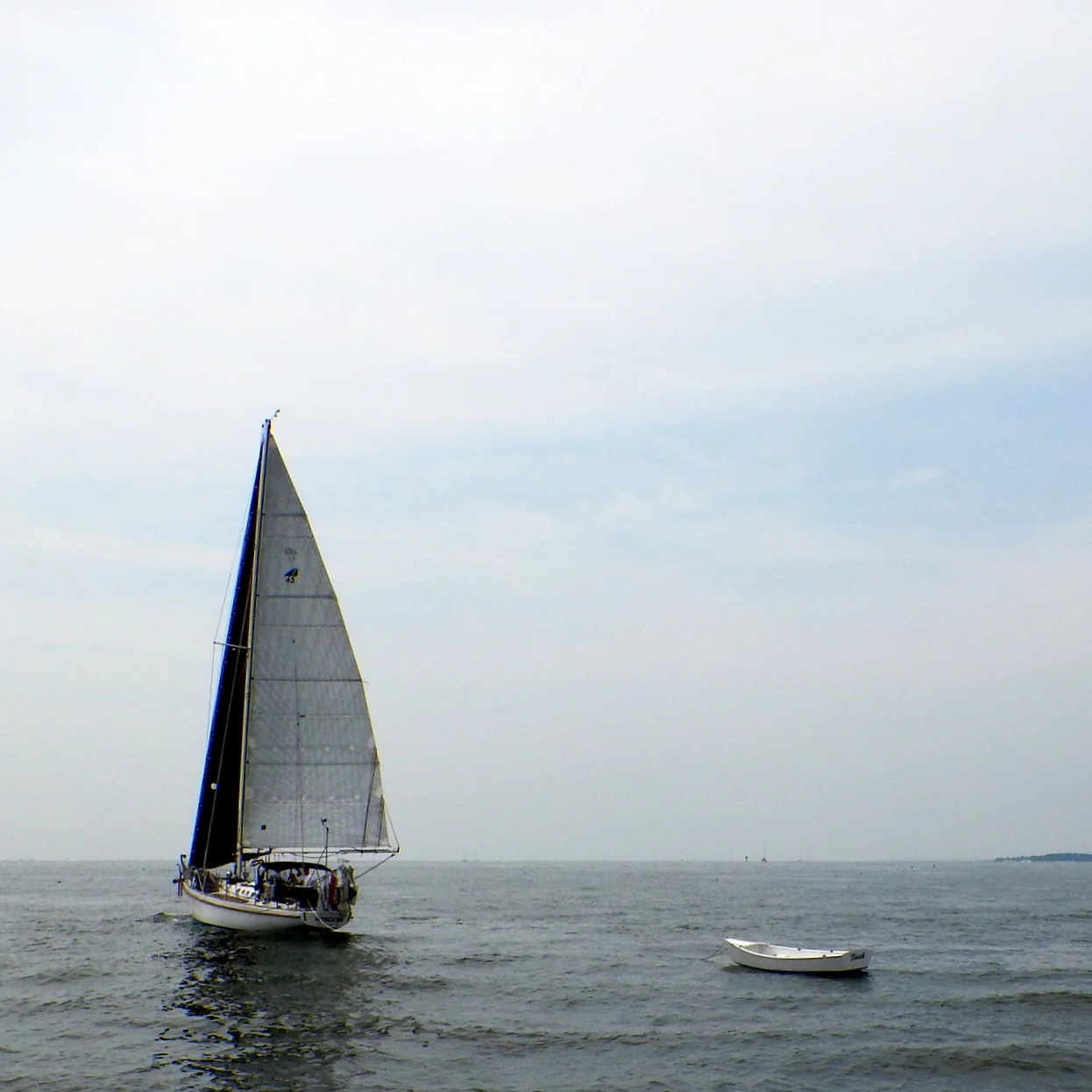
Tooth is an excellent row boat, but on long trips, he can be a drag! At 13 feet long, he is too large to store on deck when sailing. This leaves us towing him along over hundreds of miles, which has led to a few snags along the way.

We are very good at dodging crab pots in the bay, but they have a way of getting hooked on the painter. The snagged crab pot will bring us to a halt until we free it from the line. A towed behind dinghy also adds resistance to the equation, making us travel along more slowly than if we were not towing. It's the same idea as clean bottom vs. dirty bottom. It might not seem like much of a drag, but its effects will add up considerably.

While the longer length allows Tooth to carry more weight and row more efficiently, we need a smaller dinghy that we can take on long voyages with us. This is where our new dinghy will come into play.

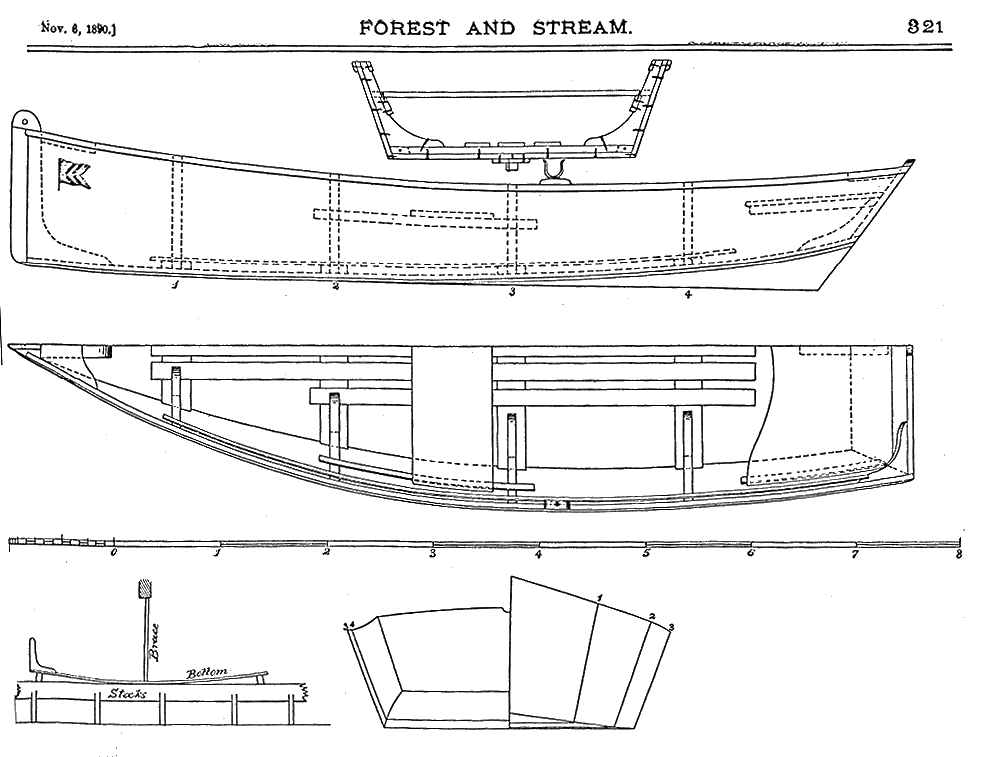
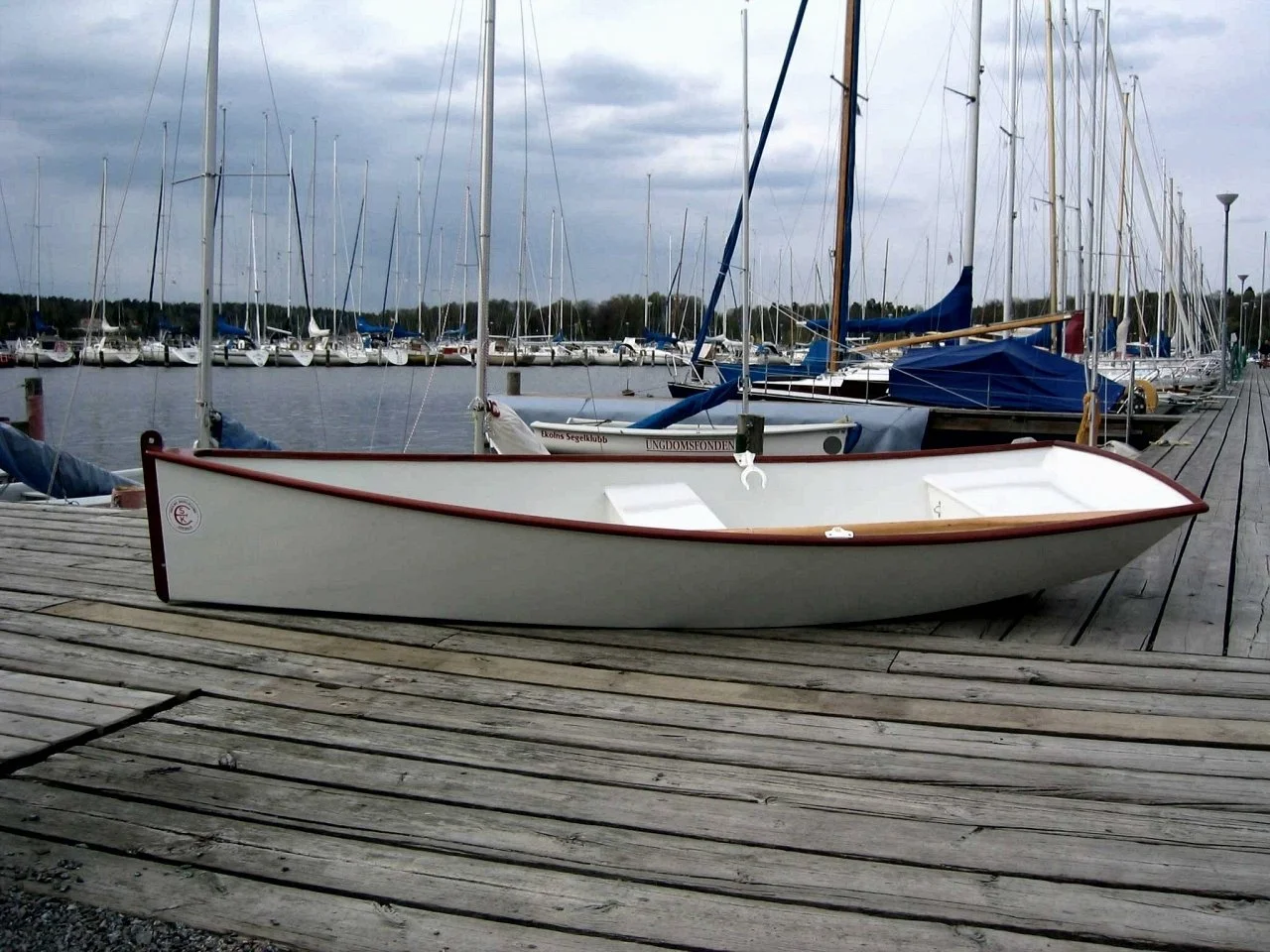
I stumbled upon a dinghy design that I really like (mostly) and plan to make only a few modifications to it. The design is rather old, appearing in an 1890 Forest and Stream. The designed skiff comes in at 8.5 feet long and 3.5 feet wide. This is close to the size I'm looking for, but still on the big side.

We have a maximum of 10 feet available on the deck, so I'm looking to occupy it with something around 7 feet long. Shortening the span between the stations will bring this boat down to size and give us the wiggle room we want and need around the stowed boat on deck.

I am also going to change it from a flat bottom to a slight Vee bottom. Tooth is a flat bottom, and Maddie and I both hate the sound of the waves slapping into it. The first time we launched it, we thought something had broken because it was so loud! To avoid having that happen again, we are going to add a bit of a Vee to the hull, allowing it to cut through the waves rather than smacking them harshly.

This design is around 126 years old, and there have been plenty of skiff designs between then and now! Why this design? Why not a more contemporary model? Most all contemporary designs are for prams (which look ugly to me) and plywood construction.

I desire something with a pointed bow, allowing us to row into surf if we need to, and a carvel plank construction using "real" wood instead of plywood. I went back in time to find plans for wooden dinghies, before playwood and "stitch and glue" had dominated the scene.

Stitch and glue construction is fast and rewarding, it's how I built Tooth; but it doesn't hold up as well as I would like it to. Tooth has had a rather rough life, being towed over 800 miles in his first year after launching. In one year, Tooth has also shown significant amounts of wear and tear.

I hope that a heavy carvel planked hull will hold up to these abuses a bit better.

As you can see, the plans are not very extensive (that single page is what I'm going off of). There are no scantling numbers given, or diagonals or buttocks, simply a very basic line drawing with a station view.

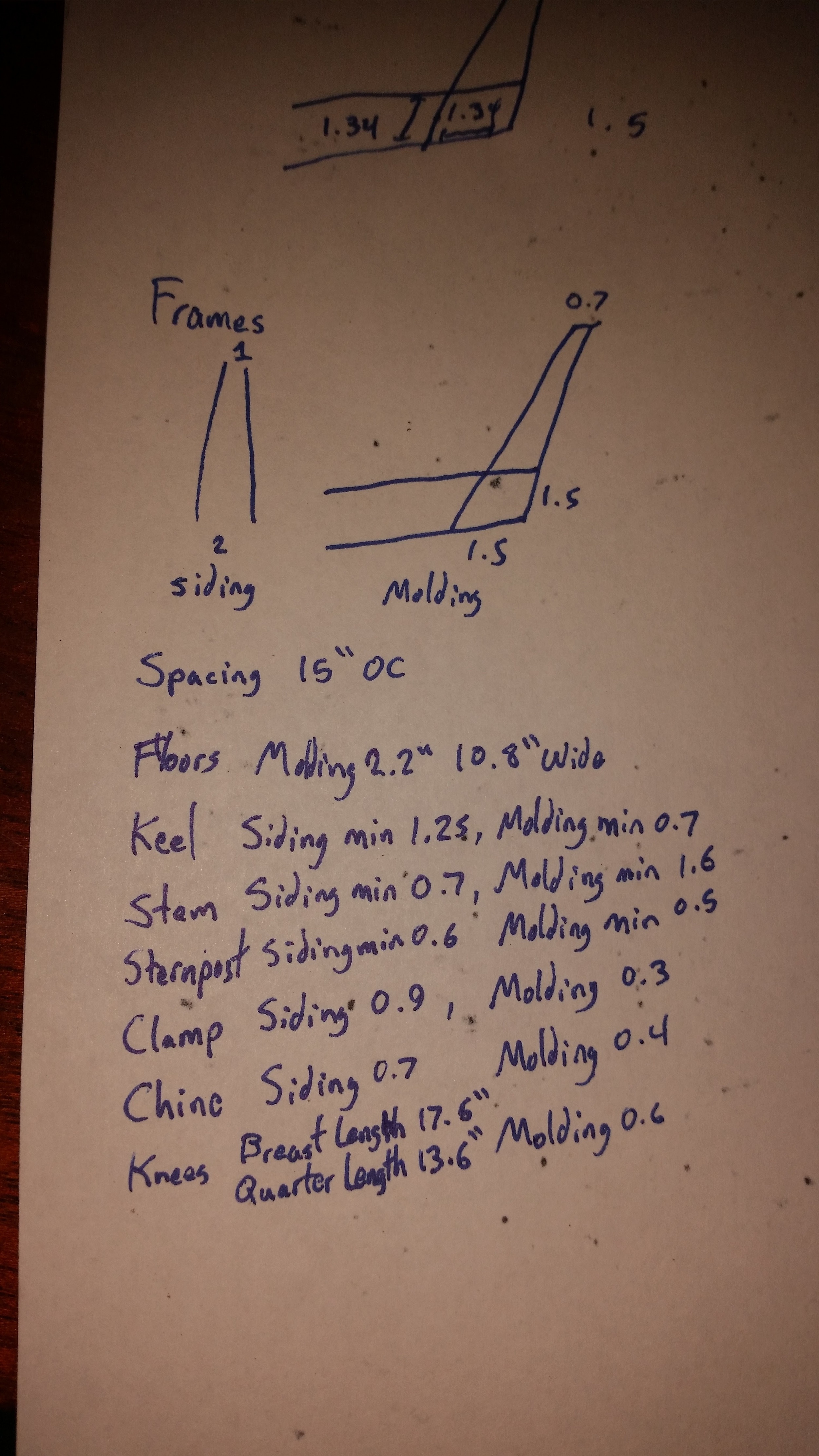
I took to Herreshoff's Scantling Rules to calculate the needed dimensions for the parts at play. I did upsize a few of the key points (keel, frames, stem, and planking) to give me a bit more strength out of it.

With the basic calculations in place, I set out to collect some lumber to begin construction. At the moment, the plan is to build the entire dinghy out of Douglas Fir (Oregon Pine); but the planking might end up being out of cedar if I can't locate clear stock at a good price.

Since I am changing the design a bit, I'm going to begin by building a mold out of 3/4" particle board. This will allow me to visualize the hull form better (and make sure it fits in its intended location on deck) before construction begins. From the molds, I can also pick up the frame bevels by running battens along the hull, making final fabrication of the frames all the easier.

Lastly, having particle board templates of all the pieces needed will make cutting out the actual pieces from the wood all the easier. Instead of doing proper lofting, I'm going to cheat and use the mold as my templates.