Baking Bread (without an oven)

Fresh bread is usually thought of as something only found in a local cafe, but you can enjoy the smells and taste of freshly baked bread right from your boat!

If you have an oven, life is easy and you can follow a regular recipe for landlubbers to bake your bread. What if you don't have an oven? Are you forced to a life without the smell of fresh bread?! 

Fear not for you can bake bread on a stove, and even a grill. There are a few simple things to keep in mind when you are baking bread (not in an oven).
First, you need to create an oven-like environment.
Second, you need to generate a lot of heat.
Third, you need to keep the bread from touching the heated surface to avoid scorching and burning. 

After many variations, I have come up with a system (that is still under constant improvement).  

To bake the bread, I use a steaming pot. It has a strainer that sits inside of a big pot, and it has a lid on it. I place the dough in parchment paper in the strainer section, and place the strainer inside the pot.

The pot is then placed on the stove (or grill) with the fire as high as it can be. A high flame will heat up the pot very quickly but will not scorch the bread, as it is just a few inches away from the hot surface in the strainer section.  

The pot, and the air inside the pot will heat up to temperatures that will simulate an oven experience, baking the bread! It might take longer than an oven, and require you to flip the loaf part way through the baking process, but it will give you actual bread that you can use for sandwiches or just to dip in olive oil. 
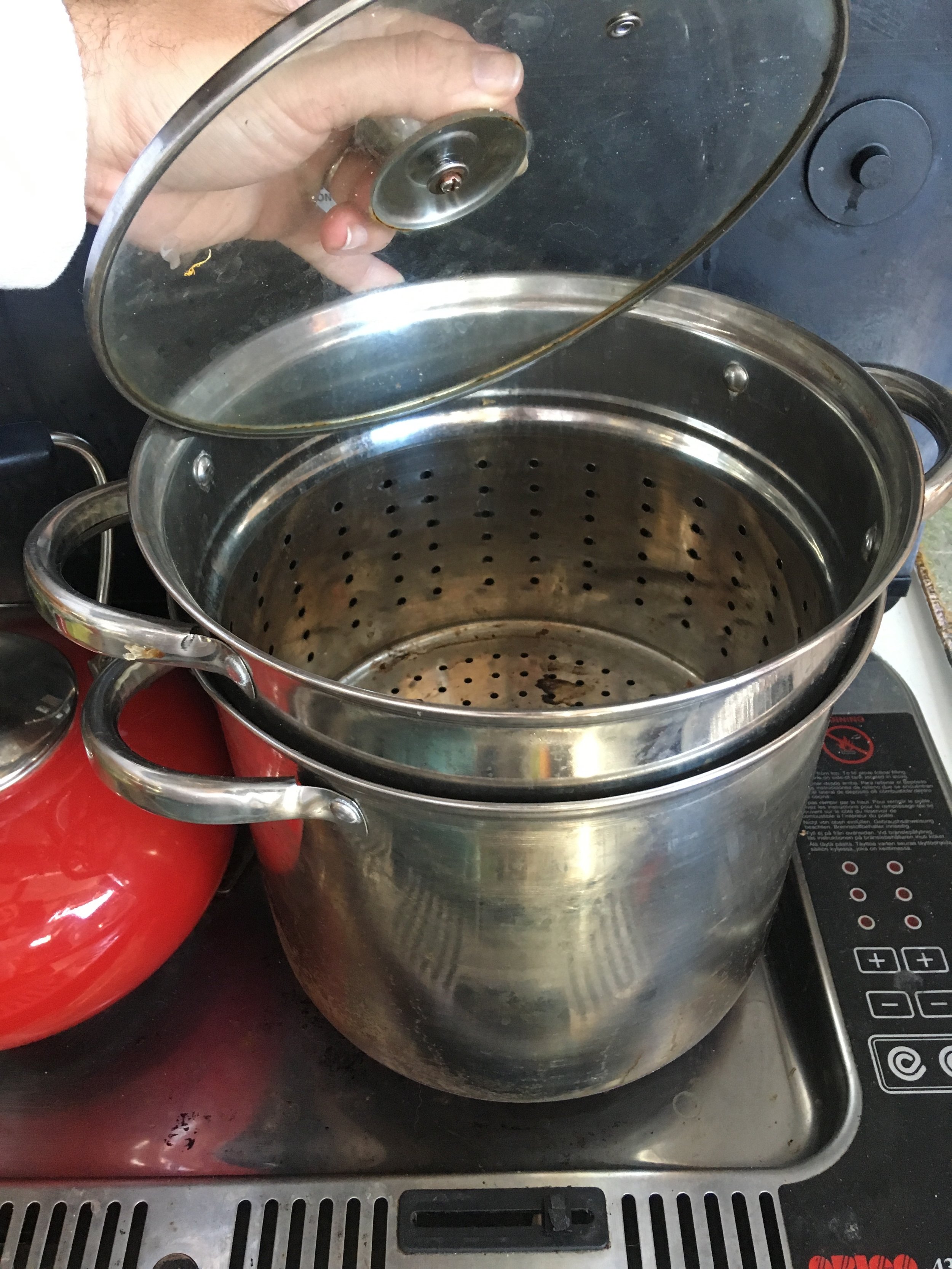
image.jpg

Tomorrow's Weather

Weather is a very important thing to a sailor, and knowing the weather ahead of time can allow you to better prepare for the weather to be. There are fancy electronic methods to predict the weather, allowing you to tap into a world of information. 

Weather can be found online on your smart phone via websites and apps, or over the radio on the various NOAA weather stations. When far out to sea, weather can still be received by SSB radio in the form of weather fax, creating a graphical display of the weather forecast.

These are all wonderful systems that will give you very precise information. The best part about these systems is the information is generated by experts in the field who fully understand and comprehend what the weather is doing now and going to be doing soon. The downside to all of these systems is that your boats electrical system could fail and you won't be able to receive this information. 

Luckily, there is a very reliable backup system to receive weather forecasts; all you need to do is study the weather yourself a bit to gain an understanding of how the sky relates to the weather to be. 

IMG_2142.JPG

You are able to see clouds that are very far away, giving you a full day's warning to what is coming your way. Looking up at the sky will tell you everything you need to know about the weather around you in your immediate area and can be decoded to reveal what the future weather will hold for you as well. 

Stay Angle to the Mast

Your standing rigging is there to support your mast and hold it up high into the sky. To do this, the stays need to be strong enough to withstand the loads and also setup at the correct angles to properly transmit these loads through the yacht. 

The minimum angle of a stay approaching a spar is 12 degrees. If the stay approaches the spar at an angle less than 12 degrees, the stay will not be able to exert the needed force on the spar to resist movement.  

Lowers are able to travel directly from the chainplate to the spar without any guidance because they approach at a wide angle, greater than 12 degrees. The further up the mast you go, the lower the angle would be and the less effective the stay would act. 

To fight this problem, spreaders are used to hold the stay out, allowing it to rise up vertically and then turn towards the mast, reaching it at an angle of at least 12 degrees. 

This same engineering tacktic can be seen on other areas of boats. Long bowsprits will have "Dolphin Strikers" which are spreaders for the bobstay, as well as spreaders for the whisker stays. These are all there to help achieve the needed minimum angle of 12 degrees of approach between any spar and stay. 

Storm Sailplan

Storm sails are small and very strong sails that are flown in high winds. While the sails themselves are very strong, there is another aspect of the sails that adds to the survival of the storm without damage to the yacht: where the sails fly. 

IMG_2150.PNG

When a mast breaks during a storm, it almost always breaks off at the first spreader. This means that the spar above the spreader will buckle and break, leaving you with a shortened mast and a broken rig.

What you can learn from this disaster is that the section of the spar above the spreaders is not as strong as the section below the spreaders. It is not a matter of strength of the spar being weaker above the spreader as the spar is the same size and strength over its entire length, its a matter of how the rigging is setup. 

The lowers, which attach below the first spreader do not need a spreader to reach the mast at a good angle (minimum angle for the stay to approach the mast is 12 degrees) without any guidance. The run from chainplate to mast is the ideal angle. The run from chainplate to cap shroud is not as lucky, and the angle would be very small. This is why a spreader is needed to hold the stay outboard, so that it can then turn in towards the mast at an angle of no less than 12 degrees. 

The mast is only supported at a few points on a yacht, and these points are the areas where the stays attach. Your first unsupported length is from the deck to the first spreader. The second unsupported length is from the first spreader to the next set of stays. On a single spreader rig, the next supported section is the mast head. On a multiple spreader rig, it is the next spreader. 

The strongest unsupported section of the spar is the first section, from deck to spreader. Therefore, when loads are high and failure occurs, it occurs above this point, causing the mast to buckle at the first spreader. 

So, flying full sail in a storm is not only bad because you are applying too much strain to the sails, rigging, and yacht, but also because you are applying strain in the wrong areas. Full sail means that the mast is being loaded all the way to the top! The loads it will be subjected to are mind boggling! 

Reefing not only reduces the sail area to decrease the force on the yacht, but it also lowers the sail area, concentrating the loads to the first unsupported section of the spar. Storm sails take this one step further and concentrate the loads entirely to the first unsupported section. 

When you setup your trysail, the tack needs to be set so that it is higher than the stack height of the mainsail. This will allow it to flow easily on either tack. While you might feel inclined to simply add a longer tack pennant to clear the mainsail, it is important not to raise the trysail too high. 

The head of the trysail should end up in the area of the first spreaders, that way the loads are concentrated in the first unsupported span. Yes, the loads during a storm will be strong, but the strongest section of the spar is being loaded and the rest of the mast is simply along for the ride. 

Once the winds calm down, you can raise your full sail on your full spar, instead of trying to jury rig something with the stump of your mast that runs up to your first spreaders. 

Relaxing in Paradise

Sailing around on your own personal yacht may seem like the lifestyle of the lazy person who doesn't want to go to work. This couldn't be farther from the truth! 

IMG_2144.JPG

Cruising is a lot of work, and no one is paying you to do it! Yes, you don't have to go to an office every morning, but you do have to do all the work to keep your boat floating. 

While it may sound like you can't escape the working world, being how you simply traded your old job for this job. The biggest difference though is the view!  

How often did you see this in the late afternoon at your old job? 

Cruising will take you to new and exciting places. Places that you chose to go on your schedule and at your own pace. You don't have a boss hanging over your neck, or coworkers creating drama in the workplace. Nope, you just have yourself and your boat, going where you want when you want.