Water Tank Plumbing

Where the tank connects to your plumbing is a topic for discussion as the two choices have alternate attributes. The plumbing can either connect at the top of the tank or at the bottom of the tank. 

If the plumbing connects at the top of the tank, a hose or pipe will need to be led down to the bottom of the tank and the tanks will drain via siphon. Water being drawn from the tank will flow up the hose and into the boats plumbing. When multiple tanks are connected to the plumbing in a system, they all depend on having a siphon to drain them properly. If an air lock forms in any of the tanks feed tube, that tanks water line will need to be primed to allow it to feed properly. 

This may seem rather inconvenient, but there is a reason to connect the plumbing at the top of the tank. If the plumbing were to slip off of the tanks boss, the water in the tank will not drain out. Instead, nothing will happen and your fresh water will remain inside your tank awaiting your use. You can either reconnect the plumbing to the tank or remove water through the tanks top access. Either way, your water will remain safe and stored until you are ready to get the water out.

The alternate option is to connect the plumbing to the bottom of the tank. This may seem the most logical as water will drain out of the boss and into the plumbing, never suffering form air locks or other related issues. If your pump stops working, water can still be removed by opening a drain lower than the tank and letting gravity do the rest! 

While this may seem the most logical, it is also plagued by a serious problem. Should the plumbing slip off the boss, the tank will empty its contents and the fresh water will become lost to the bilge. If you loose all your water while out at sea and have no method to replenish your stores once repairs are completed, you will be in serious trouble!

While it may seem trivial, the security of your water is worth the headache of dealing with air locks and the need to prime water lines associated with a top connecting tank. Be sure that the tank has a large viewing port on the top that will allow you to fit a pump or hose into the top to withdraw its contents should your plumbing system fail. 
Buying Foulies

We originally thought that Maddie wouldn't need foulies because she doesn't have to work in foul weather, I get to do that! When we are hit by a storm, I'm the one that goes forward to secure the headsails and set the reefs, I'm also the one who is at the helm as we heave to. I take the winds and the rains, which is why I have my foulies.

Maddie gets to hide under the dodger, protected from the wind and waves, where she can keep an eye on me while I work. If I were to need help, she would quickly jump to the task, but I usually don't so she can stay where it is very safe and very dry. In the interest of conserving our funds, we elected not to purchase foulies for Maddie.

Then we got caught in a gale out in the Chesapeake Bay with heavy rains which were being blown sideways by the intense winds. Maddie was safely tucked away behind the dodger, but the torrential rains crept right in Maddie got completely soaked. Meanwhile, I was getting rained on and staying completely dry with my foulies on. 

You might be wondering what is so bad with getting a little wet, you are on a boat after all? Yes, people use boats to go out on the water and then go swimming, where they get completely soaked. The difference lies with the conditions when the wetting occurs: wet from swimming occurs when you want it and for as long as you want it to, wet from foul weather occurs when it happens and for as long as it will occur for.

You will probably choose to go swimming when the sun is shining and the air is warm. Getting wet will actually cool you off and keep you comfortable. Foul weather is rarely this enjoyable. The sun is blocked out by the storm clouds and a chilling air will come over the water. Instantly, you will begin to feel cold and the storm hasn't even hit yet. The cold rain will pour down on you and the strong winds will cause you to cool even more as your wet skin attempts to evaporate the surface water. 

When you are swimming and begin to feel cold, you can simply climb out of the water and get back on the boat to warm up! In a storm, you have no control over how long the weather will last for. You might begin to feel really cold in the beginning and soon begin to shiver, but the storm will continue for hours as you miserably await the end.

Enter the Foulies! Foul weather gear's main purpose is to keep you dry. If you can stay dry you can also keep warm and comfortable. The ability to keep dry transforms the frigid rain from a discomfort to a nuisance that you have to wait out. As soon as the storm passes, you can shed your foulies and continue on while keeping completely dry and warm during the whole ordeal.

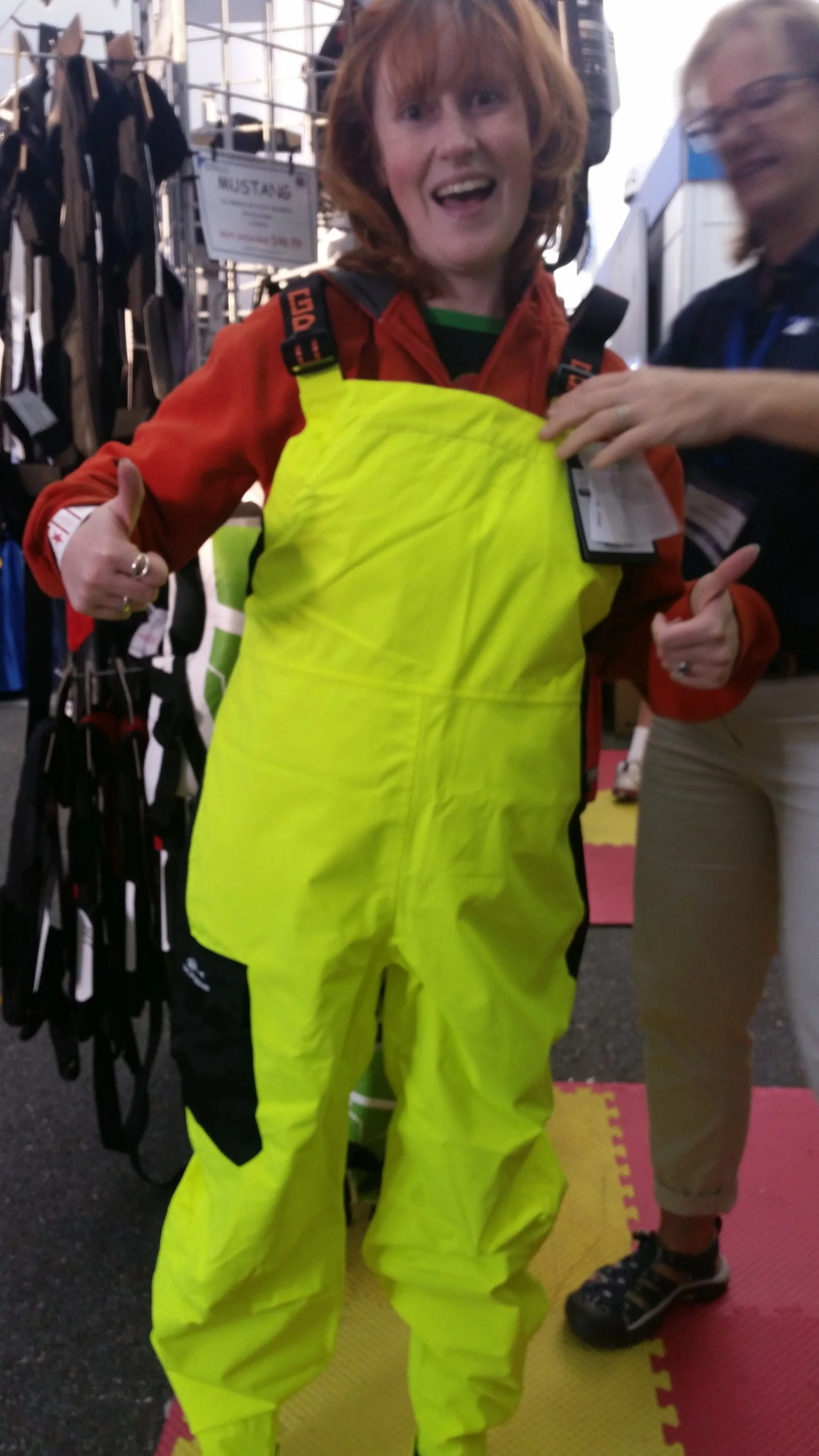
We bought bib-shorts and a jacket for Maddie at the boat show, taking advantage of the great discounts. The vendors will also bring the price down a bit further if you are paying in cash! 

Maddie's foulies are not as robust as mine, but at the same time she will not be exposed to the same severity of weather as I am. It's not that I don't trust Maddie to carry out the tasks that I perform, but instead that I don't want to put her in that risk. 

Going forward during bad weather is not a cake walk. The seas are throwing the boat around and the full force of the wind is hitting you. In really severe weather, waves can actually break over the deck and the force of the water can sweep you off your feet! This is why it is terribly important to clip in to the jacklines when going forward! I have everything rigged at the mast, so I usually only need to go as far as the mast during heavy weather. Standing on the cabin top while tucking in a late reef in large seas and high winds can be very challenging. The motion of the boat is accentuated since you are standing higher up and you can feel a little uneasy in these settings. I stand on the high side (windward side) of the deck so if I fall, I can catch myself on the mast or hang on the leeward lifelines when my tether stops me (which is clipped to the windward jackline). To sum it up, it is not fun and I don't want to put Maddie in this situation if I am able to do it for her.

Therefore, originally only I had foul weather gear since she could hide behind the dodger. Once we found that she could get very wet and cold in her hiding place, we decided to purchase her some light duty foul weather gear.

Complexity

When selecting a cruising yacht, you might think that bigger is better! Bigger boat means more space which means more room and more comfort, it's a no brainer. The problem is, as the size of the yacht increases, so does the complexity of everything on board.

At the 2016 Annapolis Sailboat Show, I boarded a 70 foot Hylas which the owners had purchased the previous year to go cruising. The owners then became ill and are no longer able to cruise due to health issues.

The yacht is certainly outfitted for ease of handling. All the winches in the cockpit are electronic, meaning you don't need to grind a winch handle but rather just push a button. This makes sail trimming very easy, as you simply need to coordinate which button to push next.

At this point, a 70 foot yacht is sounding pretty good! The yacht is so large it feels like a condominium apartment with sails and a keel! Then you start to look at the little details that begin to shine through. 

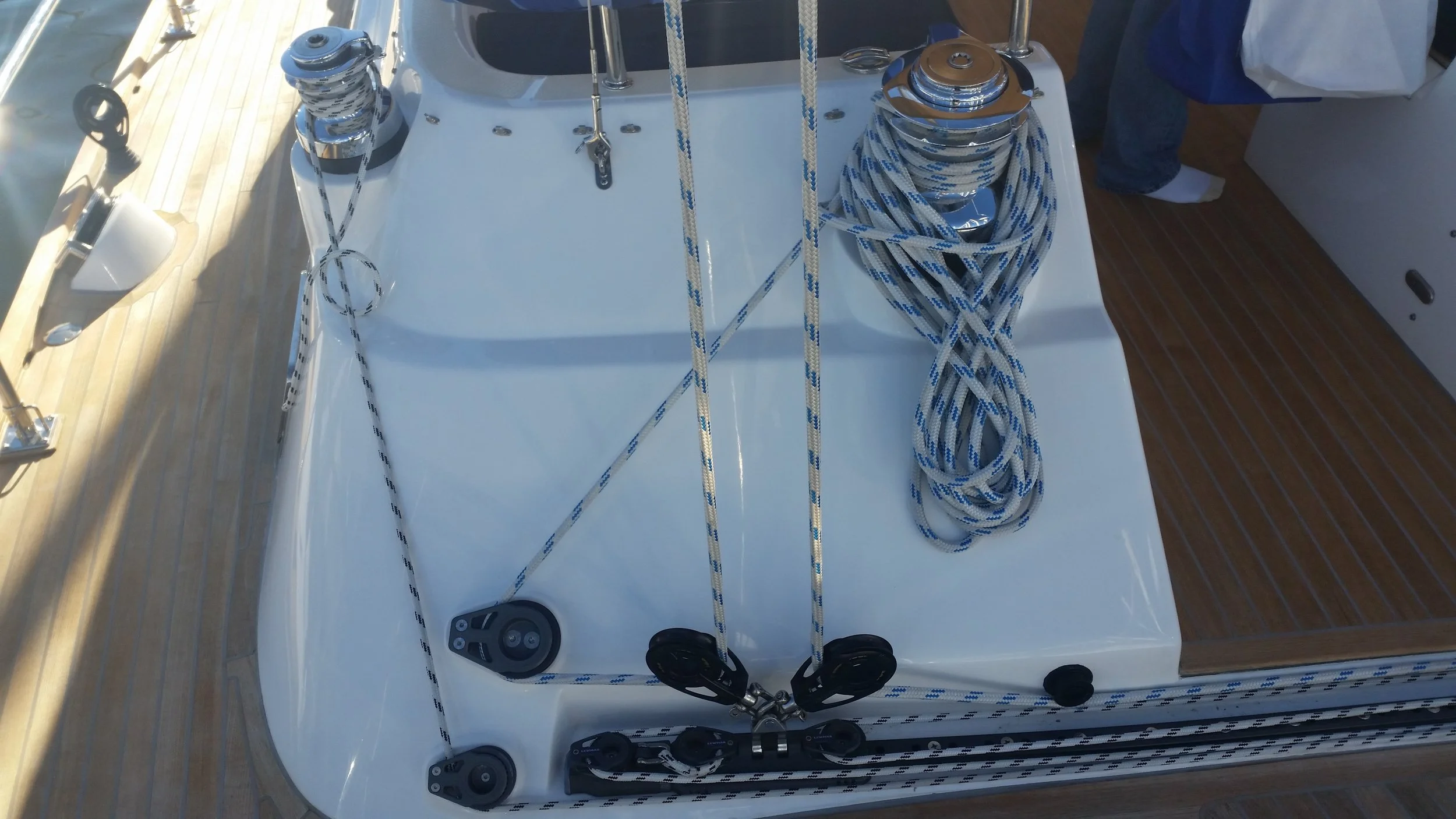
The headsails are both roller furling, which keeps the deck clear and makes reducing sail as easy as pushing a button. The thing is these headsails are so big that a regular furling line would not be able to power the furler. Instead, the furlers are powered by hydraulic fluid which is powered by a central hydraulic pump. Should a problem develop in the hydraulic system, a manual winch backup is present at the furler. That is not the place I would want to need to go with that massive headsail flogging around!

The other striking leap in complexity came when I inspected the traveler and mainsheet system. Most travelers have a pulley system that leads to a cam cleat where it is locked off. If you need to adjust the traveler's position, all you need to do is grab the line and pull it in. The traveler can be pulled in by hand with a bit of force, but nothing drastic. On this 70 foot yacht, the traveler has its own dedicated winch!

The winch is a subtle way of telling you that the sail is so large and forceful that you need a winch to adjust the traveler. Now imagine jibing that massive sail in a safe and controlled manner? I'm sure it can be done but it will require a lot of winches and planning to execute in a safe and predictable manner.

While it may seem like a dream to cruise on the biggest yacht possible, keep in mind that the size of the rigging and complexity of the systems increases exponentially with the size of the yacht. As the complexity increases, so does the headache of maintaining all of these systems, as breakdowns will occur and the more you have, the more you have to break.

The moral of the story is go on the smallest comfortable-boat you can and go while you are young and healthy!

Roller Furling Halyard Clutter

Roller furling is wonderful! At the end of the day, you can roll up your sails and be done with them! There are no sails to flake and bag, and the sheets are carried up to the clew where they can be kept clear of the deck. The deck of a sailboat with roller furling can be quickly transformed from a sailboat to a private escape in just a few short moments!

While roller furling does provide a clear deck, the clutter is typically transferred to the mast. The halyards of the roller furling sails are coiled up and hung from any available winch or cleat horn. The clean crisp mast soon becomes a rope storage area! These coils will soon collect dirt from the air and rain and begin to look less attractive as time passes. Worst yet is the fact that these halyards will not be touched for a long time, as the sails are raised once per season! Soon these coiled lines will become stiff and unwieldy. 

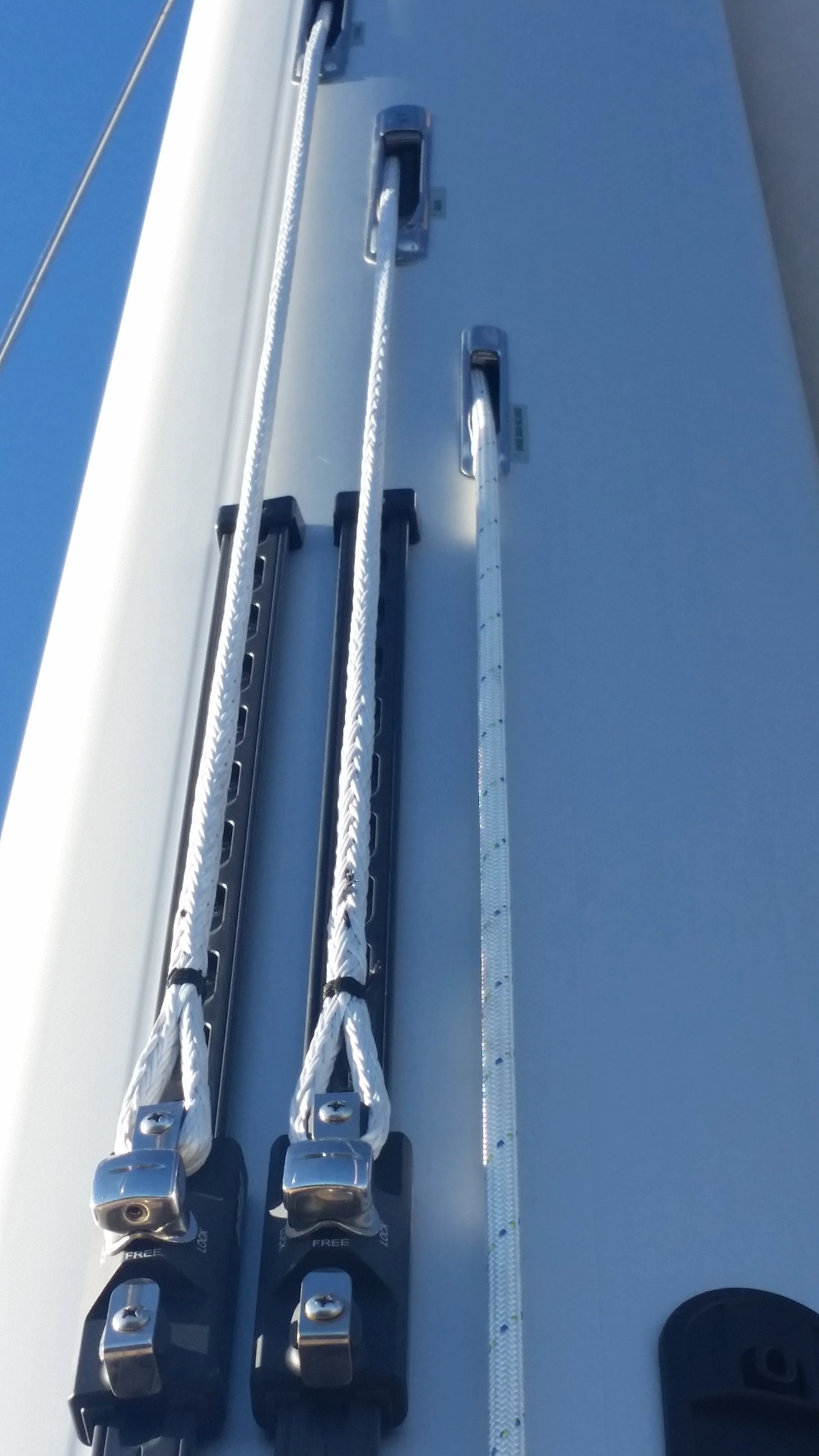
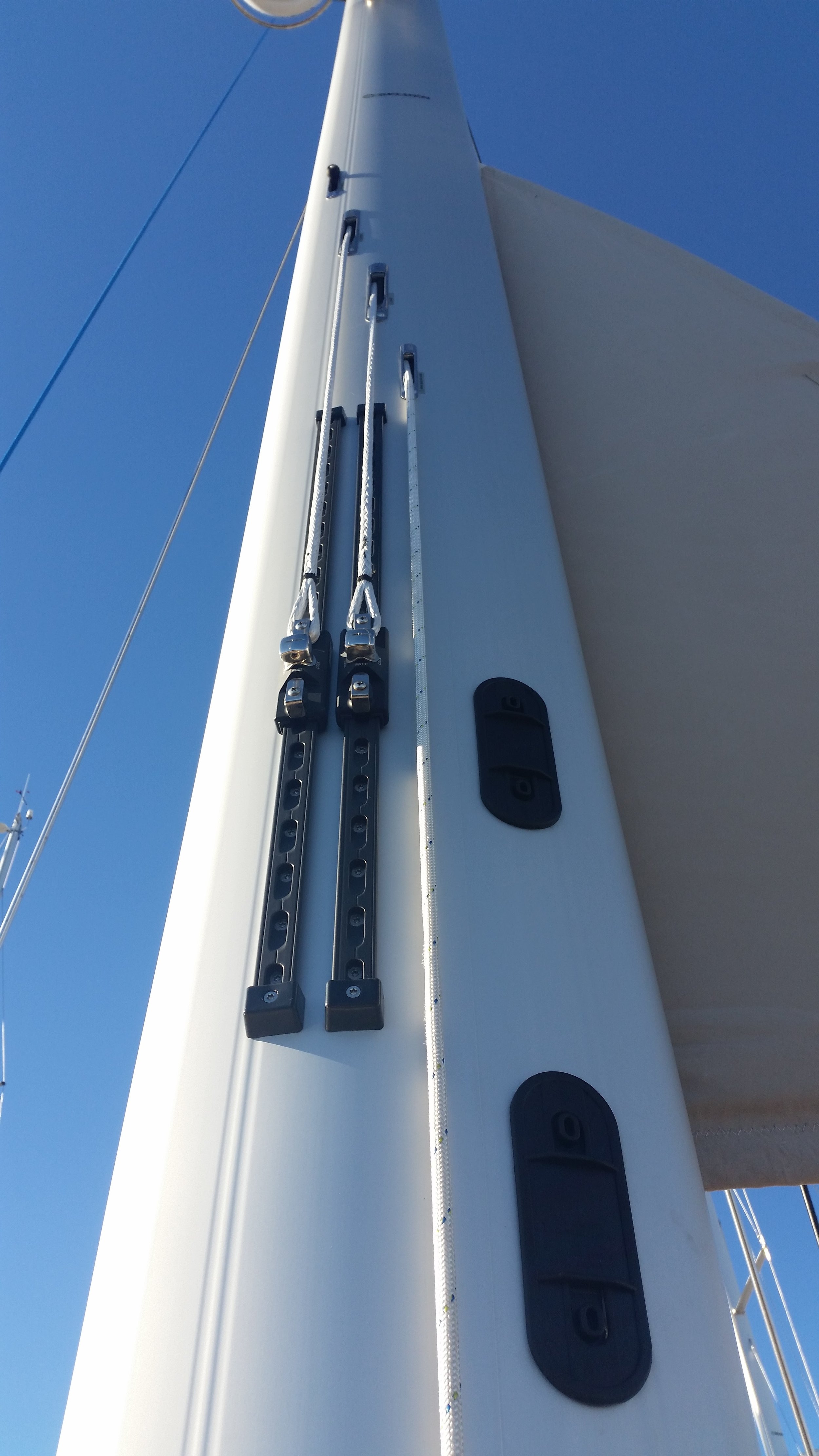
This system works beautifully to maintain the clean look of a roller furling yacht. The halyards are merely small lines that run the needed length and terminate with an eye splice. When the sail is removed, a messenger line can be attached to the halyard and the sail can be lowered as the halyard runs into the mast. When the sail is going to be re-installed, the messenger line will feed the halyard through the shiv, mast, and out the side of the mast where it can be tensioned. 

The cars on the mast allow easy tensioning of the halyards as well. Once the eye splice has exited the mast, the loop can be installed on the car and another line can be attached to the bottom of the car. The lower line can be set up on a winch to achieve the desired luff tension. Once the ideal setup is reached, the car can be locked off and the tensioning line removed. This leaves you with a very clean and crisp look at your mast to match the clean and clear look of the deck.

It can be argued that this setup will not allow you to adjust your luff tension as easily, but lets be honest about who would want this setup! I am certain that someone who wants this look is not concerned about moving the draft fore or aft in the sail to adjust the angle of attach of the luff of the sail while beating or reaching. They simply want a cleaner deck with less clutter and more open space, and this delivers exactly that while still providing the necessary equipment to properly tune the sails.

Sammy Found a New Hangout

Sammy has always been very selective in only letting me pet and hold her. If anyone else tried, she would bite them viciously! I knew something was special about Maddie when Sammy met her for the first time and didn't try to peck her skin off.

After two years of Sammy warming up to Maddie, Sammy performed the ultimate "I'm comfortable with you" move: Climbing into your shirt and poking her head out of your collar.

I'm probably the only dentist who wears a hoodie with a candy bar bashing cavities into teeth!

Yes, it was dark and yes, Maddie was wearing my hoodie (so it probably smelled like me). Sammy went right in the hoodie and poked her head out. We went for our walk and Sammy hung out there the entire time, happily watching the world go by.