Life Aboard

Upgrading the House Battery Bank

Our old house battery bank consisted of three Group 31 AGM batteries. This gave us 315 amp hours (but only 157.5 hours are usable). The house bank is only 6 months old and yet we noticed that the voltage would drop to 10.9V when the fridge would kick on. As soon as the fridge would turn off, the voltage would return to 13.5V.

The fridge will cause a drop in voltage when the compressor turns on, but the voltage sag should not be that extreme. This motivated me to renew the electrical connections to the batteries. The cables were in good shape, but the terminals left much to be desired.

The corroded terminals were creating too much resistance and not allowing the electricity to flow out of the batteries and into the system. I also found an old Sammy feather down in the battery compartment that I took out for good measure.

When the voltage would drop on the electrical system, I put volt meter leads directly onto the poles and the batteries were not dropping down to the 10.9V of the rest of the boat, they actually remained around 12.4V! This confirmed my suspicion that the battery terminals were shot and needed to be replaced.

I replaced them with shinny new terminals and cleaned up the ends of the battery cables. I also added two more Group 31 AGM batteries to the house bank for good measure. This brings our electrical storage up to 525 amp hours (262.5 usable amp hours)!

When adding new batteries, the concern of mixing battery ages always comes up. Being how the old batteries were only 6 months old and relatively new by those standards, I was less concerned with the mixing. To prevent any potential problems though, we grouped the three old batteries on Bank 2, and the two new batteries on Bank 1. 

Now the five house batteries are organized into their two banks while keeping the new and old batteries separate. With the new terminals (and extra amp hours) the voltage sag has been much less prominent when the fridge kicks in, keeping our electrical needs met in comfort.

You might be wondering why I never changed those old terminals when I replaced the house batteries, and the reason was laziness. They still went over the terminal poles and the insides were cleaned with a wire brush. When the battery cables were connected, the lights turned on in the boat and I was satisfied with having electricity flowing through our boats wires. It wasn't until the fridge issue caused the poor connections to become a more pressing concern. 

If we didn't have a fridge, the old terminals would have remained in place for many more years because they looked like crap but still worked enough to power the running and interior lights.
Connecting the Transom

The transom board is attached to the sternpost, holding the transom flush to the back of the keel. The sides of the transom are attached to planks, and the first and most important plank that will attach to the transom is the sheer strake. The sheer strake is much larger than the other planks and transmits the forces between the transom and stem, stabilizing the topsides of the dinghy.

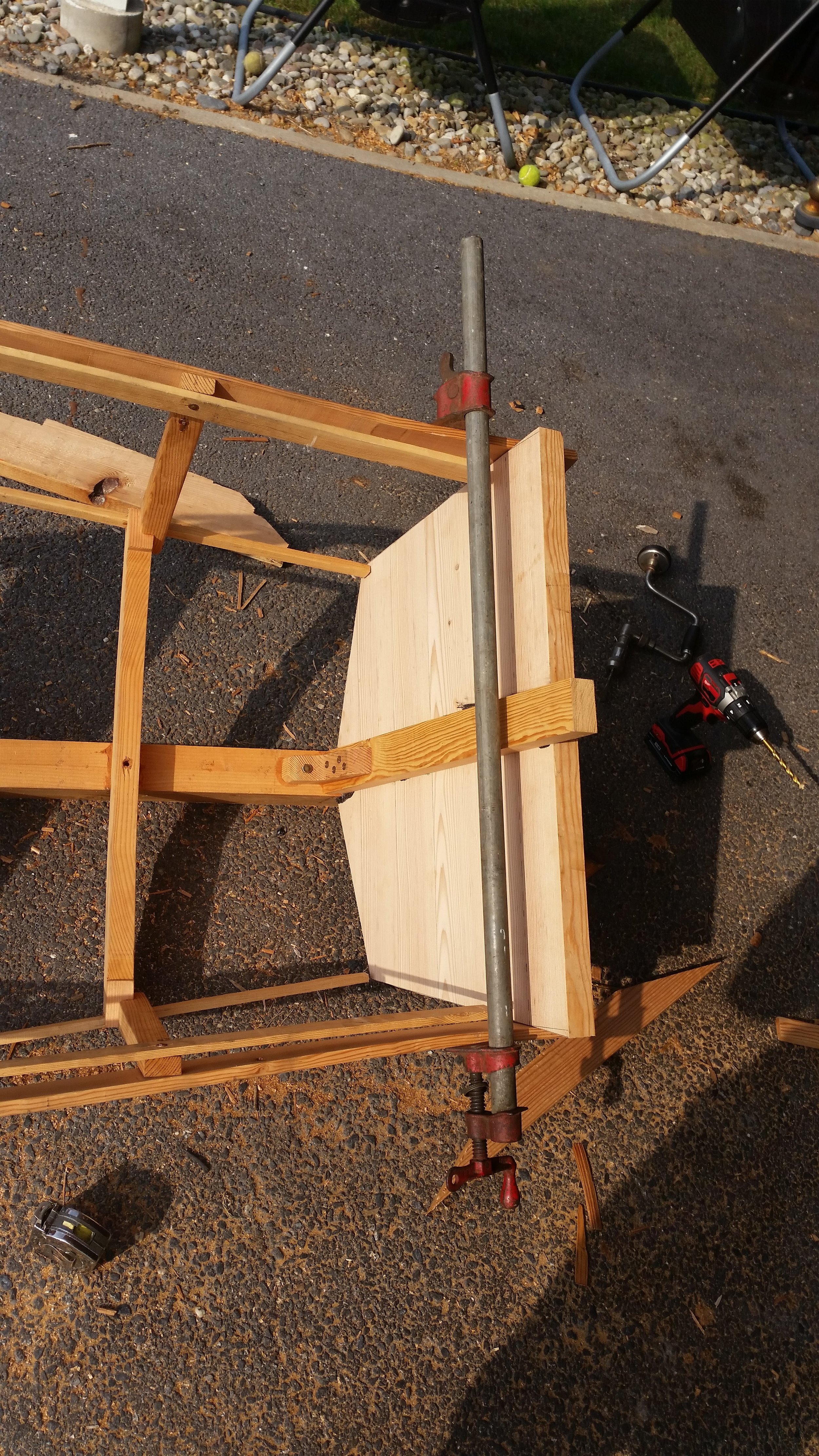
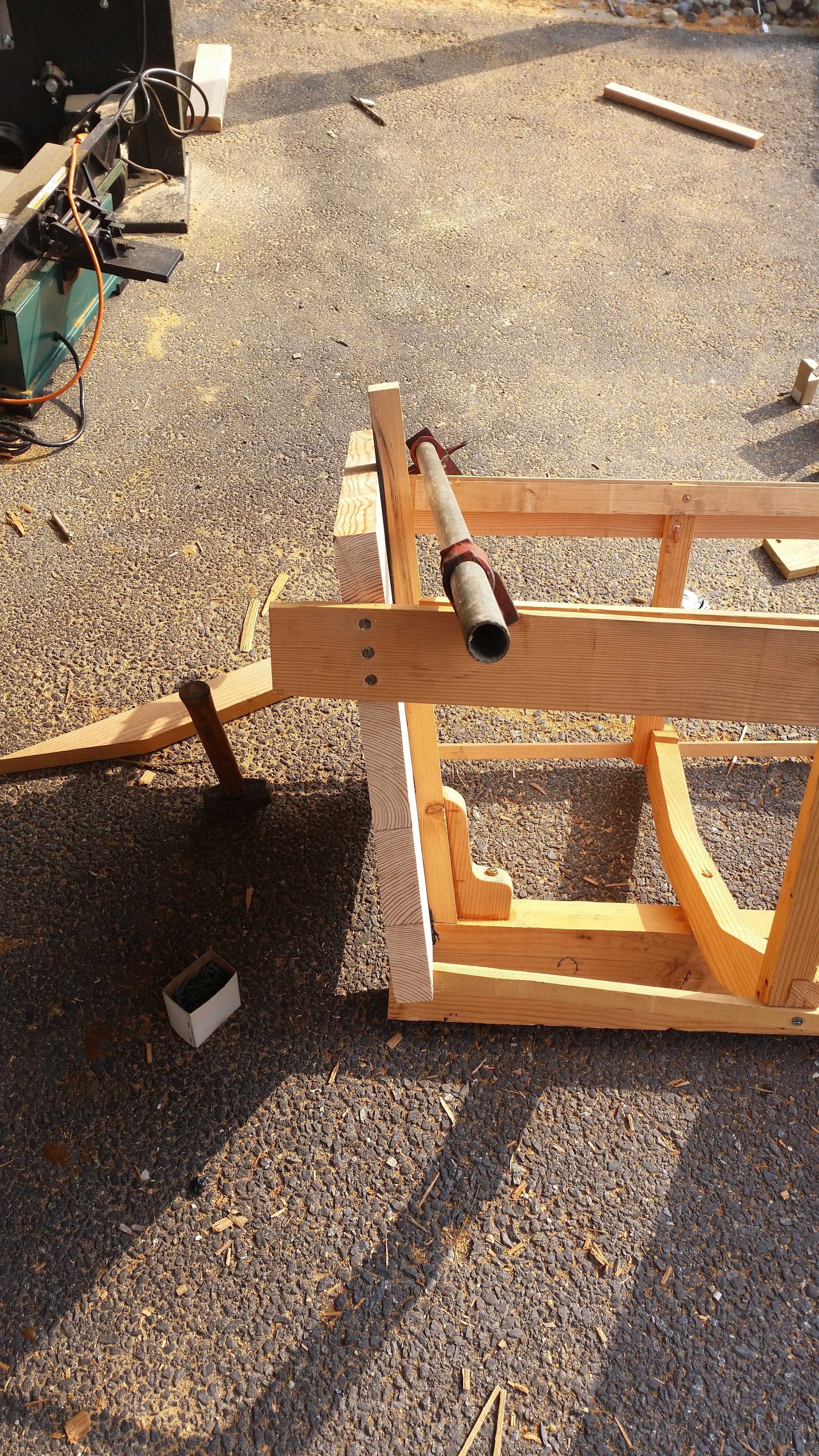
To set the sheer on the transom for easy attachment I set a table clamp athwartship and compressed the sheers onto the sides of the transom where the pilot holes could be drilled and the bronze fasteners could be driven in.

With the shelf clamps cut short of the transom, the sheer strakes are able to lie flush along the side of the transom board where it can be screwed into the endgrain. At this point, I am drilling and screwing dry without any bedding compound. At a later point, bedding compound will be added.

Once the holes were drilled and all the screws fit in properly, the clamp was eased and the screws backed about 3/4 of an inch. This gave me enough space to fit the tip of the caulk gun in between the boards and around the bronze screws. After applying a liberal amount of bedding compound, the screws were driven back into place and the excess was scraped off with a piece of scrap wood. 

The shelf clamps were cut a bit shorter to allow space for the transom knees to be fitted and attached. In the meantime the sheer is resting well attached to the transom and ready to be attached at the stem. It is important to not attach the sheer strakes until the seat is in place as the seat will act as a brace to the frames which will dictate the beam of the boat. Without a brace, the frames may flex inward and the sheer may appear to have a shorter run from stem to stern. Once the beam is corrected with the brace, the sheer may be too short.

For this reason, it is imperative that the bench be in place and the contours of the hull symmetrical and true before the sheer is fastened at either end of the dinghy.

Starting a Dickinson Diesel Heater

Keeping warm in the winter is crucial if you are planning to live aboard comfortably. Diesel heaters are a very efficient and powerful way to heat your cabin, providing plenty of heat without the buildup of condensation typical with other types of heaters. 

The cabin air inside the yacht will be used in the combustion process, taking along with it any moisture that is present in the air. This burnt air is then sent out through the chimney, keeping the cabin free of smoke and carbon monoxide.

As the air in the cabin is consumed, new air must be brought in to replace this air. Dorade vents that are used for passive ventilation in the yacht will allow fresh and dry outside air to be drawn in and quickly warmed by the burning heater.

This is all well and good, but how do you get the thing started? If you read the instructions, you may become intimidated as the instructions are rather complicated. Actually, the instructions are overly complicated. The truth is, these heaters are remarkably easy to turn on and get started.

All you need to do is start the flow of fuel, wait a few minutes, and light it. That's it!

The video is rather long, as it is the entire process of starting the heater and watching the flame slowly come up to the top where it begins to burn efficiently and heat well. The steps taken in the beginning are the only steps you need to take to get the heater rolling! Once you carry out those steps, the rest is just a matter of waiting. 

Adding Frames for the Seat

The rowing station will be set between the third and fourth stations, but this span is a bit far to reach with the bench. To alleviate the situation, an extra frame is added.

The extra frames were cut to taper similar to the original frames, but they have no floor to attach to. Instead, the floors are merely notched over the chine logs.

The bottoms of the frames were notched and set over the chine log to keep them from pulling out as the sheer and shelf were riveted to the tops of the new frames.

20161020_123404.jpg

Cleats were screwed and glued onto the frames in the third station and the new frames. These cleats will bear the weight of the seat which rests on them. The seat was then screwed into the cleats, not to hold it to the cleats, but more so to keep the seat from sliding back and forth. Another cleat was set above the seat and screwed to the frames which will keep the seat from lifting up. The seat and its top cleat were not glued in allowing me to remove them if I need to later during the construction process.

Upgrading the Bow Anchor

A while back, the various types of anchors carried on Wisdom was discussed here. In that article, we talked about our primary bow anchor being the Bruce anchor. The bow anchor is a very special anchor because it is the go to anchor. This anchor is the first to go down and needs to work perfectly in the typical conditions where you will be anchoring. 

The Primary Bow Anchor lives in the bow roller and is always connected to the all chain rode. Accessory anchors are attached to supplemental anchor rodes, typically being made of all rope or chain and rope combinations. For years, the Bruce was the primary bow anchor on Wisdom as it has always held us well in the Chesapeake Bay. This anchor has held without fault during gales in unprotected anchorages and let us sleep peacefully night after night. 

You might be wondering why I would swap out a perfectly good anchor for a different anchor that needs to be purchased? The answer lies in the rode. I always let out an excessive amount of chain when we anchor.  The typical night time hook will be 7:1, and a storm anchoring will be 10:1 or greater! We were once in a gale with 290 feet of chain in 10 feet of water. 

Yes, the Bruce held fine, but it was more likely that the chain held fine and the Bruce was an ornament at the end of the line. Since we carry 300 feet of chain, anchoring with lots of chain is possible for us, we simply let it run out when we arrive in the anchorage for longer. The problem comes in the morning.

We have a manual windlass which means that I need to crank all that chain up every morning. If we let out 200 feet of chain, I now need to crank in 200 feet of chain! While morning exercise is always good, Maddie is usually sleeping right under the windlass and the 200 feet of chain being cranked in is anything but peaceful. 

We were talking with a friend who has a modern anchor and usually anchors with 3:1 scope for a night time hook. If we were in 18 feet of water, 10:1 is 180 feet of chain, 3:1 is only 54 feet. The thought of cranking in an extra 130 feet of chain made Maddie and I consider modern anchors and so began the search for an upgraded anchor.

I came across the YouTube channel SV Panope which brilliantly demonstrates how different anchors perform. The creator attached a GoPro to the anchor and then did various tests to see how the anchors behaved. Instead of testing the anchors in an appropriate method, the creator tested the anchors in the most abusive way possible (on purpose).

He would set the anchor with a very short scope and then pull hard on them with the engine. Then he would move directly over the anchor with considerable speed and see if he could get the anchor to reset or drag. He also did an interesting test called "Reducing Scope" where he would anchor, test, shorten the scope, re-test, shorten the scope, re-test, etc., until the anchor fails to reset. 

This sort of abusive test will reveal any short comings in the anchor and make the true champions shine! The old style anchors performed well, but failed under the torture tests; the modern anchors, on the other hand, managed to work in these harsh testing conditions. 

Finally, my favorite part of the anchor tests is he is not sponsored by any anchor company. This helps reduce bias on his part and ensure a more even testing of the anchors. The anchor tests performed by the companies are horrible tests engineered to showcase their product. Rocna tests always show Rocna as the best, Mantus tests always show Mantus as the best, Manson tests always show Manson as the best, etc. SV Panope tests are unbiased and truly showcase the abilities of the different anchors.

In the videos, it appeared that Manson had some trouble resetting, while Rocna and Mantus performed rather well in the reducing scope and reset tests. Both Rocna and Mantus anchors have the undesirable ability to bend their shank. This occurs because the anchor sets so deeply that the fluke will not rotate on a tide reversal. The fluke remains steady while the boat swings by and the shank bends from the force. This is more common in aluminum anchors, such as Fortress brand anchors, but it can still happen to galvanized steel anchors. Rocna anchors are welded together where Mantus are bolted together.

The difference comes down to service-ability. Should the shank bend while cruising, welded anchors can not be repaired, they must be replaced. If we chose a Rocna and the shank bent, we would need to purchase a new anchor. If the shank on a Mantus were to bend, all we would need to do is contact the manufacturer and have a new shank sent to us! The ability to repair the anchor while cruising is a very appealing feature that the Mantus anchor affords us.  

Looking at the two anchors, you can see the sharp demarcation in size between the two. The Mantus offers significantly more surface area in the fluke to hold the bottom when compared to the Bruce. The tip of the Mantus is also weighted to help drive it deep under the seabed. 

The Bruce tends to lay on its side, so only half of the flukes are under the seabed, while the Mantus is designed to bury the entire fluke and hold with all its might. 

This comparison is not completely fair though. The Bruce is 20kg, and the Mantus is 30kg. Naturally, the Mantus is going to be larger as it has 33% more mass. When we chose to upgrade the primary bow anchor, we also chose to upgrade the weight of the anchor at the same time. The mantra: "No one ever slept poorly because their anchor was too heavy" kept our minds determined to purchase a heavier anchor, as well as a modern design.

Note how much more expensive the Stainless Steel anchor is compared to the same size Galvanized anchor.

Larger anchors come at a price, they are bigger! The chain chock is located on the bow at the length of the old 20kg Bruce's shank. This means that the 30kg Mantus's shank is too long. Our options were simple, relocate the chain chock or tie the shank to the toe rail.

Being how the chain chock is a block of teak through bolted to the deck and does not leak, we opted to tie the shank to the toe rail and keep it running along side the chain chock. When we go to anchor, the Mantus is simply slid out on the roller and released when the time is right. Until then, it remains tied to the bow awaiting deployment.

It's a bit of a tight squeeze, but we managed to get the 30kg Mantus to fit on the bow roller without much movement. Retrieval will be a bit more complicated as we need to tie the lashing and pull the anchor into position each time it is raised, but this is only to bring the anchor further into the bow. It can just as well hang out further on the roller awaiting its next deployment.

You might be wondering what will become of the old Bruce? It will live out the rest of its life as our secondary anchor. Should the Mantus shank bend, we will switch to the Bruce as we await the delivery of the new shank. In the meantime, the Bruce will continued to be cared for as a supplemental anchor aboard Wisdom.