Life Aboard

Choosing Where to Live Aboard

When you think about living on a boat, you probably imagine someone sitting in their cockpit while sipping on margaritas with their boat anchored next to a sunny beach lined with palm trees. While this style of life aboard exists, it is not the only way to live on a boat.

Most people liveaboard in marinas, tied to a pier next to large cities. These cities are located in various latitudes, fluctuating from equatorial regions where it is summer all year long, all the way up to higher latitude regions which will expose liveaboards to brutal winters. Deciding where you want to live will also carry along the climate you will live in. 

To make your boat as comfortable of a home as possible, appropriate steps need to be taken to make sure that you will be well prepared to live in a comfy climate all year round. If you are close to the equator, air conditioning will prove very valuable. If you live in a more temperate climate, an air conditioner with reverse cycle will be a worthy feature to invest in. If you live in an area where the winters are fierce, a powerful heater will be crucial to your winter comfort levels.

Living aboard tied up to a marina is not much different from living in a town house. You have to park in a parking lot and walk a bit to get to your boat. The walk will be exposed to the elements, but your boat will be a comfortable escape where you can relax and be cozy. 

Proper planning and preparation will make living aboard just as comfortable as living on land. When connected to shore via a pier, all the comforts of land based life are just a few steps away while also granting you all the advantages of living on a boat.
Costs to Live Aboard

Living aboard a boat is exactly what you want it to be and its price will match accordingly. There are those who enjoy the creature comforts and pay to have these features set up in their boat. On the contrary, there are those who insist on living boat life with very minimal creature comforts and keep their boat set as a boat that they live in, all while costing them very little in the process.

The flexibility of living the way that you want is as wonderful, as is the cost of doing so. There are those who live on million dollar yachts and who pay exorbitant amounts of money to keep their yacht looking pristine. They will have professional crews detail their yacht a few times a year and have repair crews working on their boat constantly to keep all the complex systems that keep breaking down in operational condition.

Then there are those who live on smaller boats that they acquired for either next to nothing or even free, yes, some people actually give away their boats for free! These people do not have the lavish and costly maintenance costs that the owner of the mega yacht has, and they live a life on the water with minimal expenses right beside their costly bretheren. The beauty of the situation is you can live a life that you can comfortably afford without stretching your wallet too far. This lets you live a comfortable life right on the water.

Since you can choose how expensive you want your life to be, you also get to choose how you want to spend your money. When Maddie and I have more money on hand, we find ourselves eating out more often. We will go to restaurants and order drinks and appetizers. When we find our funds a bit tighter, we cook in more often and are much more frugal with our spending.

Measuring Flare

With no set reference point to measure from, it might be considered a daunting task to measure the flare of the frames in relation to the floor. Where do you position the floor? How do you know the floor is straight? How do you know that anything is straight? 

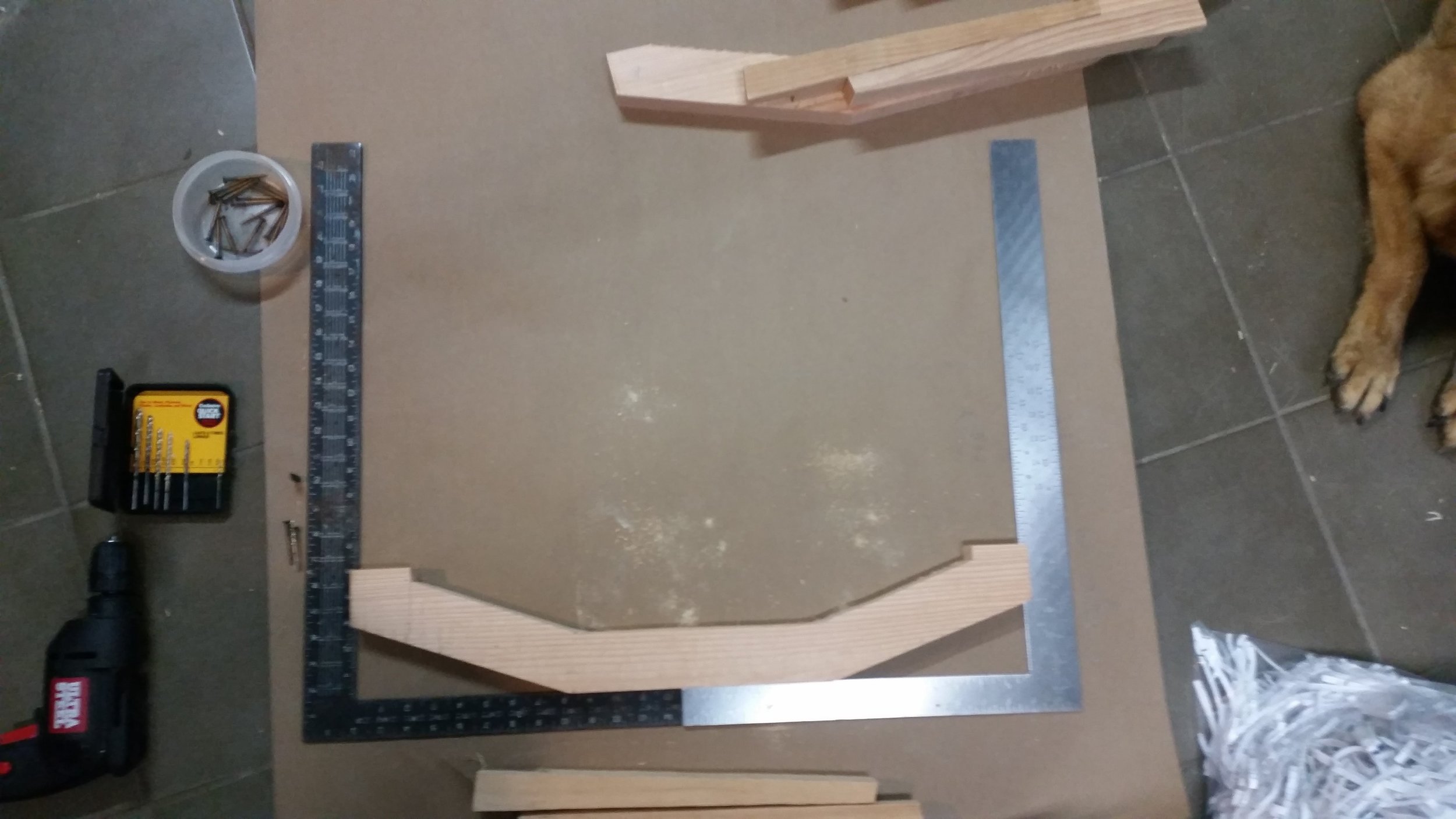
The answer is simple. The floors have two perpendicular surfaces on them, the bottom and the sides. By setting a square again these two sides, you have just created a plane of reference for the entire project! 

A second square can be set over the first square, allowing you to verify both sides at the same time and verify the squareness of the entire floor. 

If the sides are not parallel, the two squares will not line up on the bottom, but instead will deviate. Secondly, the measurements on the squares will not be identical. This builds a system for checking into the entire jig as well. 

If you find that one side is not parallel, you can choose which side to favor, and adjust the squares from there. You can know that the final measurement is fine as long as you have the squares square to each other and contacting the floor on all three sides.

Now that the floor is properly oriented, you can set the frame onto the floor and adjust the proper amount of flare. In our case, the chine is 2 inches more narrow than the sheer, so the frames need to flare 2 inches on each side. 

image.jpg

Placing the bottom of the frame on the floor in its corresponding position and keeping it fixed in that place will allow you to adjust the flare without altering the location of the chine.  

In our case, the top of the frame is set 2 inches outboard of the frame. This is easily identified because I am using 2 inch thick squares. If my flare were any other measurement, a third square would be required to measure the distance atwarthship from the vertical square. 

 With all the pieces in their assumed positions, it is time to verify everything. The top of the frame needs to be at the height of the sheer, the frame needs to contact the floor at the chine, and the floor needs to be set square in the squares. Lastly, both frames need to be the same height, that way the sheer is even on both sides.

image.jpg

From this point forward, the frames are now to be considered unique. Each frame will be custom cut to fit a specific floor and a specific side of the floor. Creating a marking system for the parts is crucial. 

I numbered the floors based on the station it is from and the sides of the floor A and B. Then the frames are labeled by station and letter side. For example: 3A, 3B, 4A, and so on.  Keeping everything organized will reduce confusion during assembly and avoid simple errors that are easily avoided.

Cutting the Frames

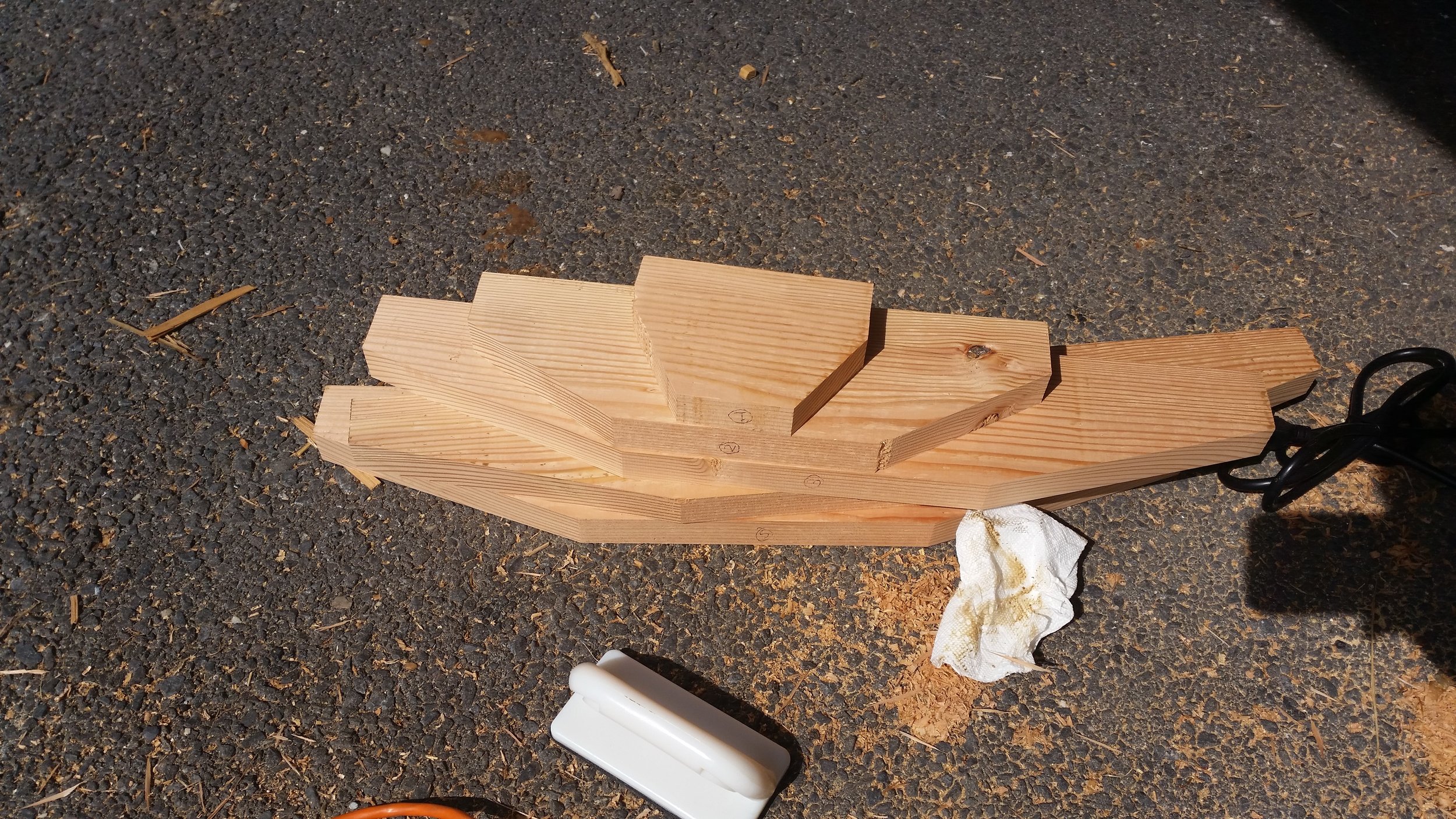
The frames attach to the floors and provide structural support to the planks that will make up the hull of the dinghy. The frames are cut out of a larger piece of Douglas Fir with straight grain and quarter sawn annual growth rings. Care was taken to avoid any large knots in the wood while using the wood in the most efficient method possible. 

The frames will guide the planks in flaring the top sides. The chine is located two full inches inboard of the sheer, and the frames need to embody this flare. To accomplish this task, careful measurements were made on a piece of lofting paper, where the final shape of the frames could be determined.  

The top of the frames are 18 inches above the bottom of the floors, and extend 2 inches beyond the floors in an atwarthship dimension. Knowing that the floors are around 5 inches high, the frames only need to extend 13 inches upward. Some overlap was added to allow firm attachment between the frames and the floors.

15 inches of vertical height is decided to be the appropriate length for the frames. The next variable is the flare, 2 inches atwarthship. By using squares, I was able to plot the points that the frames needed to reach. Then it was simply a matter of connecting the dots. 

The base of the frame shall be 1.5 inches and taper down to 0.75 inches. The bottom of the frame is set horizontally, serving as the reference point. The top outboard side is measured 15 inches up and 2 inches out. The upper inboard point is meaured 0.75 inches in from there. With the lines drawn to connect the dots, I had a diagram of the frames, now to bring them into real life! 

image.jpg

The drawing was then cut out and laid on an appropriate board. Marking the corners and connecting the marks outlined the frames, ensuring that no knots are included and as little wood is wasted. 

The frames were cut out on the bandsaw, converting the cluster of drawings into real life sticks that would become the frames of our dinghy. 

Finishing the Floors

The floors were cut out of Douglas Fir and are not the heaviest of timbers in the boat, but every bit of excess wood counts towards the total weight of the craft. Based on the scantlings for a craft this size, the floors only need to be 2.2 inches tall, and 0.7 inches wide. As you can see, these floors are greatly oversized at 5.25 inches tall and 1.5 inches wide!

I want to keep the width as that provides more wood for fasteners to drive into, but the height is a bit much. The other negative caused by the extreme height of the floors is it will greatly reduce the interior space of the dinghy. The height of the hull will be 18 inches, and a 5 inch floor would only leave us with 13 inches of interior depth. Naturally, height was on the chopping block!

I marked a line that will give me a uniform height of 2.25 inches and then cut along the line with a bandsaw. 

The central portion of excess wood was removed, which reduced the weight of the floors considerably without significantly impacting the strength of the floors. The weight reduction in the front floors was negligible, but quite significant in the aft floors. After sanding and fitting the frames, the setup will be ready to fasten permanently with glue and bronze screws.