Life Aboard

Life Cycle of a Boat

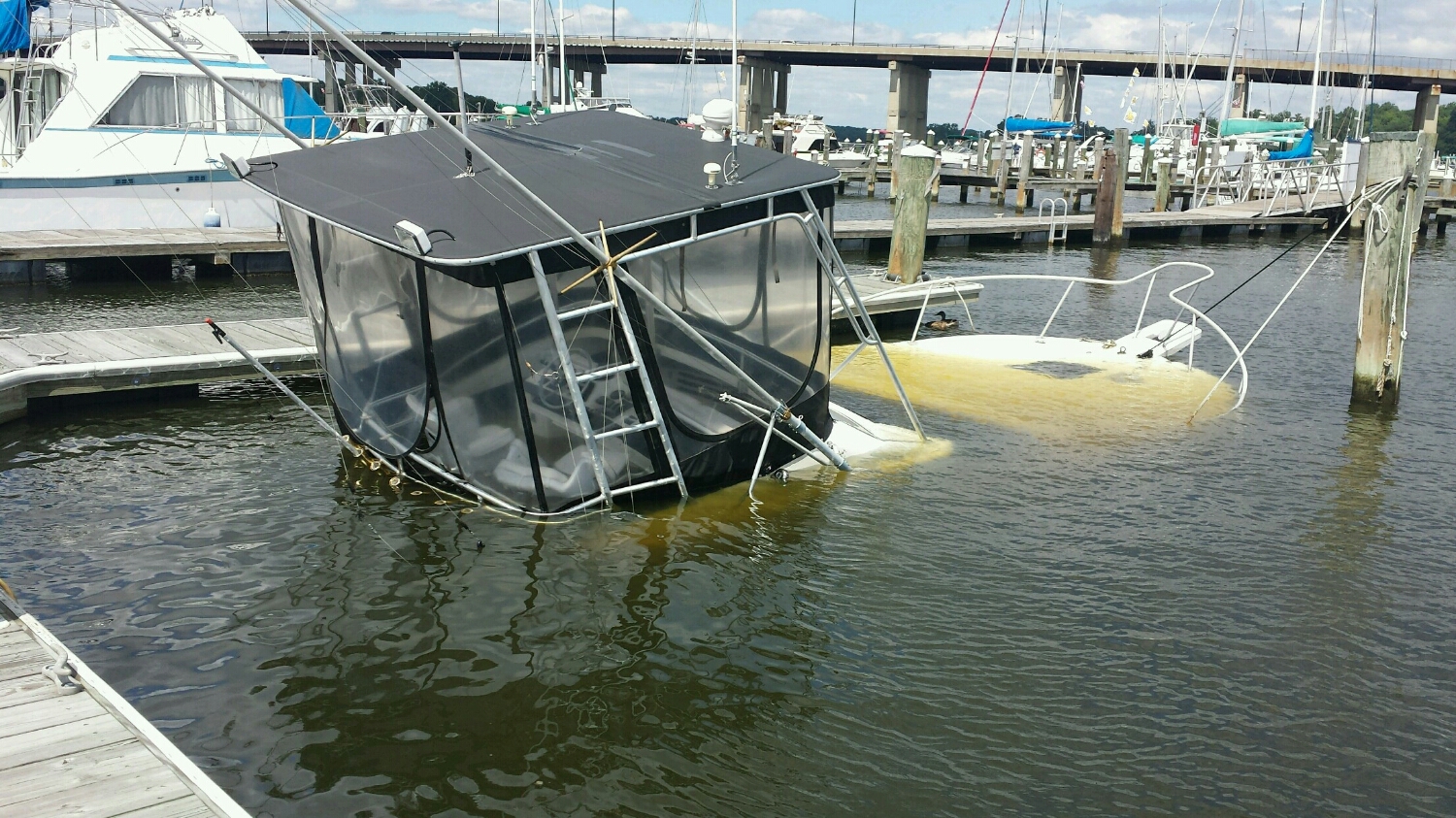
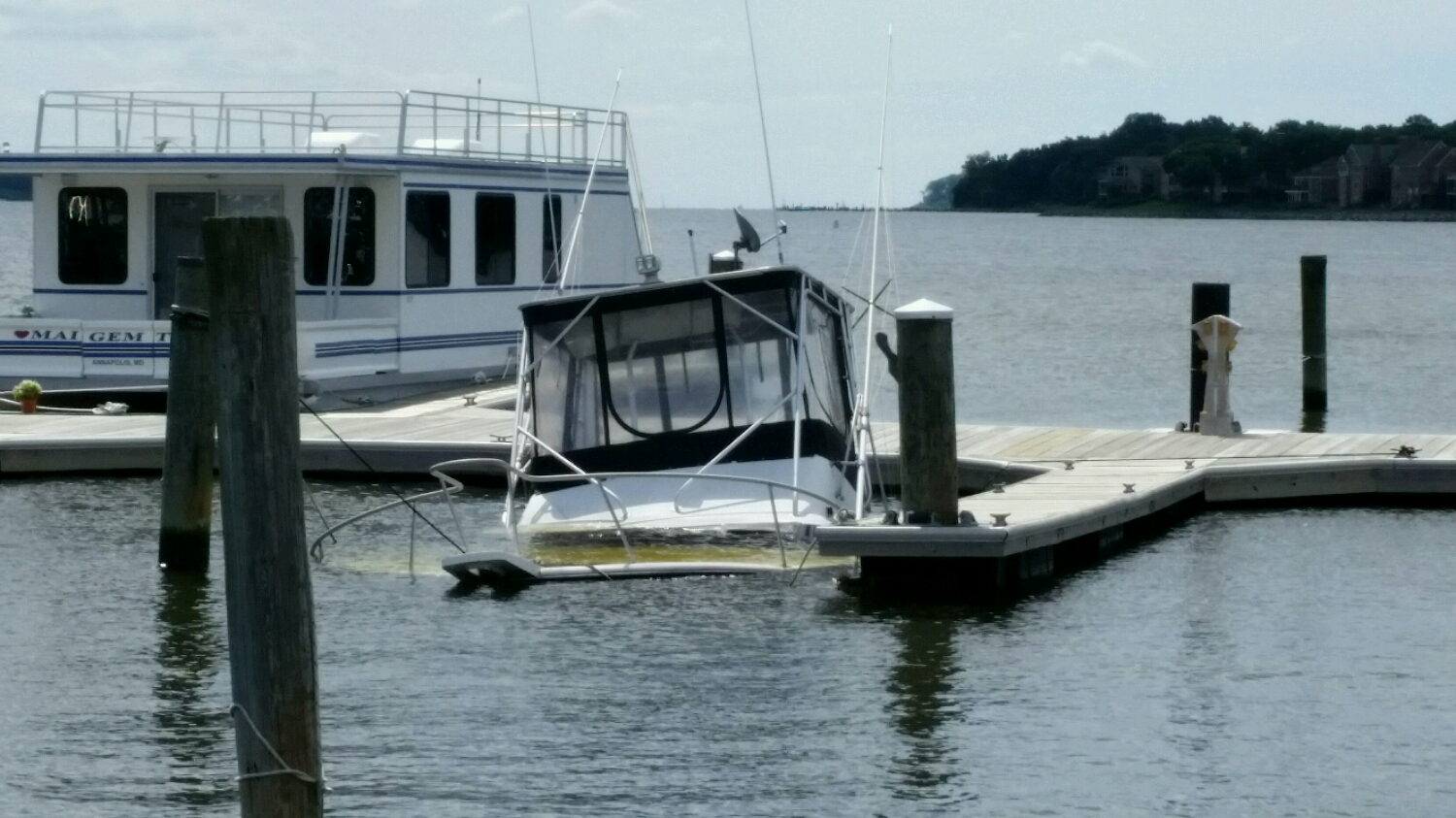
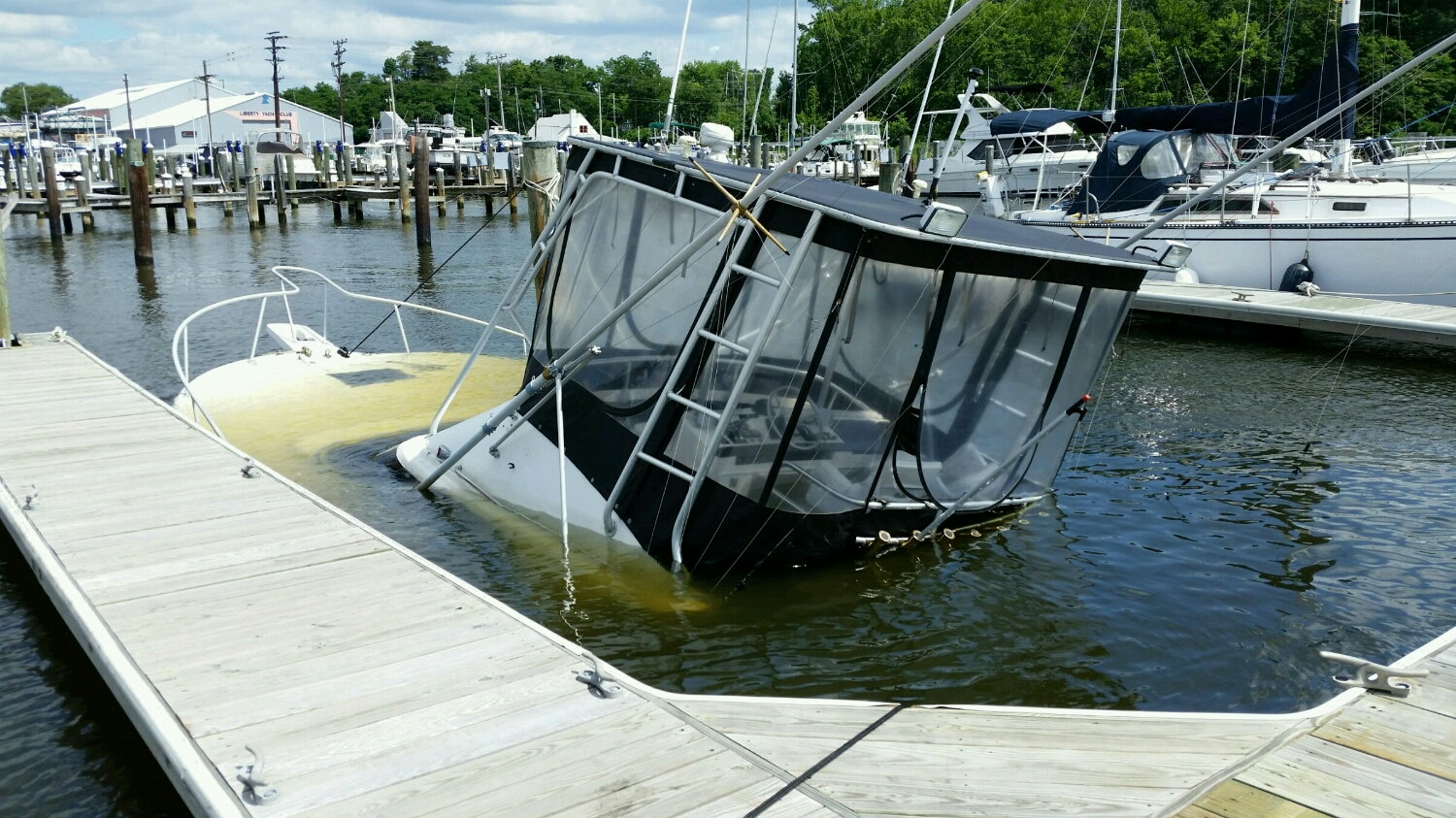
They say that every boat ever made wI'll sink and our job is to prolong the inevitable. This boat reached the end rather quickly!

upload.jpg
upload.jpg
upload.jpg

At 6:30am, this boat was floating. By 8:30am, it was on the bottom! 

I do not know the cause of this vessels sinking, but this should serve as a reminder to check all the holes in your boat!  

I suspect this may have been due to a sea cock issue. If the hose slips off the sea cock, water will pour into the hull at an alarming rate! Boats with large motors will have massive through hulls to supply the enormous flow of water required to cool them.  

Whenever we leave our boat for a period of time, we close all the sea cocks. I also inspect the hoses and hose clamps regularly, replacing them at the first sign of deterioration. 

When a boat is holed, the inevitable happens quickly!  

Man Overboard Recovery

Life Sling is considered to be the best Man-Over-Board recovery system on the market, and for good reason. The old standard is a Type IV throw-able device, typically a cushion, horseshoe, or life ring. These devices were thrown in the direction of the victim so that they can stay afloat as the boat came back to pick them up. Keeping the victim afloat longer is wonderful, but how do you get them back to the boat?

Life Sling solves this problem by way of a tether. Inside the Life Sling pouch is a floating horseshoe attached to a very long polypropylene line that ends in a webbing strap which is tied to a secure point on the boat (make sure you always keep the webbing tied to a secure point, because in the heat of the moment you might forget to tie the line and defeat the benefits of a Life Sling). Polypropylene floats, which helps you identify where the line is as well as minimizing the risk of any prop fouling issues during the recovery.

The instructions on Life Sling are very simple:

  1. Throw the Life Sling into the water
  2. Circle around the victim
  3. Pull the victim back into the boat
  • If the victim is unconscious, use a lifting system to raise them into the boat

These instructions are very good, but not very specific. This works in the marine market where each and every boat is different, and no set of instructions would work on every boat. Maddie and I decided to test out how we would recover a helpless victim on our sailboat, where winches, lines, and spars are available at our disposal. We certainly learned some valuable lessons during the recovery process!

We tried out the system in a quiet creek, where the water was still and there was no wind present; very different from the chaotic environment of a storm where a crew member got washed overboard and needs to be recovered, but the principles are the same. What is important to note is that we were anchored, had no sails up, and everyone was happy and healthy. It still took us 10 to 15 minutes to recover one person, so we feel that this process might take closer to an hour if we were in very poor weather conditions. Due to the trouble and difficulty of the recovery method, we both feel that the most important part of MOB recovery is to avoid the MOB situation in the first place! Always wear a tether and clip in when on deck in rough conditions and keep it clipped in at all times. Also, keep good footing and always use handholds as needed. If you can stay on the deck, you will be much better off. If I were to fall off the deck, I would be dragged along next to the boat by my tether connected to the jackline. There would be no need to locate my floating body in the distance as I would still be attached to the boat!

In our test, we were anchored and simply took the Life Sling far from the boat via stand-up paddle board. The victim swam out to the Life Sling and got inside the horseshoe. We did not practice the boat maneuvers to get the Life Sling to the person as both Maddie and I feel we are capable of steering the boat towards the victim. Our plan is to circle around the victim to get the Life Sling to them, then heave to for the recovery. We both agree that we can manage the boat alone to get in position to recover the floating person, but we wanted to practice the actual hoisting and recovering of the person. This is how it proceeded.


Our plan to hoist the person out of the water is to use the boom and winches to raise them above the lifelines, swing them over the cockpit, and lower them to safety.

  • The canopy needs to be collapsed forward
  • A snatchblock attached to the end of the boom with lifesling line run through it
  • A preventer line tied to the end of the boom and run forward
  • Mainsheet eased to allow the boom to swing over the water while preventer is tightened.
  • Topping lift adjusted to raise end of boom high up

This setup will hold the boom securely over the side of the boat without risk of the boom swinging back to the other side (which would smack the person into the side of the hull). The topping lift is adjusted to get the end of the boom very high into the air so that the hanging person will clear the lifelines with their feet as they hang fully raised.

The cockpit awning needs to be removed or tipped forward to allow the person to fall into the cockpit easily. If the canopy were in place, you risk bending the frame and injuring the person when they smash into it. By collapsing it, the risk of injury and damage is greatly reduced. 

The mainsheet pulls the boom over the cockpit while the preventer keeps it out over the water. The yellow polypropylene line is led from the Life Sling, to the snatch block at the end of the boom, to a turning block on the toe rail, to the winch. This setup allows us to use the winch as a lifting mechanism to raise the person into the boat with proper fair leads, minimizing harm to the equipment on board while keeping the recovery process very controlled and dependable. 

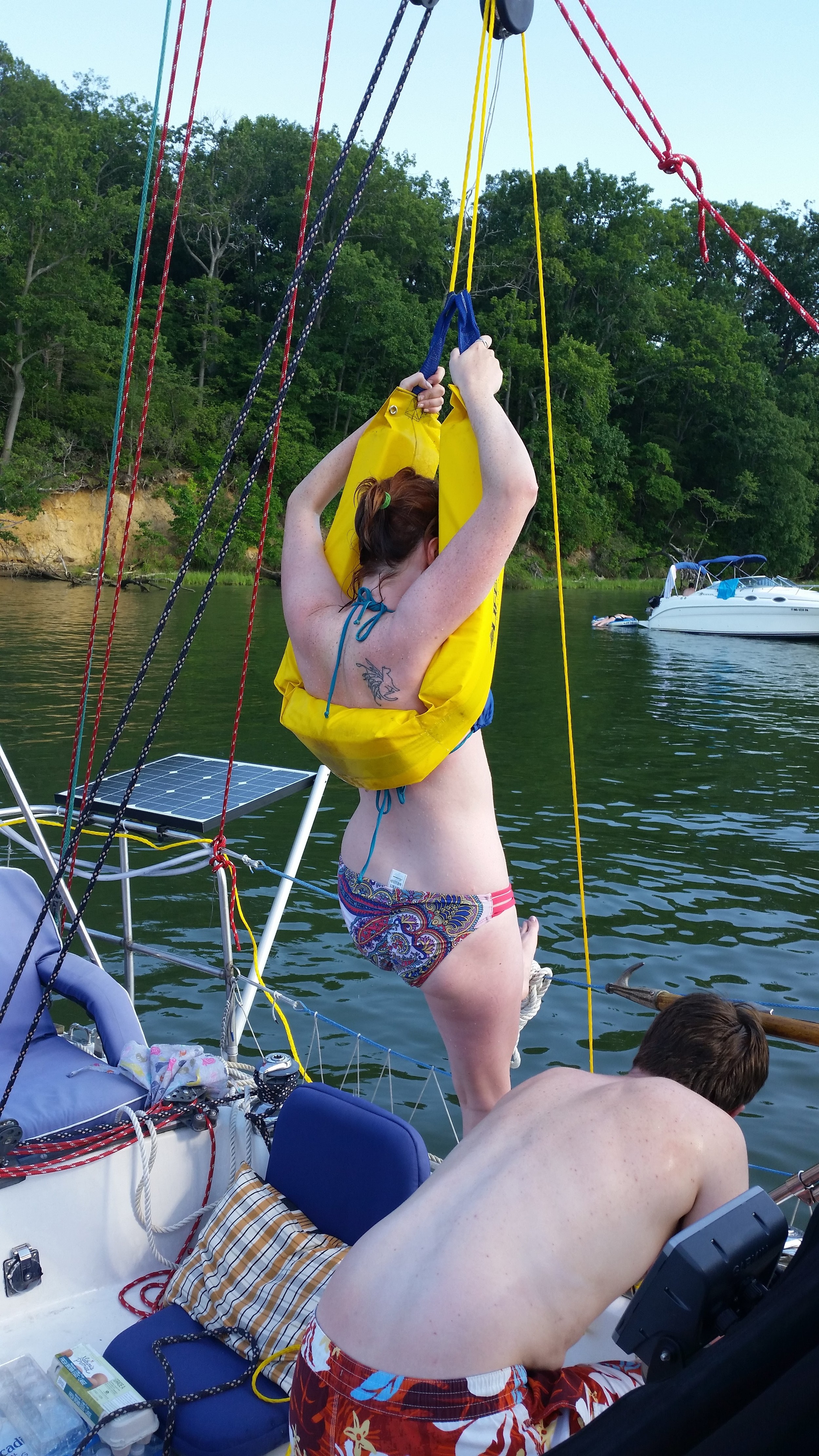
Maddie got herself into position, waiting in the water inside the Life Sling as I began to haul her closer to the boat.

Once under the boom, I was no longer able to pull her in by hand. I needed to put the yellow line on a large winch. In our setup, we used the primary winch to raise her up into the air.

The Life Sling horseshoe does work well to hold the person in its sling. Maddie hung completely limp and felt very secure inside the sling. The only problem is the sling crushes down on your ribs making it very difficult to breathe. I would hate to be in duress while hanging in this position for a long time during a recovery!

I got Maddie raised high above the lifelines, now we are ready to swing her into the cockpit.

To swing her over the cockpit, the preventer needs to be eased while the mainsheet brought in. Once she is over the cockpit, I slowly lower her into the cockpit in a controlled manner. 

Once Maddie was back on board, I hopped into the water to let Maddie recover me. She was able to winch my heavy body into the air and bring me into the boat in a very controlled manner. I weigh almost 200 pounds and there is no way she could bodily pull me into the boat. With use of the winch, she was able to raise me out of the water and get me into the cockpit without exerting herself too much. I had to take some of the weight off my chest by putting my feet on the rubrail as the sling was crushing my ribs making it very hard to breathe. 


We both agreed that this is a very tedious and lengthy process to recover a person. It would be much quicker to have them climb into the dinghy or climb up the rope boarding ladder instead of rigging this system to winch them out of the water. 

We also wondered how we would get the unconscious person into the sling! We couldn't come up with any smart ideas. If you have any tricks to get an unconscious person out of the water, let me know in the comments section down below! Our best idea is to jump in and put them in the sling, then climb back on board and raise them out. This is a moronic idea because you risk being lost as well since no one is on the boat.

In the end, we feel that the best protocol is to not fall overboard in the first place. If someone did fall in and we simply were not able to get them back on board, the Life Sling does work, and will always be a last option to recover a man over board.

After this exercise, our plan is to deploy the Life Sling to get them back to the boat, and then have them either climb into the dinghy or climb up the rope ladder. We will only use the Life Sling as a hoisting method as a very last resort option due to the complexity in rigging it and time required to raise the person out of the seas.

I still feel that a Life Sling is much better than a regular Type IV throwable, but I don't think it's the easy magic bullet to get someone out of the water. It is still necessary to have other, easier to use, equipment on hand to get a conscious person out of the water and back into the safety of the boat; such as boarding ladders.

Rope Fenders in Action

The rope fenders for Wisdom took much monger than expected! I thought they would take a few days to make and that it would give me something to do in my spare time last winter. The reality is they took up all my time last winter. 

Each fender consumed massive amounts of rope and time, taking almost the entire winter to complete. Instead of being a "spare time project", they were the main project. I still remember staying in a few weekends to work on and finish the rope fenders.  

When the massive sausage shaped behemoths were completed, worry about their weight was frequently asked. They weigh too much for Maddie to lift, so I am forced to bear their full weight. Luckily, being made of rope with hundreds of loops, I can grab on to them in any position; making manhandling them very easy. 

While weight may seem undesirable, I actually wanted them to be quite heavy. I have no desire to store bulky fenders in the lazarettes, so I ended up keeping them on the side decks. 

When we were in strong weather, these fenders would be picked up by the wind and dribbled on the deck like a bunch of basketballs. The constant pounding and smacking would make me want to throw them overboard! The only thing that stopped me was the fact that they are made of plastic and would only add to the already very serious problem of floating plastic debris in our oceans. For these reasons, I wanted to make fenders that were too heavy to float in the wind!  

upload.jpg

Now they remain in constant contact with the deck. I am concerned with a boarding wave washing them off, as well as them rolling about the deck when we heel; which is why I tie one of their ends to the toe rail. 

When deploying them, having an end tied is also insurance against loss by dropping them in the water. Being made of solid rope, they do not float. Keeping one end tied ensures that if dropped, it can still be recovered.

Keeping that end tied is also helpful in reducing the amount of weight I need to bear when setting them. I can rest the fender on that tied end while I get it into position. Then the other end is tied to hold the fender at the appropriate height. While each fender is very heavy to dead lift, keeping one end tied to work off of greatly reduces the functional weight. 

upload.jpg

I like to set them right on the rub rail. This ensures that the maximum distance between me and the rafted boat next to me will be maintained. My rub rail also extends a few inches (it's wide enough to comfortably walk on) and I would hate for it to shoot over the fender and dig into someone's gel coat. 

For added distance and protection, rafting boats can set their plastic fenders against my rope fenders. This way, none of the boats get hurt and we can all enjoy an afternoon together.  

upload.jpg

Snubber

Anchor snubbers are a very important, yet over looked part of ground tackle. Ground tackle, in its simplest form, is the equipment needed to attach the boat to the bottom in a secure manner. 

Most people think of this being anchor and rode. When the rode is rope, this can be the extent of the gear required.  

The rope will offer elasticity in the system, reducing the shock of the boat rising and falling back during rough anchoring conditions.  

When all chain rode is used, as it is preferred due to the increased weight and reduced risk of chafe, more equipment must be included to make the ground tackle system work properly. 

All chain rode offers no direct elasticity, as the chain will not stretch when pulled. It does offer some indirect elasticity, thanks to catenary, which is the parabolic curve that forms in the chain as it travels from your bow roller to the anchor. As the boat pulls back from a large wave pushing on the vessel, the chain will be pulled back under tension. This force them needs to lift the chain up, reducing the catenary as the chain becomes a straight bar. Once the wave passes, the chain will fall once again and catenary will develop again, losing the potential battery for the next shock.  

If the force exceeds the stored elasticity in the catenary chain, a strong lurch of incredible force will develop as the boat is snapped by the taught rode. All of this force can dislodge the anchor, causing it to drag, and damage the deck gear.  

Chain stoppers are easily bent by this amount of load, and risk ripping or if the deck if overloaded. If no chain stopper is present, all of this load is transferred to the windlass gypsy, running the risk of damaging the gypsy and the gearing inside. 

If the bow roller is open, the chain can also fall out of the roller and cause serious damage as it saws on other parts of the boat. If the roller is captive,the chain will not be able to escape, but the forces on the roller are still extremely high!  

The solution to the chains downfall is to use a nylon snubber. The nylon snubber offers the elasticity of nylon rode while the strength and weight of chain is still present everywhere else. The last section, connecting the rode to the boat is then completed in nylon rope.  

The nylon snubber is attached to the chain rode and to the bow cleats, which are very strong and ate designed to take such abuse.  

upload.jpg

If the catenary chain is drawn taught, the snubber will still protect all the deck gear while offering elasticity and avoiding the shock load. This also helps ensure the anchor is not lurched and un-set. 

Bow roller design is also unimportant, as the snubbers takes over the last connection to the bow. Open rollers are no longer at risk of losing the chain. Captive rollers are no longer at risk of being bent.  This is all thanks to the nylon snubber.  


upload.jpg

As the boat swings around, the nylon snubber pulls on the rode and transfers the force to the cleats. The section of chain between the windlass, chain stopper, and roller, are all slack since all the tension is diverted to the lines of the snubber. 

When it comes to snubbers, I have seen many different styles, but I prefer the simplest for a few reasons that I will go over.  

Connecting the snubber to the chain can be done by chain hook or by knot. Chain hooks are uncredited convenient, simply slip it on the chain as it runs out and cleat the other end. The chain is instantly captured at the end of the snubber. The problem is the hook can easily slip of the chain, rendering the snubber ineffective.  Some companies, like Mantus, have come up with chain hooks that can not easily slip off to negate this problem. The fact that they came up with a better chain hook means that chain hooks were slipping off enough to need improving.  

I prefer to tie a knot at the end of my snubber. A good knot will not slip off of the chain like a chain hook, and will hold securely until untied. I prefer a magnus hitch for my snubber since I use both tails, but a rolling hitches would also work.  

One last advantage to tying the snubber is you result with two tails. A chain hook only has one tail. This means that a chain hook snubber will pull the boat towards the side the snubber is run through. If it runs through the port chock, the boat will be pulled so that the port side is facing the wind and seas. This also means that all the force is directed onto that one chock and cleat. 

When tied, there are two tails, meaning two snubber lines! The lines can be set equally so that the resulting pull is even and the boat faces the weather bow on. This also reduces the force on each snubber line by half, as the load is now shared between both lines. 

On a final note, snubbers should be made of Three Stand Nylon, not double braid nylon. Double braid is not as elastic as three stand, and in a situation where elasticity is desired, choosing the least elastic option would be silly.  

My snubber is 3/4 inch three strand nylon tied with a magnus hitch and secured with both bow cleats, forming a bridle to the chain rode. This may seem like overkill, but it holds us through all sorts of weather and is easy to untie when we are ready to leave.  

upload.jpg

Until then, we know our ground tackle is well set. 

Deep Sleep

Morty usually sleeps like this:

upload.jpg

He makes a bed out of the sheets in the cockpit and gets cozy on the soft ropes. 

Today he ran around on a beach, then went swimming, then ran around some more! Morty then darted to our dinghy Tooth and hopped in while looking at me. I figured this meant he was done and wanted to return to Wisdom.  

As soon as he got back on the boat, he began looking for a place to sleep. Maddie kept him up while we raised anchor and set off, which apparently pushed him past the point of exhaustion. This is how he went to sleep this time: 

upload.jpg

His legs were streched out straight, and he made no effort to make a bed out of rope either. 

upload.jpg

He was out cold!