Life Aboard

Storing the Sculling Oar

The sculling oar is very useful, and it is very big! At 16 feet long, this oar is a bit of a challenge to store. I have many lines running on the deck with all the sails and I always worry that the oar will foul a line. 

Getting the oar out of the way has become a high priority for us. I decided to tie it to the lifelines that way it is available for use when needed but out of the way when not. At 16 feet in length, finding a span that was straight enough and out of the way proved difficult. The shrouds were my first logical choice, but the curvature of the hull was too great in this region. The oar was also at great risk of getting hooked on a sheet and breaking! 

The next location was the stern, but it would get in the way of the winches and sheets if set horizontally. If set vertically, the oar might be too much windage.

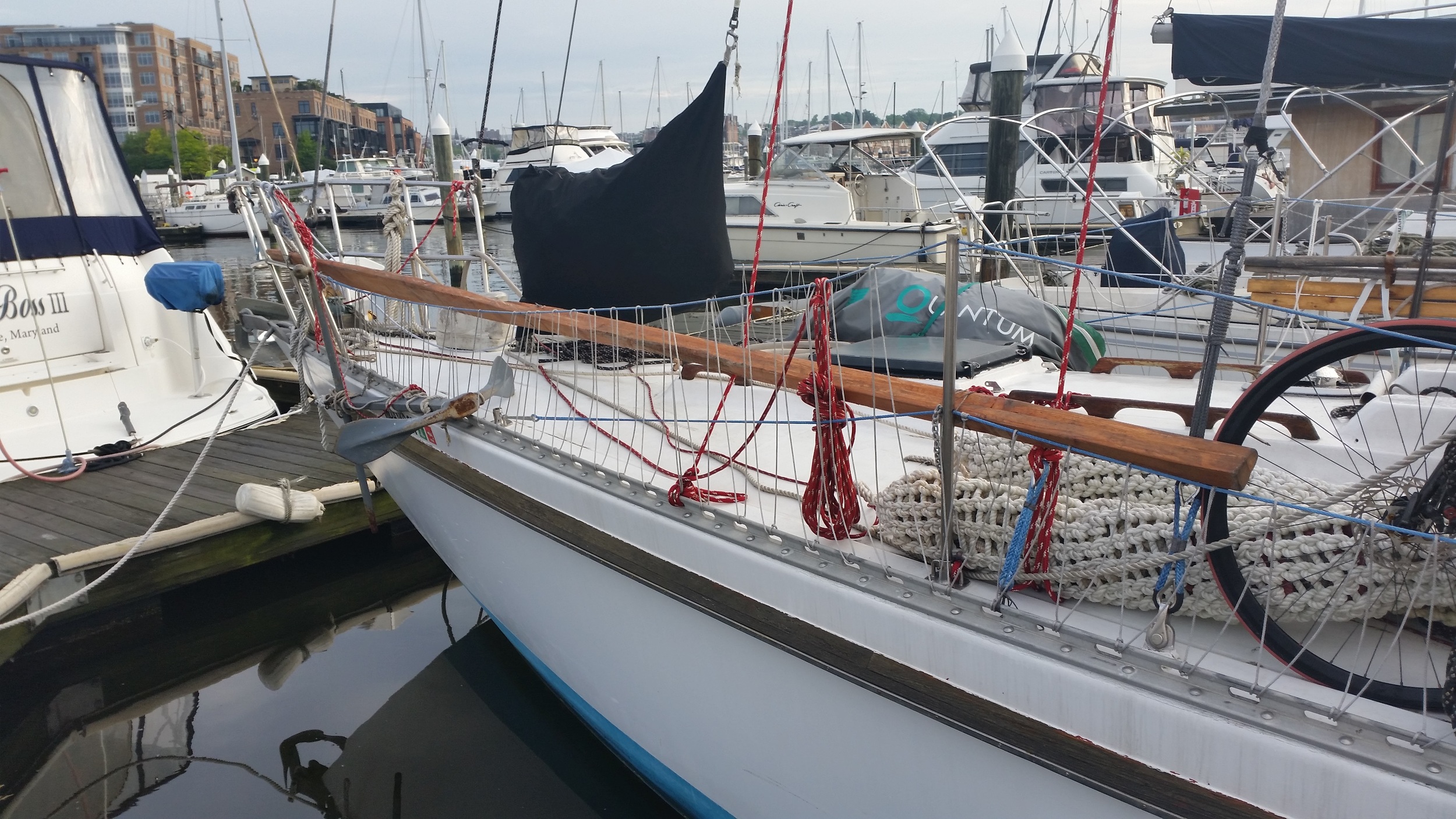
The next option was to set the oar up in the bow area. Tying it to the lifelines, stanchion, and bow rail seemed to get the oar out of the way while being clear of all sheets. It also lays lower than the foot of the headsails, so it would remain completely out of the way.

The oar is neatly stowed on the bow, out of the way but also ready for deployment when needed.

My First Sail

I grew up in Puerto Rico where the strong tropical sun would burn me to a crisp in no time! To combat the harmful UV rays, I would wear long sleeve rash guards and a sheet over my legs. It wasn't long before I realized that this sheet could turn my simple kayak into a square rigger!

This simple queen size bed sheet was tied to the kayak and raised to catch the wind. Here you can see my dog and I riding the wind effortlessly! I tried many variations, using the paddle as a mast, a yard, and even as a dagger board. 

Back then, I never imagined myself owning a sailboat; let alone living on one! It's incredible how much can change in just a decade!

We're Getting Married!

Maddie and I are getting married today! 

We met on Tinder 2 years ago and she moved aboard right away (per my request). It was a rough adjustment for her at first, transitioning from living in a land house with lots of space to a narrow sailboat. 

The first year was a mixed bag, there were fun times when we would relax on the deck, and then there were the not-so-fun times when we were re-powering and on the hard. We worked on projects together, like when she helped me paint Tooth after I finished building him, or choosing the colors for the synthetic rigging on Wisdom.

During her first year, she learned the basics of sailing and came to trust Wisdom through all sorts of weather. Then we set off on a month long sailing trip out into the ocean where she really fell in love with sailing!

It was on that trip that I proposed to her and we became engaged.

One year after that, and a lot of planning later, we are getting married. We will tie the knot and start our journey as a married couple. I figure if we can live together in a small boat, we must be compatible. 

I always maintain one rule on the boat, I am captain and she is Admiral! Following this simple chain of command, we work very well together and make decisions as a couple in a way that makes both of us happy. I look forward to a long lifetime of cruising together.

Edson Bilge Pump Rebuild

The new diaphragm and flapper valves arrived from Edson, allowing me to finish the rebuild of this old bronze Edson pump. Now that I know how far the pump lever needs to move, I can finalize its placement in the boat.

This pump is capable of pumping 1 gallon per stroke, which means that we can easily pump a lot of water without depending on our batteries holding up in the event of an emergency. By mounting it inside the cabin, we are also able to pump from the safety of a closed cabin if the situation were to call for it.

On a less "gloom and doom" viewpoint, this pump will make cleaning the bilge that much easier since I can keep an eye on the water in the bilge while pumping it overboard at the same time. My current manual pump is located in the cockpit, which doesn't let me keep an eye on the water clarity as I clean the bilge. As soon as the bilge water is clear, I can shut the hose off and dry out the bilge! This can make the quick and easy process of cleaning the dust out of the bilge all the easier.

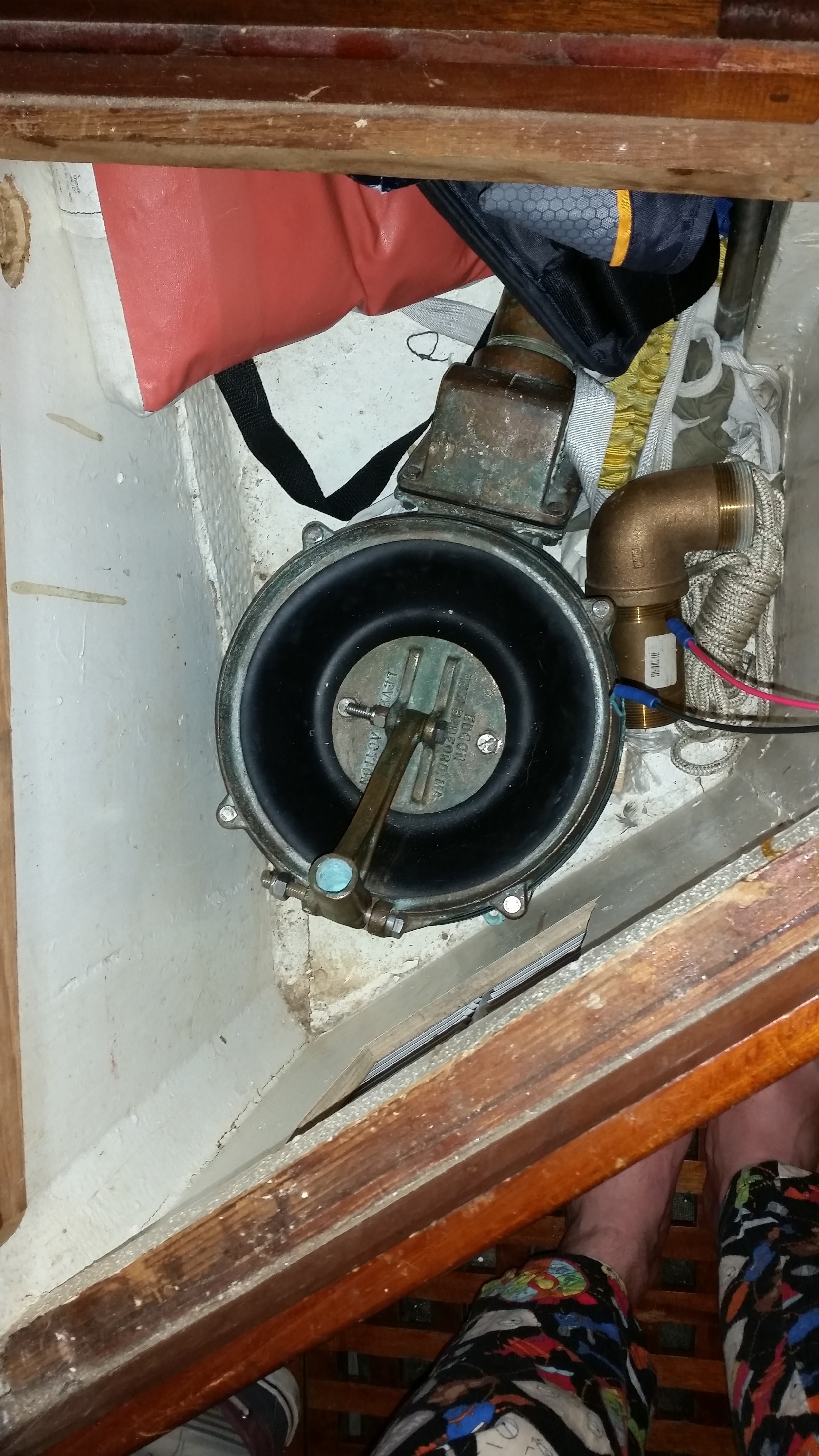
The downside to this bilge pump is its size. This thing is huge and finding a place that is both out of the way and accessible that can fit this behemoth has proven difficult. The locker where I used to keep my dive gear seems like a good spot for the pump

The bilge pump fits in the bottom of the locker and can be plumbed with with relatively short hoses. This will keep down the amount of head and resistance on the pump and increase its efficiency.

I do need to build a base for the pump so that it can mount on a level surface with the hoses attaching to it.

The plan for routing the hoses is to lead the intake hose from the bilge under the quarter berth and through the bulkhead into the locker. From there it will enter the bottom of the pump and exit into the back of the locker where it can run up the side of the hull and exit through a (yet to be installed) 2" through hull fitting just under the rubrail. A seacock will be mounted on the through hull fitting to avoid water flowing back into the boat when heeled over or if the hose were to leak. 

This bilge pump will hopefully only be used to clean the bilge, but if we did need to use it in an emergency, we can do it from the comfort and safety of the cabin.

Fixed vs Folding

The salon table is an important piece of furniture in a sailboat, and they come in many different styles to meet the varied needs of different sailors and liveaboards.

In their simplest form, tables are a horizontal surface which provides space to support objects. In a boat, horizontal surfaces are in short supply, so the salon table becomes the main table for everything that goes on in the boat. Since this table is so important, bigger may seem better! Sailboat interiors have limited space, the larger the table the less residual space you will have for the remainder of the interior accommodations. Since interior space is limited, the struggle between size and usability has been churning on.

Small tables can provide space for one person to eat a small meal, and take up almost no space. This leaves the rest of the interior unobstructed! This may seem great until you have someone visit for dinner and you have to take turns on who gets to use the table.

20160519_170728.jpg

Mid-sized tables offer more space for eating and working and only take up a bit more space. They offer enough space for two people to eat on the same table at the same time, or space for a small chart book. 

20160523_071751.jpg

Large tables offer space for many people to sit at and eat at the same time and space for projects, all on the same table. These tables are also large enough to set out full size charts. This may seem great, but these tables also take up a lot of space! 

Since we all want the biggest table possible, we first need to evaluate what will fit in the boat. If you have a narrow boat, maybe a midsized table is all that will fit. If you have more beam and length in your salon, then a larger table might still fit. The big question with tables is: "What do you do with them when you are not using the table?" 

Space is a premium on a boat, and if you have a lot of space, why would you want to occupy all of that space with a table? Island Packet offers a large table that folds up on the wall in the salon. When you need the table, you can lower it down; when you are finished with the table, you can fold it up onto the bulkhead to open up the very spacious salon!

Source: http://ipy.com/wp-content/themes/ipy/yacht-gallery/360/4.jpg

Source: http://ipy.com/wp-content/themes/ipy/yacht-gallery/360/4.jpg

Source: http://ipy.com/wp-content/themes/ipy/site-images/360-main.jpg

Source: http://ipy.com/wp-content/themes/ipy/site-images/360-main.jpg

These tables offer plenty of space when they are lowered for projects and entertaining. When the tables are stowed and out of the way, the salon is opened up and the full beam of the boat is available for whatever you want!

The downside to these tables is they need to be completely cleared to be put away. If you have a long standing project, it can't live on the table when you go to stow the table. 

The other downside with these tables is they will always maintain themselves parallel to the floor. This means that as the boat heels over, the table will lean with it and everything sitting on the table will slide towards the low side. Table fiddle blocks will help keep plates from sliding off the side, but you will still have to deal with everything settling on one side of the table. 

A fixed mounted table can be gimbaled, allowing it to swing with the boats motion to keep the table top flat and level with the water. This is very useful on long tacks when you want a flat surface to eat on. Our table has a bolt that locks it in place (making it not gimbaled) which we keep installed while in port.

The alternative to a stowable table is a fixed table. Fixed tables will permanently occupy a section of the salon and can not be removed to free up space in the salon. This is a sacrifice, as the salon is a highly used area on the boat. 

20160523_071831.jpg

The advantage that a fixed table has over a folding table is the fixed table can hold a lot of storage! The entire table base can be serve as a large storage area. On Wisdom, we keep all our bed linens and games in the table.

When deciding which table you want to have, you need to evaluate how you will be using the space in the salon. If you do a lot of projects, a fixed table is very handy. If you do yoga, a folding table is very handy.

If you already have a table in your boat, you know that you can learn to live with whatever type of table you have. Maddie has expressed interest in removing the fixed table and replacing it with a folding table on the bulkhead. After showing her how much storage we would loose and how little space we would gain, we quickly discovered that she could do her yoga in the area between the galley and the salon (a much easier alternative).