Transatlantic: Day 21 [Day 42]

We continue to make our way East but we have removed the Northern component of our course. Why? We have enough wind!

IMG-3364.jpg

The winds in the Westerlies are pretty easy to navigate and sail in because you can choose what kind of winds you want to be having. The further North you go, the stronger the winds will be. The further South you go, the lighter the winds will be. If you feel that the winds are a bit light, simply sail a bit more northerly until the winds build to your liking. If you feel they are a bit too strong, simply head a bit more southerly. When you finally find the winds you like, just head East and the winds will stay constant for you!

FullSizeRender.jpg

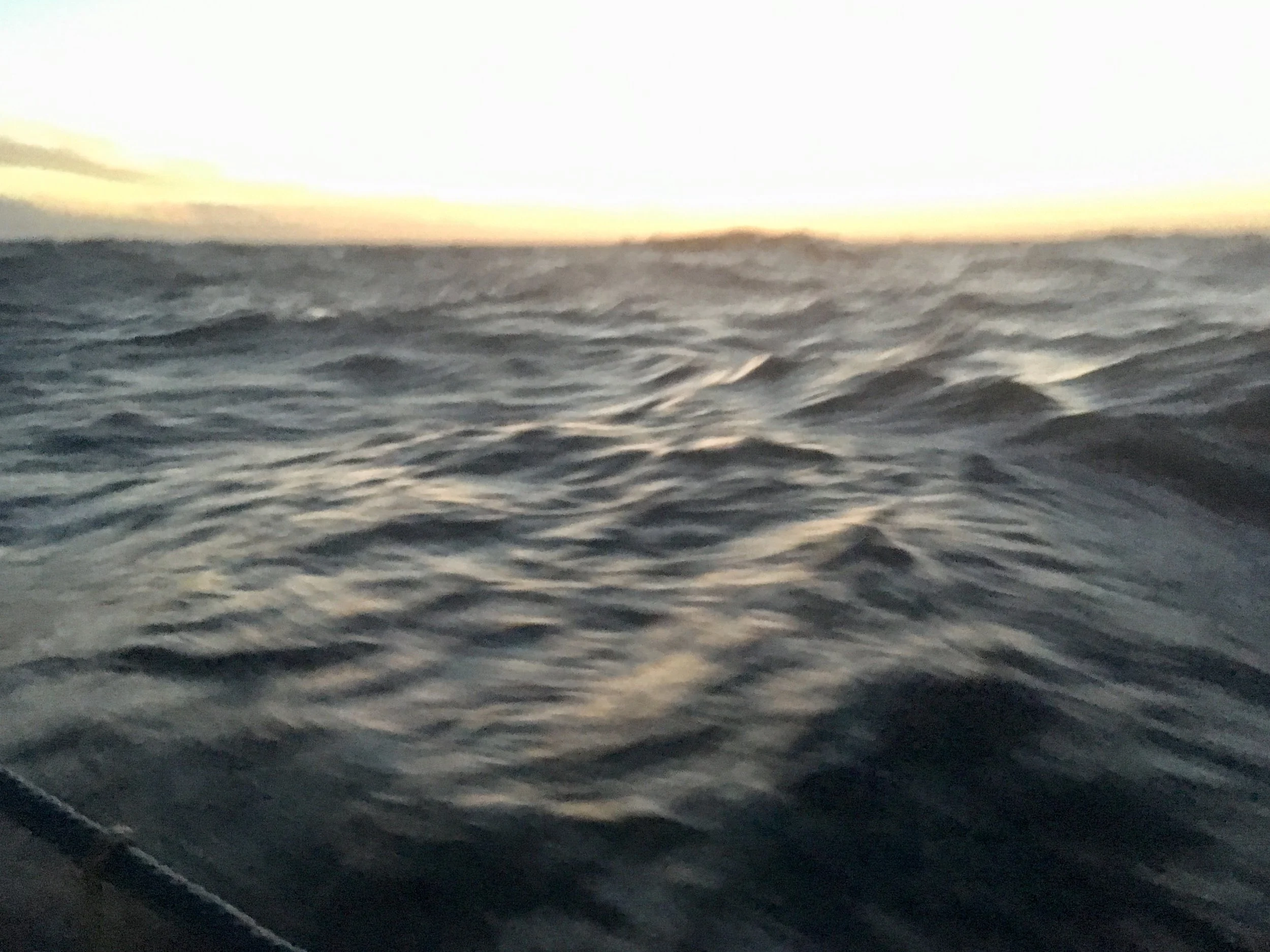
While stronger winds do mean larger seas, when they are following seas, they are not so bad!
FullSizeRender.jpg

The waves come at your stern and simply slide under the overhang. The stern lifts and you surf down the wave. As the wave passes the boat, the bow goes up and the boat would normally lose its speed as it tries to climb the back of the wave, but the winds are strong and won’t let you decelerate, powering you along as you ride through the seas.

FullSizeRender.jpg

As night falls, the stars begin to come out. This one star, probably Venus or Jupiter, is already out even before the sun has sunken beneath the horizon. We always reef down in weather like this, not because we want to go slower, but because we don’t want to be reefing in the dark. Should the winds build further, we would be over-canvassed and over-powered, necessitating us to deal with tanbark sails in the dark. Reefing early means that the person on watch simply watches and the person off watch sleeps. Nothing dramatic happens and everyone stays safely well rested.

FullSizeRender.jpg

Thankfully, the Moon is well light in the night as we are making our way towards the Azores. I always prefer to sail at night with a full moon. It makes the mystery of the darkness wash away as your eyes adjust to the small amount of sunlight being reflected back at the surface of the Earth.

It is also very useful to judge the sea state as the moon beam lights up the tops of the waves on its way to your yacht. In your perspective, it might look like a single beam of light leading up to the moon, but everyone has this same perspective as the light from the moon is radiating out evenly in all directions and you are only able to perceive the light that is coming your way; just as someone else can only perceive the light coming their way.

Imagine if we could all see the world from other peoples perspectives? I’m sure there would be a lot less conflict!

Transatlantic: Day 20 [Day 41]

July 27, 2018 and we are approaching the turning point to head back down to the Azores. It has been 20 days at sea with no sight of land, and if we continue on our current course, we will miss the Azores entirely! We need to turn south, but if we do so too soon, we will get caught in the high again. Too late and we will end up sailing extra miles as we fight the Gulf Stream that is running Easterly in this region of the world.

IMG-3363.jpg

Being bored on the boat, I played with the little icons again. The windmill is the waypoint that some of Australian friends said would be good wind and the walking man was a waypoint that a friend on shore in the United States said would be a good waypoint for wind. They are both close, but the interesting thing is they are not the same points, even though they were both using Predict Wind to get this information. Makes me wonder if the program gives reliable information or if the different users were simply inputting different information?

IMG_4162.PNG

The first light house is Flores, the next point, a tree, is Faial (our destination) and the third light house is Terceira. Our Australian friends are currently in Flores and enjoying the wonders of being on land again. We want to check in at Flores to experience the classic “Azores Check-in” and then we have a friend on Terceira that we want to visit once we are checked into the island chain.

Transatlantic: Day 19 [Day 40]

Today is July 26, 2018 and the most magnificent thing happened: Dolphins.

IMG-3362.jpg

The winds returned and we began sailing rather quickly, fast enough that we were comfortable under full sail without much effort and yet the seas hadn’t built yet so we were moving along at a relatively flat attitude. Out of nowhere I begin hearing the sounds of dolphins as they jump out of the water to survey the world above the waters edge. They approach the cockpit where I stand up and begin filming them. They seem to like this and we have found that if we do not make a big to-do over their presence at this point, they will then just swim along to somewhere else. If we do this big to-do, they will then move up to the bow and begin bow riding us!

IMG_2825.JPG

To make this moment even more special, we were moving along under full sail at speeds over 6 knots! The dolphins in the past seemed to get bored with us and basically float along in front of the boat as if offering to give us a tow if we threw them a line simply because they felt sorry for how slow we were moving. These dolphins got to have fun bow riding us! We were moving and they were kicking!

IMG_2822.JPG

Dolphins are one of the most awesome parts of blue water cruising. It doesn’t matter the weather, the conditions, or your energy level; when dolphins come around, all you want to do is watch them play and stare in awe at the awesome display of grace and agility that a dolphin embodies.

FullSizeRender.jpg

As the sun began to get low on the horizon (and the dolphins probably got a bit tired) they departed us and we were once again all alone out in the middle of the ocean. The closest mammals in this part of the world came to pay us a visit and check in on us, but now they have gone back to their world as we skim the surface of an alien world where we are merely visitors who have already sent in our mark from far away (plastics).

Sunsets out in the ocean are always beautiful, and one of my favorite parts about being out at sea. The clouds block out the sun but the rays come peering through in splendid form, reminding you that you are an insignificant observer in this incomprehensibly large universe.

Transatlantic: Day 18 [Day 39]

Winds have sort of returned. We have enough to keep our sails full, our wind steering on course, and the sense of movement through the water, but not at any real speed that you feel your direct attention is needed at every single moment.

This kind of slow and comfortable sailing is actually my favorite. Nothing happens fast, nothing is really important, and everything is easy to handle. The winds are light enough that full sails can still be managed without the aid of a winch, but you have enough wind to keep the sails full, even when moving through the seas. The winds are also too light to actually create large seas so the boat doesn’t actually ride up and down waves. Instead, it just looks impressive as the bow slices through the waves and the water parts around the front of the boat. It looks really good but it’s not really that impressive of a feat.

IMG-3361.jpg

While out in these conditions, a whale surfaced near the boat and Maddie was able to get a picture of him. At first glance, I thought it was a Minke Whale because of the size of the whale, as well as the size and position of the dorsal fin. Once we made landfall and had access to literature on whales, we now strongly believe it was a Northern Bottlenose Whale.

FullSizeRender.jpg

You can sort of see the beak of the whale under the surface of the water in the picture above. In the picture below, you can see this weird hump on the head which was characteristic of a Northern Bottlenose Whale as well, and not a feature of the Minke Whale. The whale surfaced around us a few times and it felt truly magical. Here we are out in the middle of the ocean and the whale decided to surface next to us!

FullSizeRender.jpg

The whale could easily see us at the surface and chose to reveal itself to us at that point. It could have easily surfaced far away from us where we might have heard it but never seen it. It could have also surfaced once and then dived back down and out of sight, but instead, it remained near us for a few minutes, watching us as we watched what it was doing.

FullSizeRender.jpg

Today was absolutely magical! We had enough winds to feel like we were being productive, and then we saw a whale out in the middle of the Atlantic Ocean! We are as far from any whale watching tour possible and got to see a whale in their natural environment, where they spend most of their lives, in the deep blue.

To top the day off with an extra special amount of magic, the moon rose while the sun was still up.

I know this will sound childish, and even after studying celestial navigation, I still feel that the sun belongs in the sky by day and the moon in the sky by night. On moonless nights, I feel like if something vital is missing; likewise, on days when the moon is out I find myself looking at the moon and thinking: “You aren’t supposed to be up there yet!”

Every time I see the moon by day, that childish thought rolls through my mind. On the flip side, that thought makes me notice the features in the sky!

Transatlantic: Day 17 [Day 38]

As promised, the winds returned. Our little break from sailing was much needed as we were a bit tired from all the watching and movement of the boat. Just the act of sitting in a sailing vessel is strenuous as you are constantly moving your core to maintain yourself straight and steady. Sleep is not as deep because you are listening for the on watch person should they call out for you to assist them.

Having a break in the middle was actually really nice because it let us recharge and regroup. We ate, we rested, and now we were ready to go once again.

IMG-3360.jpg

With the winds back, we were moving along quickly at our old pace, covering more than 100 nautical miles per day.

IMG_4160.PNG

Friends on shore were giving us coordinates for where the wind is located, and we had plenty of time to play with the symbols on the screen.

The skull and crossbones is the location of a Hurricane, the windmill is the waypoint where the wind is located (based on weather routing software), the little boat is our Australian friends who left Bermuda a few days before we did and were a few hundred miles ahead of us as a result.

This little map is the closest thing we have to an electronic chart of where we had been and where we are going. You can see the marks as we traveled down the coast of the United States, some of the points off of Georgia were “far out to sea” in our opinion at the moment. Now when we look at this map and see how we just rocketed away from the shore and shot straight out to sea, we begin to wonder what we were thinking.

What changed in our minds that let us point directly away from land and head straight out towards an empty horizon? We have charts and know that land is out there, but what about the first explorers who were setting out blindly? They had no idea what or where land was located, and simply ventured out over the horizon to lands unknown.

With all this knowledge, we were still scared to actually let go of land and head out to sea. Now we are out in the middle and not even thinking about looking back. We are cruisers and we are crossing the ocean; the best way to do that is to head straight towards your destination!