
Failed Dorade Upgrade

The idea is simple, add baffles to our dorade box so that gushing waves don’t pour through and into the cabin.

I built a test box that would allow me to place baffles of different sizes in different positions to try and find the best combination to stop the flow of water while still allowing plenty of air to pass through.

IMG_3500.PNG

Tests were very easy to carry out. I used a bucket of water to simulate a boarding wave, and simply dumped the whole thing in as hard as I could. Water would then roar and pour through the system, loosing its speed at each baffle, until it quelled before reaching the end.

Just two baffles seems to be the most effective at stopping water without disturbing air flow. One large one on the bottom and a smaller one at the top closest to the hole that opens for the boat intake.

The plan was simple and I was ready to retrofit the modifications to the old dorades!

FullSizeRender.jpg

The great ideas all came to a quick halt when I cut open the top of the dorade box. The box ranges from 3/4” thick to 1-1/2” thick of solid (no core) fiberglass. I am a strong believer that any modifications I do to the boat need to be equivalent or better than what was currently there. At this moment, I knew I had failed.

There was no way I could add to this box in such a way that would be as strong or stronger than what is currently there. I simply didn’t have the materials or time on hand to layup a 3/4” thick box with baffles. I was expecting the box to be between 1/4” to 1/2” thick, and probably cored with wood, not solid fiberglass.

FullSizeRender.jpg

It makes sense that it was so thick, as I frequently step hard on them when the boat heels over. Having a strong foot hold is key in a rough sea way while working on the deck. The thought of making them larger and then more prone to impact means that they should be even stronger than this!

With my tail between my legs, I began to think of alternatives. Suddenly the easiest alternative came to mind: turn the cowl away from the wind when in rough conditions.

Yes, something as simple as not having the cowl face forward in heavy seas had escaped my mind. When I go up to reef, I simply need to also rotate the cowls away from the wind.

I sit here on the deck, looking at this massive hole I need to fill back, and realize that all I needed to do was rotate the cowl.
Visiting New York

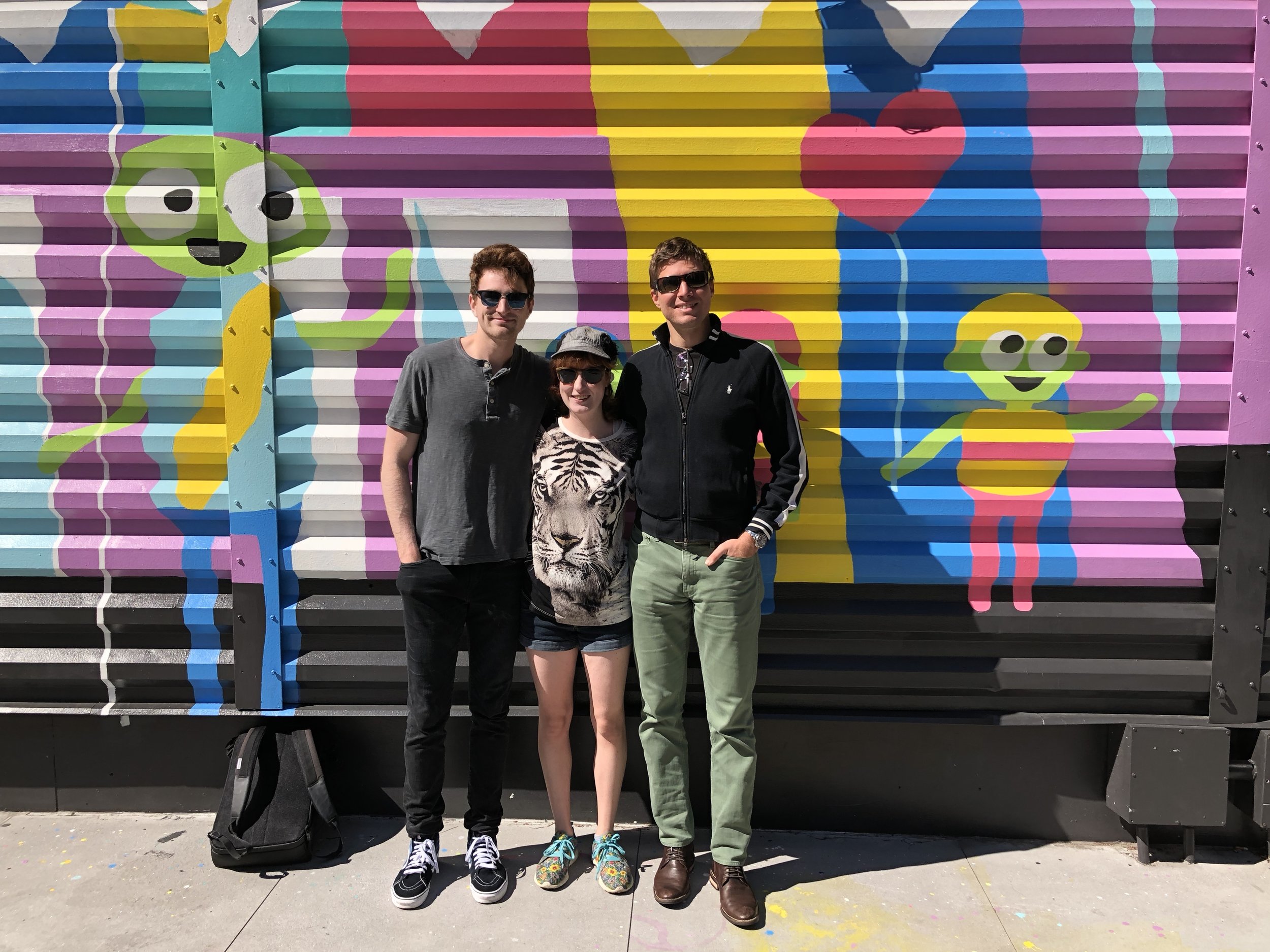
One of the benefits of cruising is that you can afford to travel. Wisdom is currently in the Azores, and to not overstay our visas, we had to return to the United States by plane while she is being repainted. While back in the States, we took advantage of our proximity to New York City for a little city exploration.

IMAGE.JPG

Maddie’s brother lives in New York, so we also got to visit with him! Having a local show you around is always better than wandering around aimlessly. He took us through cool murals and interesting parks as we visited the key sights and experiences that make a trip to New York complete.

IMG_3310.JPG

It sure is a different world than the one Maddie and I are used to. Instead of clouds obscuring the sun, it’s the tall peaks of buildings that reach up into the sky. Small streets in tiny ports that we anchor near are a far cry from the busy streets of this city.

All the hustle and bustle is fun for us to visit, but we do enjoy the peace and tranquility that we get when we are at the boat. Being in a busy city sure does make you appreciate the solitude of the open ocean even more.

Thomas, the Tomato Plant

Ocean passage making is hard on land based plants, but this hardy tomato plant seems to have made the journey!

FullSizeRender.jpg

Thomas, our tomato plant, was first sprouted in Florida, and has since made the long journey across the Atlantic and over to the Azores.

He started off life with lush green leaves that begged for sun, but with sun exposure also came salt spray. As Thomas grew, so did the concentration of salt crystals in his dirt, until the level in his pot became too harsh for him to thrive.

Leaves started turning brown and his branches became blunted, but Thomas kept trying to fruit. Eventually, little flowers formed and it seems that all his energy went into sustaining them. The remaining leaves withered away as the green tomatoes began to turn red.

Thomas is currently a dried up stick which produced a handful of tomatoes in his lifetime. We plan to make some changes for Thomas II, such as a blocked out container, and to get the plant thriving before we head out to sea.

Steel Squarerigger

While visiting New York City, we stumbled upon this old square rigger. Unlike the wooden tall ships that we have encountered over the years, this one was built out of steel!

IMG_3326.JPG

Steel boats hare their distinct advantages, being a very strong but also thin material to build the hull. You can see that over the years though, corrosion has played a role in the stem and cutwater of this ship. The pitted appearance of the old steel tells of its age like the patina that forms on a bronze port light. It’s not shiny, but its age displays its beauty.

At first glance, I didn’t really notice the pitted nature of the steel plates, but then when compared to the new smooth steel plates that have mended the hull, the story of time becomes evident and powerful.

Cut-in Waterline

Cut-in waterlines are a truly useful tool. Their primary purpose is to permanently scribe the waterline of a yacht into the topsides, that way it can not be erased or lost. Aside from this purpose, it also serves a few other wonderful services as well.

FullSizeRender.jpg

The most famous is the ability it affords you to paint your bottom without masking off the top. The bristles will simply fall into the groove and stop there. This allows you to simply paint up to the cut in waterline with ease and care without accidentally getting bottom paint on your topsides.

Taping off your waterline might not sound like a big ordeal, but when you are painting in a tidal grid, time is a very important item and one that is very limited.

As the tide is going out, you will begin scrubbing and scraping, then you have to chip off any loose paint, followed by fairing in any rough edges. This is a lot of work and adding one more step of taping off the waterline is not usually appreciated.

Having a cut in waterline allows you to simply start painting after the bottom is clean. The edge is there and unmistakable.

FullSizeRender.jpg

The second advantage of a cut in waterline is it makes it easy to see where your waterline is supposed to be, even if you raised the bottom paint as your cruising home becomes overweight. The cut in line will never move, and you can gauge how over loaded you are by how far under the water the line is.

FullSizeRender.jpg

The last and probably least thought of advantage of this scribed line on your hull is the ability to record and protect your waterline information, no matter what your yacht goes through.

We are repainting our topsides, and the bottom edge of the topside paint will go all the way down into the bottom paint area. The worker wanted to know how far into the bottom paint to sand, and the answer was easy to give and hard to forget: “Down to the cut in waterline”.

Now I could leave the country while the boat was sanded without worrying about where the worker was sanding. Best of all, when we repaint the bottom, I know how far above the cut in waterline to raise the boot stripe.

Having a cut in waterline boasts many advantages, ones that are typically only thought of as the moment they are needed arises. If you have one, enjoy it, and if you don’t have one but do have spare time to kill, consider adding it to your cruising yacht.