How Calm Can The Ocean Be?

When you imagine the ocean, you probably think about endless waves that extend out and beyond the horizon. This may be the case on windy days, but the ocean can vary in surface topography just as much as dry land can. 

IMG_2810.JPG

While out in the middle of the Atlantic Ocean, we were becalmed for four days in a row. By the second day, the ocean had calmed down and the true beauty of being out there unveiled itself. 

IMG_2813.JPG

My favorite times during these days were definitely sunrise and sunset. The sun at low angles would create a multitude of colors around you. Any slight ripple would glow with golden hues and the ever-present Portuguese Man-O-Wars around us would illuminate on the water.  

Having an electric motor meant that we didn't move very far on these four days, but had we had a diesel, we would have missed the magic of the ocean as it would have been drowned out by the roar of burning fossil fuels. 

Corssing an ocean should not be something you do in a rush, but instead it should be an experience that you can cherish and remember for a lifetime. 

Ocean Sunsets

Out on the ocean, there is nothing obstructing the horizon. That means that you will have a perfect sunset every afternoon! 

IMG_2818.JPG

Depending on different air qualities, such as air pressure, humidity, dust, air streams, and cloud cover, you will get a new and exciting sunset every time; best of all, each sunset will be unique.

IMG_2816.JPG

We make a special effort to eat our dinner in the cockpit while out at sea on a blue water voyage just so that we can watch the sunset.  

There is something magical and magnificent about watching the colors in the sky change as the glowing spot on the horizon disappears beyond the horizon. As the sun fades away, the sky will burst into a painters palate of colors, and then the stars will begin to come out. 

Mars and Jupiter are usually the first of the night lights that come into view after the sun sets, and rather quickly as our eyes adjust, all the stars in the sky light up in a vast wonder above our yacht. 

I have spent many nights starring up at the mast head, watching its silhouette move among the stars. Laying in the cockpit looking up at the night sky as you sit alone on the surface of the ocean with no one else present in your visible disk of the Earth makes you feel just as alone as the invisible planets that orbit the infinite stars out there in the sky. It becomes easy to imagine that someone else might be sitting on their own craft on a distant planet, looking up at their night sky and visualizing our Galaxy as just another star in their own sky.  

Whales in Their Natural Environment

Whales live in the ocean, this is a simple fact that we all know, but do we truly understand it? 

whale watching tours will show you whales when they pass near our environment, the shore, where a short boat ride will bring our paths together. Whales migrate seasonally, and their routes near shore are well understood now. What about when they are not near our world, and instead we are the ones visiting theirs?

IMG_2817.JPG

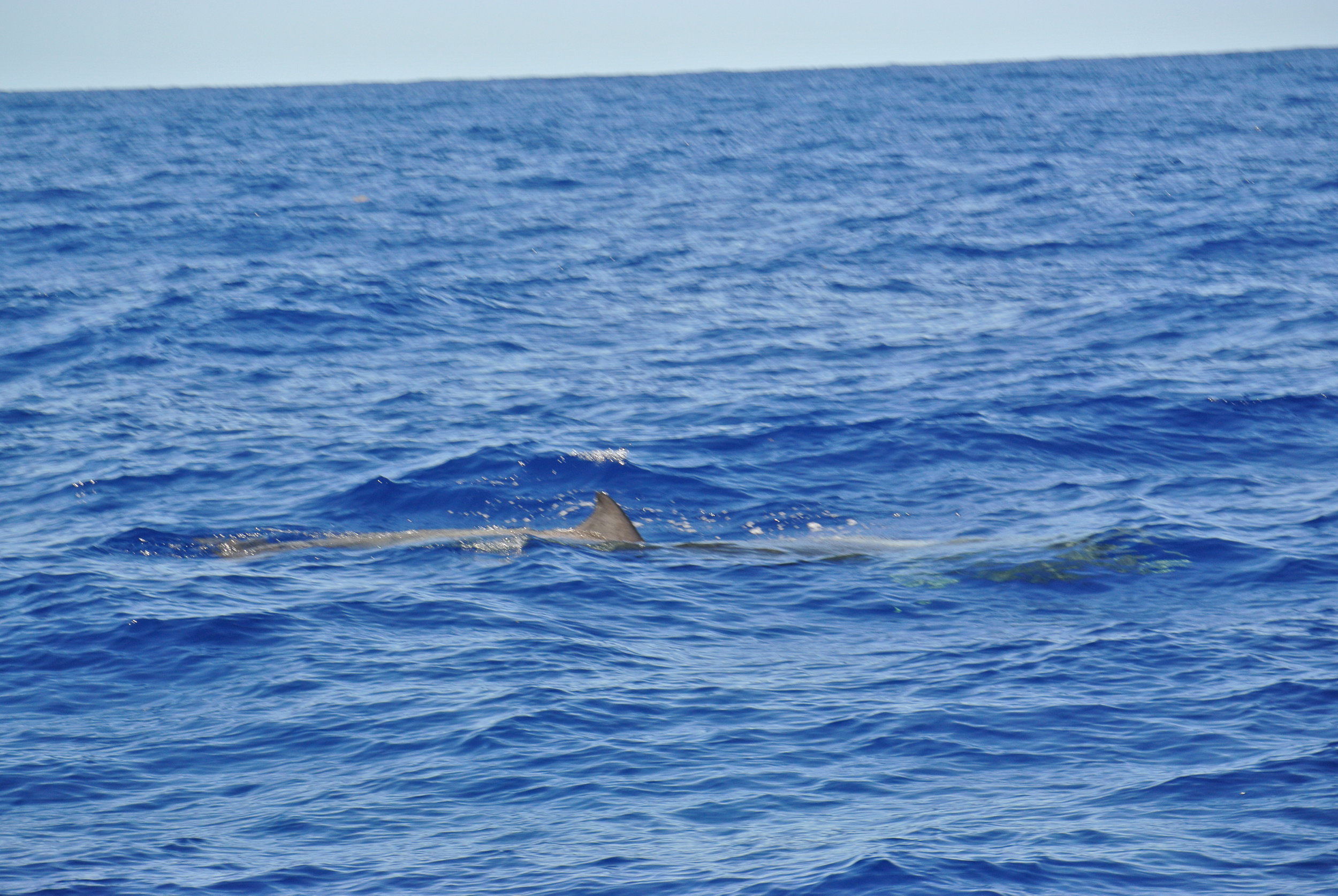
While in the absolute middle of the Atlantic, 1,500 nautical miles from the East Coast of the United States and 1,500 nautical miles from Portugal, we were visited by a whale. 

IMG_2815.JPG

This Northern Bottlenose Whale came by our boat and swam with us for a few minutes. In this realm, we are the visitors in their world. We have left the shore and come into Whale Territory where whales want to come near us to see who is the new visitor in their waters. 

Seeing a whale out here is truely magical. They can see you from far underwater and choose to surface near you, especially the second and third times. This is performed on their terms and should be referred to as Human Watching for the whales. 

Portuguese Man-O-War

These "jelly fish" are both beautiful and terrifying.  Siphonophores Colonial Organism or Complex Organism

While they were thought of as jelly fish for some time, their exact classification has been under serious scrutiny lately. Due to their deep ocean living situation, studying their lifecycle has proven difficult, making it really hard to asses exactly what they are.  

IMG_2807.JPG

Portuguese Man-O-War are named so not because they come from Portugal, but rather because they look like the Man-O-War tall ship that the Portuguese used back in the age of sail. The creature has tentacles like a jellyfish, but instead of a bell filled with fluids it has a balloon. Instead of undulating the bell for locomotion, it raises a sail to the wind. 

IMG_2819.JPG

As if these creatures weren't interesting enough, their very classification as an organism has come into question. Portuguese Man-O-War are Siphonophores, but that is kind of the best we can do when it comes to classifying them. It turns out that the creature is more akin to a colony than a single organism. Each major part of the Man-O-War seems to be its own creature, capable of living on their own without the direct need of the other organisms. At the same time, each organism that makes up the "colony" is so highly specialized that it resembles tissues in different organs, making this a complex organism instead of a colony.   

IMG_2820.JPG

Sadly, this creature is so confusing and interesting that scientists still don't fully know how to classify it. Should it be a colony made up of obligate mutualistic organisms or is it actually a complex organism made up of various organs, and not various organisms? It seems like a simple question to ask and answer, but the various parts of the Man-O-War exhibit both traits and therefore it continues to perplex scientists.

Micro plastic

Maddie took this photo of a Portuguese Man-O-War while we were crossing the Atlantic Ocean. This photo was taken at approximately 35 degrees North and 35 degrees West, so pretty much in the middle of the ocean!

IMG_2811.JPG

We were having a series of becalmed days and the surface of the ocean became smooth as glass. On the surface of the water, we noticed this fine dusting that extended all the way out to the horizon. While this photo is of the Man-O-War, the dusting surrounding it is very evident. 

Sadly, this dusting is not volcanic ash, pollen, or Saharan desert dust, instead it is tiny pieces of plastic that have been broken down into microscopic pieces. Large pieces of plastic that wash out to sea will break down into tiny pieces as the sun beats down on them. A small water bottle can pulverize into enough micro plastic components to cover miles of ocean surface. 

When I lived aboard in Baltimore, Maryland i the Inner Harbor, it would pain me to see plastic trash that was flushed into the harbor from the city. I used to collect the pieces of plastic that were in reach from the pier, but for every piece of plastic I would collect, more than a dozen would wash out into the Chesapeake Bay. 

The bay then drains out into the Atlantic Ocean where the plastic trash gets picked up the ocean currents and swept way out into the ocean. Over the years, the plastic trash will brake down and eventually turn into this micro plastic dust that covers the ocean.  

Sadly, as of yet, there is no clear way to remove all the plastic debris that is floating in the worlds oceans, but hopefully someone far more intelligent than I can become inspired to inventing a solution that will help reverse the terrible things humanity has done to the worlds oceans. 

In the meantime, we can all help to reduce how much plastic makes it out into the ocean. Something as small as not using a plastic bag from the grocery store or drinking out of the cup instead of using a plastic straw. It may seem like a small contribution, but that tiny plastic device that you were about to use once and for a few minutes is the equivalent of miles of ocean surface that is covered with plastic.