Stay Angle to the Mast

Your standing rigging is there to support your mast and hold it up high into the sky. To do this, the stays need to be strong enough to withstand the loads and also setup at the correct angles to properly transmit these loads through the yacht. 

The minimum angle of a stay approaching a spar is 12 degrees. If the stay approaches the spar at an angle less than 12 degrees, the stay will not be able to exert the needed force on the spar to resist movement.  

Lowers are able to travel directly from the chainplate to the spar without any guidance because they approach at a wide angle, greater than 12 degrees. The further up the mast you go, the lower the angle would be and the less effective the stay would act. 

To fight this problem, spreaders are used to hold the stay out, allowing it to rise up vertically and then turn towards the mast, reaching it at an angle of at least 12 degrees. 

This same engineering tacktic can be seen on other areas of boats. Long bowsprits will have "Dolphin Strikers" which are spreaders for the bobstay, as well as spreaders for the whisker stays. These are all there to help achieve the needed minimum angle of 12 degrees of approach between any spar and stay. 

Storm Sailplan

Storm sails are small and very strong sails that are flown in high winds. While the sails themselves are very strong, there is another aspect of the sails that adds to the survival of the storm without damage to the yacht: where the sails fly. 

IMG_2150.PNG

When a mast breaks during a storm, it almost always breaks off at the first spreader. This means that the spar above the spreader will buckle and break, leaving you with a shortened mast and a broken rig.

What you can learn from this disaster is that the section of the spar above the spreaders is not as strong as the section below the spreaders. It is not a matter of strength of the spar being weaker above the spreader as the spar is the same size and strength over its entire length, its a matter of how the rigging is setup. 

The lowers, which attach below the first spreader do not need a spreader to reach the mast at a good angle (minimum angle for the stay to approach the mast is 12 degrees) without any guidance. The run from chainplate to mast is the ideal angle. The run from chainplate to cap shroud is not as lucky, and the angle would be very small. This is why a spreader is needed to hold the stay outboard, so that it can then turn in towards the mast at an angle of no less than 12 degrees. 

The mast is only supported at a few points on a yacht, and these points are the areas where the stays attach. Your first unsupported length is from the deck to the first spreader. The second unsupported length is from the first spreader to the next set of stays. On a single spreader rig, the next supported section is the mast head. On a multiple spreader rig, it is the next spreader. 

The strongest unsupported section of the spar is the first section, from deck to spreader. Therefore, when loads are high and failure occurs, it occurs above this point, causing the mast to buckle at the first spreader. 

So, flying full sail in a storm is not only bad because you are applying too much strain to the sails, rigging, and yacht, but also because you are applying strain in the wrong areas. Full sail means that the mast is being loaded all the way to the top! The loads it will be subjected to are mind boggling! 

Reefing not only reduces the sail area to decrease the force on the yacht, but it also lowers the sail area, concentrating the loads to the first unsupported section of the spar. Storm sails take this one step further and concentrate the loads entirely to the first unsupported section. 

When you setup your trysail, the tack needs to be set so that it is higher than the stack height of the mainsail. This will allow it to flow easily on either tack. While you might feel inclined to simply add a longer tack pennant to clear the mainsail, it is important not to raise the trysail too high. 

The head of the trysail should end up in the area of the first spreaders, that way the loads are concentrated in the first unsupported span. Yes, the loads during a storm will be strong, but the strongest section of the spar is being loaded and the rest of the mast is simply along for the ride. 

Once the winds calm down, you can raise your full sail on your full spar, instead of trying to jury rig something with the stump of your mast that runs up to your first spreaders. 

Relaxing in Paradise

Sailing around on your own personal yacht may seem like the lifestyle of the lazy person who doesn't want to go to work. This couldn't be farther from the truth! 

IMG_2144.JPG

Cruising is a lot of work, and no one is paying you to do it! Yes, you don't have to go to an office every morning, but you do have to do all the work to keep your boat floating. 

While it may sound like you can't escape the working world, being how you simply traded your old job for this job. The biggest difference though is the view!  

How often did you see this in the late afternoon at your old job? 

Cruising will take you to new and exciting places. Places that you chose to go on your schedule and at your own pace. You don't have a boss hanging over your neck, or coworkers creating drama in the workplace. Nope, you just have yourself and your boat, going where you want when you want. 

Dead Bilge Pump

Our shaft sump pump stopped working one day, but never gave us a clue why. Many months went by and we neglected the failed pump, causing it to live submerged in the drippings from our shaft log. The time has finally come to fix the problem and get the pump working again. 

IMG_2136.JPG

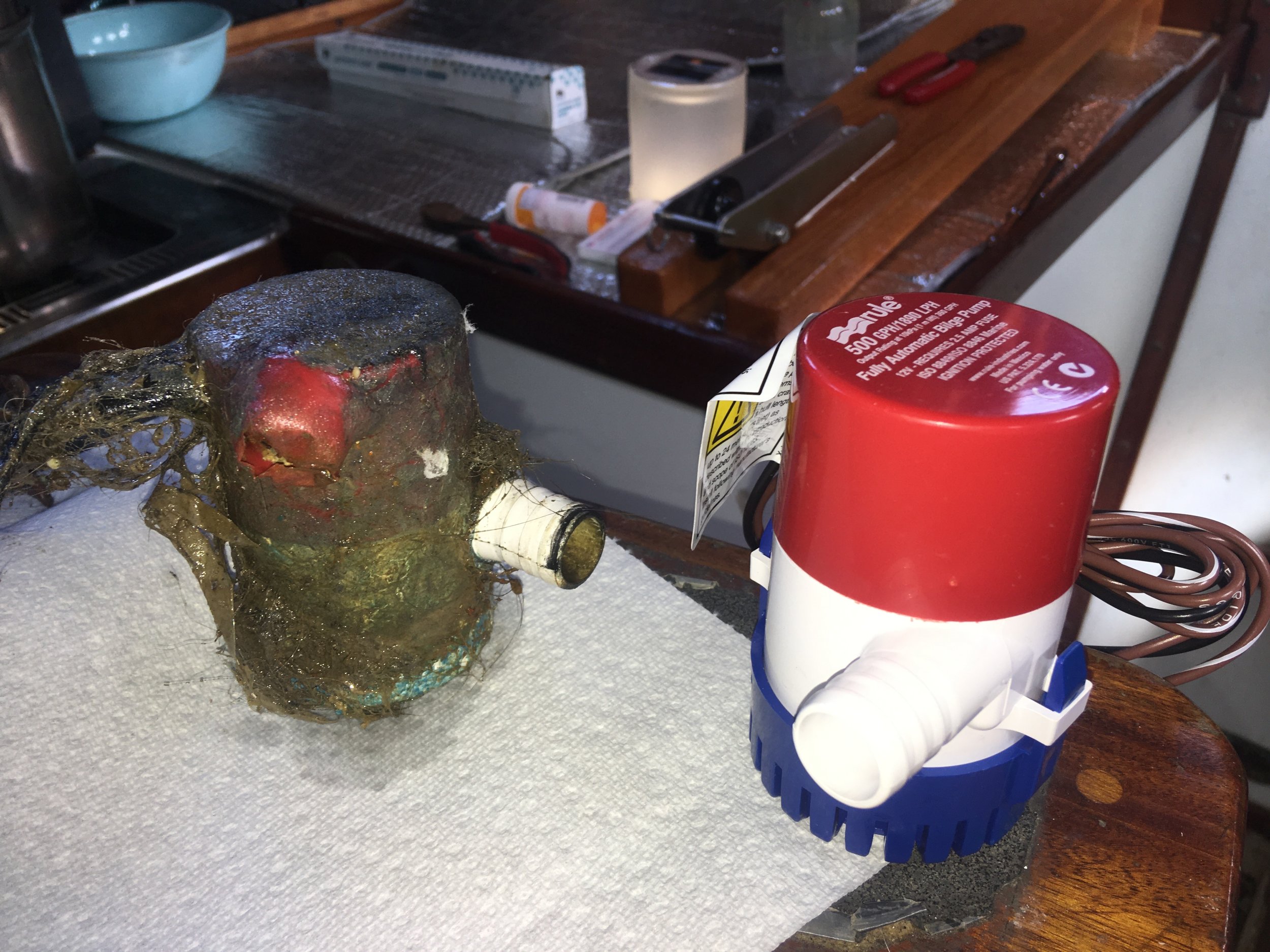
Lovely, isn't it? Hair, sand, and fouling has collected on the surface of the pump, but that didn't lead to its failure. The failure came from that giant bubble on the top of the pump!

IMG_2146.JPG

The pump apparently overheated, causing the plastic to heat up and melt. The plastic then expanded to the point where it became so thin that it burst and water poured into the electric motor inside, killing it instantly! 

IMG_2145.JPG

Comparing the old pump to the replacement, the issue becomes very apparent. The alarming thing is that the breaker never tripped! We could flip the breaker to turn on the pump, and nothing would happen. The pump didn't run and the breaker didn't trip. I just figured that the unit had died and needed to be replaced, but this was not what I had pictured in my head. 

The water that came out of the housing was stained with rust, letting me know that everything inside the pump has died an oxidative death. It was a little concerning that the breaker never tripped even though salt water was poured over all the internal electrical connections, but regardless, the pump has been replaced and the sump can now be emptied once again. 

Self Steering in Action

Our self steering system was designed and built by Scanmar. We have their Monitor Windvane mounted on our stern. The unit is known as a Servo-Pendelum system, where the wind information from the windvane is fed down to the servo-pendulum (rudder paddle in the water) to then use the force of the water passing by to power the wheel and control the boats rudder. 

IMG_2148.PNG

The system works very well and is powerful enough to steer us straight on a course in the worst of weather. The harder it blows, the faster you will go. The faster you move through the water, the more force the paddle has to pull on the control lines of the wheel and turn the rudder. 

While sailing in heavy weather where you are surfing down waves in excess of 8 knots may seem fun, it is in light weather that the unit really proves itself! 

We have found that it works well when we are sailing along at around 4 knots, and well enough to keep us on course all the way down to 2 knots. When we are sailing slowly, there is less wind and we don't move very fast; meaning that the paddle has less umpf to pull on the wheel, but at the same time, a well balanced boat will sail straight in these conditions regardless. 

We absolutely love our Monitor Windvane, and greatly enjoy watching the paddle snake its way through the water behind us as we manage to sail straight on our course!