
Climbing Your Mast on a Wire Halyard

First off, I want to emphasize that you should never climb a mast with a wire halyard, or a wire-rope spliced halyard. 

Now, if you have a wire halyard and you need to go up, then you need to make due with what you have! 

If your halyard isn't long enough to reach your harness, now you need to attach a length of line between the end of the halyard and your harness, that way when you are finished, you will end up on the deck and not suspended a few feet above the deck when you are tired and want to get out of the harness! 

Wire is dangerous to tie knots in because it is both slippery and brittle. If you bend it too tightly, it will crimp and kink, damaging and weakening the wire strands and leading to its eventual breakage. Keeping bends open will also make it easier for the knot to slip and come untied. Thus you encounter the dilemma of tying a knot in wire and rope! 
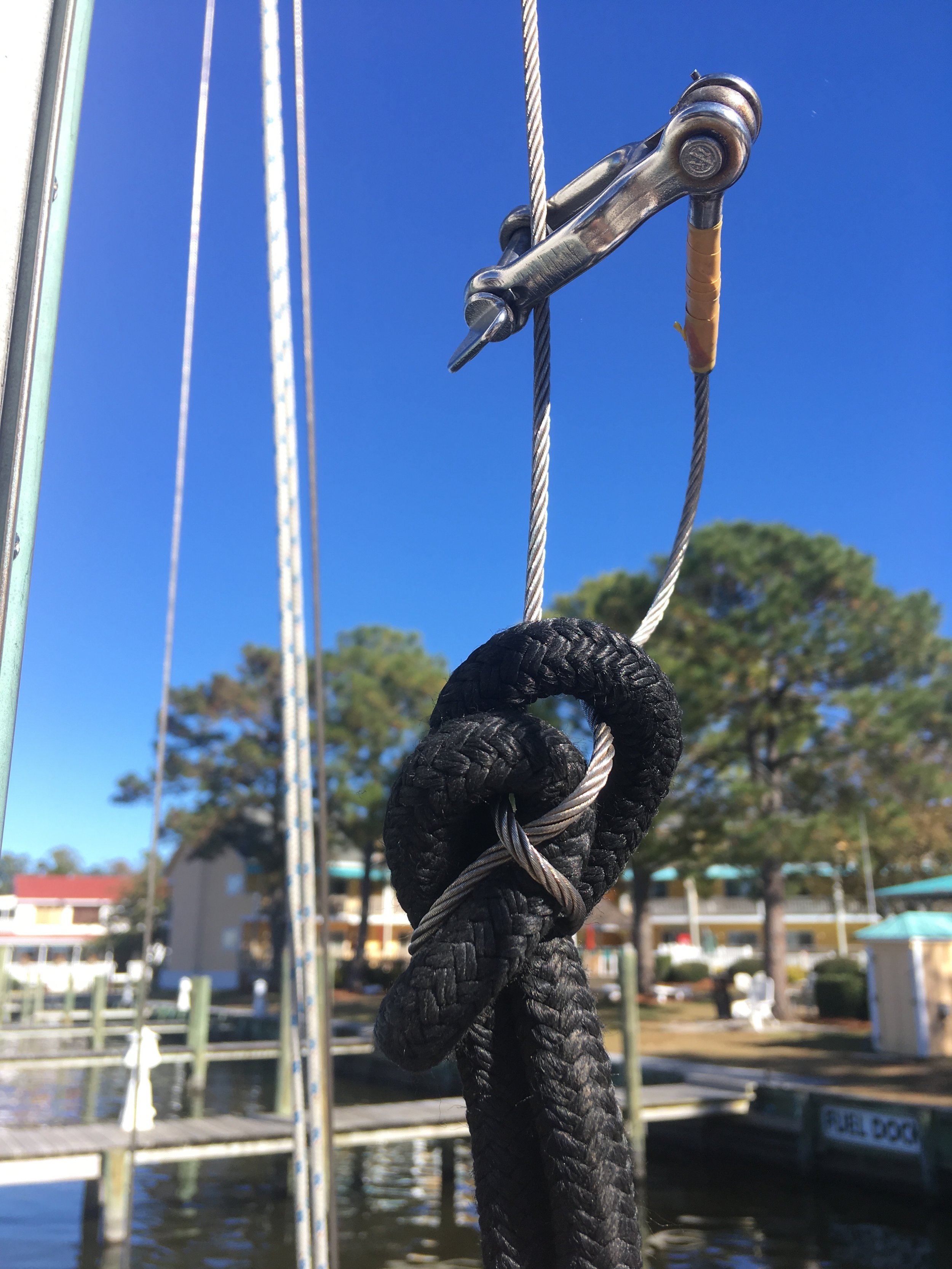
IMG_1874.JPG

While helping out a cruiser climb her mast, I tied this knot between the two materials to allow her to hang safely from her wire halyard. The knot is a combination of a sheet bend and a figure eight in a bight. An important thing to do with this knot is to certainly secure the bitter ends. I attached the shackle of the wire onto itself and the bight of the rope had the tail passing through it. These added features are merely present so that if the knot were to slip, it would slid onto the attached bitter end and stop moving from there. 

Naturally, since this knot is new to me and created on the fly out of necessity, our cruiser friend who was in the harness and at deck level was encourage to drop from her feet to a seated position to test the knot and verify that there is no slippage or other concerns that might occur while she was aloft. 

While creating a new knot, be sure to test it at its desired function, and incorporate some method that will facilitate ease of untying after the knots intended purpose has been completed. 

The Importance of Weather Helm

Weather helm might feel like a constant force that you battle against as you sail across the water on a reach, but this constant nuisance is actually intentionally placed there by your yacht designer. 

Imagine a perfectly balanced yacht, with the sails set perfectly balanced and the rudder straight. The captain can lock the helm and relax as she steers herself through the waves. Now imagine that this captain slips and falls overboard with his perfectly balanced sails and rudder straight! He will float in the water as he watches his yacht and salvation sail off into the distance at hull speed! At this point, he is in incredible danger of drowning as no one knows he has fallen and is not coming to his rescue!  His best hope of salvation is speeding away at a pace he can never match through the water.

Now imagine the same scenario with a yacht that has a bit of weather helm (not too much, but just a bit). The sails are not balanced, so he must hold the helm to keep the rudder just a bit to leeward. When he falls overboard, the force on the rudder will push the rudder straight, no longer fighting the weather helm and the yacht will then turn upwind. With no one at the helm to keep the course, the yacht will point up into the wind and stall, coming to a stop or even tacking over and heaving to. This means that the yacht will come to a stop and the wet captain will be able to swim over to his yacht and  climb aboard; saving his life and getting him home again to tell the tale!

While excessive weather helm is a nuisance and a problem, a little bit of weather helm is a great safety feature that should be praised instead of cursed! 

Weather Helm and Genoas

The concept of sail balance is pretty easy to grasp. Powering up the headsails will produce lee helm as it moves the Center of Effort (CE) forward. Powering up the mainsail will produce weather helm as it moves the CE aft. When the forces of the main and headsails equal each other, the CE will align with the Center of Lateral Resistance (CLR) and will sail straight.  

If you suffer from weather helm, all you need to do is add more headsail area and/or reduce mainsail area, as this will move the CE forward and reduce the weather helm felt by the captain. A genoa is a massive headsail which should give you plenty of leeward force and help balance out the yacht, but this may not be the case. 

As you sail and feel weather helm, you might try reefing the main and letting out more of the genoa from the roller furler. Somehow, nothing seems to have changed! The weather helm is still present. Letting out more genoa doesn't seem to help any more either, as the problem continues to exist! 

Why would such a large headsail fail to balance out the sailplan? The answer is simple: a genoa is a jib that extends beyond the headsail triangle and continues aft of the mast. While the headsail is set forward of the mast, the portion that exists aft of the mast will move the CE aft. The larger the genoa, the more this effect increases.  

This is why you will see people beating to windward under genoa alone, with no mainsail, and they will be sailing along at a good pace! The large headsail, especially with genoas that are 150% or larger, will create enough weather helm by themselves that they are able to power your yacht to weather. Adding a mainsail to the combination only exasperates the situation, adding even more CE aft which will create even more weather helm. 

If you have a genoa and find your self struggling with weather helm, consider roller reefing your genoa before you try to reef your mainsail. Reefing your genoa will actually move the sail area forward and also move your CE forward which will help reduce weather helm and balance your sails. 

What is Sail Balance

A perfectly balanced yacht is a dream that most long for. The thought of setting the sails with the rudder straight and locking the helm as the yacht sails herself through the seas towards their intended destination.

Then reality comes when you set the sails and find that it keeps turning to windward and you end up dragging the rudder to leeward as you fight the forces and try to keep on course. If the winds build up too much, you will soon feel overpowered as your arms turn into spaghetti noodles with exhaustion and your yacht rounds up into the wind. 

The fight is over, and the forces of wind and balance have won! But why does this happen? 

Weather helm is caused by two forces: wind force and hydrodynamic force. The wind forces on the sails add up into what is referred to as the "Center of Effort" which is none other than the geometric center of each sail, and then the combination of each sails Center of Effort (also referred to as CE) to give you the yachts CE. 

The hydrodynamic forces are the same concept, being the geometric center of the underwater profile when viewed as a silhouette. This is called the "Center of Lateral Resistance" and is also referred to as the CLR. 

CE can be moved around by changing the sails that are flying and adjusting the trim of the sails, but CLR does not change.

Basically, you have two variables that control balance, one is fixed, the other is in your hands to control!  

If the CE is aft of the CLR, the yacht will want to turn to windward. This is the case if too much sail is being flown aft and not enough sail is being flown forward. 

If the CE is forward of the CLR, the opposite will occur and the yacht will want to turn downwind. This is the case when flying a giant spinnaker, as the large sail area forward will pull the yacht downwind and will not allow the yacht to travel upwind. 

Balance occurs when the CE and CLR are in the same position fore-aft. When this occurs, the yacht will sail straight with no desire to turn, requiring no input from the rudder to keep it on track. 

Meeting DinghyDreams

While in Oriental, NC, we met Emily who was solo cruising on an Ariel 26. Now, Emily was different from other cruisers we have met so far for a few reasons: ​

1. She is a solo female cruiser.​

2. She does her own repair work.​

The first point really stood out to Maddie and me. There seems to be a typical group of people who are cruising, and they fall neatly into a few categories. You have the retired couple who worked their whole life with the dream of cruising and is now doing it in retirement, and then you have the younger crowd that seems to be dominated by men. ​

The younger crowd seems to made up of guys in their early 20s who want to go explore the world and find themselves! They gather up what they can and set out on a boat around 30 feet in length or less and head off cruising. They will work their way along as they travel and see the world from a perspective that most only dream of!

Some of these young men are accompanied by a wife or girl friend, but if they are alone, they are all male. Emily breaks this stereotype by being a solo female cruiser. I am not saying that women can't or shouldn't, (in fact I think everyone should!)​ but just that you rarely encounter this situation.

IMG_1875.JPG

To make it even more unique, Emily does her own repair work. She knows the setup of her boat and everything that makes it tick! If something starts to fail, she knows what the problem is and how to fix it; then when she makes her next port, she fixes it herself!​

Emily maintains a blog as well and I highly encourage you to check it out! ​

Http://www.dinghydreams.com​

She is currently heading south towards warmer waters (we all are this time of year) where she will continue to replace her aged standing rigging as she works along the way.​

Cruising is an amazing vantage point on the world, and it shouldn't be limited to just crazy young guys and elderly retired couples. Everyone who dreams of sailing off into the distance to see what's out there should certainly give it a go! If you have trouble along the way, there will always be other friendly cruisers around who will be there to lend a hand.​

Fair winds Emily!​