Snubber

All chain anchor rode has the advantage over rope in that the chain is heavy and produces a more pronounced catenary curve. This curve will allow your anchor rode to pull horizontally on the anchor, which will allow it to hold well, as opposed to a slight upward pull, which would cause it to drag. The problem with all chain rodes is that the chain offers no elasticity. If your yacht is lurched back, the curve will straighten out and snap on the chain with a considerable shock load as the yacht pulls the chain tight and then ends in an inelastic lurch. To avoid this minor issue, it is best to use a snubber made out of a very stretchy material, such as 3-Lay nylon rope. 
IMG_1739.JPG

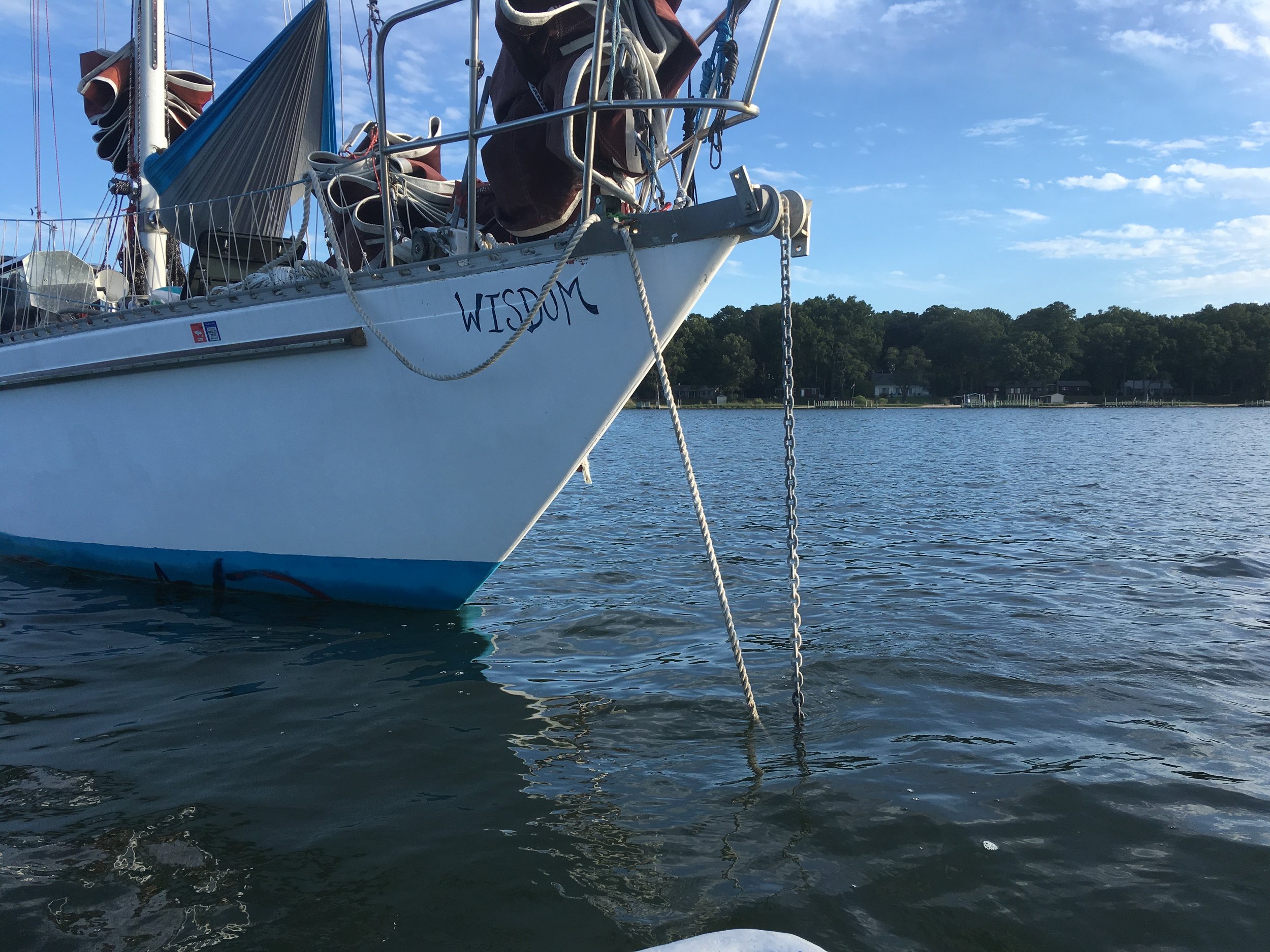
A snubber is merely a piece of line that is tied off to the chain and to a cleat on the bow. It can either come off the bow through the roller or through a rope chock on the side of the bow. Either way, it will remove the last bit of shock that could be present if the chain were to be pulled tight. 

Setting up a snubber is very easy. Once the anchor is set properly, simply tie the end of the snubber to the chain with a secure knot, then let out more chain until the chain hangs straight down from the bow and the snubber has taken up the full load. 

IMG_1755.JPG

A common knot used to tie a snubber is a Rolling Hitch, but I personally use a Magnus Hitch. Both knots will hold onto chain very well, I just find that the Magnus Hitch is much easier to untie after it has been loaded and stressed. 

IMG_1741.JPG

You can see how the snubber is transmitting the load from the bow to the chain, and the chain that lies between the boat and snubber hangs slack off to the side.  

When I will be anchoring for a long time, or during a storm, I will also add two Half Hitches to the knot, that way the snubber has even less chance of coming untied in a desperate situation. 

Snubbers are easy to setup and offer a lot of security and comfort to an anchored yacht. They only take a few minutes to setup and will give you peace of mind for the entire time you are at anchor. 

Anchor Lights

The requirement for an anchor light for most pleasure boats is 360 degree visibility for 2 nautical miles. This means that the anchor light must be located above everything else that way it can be seen from any direction. 

On a power boat, the anchor light is typically located at a reasonable height, just above the flying bridge. On a sailboat, this location is elevated significantly, as they are placed on top of the mast. 

FullSizeRender.jpg

Yes, the anchor light is very visible from a distance, alerting others of your presence and preventing a needless collision, but only at a distance. When we have anchored in busy anchorages, where there seems to be a lot of boat traffic as the sun is setting, we notice that people have been skirting past us at a rediculously close range. 

This made me wonder, do they see the anchor light way up high in the night sky? Or is it out of their field of view? 

The other problem with a single white anchor light is it does nothing to demarcate where we start and where we end. Ideally, other boats would keep a safe and reasonable distance from us, thus nullifying any fears or concerns of a close passing vessel, but they do not seem to care in the same way. They will pass less than 10 feet from our bow or stern, missing us only by luck! 

FullSizeRender.jpg

Before our luck runs out, we have made some alterations to our setup. We hung a solar powered lamp off the stern and off the bow. When we are anchored in a high traffic area, we can simply turn them on at the times of peak traffic (usually when small skiffs are returning home after the sun has set) so that these inconsiderate boaters can better see where we start and where we end.

I can not say for sure if this has worked becuase I do not know what is going through the mind of someone who flies through an anchorage at full throttle in the dark, but I can say that since we have started setting these lights, there has been a much greater distance granted between us and the speedy passerby. 

Ideal Sailing Conditions

When people dream about sailing, they often picture a steady breeze and full sails set as they power through the seas. In a dream world, this may be fine, but in our world, ideal sailing conditions refer to winds that allow us to get to where we want to go as quickly and comfortably as possible. 

We have found that when we are full sail, the winds are actually a bit on the light side and we aren't going as fast as we could be if we had more wind. 

IMG_1699.JPG

To us, ideal sailing conditions often involve a reefed sail plan. If we are reefed, we always have more sail available to us than what we are using. This means that if we feel the desire to go faster, all we need to do is set more sail! If you are full sail, then you have no recourse left, you are already at your maximum and have nowhere to go from there! 

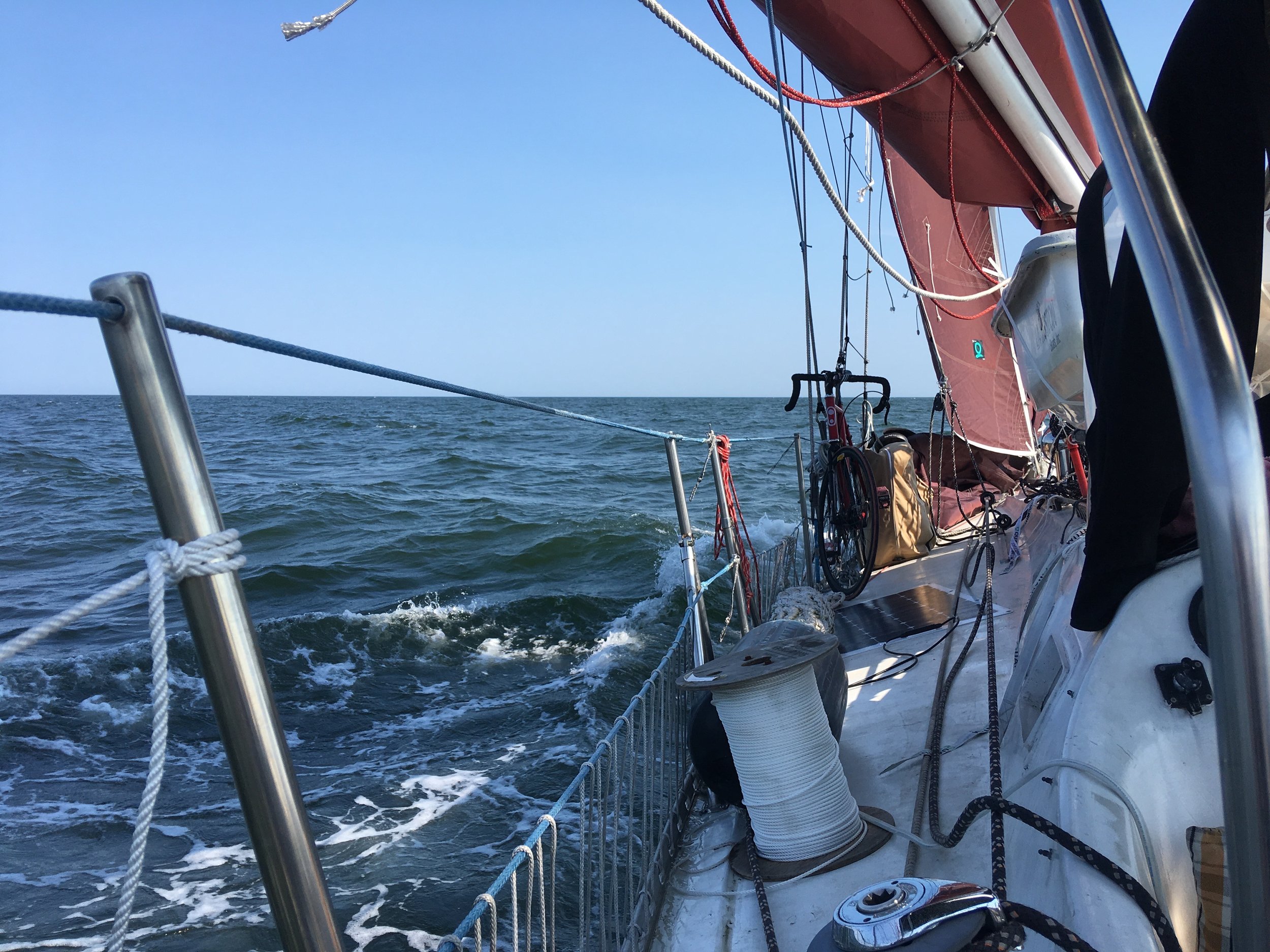
In this situation, we were close reaching under our staysail and our mainsail with one reef in it. We were still able to achieve 5.5 knots with ease without heeling over much at all. This keeps the boat level and life aboard more comfortable as we don't have to worry about stuff sliding off of horizontal surfaces in the cabin.  

The only way this could have been more ideal is if we had been on a broad reach, there the seas come from behind and help push you along, instead of beating into them as you work to windward. 

All in all, when there is plenty of wind, you can reef down for comfort and still maintain your boat speed through the water. This will keep you moving fast, morale high, and dream sailing a reality! 

Stowaway

A rather common sight to see while out far from land are small land birds that have been swept out to sea. These small birds had no intention of going out to sea, as they are not suited to survive over water, but by an ill fated gust, they have now found themselves over open waters. 

IMG_1731.JPG

These little birds will descend upon a sailboat as you are the only place for them to land and rest their tired wings.  Most of the birds that land aboard are quite grateful to have found you, as you are their only hope in survival, but they will still keep their distance from you. It is nice to offer them some water to drink by setting water in a small bowl and placing it somewhere far from you so the bird can drink and rest in peace.

This tiny little bird was actually very gregarious, he rested for a little while and then sprang to life with a full fury of energy! We had recently been bequeathed with a large gift of flies that had descended upon us earlier and this little bird landed in heaven. He would hop around the cockpit, hunting the flies! There were so many of them that he had an easy time about catching them. What was more humorous to us was that he seemed unfazed by our presence. He would climb all over us, hopping along on his little feet, as he stalked and ate the flies that were swarming around us. 

This little stowaway stayed with us for several hours, hunting most of the flies that had plagued us, until we passed by a light house and he took flight for the distance. Most birds will stay onboard until we get very close to land, but this little adventurous fellow was not waiting around for us to make landfall! 

How to Tell When You Are in the Gulf Stream

When the winds are blowing out of the North, against the direction of the flow of the Gulf Stream, it is very easy to tell when you have reached its magical waters. The waves will build high and break in steep fashion and the crossing will be miserable! 

If the winds are blowing from the South, with the direction of the flow of the Gulf Stream, it will be much less noticeable. When the wind and current is going in the same direction, the Gulf Stream can be rather hard to denote.  

One of the biggest ways to tell that you are in its waters is your position will not match up with your dead reconing because the current will cause you to drift north as you move east. On a GPS display, you will note a deviation between the heading of the yacht and your course over ground. As you are pointing East, yet moving slightly North-East. 

This is all well and fine, but it takes navigational equipment to identify the stream. What about a method that may seem out of place on a cruising yacht? What about water temperature? 

The waters along the east coast of the United States will usually be in the range of 60F to 75F. The Gulf Stream on the other hand will typically be well above 80F. By measuring the water temperature, you can easily discern when you have actually entered the stream and also tell when you have exited the other side of the stream.  

Having a salt water plumbing setup makes this job much easier, as you can simply fill a glass with sea water in the galley and let the thermometer do its thing! If you do not have the luxury of salt water plumbing, you could also pull up a bucket of sea water every now and again to measure the temperature of the water you are passing through. 

I would caution against towing a thermometer behind you for a few reasons. First, a fish might find it to be an intriguing morsel and it might get bitten off its tow line. Second, the tow line could also break. Both of these scenarios involve you losing your thermometer, in which case you would no longer be able to accurately measure the water temperature. The other problem with losing your thermometer is they tend to contain plastic components which would break down and add to the already significant plastic pollution problem in the oceans. 

For these reasons, I would highly recommend that you pull sea water into your boat and measure the water temperature in the safety and security of your yacht. 

The Gulf Stream can be a tame river in the ocean that you innocuously pass over or a nightmare, all depending on the winds and how they interact with the current. Be sure to cross the Gulf Stream only when the wind is blowing with the current. Otherwise, as others have told me "Add 20 knots to whatever the forecasted wind speed is, that's what it will be like out there."