
Ideal Sailing Conditions

When people dream about sailing, they often picture a steady breeze and full sails set as they power through the seas. In a dream world, this may be fine, but in our world, ideal sailing conditions refer to winds that allow us to get to where we want to go as quickly and comfortably as possible. 

We have found that when we are full sail, the winds are actually a bit on the light side and we aren't going as fast as we could be if we had more wind. 
IMG_1699.JPG

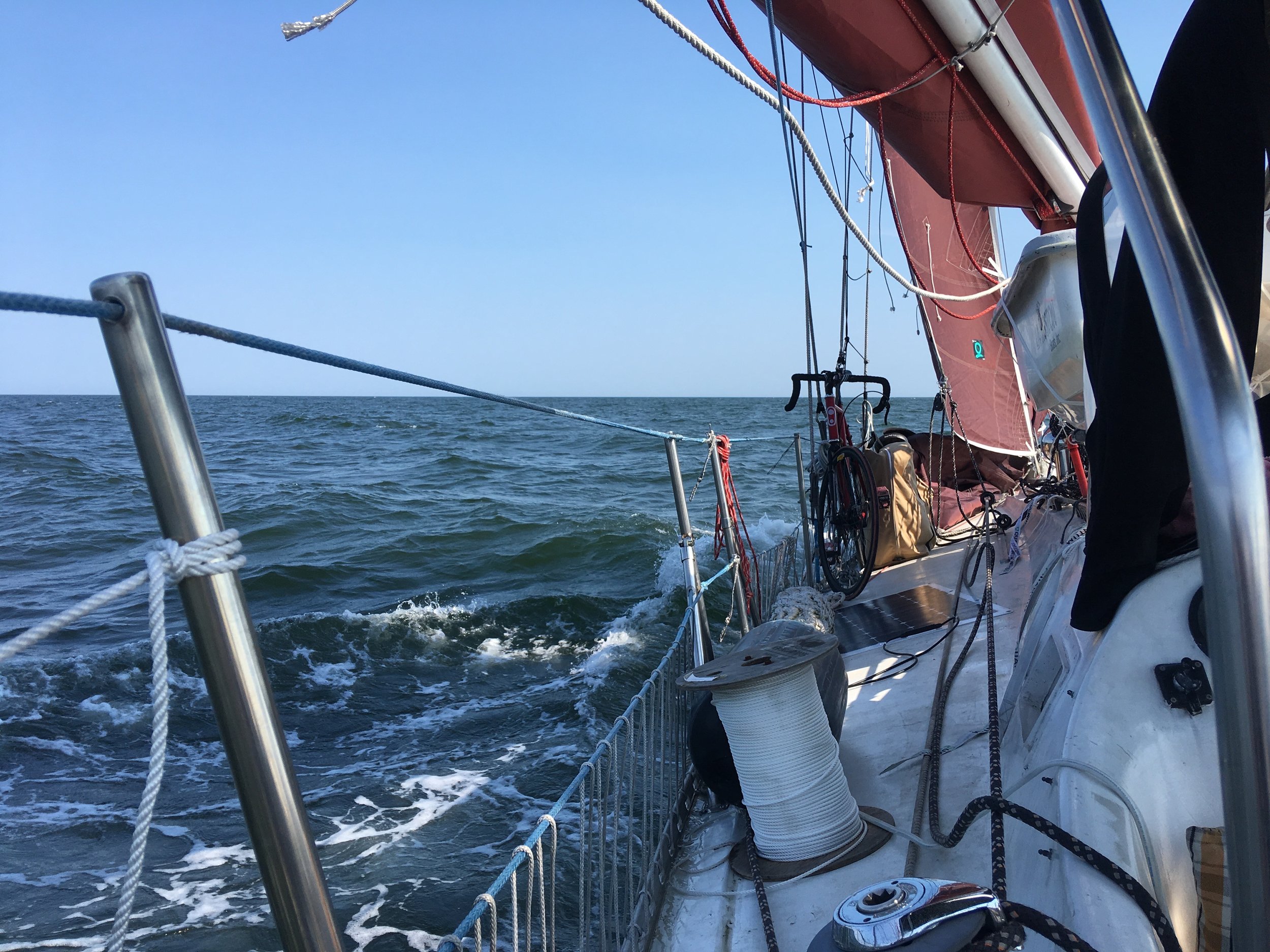
To us, ideal sailing conditions often involve a reefed sail plan. If we are reefed, we always have more sail available to us than what we are using. This means that if we feel the desire to go faster, all we need to do is set more sail! If you are full sail, then you have no recourse left, you are already at your maximum and have nowhere to go from there! 

In this situation, we were close reaching under our staysail and our mainsail with one reef in it. We were still able to achieve 5.5 knots with ease without heeling over much at all. This keeps the boat level and life aboard more comfortable as we don't have to worry about stuff sliding off of horizontal surfaces in the cabin.  

The only way this could have been more ideal is if we had been on a broad reach, there the seas come from behind and help push you along, instead of beating into them as you work to windward. 

All in all, when there is plenty of wind, you can reef down for comfort and still maintain your boat speed through the water. This will keep you moving fast, morale high, and dream sailing a reality! 

Stowaway

A rather common sight to see while out far from land are small land birds that have been swept out to sea. These small birds had no intention of going out to sea, as they are not suited to survive over water, but by an ill fated gust, they have now found themselves over open waters. 

IMG_1731.JPG

These little birds will descend upon a sailboat as you are the only place for them to land and rest their tired wings.  Most of the birds that land aboard are quite grateful to have found you, as you are their only hope in survival, but they will still keep their distance from you. It is nice to offer them some water to drink by setting water in a small bowl and placing it somewhere far from you so the bird can drink and rest in peace.

This tiny little bird was actually very gregarious, he rested for a little while and then sprang to life with a full fury of energy! We had recently been bequeathed with a large gift of flies that had descended upon us earlier and this little bird landed in heaven. He would hop around the cockpit, hunting the flies! There were so many of them that he had an easy time about catching them. What was more humorous to us was that he seemed unfazed by our presence. He would climb all over us, hopping along on his little feet, as he stalked and ate the flies that were swarming around us. 

This little stowaway stayed with us for several hours, hunting most of the flies that had plagued us, until we passed by a light house and he took flight for the distance. Most birds will stay onboard until we get very close to land, but this little adventurous fellow was not waiting around for us to make landfall! 

How to Tell When You Are in the Gulf Stream

When the winds are blowing out of the North, against the direction of the flow of the Gulf Stream, it is very easy to tell when you have reached its magical waters. The waves will build high and break in steep fashion and the crossing will be miserable! 

If the winds are blowing from the South, with the direction of the flow of the Gulf Stream, it will be much less noticeable. When the wind and current is going in the same direction, the Gulf Stream can be rather hard to denote.  

One of the biggest ways to tell that you are in its waters is your position will not match up with your dead reconing because the current will cause you to drift north as you move east. On a GPS display, you will note a deviation between the heading of the yacht and your course over ground. As you are pointing East, yet moving slightly North-East. 

This is all well and fine, but it takes navigational equipment to identify the stream. What about a method that may seem out of place on a cruising yacht? What about water temperature? 

The waters along the east coast of the United States will usually be in the range of 60F to 75F. The Gulf Stream on the other hand will typically be well above 80F. By measuring the water temperature, you can easily discern when you have actually entered the stream and also tell when you have exited the other side of the stream.  

Having a salt water plumbing setup makes this job much easier, as you can simply fill a glass with sea water in the galley and let the thermometer do its thing! If you do not have the luxury of salt water plumbing, you could also pull up a bucket of sea water every now and again to measure the temperature of the water you are passing through. 

I would caution against towing a thermometer behind you for a few reasons. First, a fish might find it to be an intriguing morsel and it might get bitten off its tow line. Second, the tow line could also break. Both of these scenarios involve you losing your thermometer, in which case you would no longer be able to accurately measure the water temperature. The other problem with losing your thermometer is they tend to contain plastic components which would break down and add to the already significant plastic pollution problem in the oceans. 

For these reasons, I would highly recommend that you pull sea water into your boat and measure the water temperature in the safety and security of your yacht. 

The Gulf Stream can be a tame river in the ocean that you innocuously pass over or a nightmare, all depending on the winds and how they interact with the current. Be sure to cross the Gulf Stream only when the wind is blowing with the current. Otherwise, as others have told me "Add 20 knots to whatever the forecasted wind speed is, that's what it will be like out there." 

Gulf Stream

The Gulf Stream is a massive current that passes up the East Coast of the United States. This meandering highway in the ocean has two definite areas that it will always pass by, the Straights of Florida and the Cape Hatteras. Everywhere else, the stream moves around on a daily basis.  

There are horrible stories about hellish Gulf Stream crossings where the winds and seas build quickly, making the crossing a horrible endevour. Other times, people state that they crossed the Gulf Stream without even noticing its presence. 

The trick to the Gulf Stream is to only cross it if the winds are flowing with the current. The current tends to run at around 3 knots from the South. If the winds are from the North, the winds and current will clash and form very steep and hellish seas. If the winds are from the South, along with the current, then the passage will be most mundane.  

As you approach the Gulf Stream, the west wall will be your greatest challenge. If you are able to get over this hump in the ocean with favorable winds, you will simply be carried along by the current as you make your way to the other side. This will make for a very uneventful journey and a calm crossing. If the winds are blowing from the North, it would behoove you to heave to and wait for the winds to change, as jumping into the Gulf Stream at this time would be a huge mistake. 

Making Your Own Ice

Ice can be purchased, but what if you can't afford it, or if you find yourself far from civilization? If you have mechanical refrigeration, you can simply make your own ice! 

While working on the hard in the beginning of our cruise, we met some other cruisers who seemed to have mastered the art of ice! They let me in on a few tricks that they have found to make ice living very easy. 

During the day, when the sun is shining and the solar panels are producing, they run their refrigerator. In the freezer compartment, they keep several water bottles, which are not for drinking, but instead for keeping their food. 

When the fridge is running, these water bottles will freeze! At night when the sun disappears behind the horizon, they turn off their fridge to save their batteries the abuse of keeping the food cold over night. By this time, all those water bottles have frozen solid and are now ready to do some work. With the fridge off, these frozen water bottles will become their ice source, and that keeps their meats frozen and cold as well. Over night, the water bottles might melt a bit, but the water is kept in place by the plastic bottle and when the sun rises, the entire process repeats itself!

We keep two 500mL bottles in our freezer for this purpose, but have also take it one step further.  

When we are tied up in a marina and connected to shore power, we no longer have to worry about solar panel production. We can run our fridge full blast day and night! Instead of freezing water bottles, we switch over to gallon ziplock bags filled with water. We fill them pretty full, but still able to keep thin and stack them in our freezer in pairs. As the time passes, these bags of water will freeze into blocks of ice that can be used to keep our food cold when we are no longer plugged in. 

The blocks of ice offer us a few options. We could either peel off the plastic and throw them into the bottom with the other blocks of ice, or keep them in their plastic and place them in our other fridge compartment that does not have a drain. As the ice melts, it would simply remain in the bag and not cause any problems of water needing to be removed from the bottom of the fridge. 

The other advantage of making your own ice while tied up in a marina is it saves you the cost of buying said ice. A 10 pound block of ice can cost around $4 in the Chesapeake, and that is saying that you can even find a place that sells it. When you are tied up, you are already paying for the water and the electricity, so why not use your time there to save you some money and create your own ice?