Air Conditioner Water System Primer

When a debris clogs the through hull fitting to the air conditioner, you need to call a diver to swim under the boat and clear the debris or pull the hose and push the debris clear with a stick. Both of these options are either time consuming or costly. 

When an air lock forms in line and the water pump stops flowing water, the hoses need to be disconnected and bled. Bleeding the lines is necessary to remove any air bubbles from the system so the pump can continue flowing water to the air conditioner. This is a very wet and messy job. 

All of these issues can be easily overcome with a simple hose and valve added to the system.

Simply connect a hose from the pressurized fresh water side to the intake hose between the strainer and the sea cock.

If you get a bag or other debris covering the through hull fitting, opening the valve will flush water out the through hull and can clear lightly obstructing debris quickly and easily. There is no need to get a diver to pull a small bag from the hole or the hassle of poking a stick through a gushing sea cock. Simply open the valve, wait a few moments, then close it again!

My through hull is rather low, so I don't typically suck up the bags floating along the surface, but I do get air in the line every time I go sailing. If you heel over far enough, the through hull will come out of the water; and if the sea cock is open, it will drain the whole system out. When you get back to port and plug the boat in, the A/C will not be pumping due to the trapped air.

This is where this system shines! Open the valve and let the water pump prime the system for you. I like to close the sea cock that way all the water is running through the pump. I recommend checking the discharge through hull to make sure that a steady stream of water is coming out. If you have a bunch of bubbles coming out, wait until the stream clears up. 

Once the flow is continuous, open the sea cock and let the pump flush any air that could exist between the T connection and sea cock. Now the system is fully primed and ready to be turned on. 

I like to listen to the pump when it first turns on to listen to air noise. If there is a bubble in the impeller, it will make a rather loud rattle sound. If it's a small bubble, it will sound like sand falling on concrete. If it's completely quiet, the system is perfectly primed and no air exists in the line.

If I hear the rattle, I will open the fresh water valve again to further flush the system until the rattle fades away. If I hear the falling sand sound, I will let it be. You can waste a lot of water to perfectly bleed the system when it will work just fine with a small bubble present in the pump. 

As you can see, this system greatly relies on the fresh water pump to provide the necessary pressure to prime the system. I have a 2 gallon per minute pump flowing at 25PSI to feed a 500 gpm air conditioner pump. A larger water pump would make the priming job easier, but I like to conserve as much water as possible on a daily basis by using a small water pump.

Storing Tools

They say cruising is simply working on your boat in remote locations. Remote locations go hand in hand with no access to hardware stores, but how are you supposed to work on your boat without tools? Tools are heavy and take up space, but you need to keep them on board with you while cruising. 

Ideally, you want to keep your tools low in the hull and in a dry space. Finding this space can be a challenge on a sailboat.

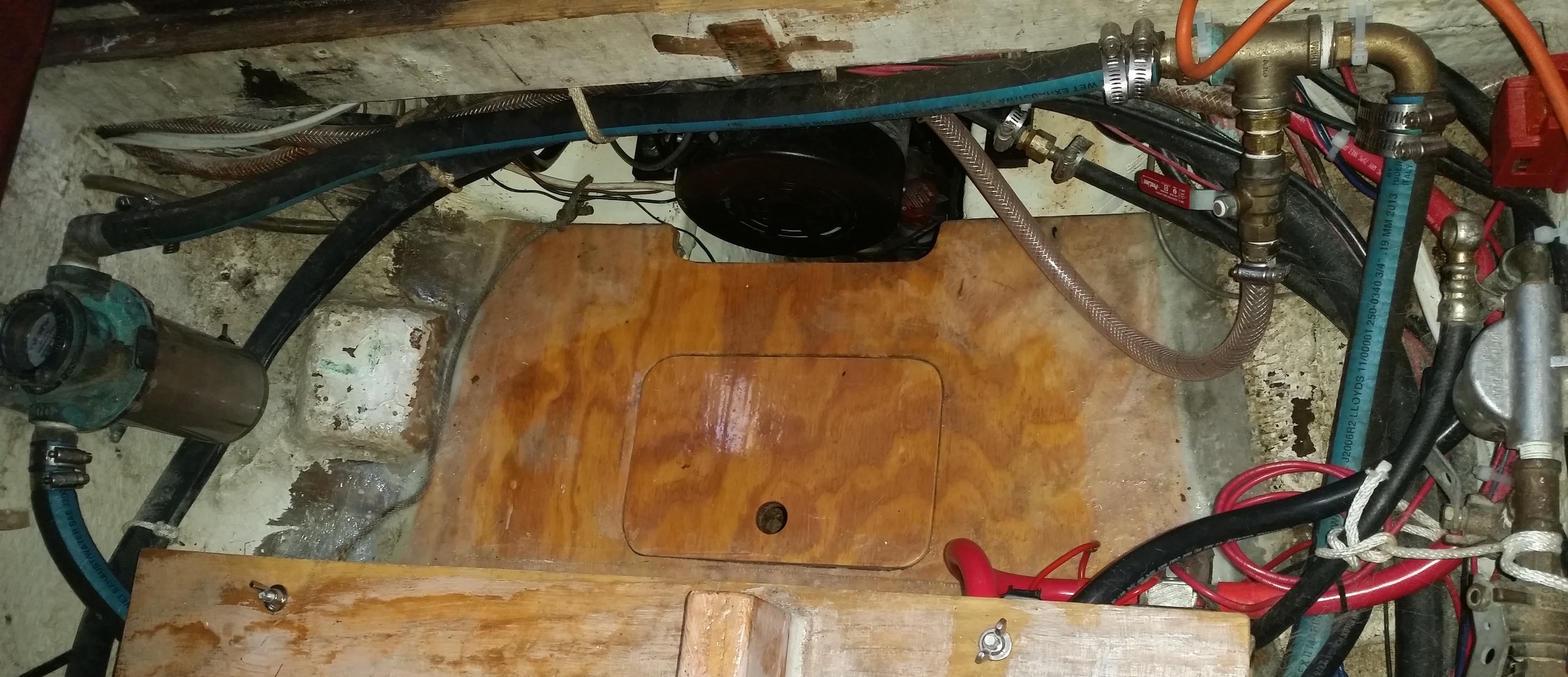
Most of the tools on board Wisdom are kept in this plastic tool box from Craftman. I do keep a set of pliers, phillips, and blade screw driver in a tupperware for easier access. The rest of the tools live in this box mounted below the floor boards. This keeps the weight low in the hull and centrally located to avoid inducing a list. 

This space used to be consumed by the old diesel engine. Now it is a battery box and storage. The front of the electric motor can be seen poking its face from under the sole bearer. 

20160103_134506.jpg

We took advantage of all the freed up space when we switched from the large diesel motor to the compact electric motor and made a dedicated space under the floor boards to safely hold the tool box in place. 

While this tool storage space is low and centerline, it is not completely dry. The tools can form slight rust and need to be oiled frequently, even though the bilge is bone dry. Simply exposing the tools to the marine environment will lead to their eventual degradation. This is another example of making the best out of what is available on a sailboat.

Items to Carry in a Row Boat

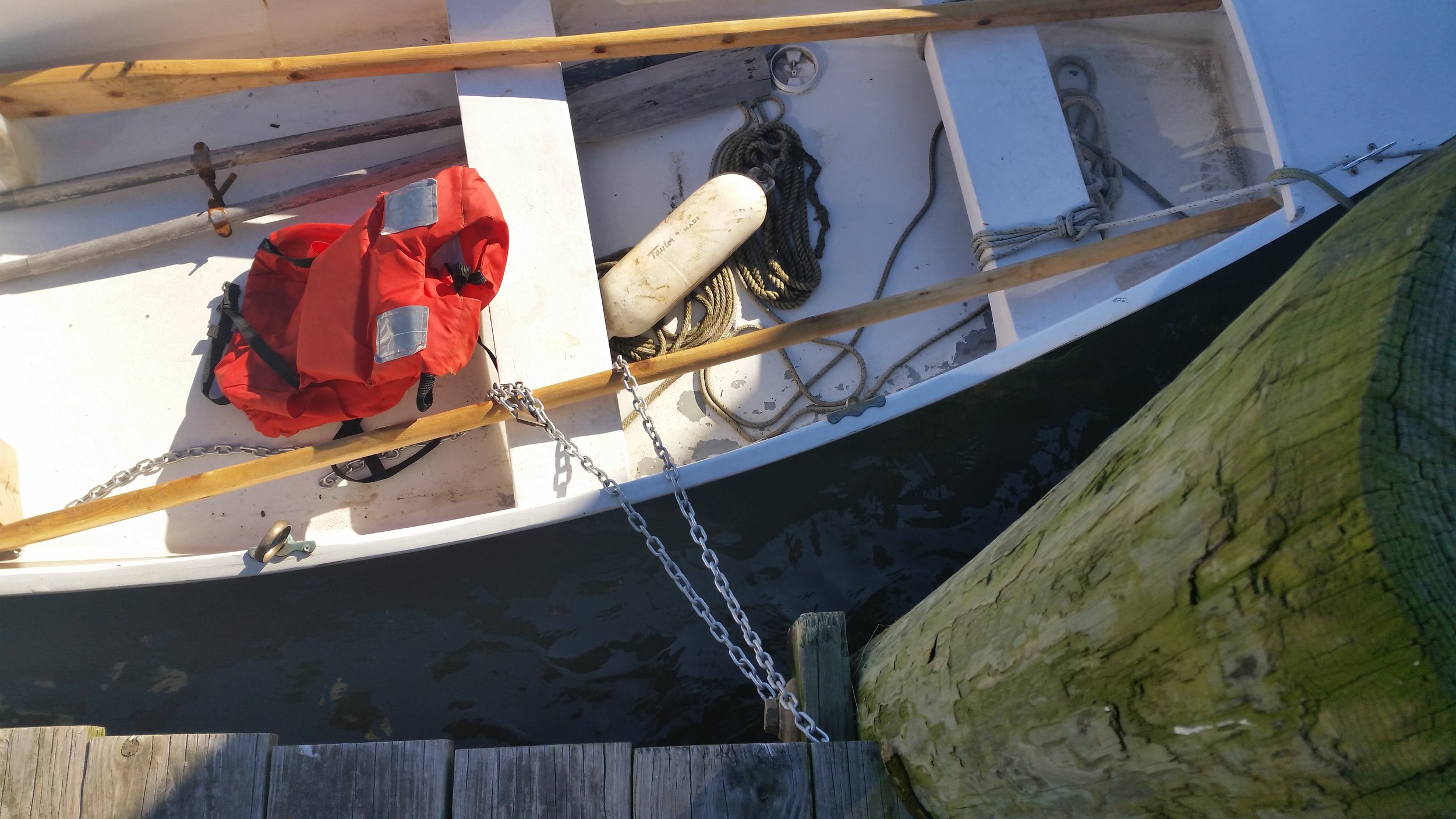
While rowing to shore on a calm winter morning, the DNR (marine police) came planing up to me, creating a huge wake in a no wake zone, to check on a row boat. Rowboats do not have motors, so we don't need to be registered or carry any papers on board to prove ownership; but we do need to carry the basics for safety.

Mandatory items to carry are:

1 lifejacket per person on board
Whistle or air horn (Sound device)
Handheld flashlight for night time navigation

Optional items to carry are:

Spare set of oars
Docklines and a long spare line
Fender
Chain and Lock
Bailer Jug
Painter and Bridle

Life jackets save lives! Each person on board should have a life jacket available to them. They may wear the life jacket if they wish, but I find that it is unnecessary to wear when rowing in calm and protected waters. If it were rough conditions, I would be wearing my life jacket before even getting off the yacht. 

A whistle or air horn is also needed to alert other vessels of your position. I prefer a whistle because they never run out of compressed air. I also like to have the whistle tied to my life jacket or around my neck, this way it is attached to me if I were to fall off. If I got swamped, I wouldn't want to then need to find the air horn in the floating debris, rather grab the whistle that's tied to me and begin blowing!

Rowboats can display red, green, white navigation lights. The problem is rowboats don't usually have a battery to power these lights. If the rowboat is under 7m (22.9 feet), it can use a handheld flashlight to alert other craft of your position to avoid collisions. 

Optional items to carry in a rowboat are simply "nice to haves" not "need to haves". 

I like to carry a spare set of oars, just in case I lose an oar or an oar breaks on me. It is very unlikely to happen, but if it were to occur, I wouldn't want to be caught without a paddle!

Dedicated dinghy dock lines are nice to have. They fit the dinghy cleats well and allow you to tie up anywhere you go. I also carry a rather long line in the boat that can act as a tow line. Should the need arise where you need to be towed, it is much more convenient to simply toss someone a line and they pull you, than to ask them to give you a tow and then ask them to give you a tow line (and hope it fits your cleats).

A fender on hand is very useful and well appreciated. When you tie up to a friends boat, the last thing you want to do is bang up their topsides as your dinghy bounces off their paint or gelcoat. I also use a fender when the sheer strake would rub against pilings or sea walls. 

Security measures are also important to carry on board the dinghy. Be sure to carry chain and padlocks as well as cable locks to encourage all your valuables to stay on board with you. I run the chain around a bench to keep it attached to a very integral part of the hull. I carry 20 feet of chain, allowing me to run about 8 feet from the boat to make a continuous loop of security. 

Another important item to have on board is a bailer jug. I use a jug of Arizona Ice Tea with the top cut open. The large opening, handle, and high volume allows for quick and easy removal of water that could end up in the dinghy. I prefer a square jug to a round jug (such as a clorox bottle) because it makes it easy to get into the corners of the hull. 

Lastly, I like to keep a bridle rigged to the hull. A bridle transfers the force of towing to the hull in a more even manner as compared to the point loading that would occur when pulling the craft by the bow cleat. The bridle is tied to the forward bench, through the bow cleats, and then to a loop. When I want to tow the dinghy, I simply tie the towline to this loop and away we go; no rigging or adjusting involved and I know the dinghy will tow well because it towed fine last time.

While the DNR wanted to make sure that I had the necessary basics on board the row boat, I feel that they are the bear minimum of items that should be on board. A rowboat is a craft that should have it's own equipment to make its use on the water all the easier and more enjoyable .

Dinghy Security

You row to shore to take care some errands and tie up to a dinghy dock. The dinghy is going to be floating there unattended for some time and there can be a lot of people walking past it. What's to say one of them won't untie the dinghy and go on a joy ride? Or worse yet, simply untie it and set it adrift? The little bow line you have is no deterrent as it can be easily untied.

What can you do to help improve the chances that the dinghy will still be there when you get back?

Chain and lock the dinghy to a fixed object
Cable lock the oars and outboard motor
Lock the lifejacket or take it with you
Hide the dinghy

When you chain the dinghy to a fixed object, make sure that it is not possible to slip it off the fixed object. When you put a chain around the piling, make sure the locked chain can't be slipped over the top of the piling. I prefer to lock to the docks under structure. These tend to be large timbers that will keep the chain trapped in place. The only way to get the chain out of the structure is to unlock the chain and slip it out.

It is also important to cable lock the oars and the outboard motor. Outboards sell quickly and are easy to remove from the back of the boat. Passing a cable lock through the bracket of the outboard and then through a cleat or around a bench will help deter the theft of the motor. Also be sure to pass the cable through the fuel tank handle to keep it from wandering off.

Oars are difficult to lock up since they are long and have no holes to pass a cable through. For this reason, drill a small hole in the blade of the oar and pass the cable lock through them to keep the oars from walking away. I personally don't lock my oars at this time because no one is interested in oars, they all want to steal outboards.

The lifejacket is another easy to take item in a dinghy. You need to have one on board for the trip from yacht to dinghy dock, but what do you do when you leave the dinghy? You can either pass the cable lock through it as well as all other valuable items in the craft, or take it with you as you run your errands. I personally take it with me because an empty dinghy is less interesting than one that is full of items to take.

My favorite way to prevent dinghy disappearances is to hide the dinghy from view. I like to tie the dinghy up where it can't be seen from the street. This way, fewer people will notice it and hopefully a potential dinghy thief will not be enticed to visit the dinghy pier. If it is a very low tide (and I'm going to be running a very short errand) I will slide the dinghy under the pier between the pilings. When the dinghy is hidden properly, all that will be seen from the dock is the small line tied to a piling. If no one knows that the dinghy is there, no one will bother it. 

The dangers of placing the dinghy under the pier is the rising tide could damage and sink it. If the tide comes up, the dinghy will be trapped under the dock and the rising tide can flood the boat. The other problem is the topsides of the dinghy can get bashed as the craft hits the underside of the pier and pilings.    

A chain and cable lock are not a guarantee of dinghy safety, they are merely a deterrent. If someone wants to steal a dinghy, they are going to choose the easiest one in the bunch. The goal is to not be easy. If they have to cut a lock, cable, or chain to get the dinghy; they will probably go for the one that is merely tied up instead. 

Winters Aboard

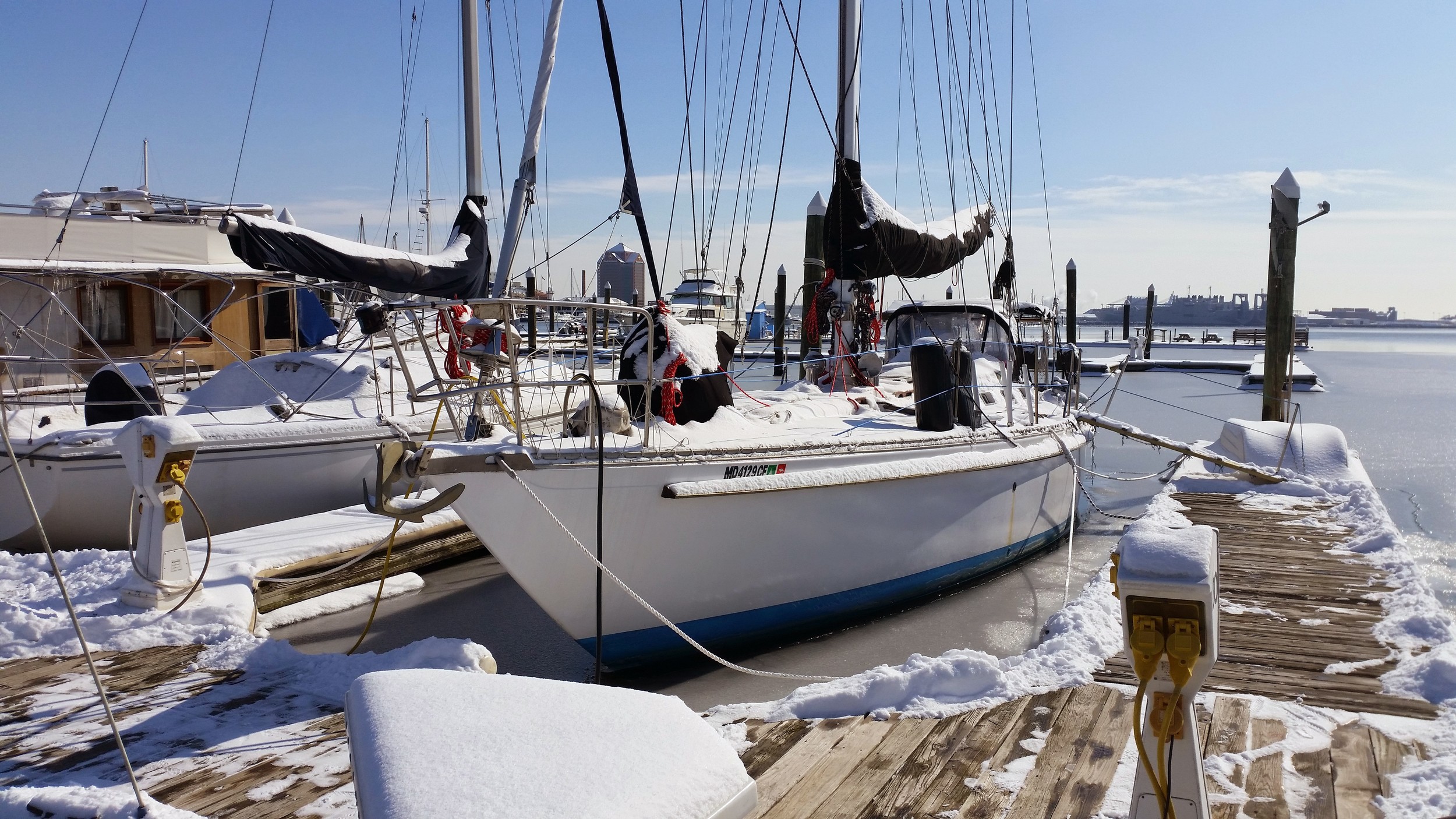
It seems a lot of people assume you have to pull your boat out for the winter to avoid ice damage to the hull. This is true if you are not going to keep an eye on your boat during the harsh months. When living aboard year round, you can't pull the boat out of the water and winterize it because this is your home! 

Dealing with ice is tricky. You can set up bubblers which create turbulence in the water to keep it from freezing. This is great as long as you have power, and during the harsh winter storms, the power tends to get taken out by falling ice covered trees. 

I have found that regular breaking of the ice around the hull proved sufficient to keep the hull safe during harsh times. I would stand on the deck and crack the ice with a long boat hook. I like to crack the ice off in sheets about 2 feet away from the boat. I can then push this large sheet of ice under the rest of the surrounding ice to create a large opening of water around my home. 

The winter of 2014/2015 (mainly during February 2015) was especially brutal! I would crack the ice in the morning before I would go to work, and by the next morning, it was thick enough to crack again! 

The other issue with ice is it indicates that the water temperature is below freezing and that means the reverse cycle heating/air-conditioning units need to be turned off. Most liveaboards rely on space heaters, but we have found that our diesel heater from Dickenson can comfortably keep our boat toasty on the coldest of nights! My concern with relying on the electric space heaters lies with the risk of power outages during ice storms. If electricity is your sole source of heat, you will be without it at the harshest of times!

Winters are not as bad as you might think, boats are a wonderful place to be on a cold day. You can snuggle up with a good book next to the fire or a space heater and enjoy your time inside. Everything is silent and peaceful, there are no wakes or drunk party boaters to deal with. While I don't get any sailing in when the water is iced, I do enjoy my time aboard. The most important thing to remember during harsh winters is that Spring is right around the corner and soon you will be enjoying the warmth of the sun while relaxing on the deck!