Dinghy Security

You row to shore to take care some errands and tie up to a dinghy dock. The dinghy is going to be floating there unattended for some time and there can be a lot of people walking past it. What's to say one of them won't untie the dinghy and go on a joy ride? Or worse yet, simply untie it and set it adrift? The little bow line you have is no deterrent as it can be easily untied.

What can you do to help improve the chances that the dinghy will still be there when you get back?

Chain and lock the dinghy to a fixed object
Cable lock the oars and outboard motor
Lock the lifejacket or take it with you
Hide the dinghy
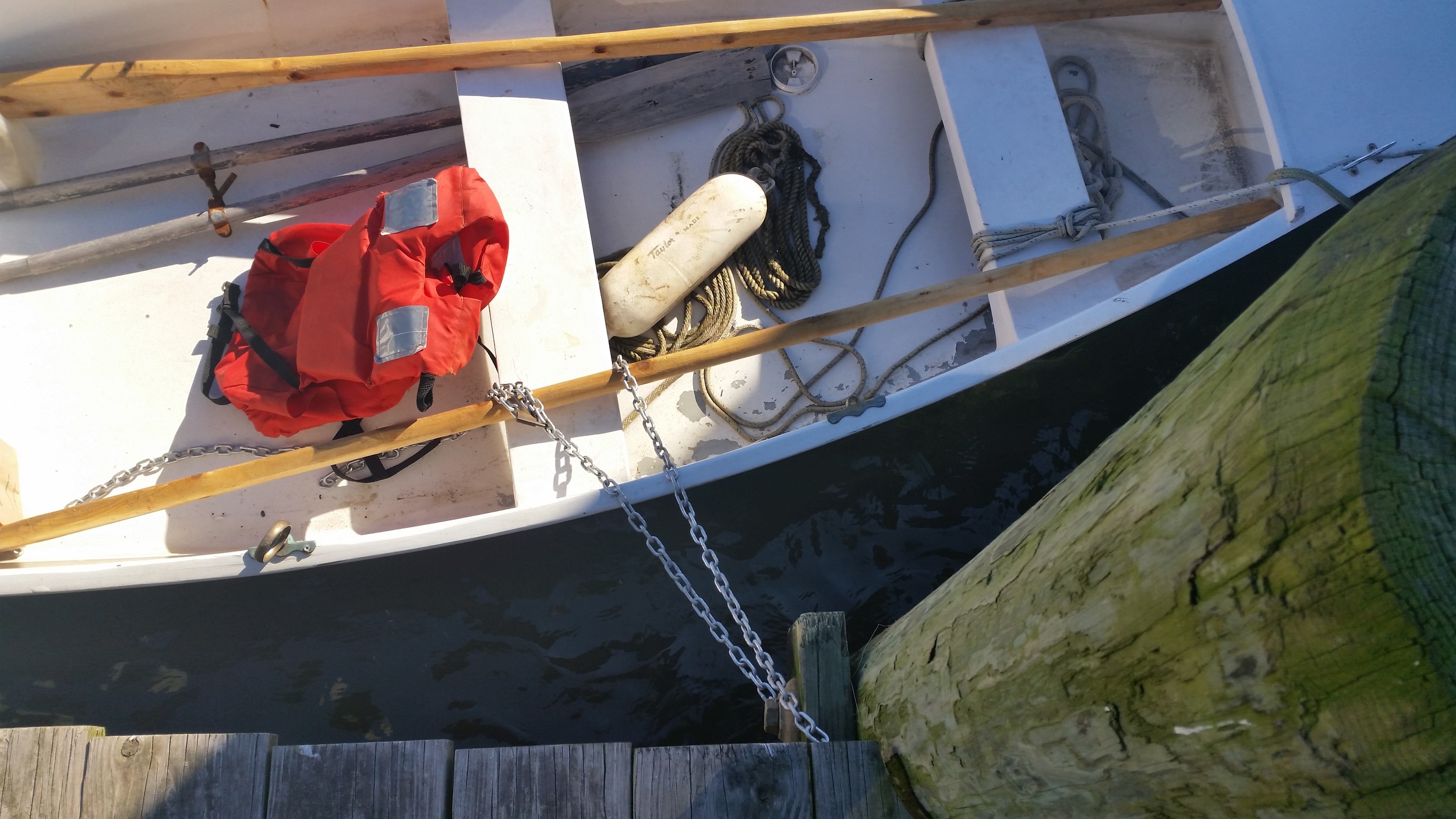
When you chain the dinghy to a fixed object, make sure that it is not possible to slip it off the fixed object. When you put a chain around the piling, make sure the locked chain can't be slipped over the top of the piling. I prefer to lock to the docks under structure. These tend to be large timbers that will keep the chain trapped in place. The only way to get the chain out of the structure is to unlock the chain and slip it out.

It is also important to cable lock the oars and the outboard motor. Outboards sell quickly and are easy to remove from the back of the boat. Passing a cable lock through the bracket of the outboard and then through a cleat or around a bench will help deter the theft of the motor. Also be sure to pass the cable through the fuel tank handle to keep it from wandering off.

Oars are difficult to lock up since they are long and have no holes to pass a cable through. For this reason, drill a small hole in the blade of the oar and pass the cable lock through them to keep the oars from walking away. I personally don't lock my oars at this time because no one is interested in oars, they all want to steal outboards.

The lifejacket is another easy to take item in a dinghy. You need to have one on board for the trip from yacht to dinghy dock, but what do you do when you leave the dinghy? You can either pass the cable lock through it as well as all other valuable items in the craft, or take it with you as you run your errands. I personally take it with me because an empty dinghy is less interesting than one that is full of items to take.

My favorite way to prevent dinghy disappearances is to hide the dinghy from view. I like to tie the dinghy up where it can't be seen from the street. This way, fewer people will notice it and hopefully a potential dinghy thief will not be enticed to visit the dinghy pier. If it is a very low tide (and I'm going to be running a very short errand) I will slide the dinghy under the pier between the pilings. When the dinghy is hidden properly, all that will be seen from the dock is the small line tied to a piling. If no one knows that the dinghy is there, no one will bother it. 

The dangers of placing the dinghy under the pier is the rising tide could damage and sink it. If the tide comes up, the dinghy will be trapped under the dock and the rising tide can flood the boat. The other problem is the topsides of the dinghy can get bashed as the craft hits the underside of the pier and pilings.    

A chain and cable lock are not a guarantee of dinghy safety, they are merely a deterrent. If someone wants to steal a dinghy, they are going to choose the easiest one in the bunch. The goal is to not be easy. If they have to cut a lock, cable, or chain to get the dinghy; they will probably go for the one that is merely tied up instead. 

Winters Aboard

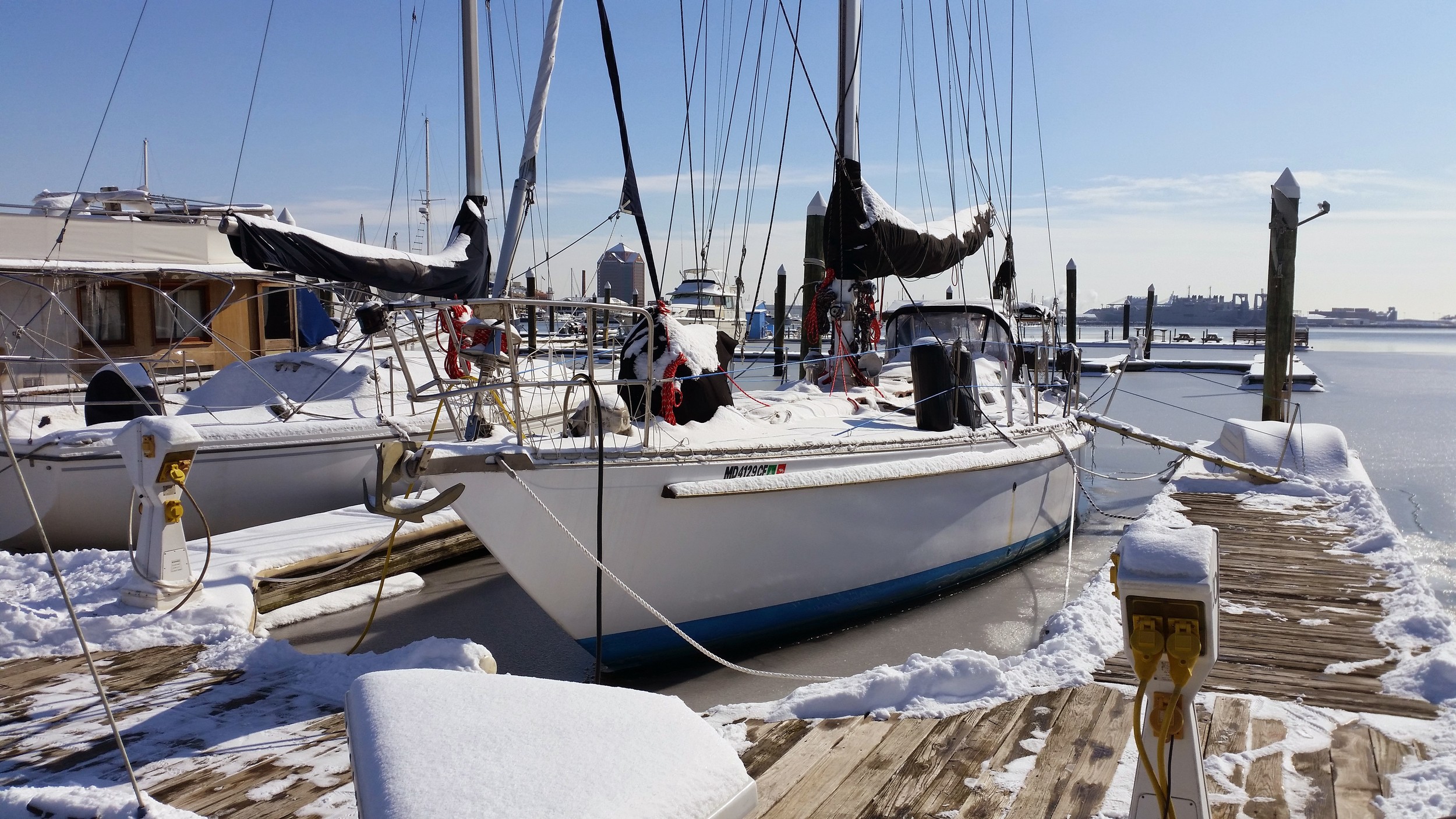
It seems a lot of people assume you have to pull your boat out for the winter to avoid ice damage to the hull. This is true if you are not going to keep an eye on your boat during the harsh months. When living aboard year round, you can't pull the boat out of the water and winterize it because this is your home! 

Dealing with ice is tricky. You can set up bubblers which create turbulence in the water to keep it from freezing. This is great as long as you have power, and during the harsh winter storms, the power tends to get taken out by falling ice covered trees. 

I have found that regular breaking of the ice around the hull proved sufficient to keep the hull safe during harsh times. I would stand on the deck and crack the ice with a long boat hook. I like to crack the ice off in sheets about 2 feet away from the boat. I can then push this large sheet of ice under the rest of the surrounding ice to create a large opening of water around my home. 

The winter of 2014/2015 (mainly during February 2015) was especially brutal! I would crack the ice in the morning before I would go to work, and by the next morning, it was thick enough to crack again! 

The other issue with ice is it indicates that the water temperature is below freezing and that means the reverse cycle heating/air-conditioning units need to be turned off. Most liveaboards rely on space heaters, but we have found that our diesel heater from Dickenson can comfortably keep our boat toasty on the coldest of nights! My concern with relying on the electric space heaters lies with the risk of power outages during ice storms. If electricity is your sole source of heat, you will be without it at the harshest of times!

Winters are not as bad as you might think, boats are a wonderful place to be on a cold day. You can snuggle up with a good book next to the fire or a space heater and enjoy your time inside. Everything is silent and peaceful, there are no wakes or drunk party boaters to deal with. While I don't get any sailing in when the water is iced, I do enjoy my time aboard. The most important thing to remember during harsh winters is that Spring is right around the corner and soon you will be enjoying the warmth of the sun while relaxing on the deck!

Name Brand vs Econo Brand

When you look at the prices for ropes, you may be shocked at how much some brands want for their line. Why pay several dollars per foot when you can buy the same size line from another brand for pennies?

There is actually a difference! I'm in the process of making rope fenders and I need a lot of line that will wrap the whole fender up in a nice package. This line will be under no tension and is purely decorative. I was paying $1.25 per foot for 1/2" Three Strand from New England Ropes and thought this was going to be too expensive to wrap the fenders. I decided to go with an Econo Brand of line where each foot only cost me $0.50 per foot. When you are talking 600 foot spools, that's a difference of $450 per spool!

The differences are greatly apparent! The more costly New England Ropes has tighter wrapped yarns, stronger lays, and resists unraveling. The Econo Brand has much larger yarns which are hardly wrapped and will unlay if the ends are not taped tightly. 

The tighter yarns also translate into better chafe resistance which directly affects the longevity of a line on board your yacht. The simple act of tying many half hitches has led the Econo Brand rope to pull apart. The line is riddled with little blebs where the yarns are pulling out of the lays from tying so many knots. If this were a working line on the boat, those blebs would be quickly chafed open, leading to premature chafe failure. 

Imagine your docklines, chafing on the chocks as the boat bobs around the slip, or the anchor rode dragging on the bottom of the sea floor. These actions would wreak havoc on a cheap rope, causing yarns to pull out and break. In these working situations, the consequences are much greater. Your boat could break free of the pier and begin to drift, causing damage to your vessel and those around it. If the anchor rode were to chafe through and snap, you will begin to drift through the water with the added cost of buying a new anchor!

If you are buying rope for your boat, don't let price dictate your decision. Do buy quality ropes that will protect your vessel as they provide a long and reliable service life!

Buying New vs Buying Old

When looking to buy a boat, you have three choices

Brand New
Used in wonderful condition
Used in poor condition

At face value, Brand New is the most expensive, Used in wonderful condition is pricey but great value, and Used in poor condition is the cheapest upfront. But what does it mean for you?

Buying Brand New has the advantage of knowing that everything on the boat is fresh from the factory and should work flawlessly. This also means that if there are design flaws, you will be the one to find them. Most reputable boat companies will pay to correct design flaws in your vessel, so you do have some insurance there. The downside comes in the way of drastic depreciation. A $250,000 yacht will not be worth that in a few years, and if you ever go to sell it, you will realize that depreciation took most of the boats value.

Buying in wonderful condition is where you buy a boat that was bought Brand New and meticulously maintained for years. All the while, problems have been discovered and then fixed along the way; delivering to you a like new yacht with all the kinks worked out! This can be the best way to buy a boat if you can find the exact boat you are looking for.

Buying in poor condition is a bit of a risk. You are essentially buying a deck and hull, and outfitting the rest from there. Cost wise, this tends to be the cheapest upfront, but the costs of outfitting a boat can add up considerably. The advantage is this can be done in stages allowing you to save up between stages. This way, you are able to have a place to live in (or camp in) while you work your way towards perfection.

They say boats cost! They cost money and time, if you save on money, you will pay more in time! 

From the choices above, it may seem that buying "Used in wonderful condition" is the best choice, as the price is greatly reduced over new, and it won't cost you any time to get the yacht ready to sail. This is true, but it is also very hard to find the boat that is exactly how you want it.

If you look at any sailboat, you will see "Owner Customizations". Some people want radar, chart plotter, auto pilot, and a wine cooler; while others want laminated sails and light weight synthetic rigging. What you want on a boat is not always what others want on their boat. This means that no matter what boat you buy, you are going to sink more money into it to make it "Your Boat"

This is where buying "Used in poor condition" shines. The boat doesn't cost much and is a blank canvas! When you buy a quality boat that is in need of a rebuild, you are buying a sturdy platform to build your dream boat on. You are in control of deciding what goes where and you are able to spend your money on the items that you value as necessary on board your boat. 

This method will cost you a lot of time if you do the work yourself, but I think it's worth it in the end. How much of a project you want is completely up to you. You can get a wooden boat from "Boneyard Boats" for free, or a sunken boat that has been resurfaced for nearly free. These are the cheapest initially, but the total cost of these projects will quickly overshadow the supposed deal. 

The next option is to buy an old boat that has a good interior, deck, hull, rudder, and spars; and take it from there. These tend to be boats that were loved and used for many years, and are in need of a re-fit. They tend to have a bad engine, blown out sails, aged rigging, and minimal electronics. These are where the true bargains are hiding! You don't have to pay the previous owner for "his favorite" chart plotter and then replacing it with "your favorite" chart plotter. Instead, you can pick and choose what and where you want to mount your electronic accessories. 

The other advantage with boats that are structurally sound is you get to pick and choose what sails and rigging you desire. If you prefer tri radial sails over crosscut sails, or full battens over partial battens, you don't have to live with the previous owners decision! You can choose exactly what sails you want and what size for them to be! Some people prefer to have a smaller high aspect jib while others prefer a monstrous 180% genoa, the choice is yours!

As far as rigging goes, you are free to select the color scheme that makes sense for you! If you want all the downhauls to be the same color, or if you want each line to be a different color, this is your chance to decide on color and feel in your hands. Boats like these take some time to complete, but the owners tend to be very pleased with the end result.

It can be hard to find your perfect yacht when shopping around. The eyes will love a brand new boat much more than your wallet will. The used market might seem daunting to sift through. Keep searching with an open mind, and consider looking at the ones the eyes might not fall in love with right away, but have the potential to make your dreams come true! 


Windpuff's First Daysail

I got home from choir this morning in a wonderful mood and found Herby on Windpuff having just tested out his completed sculling oar.  It was an uncharacteristically warm day with a few wispy white streaks across the sky, allowing the sun to finally melt the mountains of snow on land.  We just had to go out for a sail. 

Windpuff’s original name was “Dove.”  We bought her to be a day sailor for when we wanted to go out spur of the moment.  Since Wisdom is our home, she is never ready to go at a moment’s notice.  She’s big and has our various belongings strewn about so that heeling over would create a catastrophe, not to mention the fact that we just took off all her sails for winter maintenance.  Now, Windpuff doesn’t have a working motor, so we were never able to get her out of the slip safely and confidently until today.  Thus, it was today that we became truly grateful that we had her.  Within ten minutes of making the decision to go out, we were sculling away from the slip and hoisting the sails. 

It was a much needed break from any obligations that we left on land.  We were only out for about two hours, but as we glided through the water with just enough wind to fill the sails, the sun warmed our faces and everything felt right.  Even Morty enjoyed himself thoroughly. 

The sculling oar has finally made it possible to enjoy our second boat, and I’m so excited to finally be able to benefit from having it.  I love Wisdom, but I feel a special connection to Windpuff because I was involved in the process of choosing her.  We looked at her together on the hard and I even got to choose the new name.  Windpuff also taught me to sail.  It made more sense for me to learn on her because she only has two sails, she’s 30 feet long, and she’s very responsive to movements of the tiller.  I helped sail her to her new home almost a year ago and we haven’t been able to sail her since until today!  I’m excited for our future adventures with our little day sailor.