First Ice of the Season!

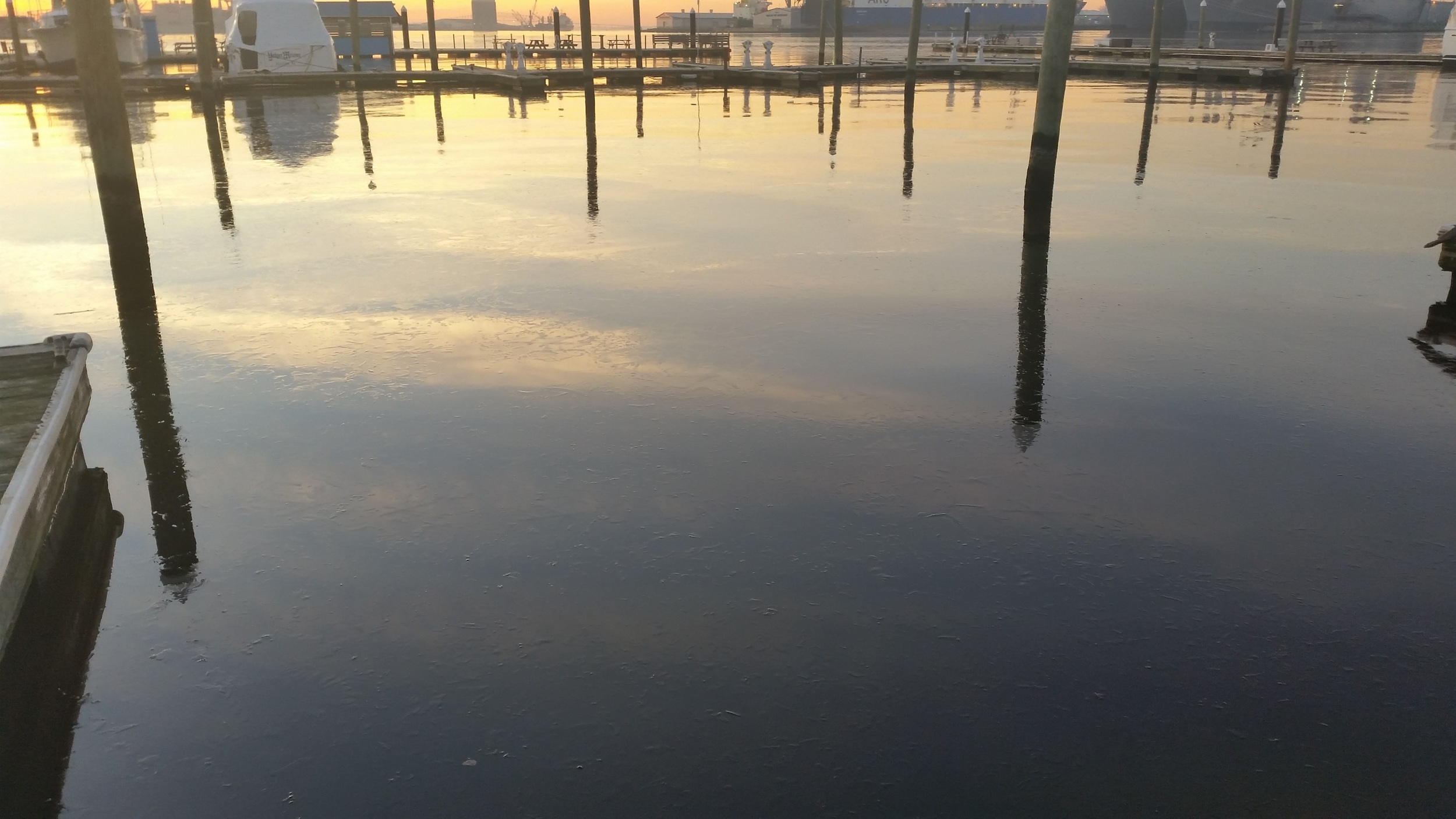
Winter is certainly upon us! We have been enjoying this warm winter with days in the 60s and nights in the 40s, but now the temperatures have finally dropped and the water is cooling off as well. This morning we had our first hint of ice! 

While it is only skim ice, it is the first sign of the chilling water temperature we are floating in.

This is by no means an impressive amount of ice, last winter is still fresh in our minds when the ice formed and stayed for weeks! Last year, the ice was so thick that some rather crazy people decided to try walking on it. Tempting death, they managed to walk from one marina to another on the thick and sturdy ice that had formed. I was content with just looking at the foot prints in the snow covered ice from the safety of the pier!

Our Floating Home

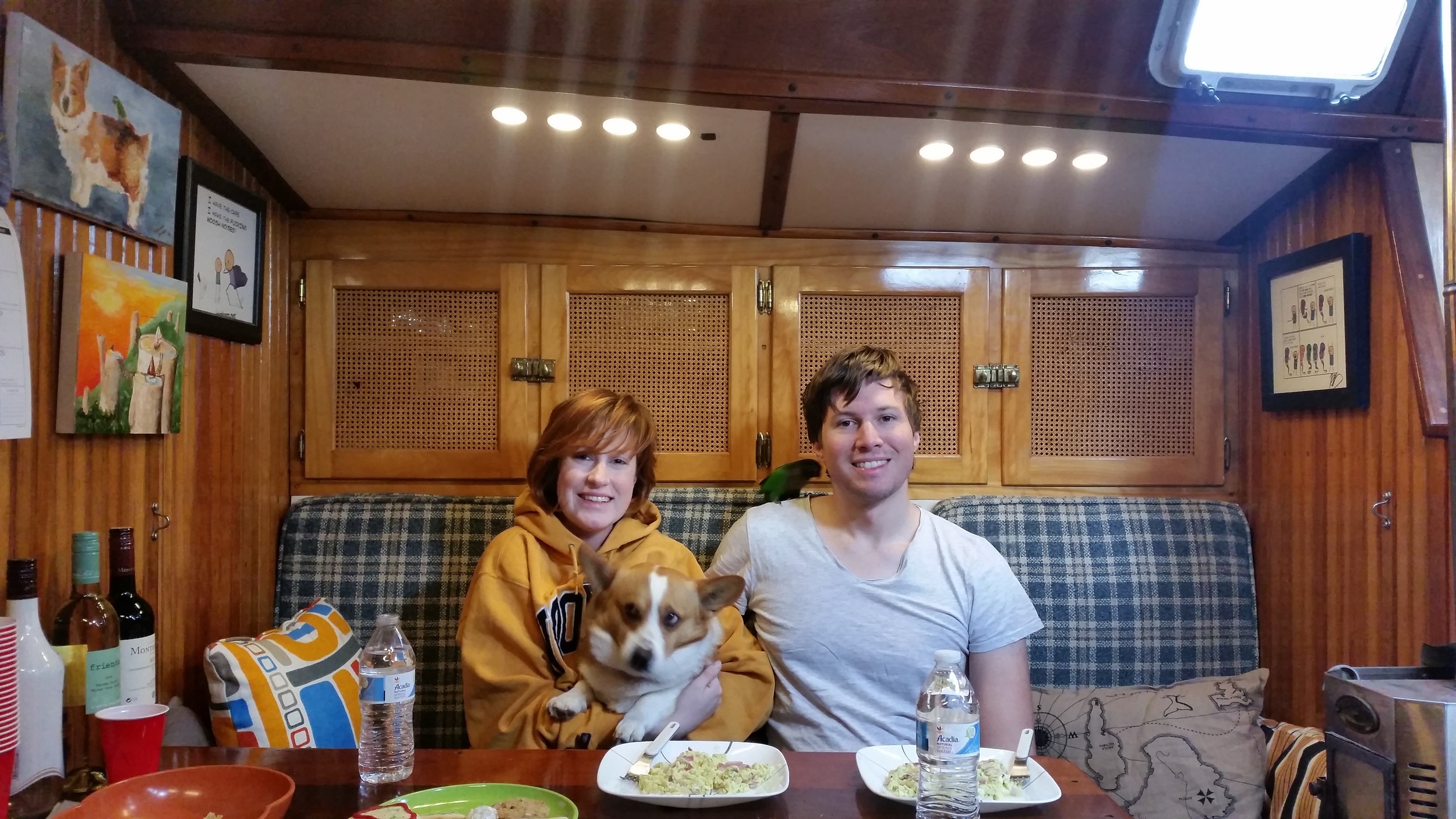
Maddie and I live in our 45 foot sailboat year round. We live here with our two pets, Morty (our corgi) and Sammy (our parrot), through the heat of summer and chills of the winter. We spend most of our indoor time right here on this bench. 

It is amazing how versatile such a small space can be! The cabinets behind us are storage for booze, diesel for the stove in the lower right corner of the picture, plates, pots and pans, and electrical connectors. Behind our backs is more storage, where we keep towels, electric heaters, ropes, paints, plumbing connectors, and paper towels. Under our seats are two of the eight water tanks in the boat, along with the water pump. The table itself also has space for storing the bedding supplies, as well as games. 

We eat, work, and relax at this small table. Maddie opens the leaves to do her paintings and I use the table for all the other projects I have done in the boat. I even built the rigging for the whole sailboat sitting right there! Add some more pillows to the bench and we can stretch out to watch a movie on our laptop computer. 

The boat is only 45 feet long, and yet we spend most of our indoor time on that bench in a room that is 7 feet long by 8 feet wide. When you have a well laid out common area, it can take the place of multiple specilaized rooms that would require much more space. I originally wanted to live in a tiny house, and then discovered sailboat living (which offers unlimited mobility to the tiny house). I think tiny houses and boat designers should work together to maximize the amount of living with minimal space! 

I have learned to organize my things more efficiently thanks to information about tiny house living. I feel that tiny house design could benefit by taking cues from sailboat interior layouts.

Ocean Sailing: Calm Days

Calm days will make up the majority of a voyage. These are the wonderful days of sailing along with a calm ocean swell. The winds are light and consistent as you calmly move along through the water. No one wants to ask about these days because they want to hear the epic days of heroic action taken to fight the breaking waves and ferocious winds.

The truth is, most sailing is spent relaxing while the boat whisks along through the water. 

We lowered the mainsail because it kept slating with the seas. We didn't loose too much speed over ground because the main was actually robbing wind from the drifter. When the mainsail was out of the equation, the staysail and drifter were able to fill up and pull us along.

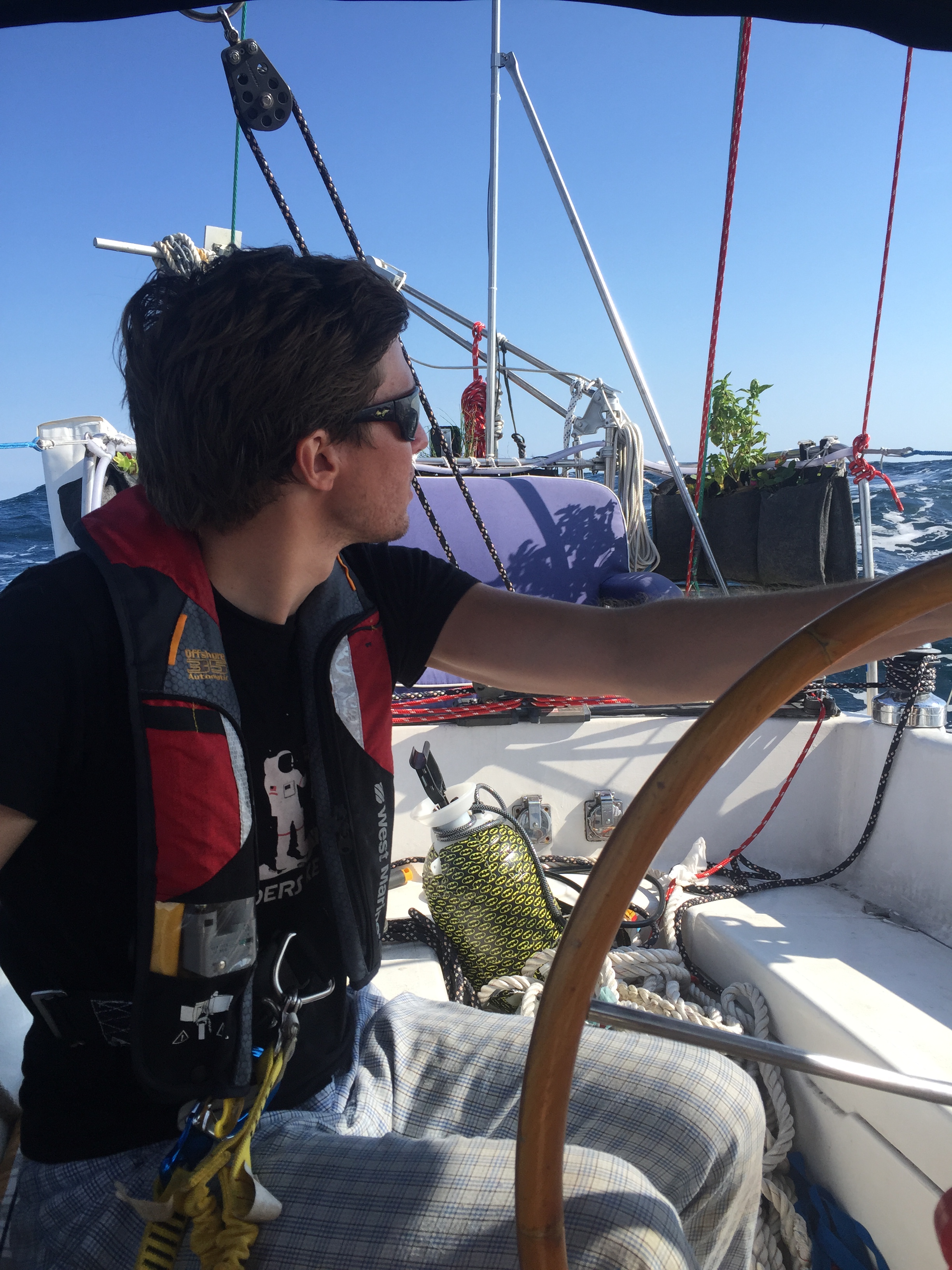
Ocean sailing is very relaxing and peaceful. Most people would probably crank up their engine and power along at hull speed in these conditions, but we are not capable of doing that with our electric engine and tiny battery bank. 

Many people view this as a drawback to not having a long distance motor, but we view this as an advantage. If we had a long distance motor, we would be tempted to crank up the engine and power our way through the seas instead of relaxing and enjoying the ocean and all of its beauty. 

We don't cover many miles on these calm days, but we don't feel exhausted at the end of the day either. The whole day is spent lounging around, reading, eating, and doing whatever strikes your fancy. There is no rush when under sail on a calm day! We know the winds will eventually change and we will end up sailing along under reduced sails, blasting our way through the ocean at 8 to 9 knots. For the time being, we enjoy our peaceful days where we mosey along at 2 to 4 knots.

If you are planning an ocean voyage, you should consider your time at sea a gift of peace and relaxation. Take advantage of your time at sea where you have minimal distractions and all the time in the world! Each day begins when you wake up and ends when you feel like it, rather than when your alarm clock goes off and when your shift ends. If you find yourself on a calm day with no wind, consider leaving the engine off to enjoy the peace and quiet of the sea instead of listening to the roar of your engine.

Ocean sailing is going to mostly consist of these calm relaxing days with a few days of storms scattered in there. The stormy days will give plenty of notice in the ways of cloud formations and increased ocean swell from a new direction (the swell will radiate out from the center of the storm, so the storm will be in the direction from the swells origin). When a storm approaches, early preparation will make them seem like a mundane occurrence rather than a special moment that stands out in your mind. Then you can continue sailing along in the nice and calm weather that predominates on the ocean. Don't let the fear of the rare storm keep you from enjoying the peace and tranquility that ocean sailing has to offer.

Ocean Sailing: Rough Days

Rough weather is an unavoidable part of sailing. You can plan to avoid major systems or closely watch the forecast, but at some point you will get caught in bad weather. I must emphasize though, it is a minor part of sailing and most sailing is done under full sail in calm conditions!

Maddie and I did a trip during the summer which took us down the Chesapeake Bay and flanking the coast as we made our way offshore as far south as Kill Devils Hill, NC. I find it hard to say that we sailed to North Carolina as the closest we got to it was 4 miles offshore. 

We sailed in July because it is a very calm month according to the pilot charts. Winds should be around Force IV most of the time and the chance of gales was minimal. I figured this would be a good time to introduce Maddie to ocean sailing!

Most of our trip was calm, but when a storm would roll in, it was serious! The amazing thing about ocean storms is they are predictable and you have plenty of time to prepare for them, you just need to know what the warning signs are.

DSC_3300.JPG

Clouds are your best warning to approaching storms. They tell you what the weather will hold for your immediate area and warn you from miles away. When this photo was taken, we were sailing along under full sail in winds blowing 10 to 12 knots. The large fluffy clouds along the horizon tell you that the weather is rather stable and the winds will be light. Then you can see the large towering cloud on the left. That is a storm in development and the top of it tells you which way its going. The top end of the cloud is being blown by the upper higher level winds and points in the direction the storm is going to be moving. 

We spotted this storm during one of our half hourly scans of the horizon. We saw that the storm was far away and blowing in our general direction, so we devised a plan. We lowered the main sail, raised the trisail, and hove to for the night (when we expected the storm to hit). If it were earlier in the day, we would have continued sailing under reduced canvas and watching the storm and its movement. Since it was late and we were ready to go to sleep, we decided to end our day earlier and heave to now.

The wispy clouds in this picture are the biggest talkers in the sky. They tend to indicate that a front will be rolling in tomorrow or the next day. If you see just a few of these cirrus clouds, then don't listen to them, but do take the clouds seriously when they begin to fill up the sky. This picture was taken looking off our starboard side and the anvil cloud (storm cloud in the first picture) was off our port side. The combination of all these clouds made us decide to rig the storm sails for the night even though it was only blowing 10 to 12 knots. 

We must have looked like idiots flying our storm sails in a gentle breeze, but the key to ocean sailing is preparation. I would rather rig the storm sails and float around in calm weather than to await the storms approach and rig the sails during the storm. We slept very peacefully that night. Every hour I would poke my head out the companionway and see how things were developing. Conditions deteriorated that night and by the following day we were sailing in a nasty storm.

By that night, it was blowing 20 knots. By the next morning 30 knots. The storm peaked around 1pm, blowing around steadily 37 knots. Strong storm wind will kick up the seas, and the longer the storm blows, the larger the seas will become. This is why a squall with 50 knot winds and a duration of around 15 to 20 min will not have seas as high as a lesser storm that blows for days.

In the early morning, the seas were already rather large. Look at the water on the left and right side of the picture and you can see that this is a large wave coming up on us the height of our stern rail and not just the horizon in the distance.

In the early morning, the seas were already rather large. Look at the water on the left and right side of the picture and you can see that this is a large wave coming up on us the height of our stern rail and not just the horizon in the distance.

There are two schools of thought when it comes to storms at sea:

Light displacement sailboats that are capable of avoiding the storms
Heavy displacement sailboats that are capable of riding out the storms

I personally feel that the middle ground boats are not optimal in the ocean. They are too heavy to escape the storm yet too light to offer the comfort of a heavy displacement in a storm.

Wisdom is a heavy displacement sailboat so her motion is slow and lumbering. This translates into a calm ride in rough seas. We never get slammed around and the full keel keeps us on track as the seas rise and fall around us. 

As the day progressed, the seas also continued to build. We all stayed calm because we never felt that we were in danger. We had plenty of warning that the conditions were going to worsen and took the appropriate steps to maintain our safety.

When we saw the signs in the clouds, we reduced canvas and set course for further offshore. The only dangers that we would encounter during the storm would be breaking waves and a lee shore. Breaking waves can be calmed by the slick when hove to and the lee shore can be avoided by keeping enough seaway. 

Rough sailing is not the norm when it comes to ocean travel, but it will occur at some point. The way to keep them from becoming the highlight of your ocean voyage is to be properly prepared and take the necessary steps to ensure the safety of the crew and vessel. This way, the stories will be about the voyage and the destinations; rather than being about the storm that took the ship.


Storing Clothes

I’m not going to lie…it took me a full year to get used to living in a sailboat.  Herby has touched on the many things that I improved during the process of creating a comfortable living space aboard Wisdom, and I’m sure I’ll be talking about them as well in the future, but right now I’m going to focus on the challenge of storage.  As a female, I have many, many clothes.   Before moving into the boat, I filled a walk-in closet and two dressers with my various seasonal garments.  One of the biggest challenges, therefore, has been selecting my favorite clothes and storing them in a way that doesn’t drive me nuts.

 You may not like to hear this, boys, but if you want your girlfriend or wife to move into a boat with you, you must relinquish all claims to your largest closet.  I went to target and bought a ton of hangers for my sweaters, dresses, and button-down shirts.  I did give up quite a lot of closet space for the installation of the AC unit, but this was a necessary sacrifice and I have no regrets.  I am not a big shoe person, but when you live in a boat, even the smallest collection of items seems like a mountain of possessions.  It was a huge help when we got one of those shoe pocket things from Ikea to hang on the inside of the closet door. 

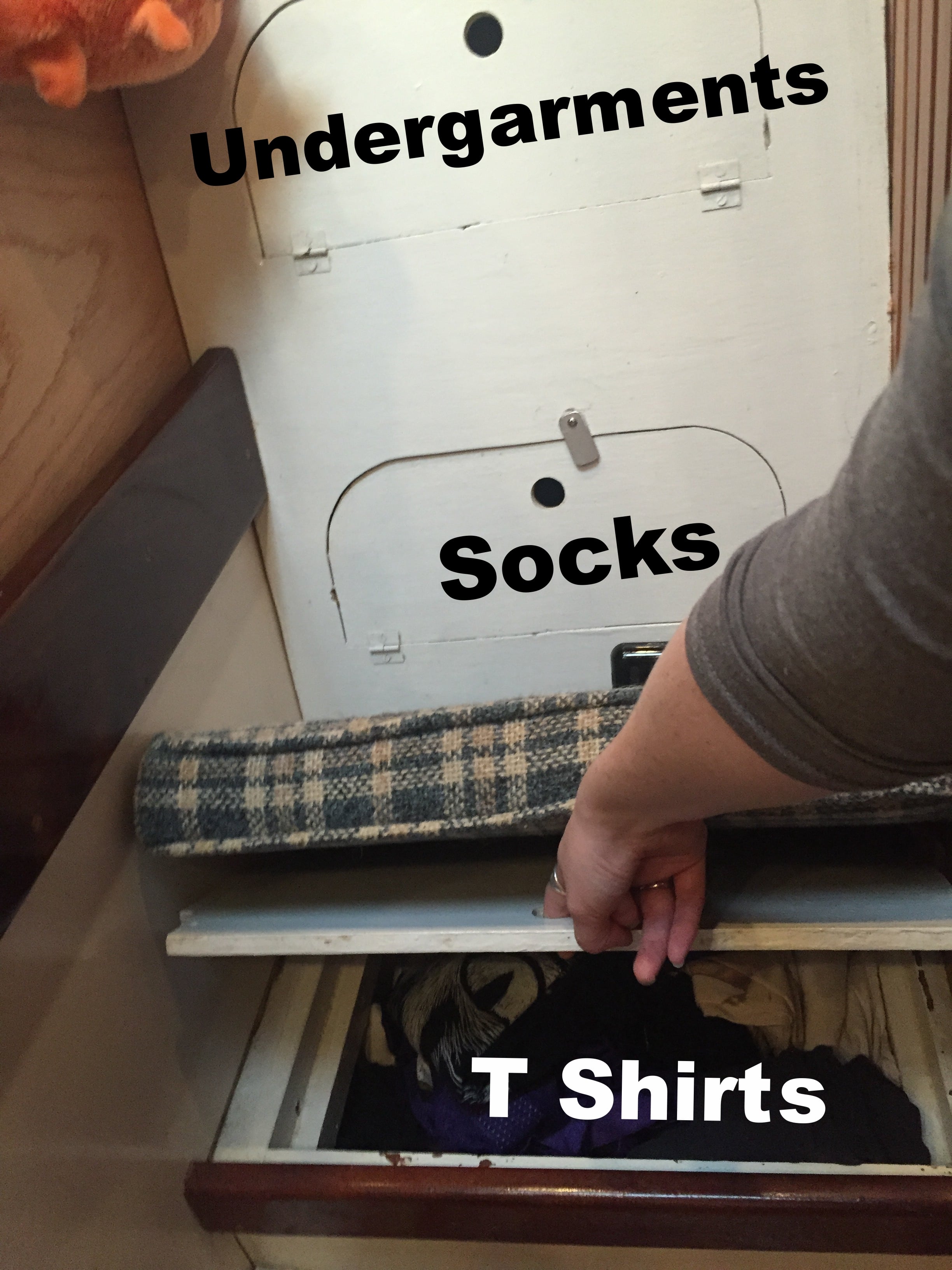
The rest of my clothing is stored in forward cabinet space.  Now in order to divvy up these cabinets fairly, I drew a chart of all the spaces and then we placed our names inside each one along with a label for what we planned to store in them.  Herby got the high up cabinets because he’s tall, and I got most of the bigger ones because I’m stubborn and have way more clothes.  Nevertheless, this worked very well for us and gave us a clear visual of all the space available before we started shoving clothes in random compartments.  I highly recommend it. 

I have an overflowing bin of pants in the largest cabinet and two plastic drawer bins from Ikea that I’ve filled with shirts.  There’s a convenient cluster of cabinets on either side of the V-birth entrance that are the perfect size for under-garments, PJ pants, and belts, and a small seat under which I store all of my graphic T-shirts.  It actually all works out quite well. 

My only complaint is when it comes to doing “The big seasonal switch,” as I have dubbed it.  This is when I take all my winter clothes in bags and switch them out for the summer ones because, I’m sorry to say ladies, but there just isn’t enough room to store warm and cold weather clothes.  My poor parents will be having to deal with half my clothes remaining in my old bedroom for quite some time.  This also includes all of my formal dress wear that I don’t use on any regular occasions. 

I’m going to list some other tips for storage that I have either discovered myself, or were passed along from my neighbors.

  1. If you have more storage room in your boat that isn’t readily accessible, store your off-season clothes there in tightly packed bins.
  2. Hang a rod in the back of your car and use it as extra closet space for dresses. (I’ve seen this done, but I wouldn’t suggest it if people frequently ride in your back seat.)
  3. Roll your clothes into tight cucumbers instead of folding them. 
  4. Use the bed to fold/roll laundry
  5. Go to Ikea
  6. Don’t wake up with a specific outfit in mind.  You’ll never find it. 
  7. Draw a picture of all the storage and divvy up space accordingly with your partner.
  8. Keep an open mind…you’ll get used to it once you establish a system that works for you.