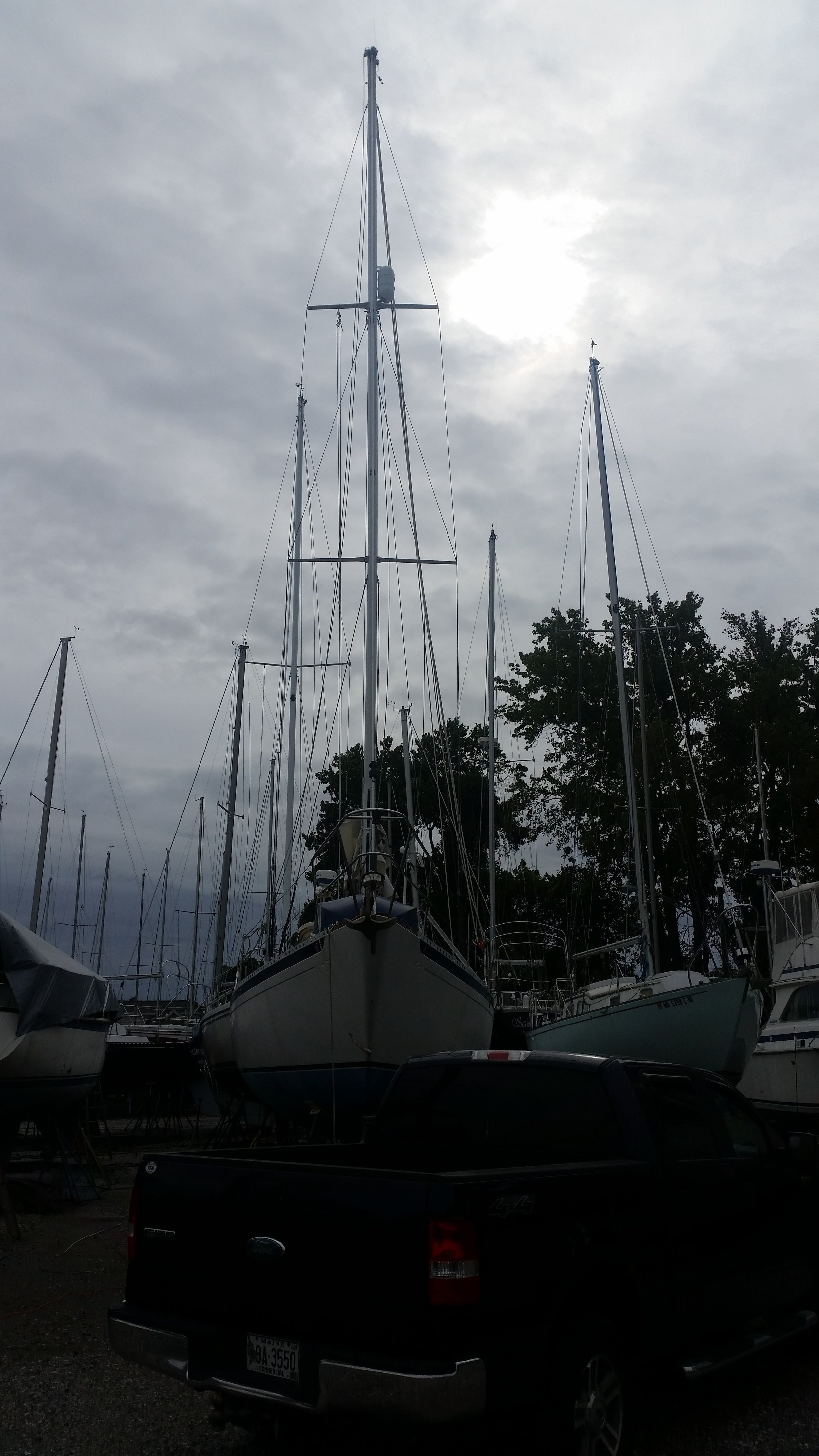
Standing Rigging

Broken Spreader

While aloft for the final inspection, I noticed that the lower starboard spreader was in serious trouble!

First, the spreader was mounted upside down. The trailing edge of the spreader was facing forward and the forward edge of the spreader was trailing. The distinction in directions is only evident due to the air foil shape of the spreader. Round and square spreaders create a lot of drag and wind resistance, air foils create significantly less drag. An air foil creates less drag in a specific direction, and slightly more drag if it is set backwards (though still much less than a round or square air foil). Being how this is not a racing yacht, a slight increase in drag is not going to be detrimental to the sailing performance of a cruising yacht.

The reason that the direction of the spreader is so important is due to the drain hole for water in the spreader. The spreader has a drain hole near the mast on the bottom side. If the spreader is mounted with the trailing edge leading, the drain hole will now be on the top side of the spreader and instead of a drain, it would act as a water fill hole. Water inside a spreader will cause more weight aloft but more catastrophically, it will hold water that can turn into ice during the winter. The expansion of the freezing water inside will place great and unnecessary stresses on the aluminum air foil spreader and lead to its eventual and apparent failure.

The other factor that came into play with this particular spreader is the location of the spinnaker halyard and flag halyards. Both of these halyards (which look like they haven't been moved in 30 years) were rubbing on the front of the spreader. While the lines themselves were not significantly chafed, they did grind away at the soft aluminum of the spreader. The lines are full of dirt which acts like sand paper rubbing on the thin trailing edge of the spreader. If you have spare halyards installed on your mast, be sure that they are not contacting anything on their run. Over the years, either the halyard or the rig will become chafed and lead to costly repairs in the future.

The combination of the thinner metal of the trailing edge of the spreader being ground away by the halyards and the ice expansion inside the spreader may have led to the opening of the spreader.

Upon this discovery, the shrouds were relaxed and the spreader unbolted. It was then taken to a metal shop to have new aluminum welded onto the trailing edge and then ground into shape. The spreader was then painted and reinstalled the next day! With the repaired spreader in place, it is time to position the spreaders and seize the tips.
Islander 36 Conversion: Deck Clean-up

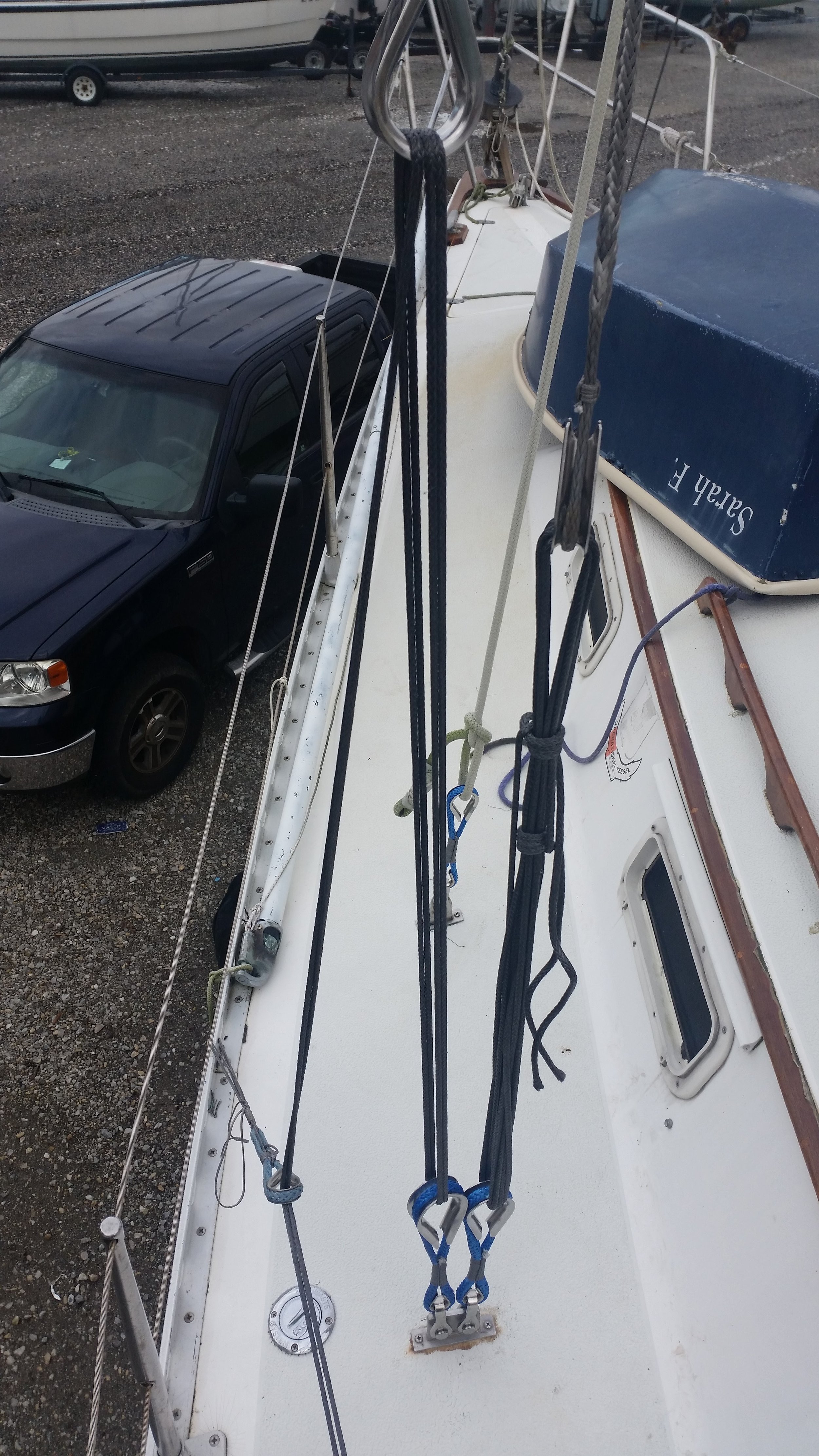
With all the stays up and tensioned, it is time to do some tidy work to the stays around the deck. 

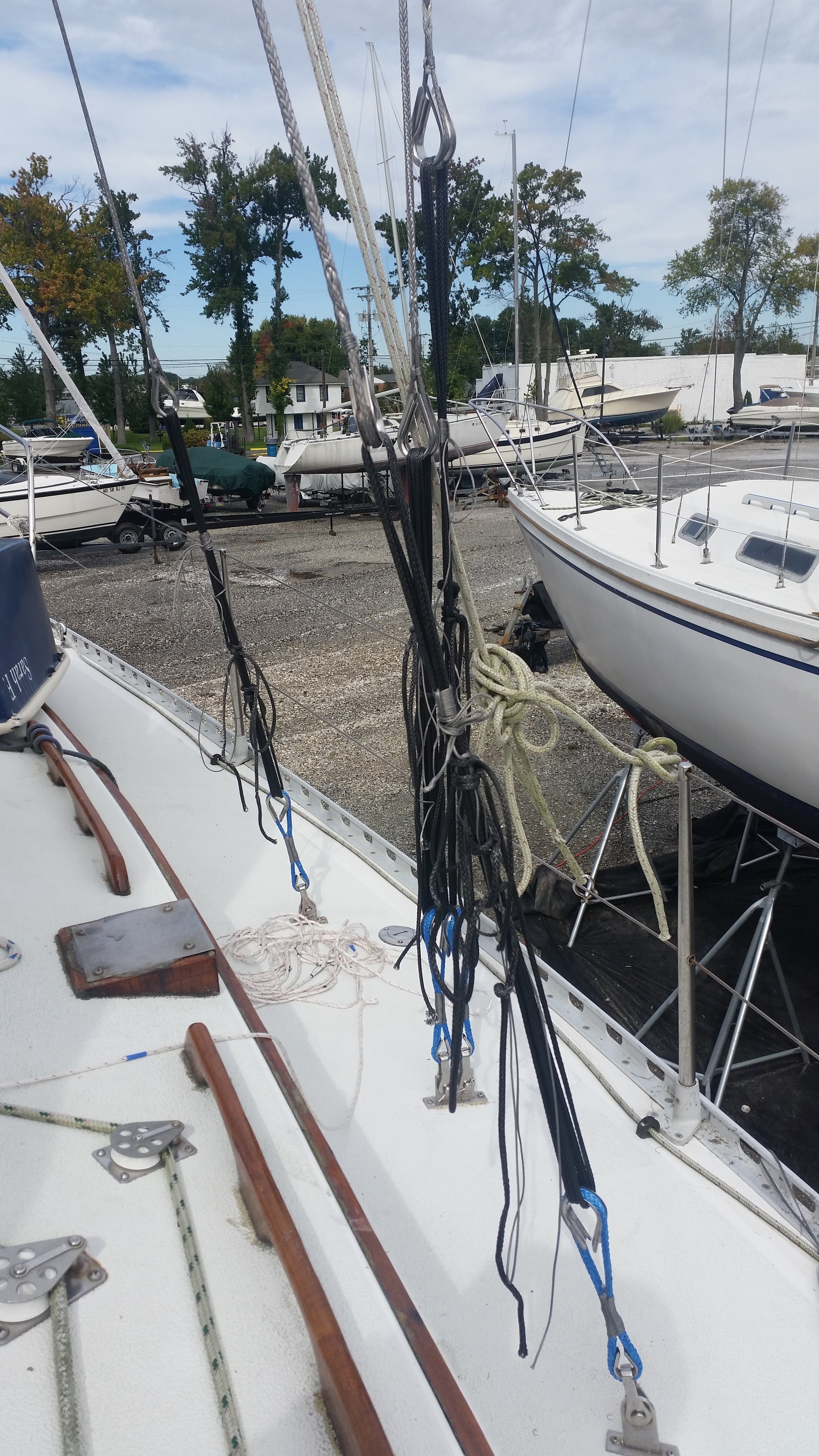
If I were to leave his rigging looking like this, I wouldn't get hired! This rats nest of rope is only acceptable during the tuning process when the stays are frequently untied and retied. There is no point in tidying up the lines if you are going to retie them tomorrow. Now that we are putting on the finishing touches, it is time to clean up the deck since we wont be messing with the lashings for some time.

The tails of the lashings were tied to cover the shroud frapping knot and to consume all the long free ends that used to hang like Spanish Moss from swamp trees.

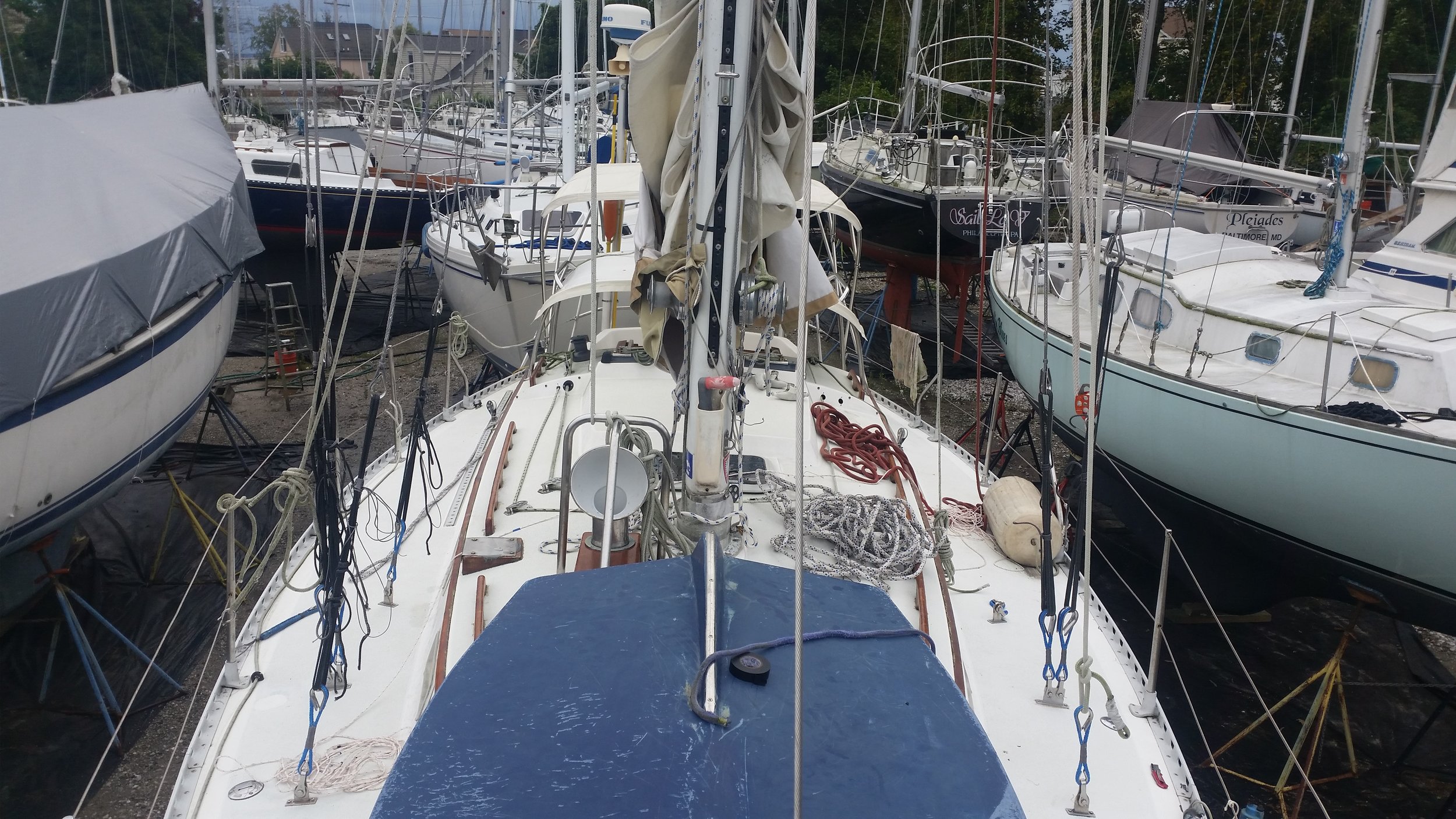
All the shrouds are finished and tied off, the backstay is set and tensioned, and this job is almost complete! With everything tied off and tidied up on the deck it will soon be time to go aloft and seize the spreader tips and perform a final inspection of the rigging conversion.

Islander 36 Conversion: Synthetic Backstay

The backstay on the Islander 36 retained its turnbuckle, making adjustment much simpler to perform as compared to the deadeye system.

Attaching synthetic stays to a turnbuckle is very simple, all you need is the correct fittings on the turnbuckle. The turnbuckle needs to be a "double jaw" turnbuckle, meaning it has a jaw toggle on the bottom to attach to the chainplate and a jaw toggle at the top to attach to the deadeye. The deadeye then acts as a receptacle to receive the stay via the lashings.

While a double jaw turnbuckle may look symmetrical and can function just fine if it is installed in either direction, it is nice to pay close attention to the thread direction on the turnbuckle. It is standard practice to install the RH threaded toggle on the bottom and the LH threaded toggle on the top. If you install it the other way, it will still function the same, but the confusion comes when you are doing repairs.

If you see that the top toggle is cracked or showing the faint clues of crevice corrosion, you know that you need to order a LH toggle because you always install a LH toggle on the top. If you do not follow this simple convention, you will need to look closely at the threads and determine which handed threads you are working with.

When using a turnbuckle, there is no need to develop a large pulley system to provide the mechanical advantage to provide tension thanks to the wonderful turnbuckle located in line! Turnbuckles are compact wonder machines, containing a very long inclined plane as well as lots of leverage to push the load up that plane. Inserting a long screwdriver into the turnbuckle body will add a lot of leverage to the system and allow you to achieve the necessary force to tension the rigging. 

The reason turnbuckles can't be used alone with synthetic stays is they don't have enough travel to absorb the stretch that will occur over the life of the stay. Turnbuckles offer five inches of travel, and once that is consumed, you can no longer tension the stay further. Lashings on the other hand offer a lot of travel and can absorb the stretch and creep of a synthetic stay over its life.

To tension synthetic standing rigging with a turnbuckle, all you need to do is connect the turnbuckle to the deadeye, the deadeye to the lashing, and the lashing to the stay. With the turnbuckle as loose as it can be (just one thread showing on the top and bottom screws), tighten the lashing using a marlin spike hitch as much as you can by hand, then tie a shroud frapping knot in the lashings to lock them in place.

With the lashings secure, begin tightening the turnbuckle until the desired tension is achieved. If and when the turnbuckle becomes two blocked, which will happen, simply loosen the turnbuckle completely and re-tighten lashings again using a marlin spike hitch. Simply tie a new shroud frapping knot and re-tighten the turnbuckle. 

You might think that the stay will be just as tight as it was when you started, but in fact it will be very slack. In essence, the stay that was pretty tight while two blocked will now be five inches longer when the turnbuckle is relaxed. These five inches will then be absorbed by the lashings and tension can be re-introduced via the turnbuckle once again.

It might seem like a convoluted procedure, but trust me, it is much simpler than running tensioning lines on the deck to a cockpit winch and setting fair leads at the perfect position to tension your deadeyes. Turnbuckles offer excellent ease of adjustability in a compact package for an equally significant price.

Islander 36 Conversion: Tuning the Rigging

The synthetic shrouds were all connected to the mast and ready to be tuned. The goal is to achieve a straight mast that is in column and centered over the boat.

At this point, the spreader position is not a significant concern. The spreaders will move around as you tune the rigging but they will not be a factor until later on. If a spreader appears to bend up or down significantly, then it must be rectified. For now, the main focus is the mast and the spreaders will simply project laterally from the mast.

The tensioning system was setup on both sides, allowing symmetrical adjustments to the tension of the stays and position of the mast. It is important to start at the top of the mast and get that centered over the boat before moving on to the lower stays. Remember to work top down, as it will make difficult problems seem much simpler to solve. 

Once the top of the mast is centered over the boat, the intermediate stays are connected to the tensioning system and adjusted until they are true. The intermediate stays will cause an S curve in the mast if they are out of tension, so adjusting them will remove this odd bend that the mast can take on.

The next stays to be tensioned are the forward lowers. These stays will pull the mast forward and induce a bend into the mast (which is desireable). These stays are not under as much tension as the cap shrouds, but still more than the aft lowers. The purpose of the aft lowers is to correct any sideways bends in the bottom of the mast that might be induced by the forward lowers. These stays are the loosest of the shrouds and require very little tension.

All of the chainplates are rather inboard on the deck, so it was detrimental to run the lashings through the deadeye and over to the turning block, so instead, they were led from the stay to the turning block to the tensioning line. This produced the least amount of lateral pull into the equation and it was rather straight forward to gauge how much tension would be on the stay once the tensioning line was released and the stay was no longer being pulled in a lateral direction.

Islander 36 Conversion: Port Side

The owner was gaining confidence aloft and was working much faster than before. In one day, he managed to remove everything from the port side and install all the new stays! 

The jib halyard was attached to the forward lower deadeye and tensioned with the mast winch. Installation was proceeding quickly until we ran out of lashing line. We were only able to attach the cap shrouds when we ran out of line. The lowers were tied to a cleat on the mast to keep them out of the way and out of harm as this day was blowing nearly 30 knots.

The gantline was attached to the lifeline to keep it from swinging in the wind and bashing into the mast and rigging. It was rather difficult to work on the deck of the boat during the severe wind we were having, so the top priority of the day was simply to get everything tied up to avoid it from being windblown and damaged during the gale that was blowing over the area.