
Life Aboard

Rope Fenders

Several years ago, I began building a set of rope fenders. They are big, heavy, and honestly serious overkill for stateside cruising (especially on the East Coast). Our journey down the East Coast of the United States and into the Bahamas involved anchoring everywhere we went (where fenders are not needed) or tying up in a marina which had padding on the finished wooden edge of the pier. The weather is always calm and there is little wave action inside the marina that would push your topsides up against the pier.

I honestly began to view our old rope fenders as overkill and dead weight on the deck, until we made landfall in the Azores! 
 

FullSizeRender.jpg

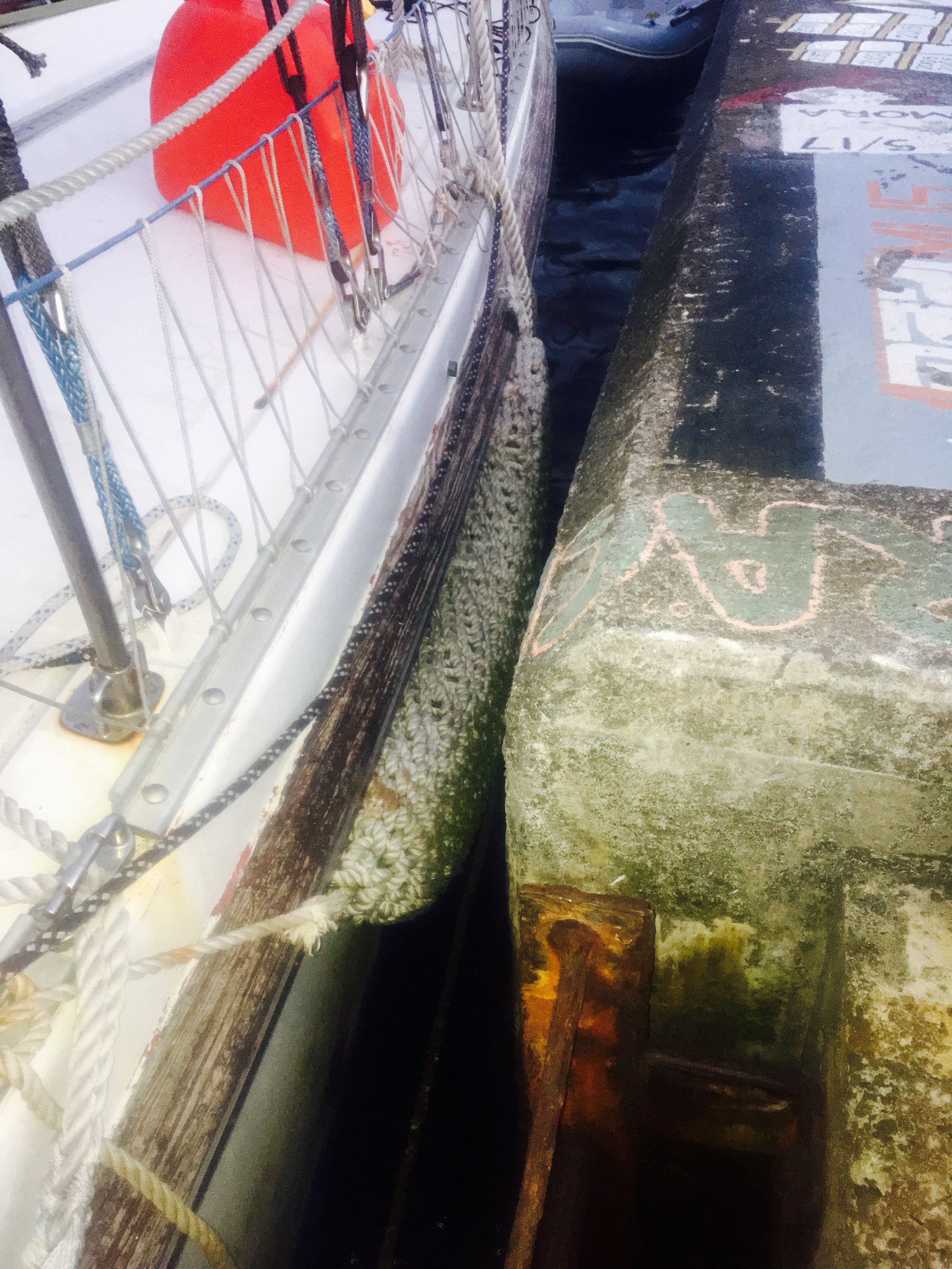
The Azores are small volcanic islands in the Atlantic with no protection from the weather. If the seas are big, they will be powerful inside the breakwater as well. The marina i also made of a few floating slips and a lot of large concrete sea walls that you tie up to. Pounding into these is a sure way to pop an inflatable fender!

FullSizeRender.jpg

Fenders alone will not save your topsides here, you need fender boards. Luckily, I made the rope fenders long enough that they themselves function as fender boards. This kept our hull a few inches away from the unforgiving concrete pier and large rusty ladder that sits in a small recess. 

If you plan on voyaging to distant lands, do your research about the mooring situation before you leave that way you can arrive prepared to safely tie up! 

The Value of Effort

Sport sailing is all about getting the most out of every puff of wind. Coastal sailing is about getting from one place to the next as quickly and comfortably as possible. Ocean sailing is about making it to the other side.

While the goal in all three types of sailing involves getting somewhere, and quickly, the first two categories can be viewed as sprints where the latter should be viewed as a marathon.

Ocean sailing is an endurance sport, there is no way around it. Every action you take requires energy, and you have to be able to keep up that pace for the entire ocean! This leads to different decision processes as to sail selection and trim, as well as course.

If the winds are light, but you have clouds building around you, you are presented with a few options:

Option 1 would be to take down the working sails and put up the light air sails. When the winds change, then take down the light air sails and put the working sails back up.

Option 2 would be to grab a book and wait for the stronger winds to reach you so you can keep sailing with the sails you already have set.

This choice came up on our third day of ocean sailing, when our crew member got frustrated that we were ghosting along at 2 knots on a broad reach under mainsail and staysail. He suggested that we swap the sails out and put up the drifter. I attested that this would require a lot of energy and that it would be the same result in the end: we would move slow.

Being how he is rather Type A and in a rush all the time, I told him that we would do it as a learning exercise, to see when something is worth the work.

I was relaxing and reading my book as we ghosted along at 2-3 knots and recommended that he do the same. Instead, we all got up, sleepy and tired since we just finished our night watches, and swapped the sails over. The entire conversion took about 15 minutes to complete and a fair amount of effort. The light air filled the drifter and we began moving along once again, at 2-3 knots.

So, was it worth all that effort?

The Truth about Ocean Crossing

FullSizeRender.jpg

Yes, crossing an ocean is a long endevour. It takes time to prepare your yacht for the journey, as well as time to prepare yourself mentally for what is to come. You are ready to eat all of your food, read all your books, and repair everything that breaks along the way! But, are you ready for what your boat will look like when you finally make landfall?

When you coastal sail, you will heel over as your sails fill and you move along, then you reach a destination and the yacht will come to rest in an upright position. The topsides remain out of the water and the bottom paint in the water. 

When you are blue water sailing, you will be heeled over for days. Not only will you be sailing the whole way, but you will probably be on the same tack for most of the journey! When we left Bermuda, we were on starboard tack for the first 12 days. This meant that our topsides with no antifouling paint was submerged for almost two weeks straight. 

The fouling growth formed on the old topsides paint, staining the white a hideous dark smear.  

FullSizeRender.jpg

The stern overhang really grew some lovely slime, as this area of the boat was perpetually bathed by the stern wave. 

FullSizeRender.jpg

Between being heeled over an average of 10 degrees for the entire trip, the constant following seas we had the whole way across, or surfing down our stern wave indefinitely; our stern definitely grew the most life on our voyage. It is interesting to note how well the antifouling worked, as the blue bottom paint is completely clear while the white topside paint above it is covered in layers of slime and growth. 

When we hauled out in the Azores, we did not have the boat power washed, as we were going to be sanding the paint away shortly in preparation for the next project. The growth that is visible is untouched and undisturbed in its locations and intensity.

When you make it to the other side of the ocean, don't expect your topsides to look as pretty as you feel. You will have some scrubbing to do when you get there! 

Ocean Sailing Personalities

Everyone has heard of Type A, and Type B personalities. Type A people are high strung go-getters who live their lives by a rigid schedule and everything must be kept at its highest level of performance.

Type B people are laid back and relaxed. If something needs to get done, they will get it done eventually, but it probably won't happen by the deadline. Schedules, to them, are those things that some people talk about, but they don't really know much about them.

A seldom known third type of personality, known as Type C, also exists. Type C people are those that can switch between being Type A and Type B. These people are the true leaders in ocean sailing.

Ocean sailing requires you to earn enough money to buy or build a boat capable of crossing the ocean. This means that you need to get stuff done to hold down a job that will pay enough to do such a feat. Type A people excel at this, as their dream is to work in the fast paced and competitive world of business. They will earn their money and work hard towards getting to their dream. Type B people may dream of sailing across an ocean, but they can never seem to get their act together. This financial roadblock keeps most of them from ever getting the opportunity to go out to sea.

The sad truth is, the best personality to have when out at sea is Type B. Ocean sailing is slow and boring. When there is no wind, there is no forward movement! You simply sit there bobbing around as you wait for winds to come. A Type B person will use this time to relax and enjoy the view, while a Type A person will go absolutely stir crazy! They will see the slow speed and factor it out for the duration of the journey and calculate that they will never make it in time! They set out to sea with a mental arrival date because they need a schedule, and seeing that this calm and relaxing day will lead them to be late; a term that is unacceptable to be used to describe them.

The best personality type for such a crossing is going to be a Type C person. This person can be Type A in the professional world, achieving great accolades and earning enough to purchase a bluewater boat, and then switch to Type B so that they can enjoy the ocean crossing.

​Tip-toeing Around Monsters

When you picture a cloud, you probably see the white puffy part hovering high in the sky. The base is clearly visible above the horizon and the top of the cloud is also in view. These are happy clouds that grace you with shade on a hot ocean day!

Monster clouds are the ones that rise up over the horizon with no visible base. These clouds are so massive that they are located somewhere beyond the curvature of the Earth yet they still take up almost half of the visible sky! These are pressure systems, so massive that they have a different air pressure than their surroundings.

If you are in a high pressure with clear blue skies, these low pressure monsters will look like massive white hazes in the distance. If they are far enough they will look like a white dome, if they are closer, just a hazy white horizon. The winds in these creatures can be quite powerful, so it is best to avoid them.

To do this, you choose your course based on where they are going and stay out of their way. You are a literal ant in a room full of elephants when you are sailing the ocean blue. Don't get stepped on!