Life Aboard

Stern Anchor Roller

Stern anchors are wonderful tools that can ave your boat in nasty situations. A stern anchor can be used as an "emergency brake" to stop the boat in a hurry! The problem with stern anchors is they are hard to mount in a way that is as easy to deploy as the bow anchor is. 

IMG_2143.JPG

Yes, if you need to stop in a hurry, you could drop the bow anchor and cleat it off. The problem is this would require that you run up to the bow and drop said anchor while in a moment of panic where every second counts! 

Having a stern anchor that is set and ready to deploy is very important because it can be released from the cockpit, where you are while at the helm. This allows you to quickly drop the anchor while never leaving the helm. 

Ok, so a stern anchor is wonderful, but where do you install one? We carry our stern anchor in a PVC pipe that is lashed to the stern pulpit. It works and can be deployed relatively quickly, but not as easily as we would wish it to be. After it has been released, there is still the issue of recovering the anchor, which is anything but easy with the pipe! This all leads to the seldom deployment of our stern anchor and the fact that if we really needed to deploy it in a hurry, we would fail. 

To make our lives easier, we decided to build a proper anchor roller for our stern anchor. This will go mounted on the aft deck and be supported by a stanchion that wil take up the vertical loads. The roller will hold the anchor out and off the stern of the boat, ready to deploy and easy to recover, without causing damage to our transom. 

Making a stern roller is rather easy, all you need is a piece of wood and a roller. I used a small roller that I was able to purchase on sale for $20 and through bolted it to a massive piece of oak. Oak is a very strong wood that will easily withstand the loads. Wood gives you the flexibility to design and position the anchor as far from the transom as needed to prevent the flukes from digging into your topsides.  

You can buy long stainless steel anchor rollers that would negate the need for a massive piece of wood, but they are also ridiculously expensive! The only item that actually needs to be a roller is the portion that contacts the anchor, and this only occurs at the very end. The U shaped wood surrounding the roller will contact and hold the flukes of our FX-37 Fortress anchor, negating the need for any specially formed stainless steel anchor roller. The distance can be tailor fitted to meet the needs of your boat with wood, rather than being confined to the limited sizes available in pre-manufactured stainless steel units.  

Stern anchor rollers are a compromise. Your boat was designed to carry an anchor at the bow and not on the stern. The more gear you add to your yacht, the less space you will have available to squeeze in an anchor roller. Figuring out where you can best fit a stern anchor will be tricky, and you might not ever find a perfect spot; but all you need is "good enough" as that will get your hook mounted on the stern. Once it is there, it will be at your disposal, allowing you to drop the emergency brake in a hurry or setup up a stern anchor to keep you from swinging.
Baking Bread (without an oven)

Fresh bread is usually thought of as something only found in a local cafe, but you can enjoy the smells and taste of freshly baked bread right from your boat!

If you have an oven, life is easy and you can follow a regular recipe for landlubbers to bake your bread. What if you don't have an oven? Are you forced to a life without the smell of fresh bread?! 

Fear not for you can bake bread on a stove, and even a grill. There are a few simple things to keep in mind when you are baking bread (not in an oven).
First, you need to create an oven-like environment.
Second, you need to generate a lot of heat.
Third, you need to keep the bread from touching the heated surface to avoid scorching and burning. 

After many variations, I have come up with a system (that is still under constant improvement).  

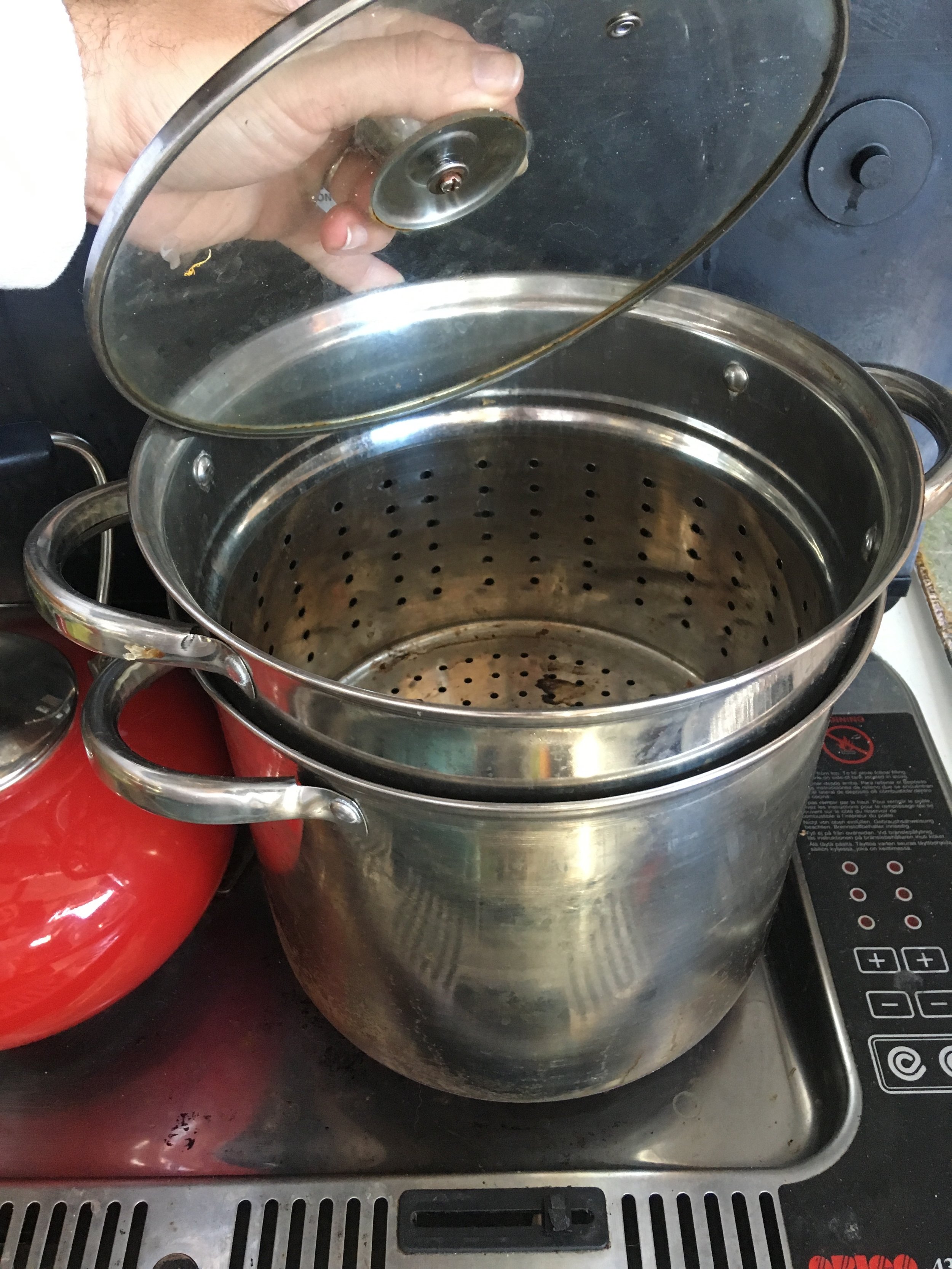
To bake the bread, I use a steaming pot. It has a strainer that sits inside of a big pot, and it has a lid on it. I place the dough in parchment paper in the strainer section, and place the strainer inside the pot.

The pot is then placed on the stove (or grill) with the fire as high as it can be. A high flame will heat up the pot very quickly but will not scorch the bread, as it is just a few inches away from the hot surface in the strainer section.  

The pot, and the air inside the pot will heat up to temperatures that will simulate an oven experience, baking the bread! It might take longer than an oven, and require you to flip the loaf part way through the baking process, but it will give you actual bread that you can use for sandwiches or just to dip in olive oil. 

image.jpg

Tomorrow's Weather

Weather is a very important thing to a sailor, and knowing the weather ahead of time can allow you to better prepare for the weather to be. There are fancy electronic methods to predict the weather, allowing you to tap into a world of information. 

Weather can be found online on your smart phone via websites and apps, or over the radio on the various NOAA weather stations. When far out to sea, weather can still be received by SSB radio in the form of weather fax, creating a graphical display of the weather forecast.

These are all wonderful systems that will give you very precise information. The best part about these systems is the information is generated by experts in the field who fully understand and comprehend what the weather is doing now and going to be doing soon. The downside to all of these systems is that your boats electrical system could fail and you won't be able to receive this information. 

Luckily, there is a very reliable backup system to receive weather forecasts; all you need to do is study the weather yourself a bit to gain an understanding of how the sky relates to the weather to be. 

IMG_2142.JPG

You are able to see clouds that are very far away, giving you a full day's warning to what is coming your way. Looking up at the sky will tell you everything you need to know about the weather around you in your immediate area and can be decoded to reveal what the future weather will hold for you as well. 

Relaxing in Paradise

Sailing around on your own personal yacht may seem like the lifestyle of the lazy person who doesn't want to go to work. This couldn't be farther from the truth! 

IMG_2144.JPG

Cruising is a lot of work, and no one is paying you to do it! Yes, you don't have to go to an office every morning, but you do have to do all the work to keep your boat floating. 

While it may sound like you can't escape the working world, being how you simply traded your old job for this job. The biggest difference though is the view!  

How often did you see this in the late afternoon at your old job? 

Cruising will take you to new and exciting places. Places that you chose to go on your schedule and at your own pace. You don't have a boss hanging over your neck, or coworkers creating drama in the workplace. Nope, you just have yourself and your boat, going where you want when you want. 

Dead Bilge Pump

Our shaft sump pump stopped working one day, but never gave us a clue why. Many months went by and we neglected the failed pump, causing it to live submerged in the drippings from our shaft log. The time has finally come to fix the problem and get the pump working again. 

IMG_2136.JPG

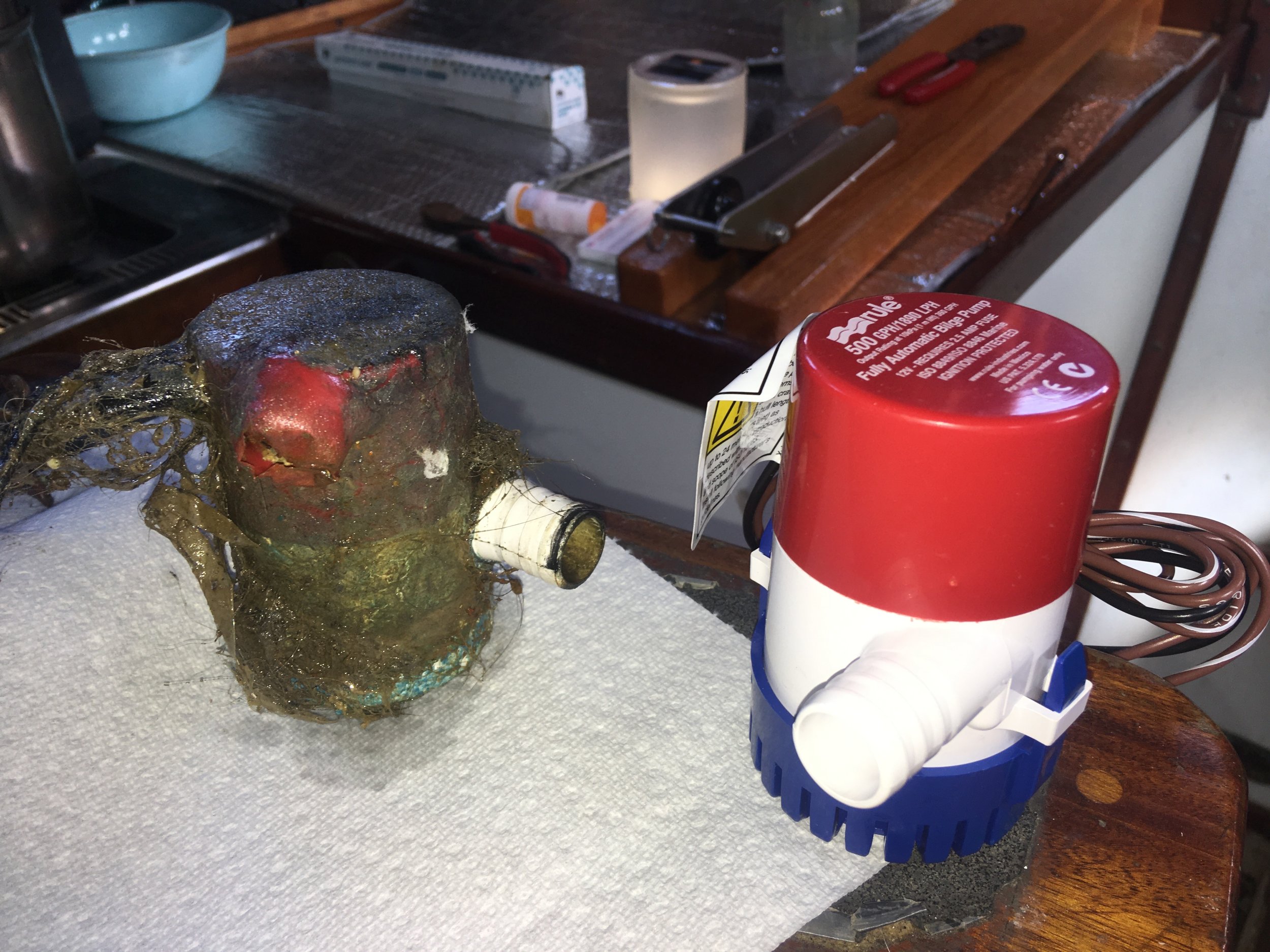
Lovely, isn't it? Hair, sand, and fouling has collected on the surface of the pump, but that didn't lead to its failure. The failure came from that giant bubble on the top of the pump!

IMG_2146.JPG

The pump apparently overheated, causing the plastic to heat up and melt. The plastic then expanded to the point where it became so thin that it burst and water poured into the electric motor inside, killing it instantly! 

IMG_2145.JPG

Comparing the old pump to the replacement, the issue becomes very apparent. The alarming thing is that the breaker never tripped! We could flip the breaker to turn on the pump, and nothing would happen. The pump didn't run and the breaker didn't trip. I just figured that the unit had died and needed to be replaced, but this was not what I had pictured in my head. 

The water that came out of the housing was stained with rust, letting me know that everything inside the pump has died an oxidative death. It was a little concerning that the breaker never tripped even though salt water was poured over all the internal electrical connections, but regardless, the pump has been replaced and the sump can now be emptied once again.