
Life Aboard

Collision At Sea

While cruising, we come across many ships and yachts on the water. Naturally, we are all keeping a good lookout and this lets us all avoid any problems. If I see a yacht on the horizon and that yacht sees me, we will both work our hardest to avoid running into each other.  

Sailors tend to keep their distance, as none of us want to get too close to each other. It's a big ocean after all, why get too close? Power boaters will cut it closer, as they feel their motor boat will zip along before we move. We have had some very close encounters where a powerboat insists on passing across our bow instead of going behind our stern. It is always nicer to a sailboat to pass on their stern, not only because it is less nerve wracking, but also because of the wake you create. A wake hitting a sailboat on the stern will give them a gentle push. A wake hitting a sailboat on the bow will stop them in their tracks! 

Private yachts are plentiful on the weekends, as most people with boats also have jobs. Therefore, they are working during the week. On weekdays, the kinds of boats we come across are other cruising sailors and commercial ships. 

Commercial ships can be categorized into three groups, fishing, massive cargo ships, and tug boats. The fishing boats are keeping a good lookout and tend to stay close to the coast where they work their traps. The massive cargo ships are limited to the channel as they are constrained by draft. 

When sailing along, you technically have right of way over any power boat because you are under sail, but a massive cargo ship can't maneuver around you. This means that when you are outside of a shipping channel, sail has right of way. When you are in the shipping channel, yield all right of way to the massive cargo ships.  

When offshore, there are no channels, and you once again have right of way over the container ships. I have found these captains to be very curtious when off shore. I simply hail them on the radio and tell them my position to verify that they can see me. Then they adjust course slightly to avoid any kind of close encounter. When you contact them miles apart, tensions are lower and a course correction of 1 degree will make all the difference in the world. If you wait until you can see the captains face in the bridge, tensions will be much higher and I don't think they would be as courteous about the entire situation. 

The last kind of commercial ship you will encounter would be tug boats. Honestly, these have been the worst kind of boat to deal with on the water in terms of curtesy and alertness. When pushing or pulling cargo, they will stay in the channel and the same rules apply as with massive cargo ships: yield all right of way to them. When they are not carrying cargo, they tend to cruise along next to the channel since they are not constrained to the channel by draft. This is where the problems begin.  

Tug boats are small and low, making them hard to spot off on the horizon. They also move along quickly, meaning that when you see them, they are going to be upon you very soon. The last problem is: the tug boat captains don't seem to keep any kind of lookout at all. We have narrowly avoided collisions with tugboats multiple times because they come right at us! 

Our last near miss occurred at night. We were outside of the channel and saw navigation lights approaching us. We were under sail and had our masthead tricolor light turned on, he was under power and had his navigation lights and steaming light turned on. I kept an eye on the tug figuring that it would turn to avoid a collision, but it kept its course. Naturally, the wind died and we slowed as the tug boat neared us. It got so close before turning that we could see all of its interior lights through the portholes. When we were a mere 100 feet away, he made a drastic turn to starboard as we quickly jibed to port to evade a collision. Maddie and I think that he wasn't looking and turned as soon as he saw us, which was almost too late!  

Sadly, this isn't an isolated incident. We often see tugs running next to the channel at full speed, narrowly missing other yachts as well. Our theory is that they are busy doing paper work and not looking at the water as they head from one job to the next. They are focused on work and not on the seas around them. The probably have their AIS alarm turned on, warning them of any approaching commercial ships, and ignore the rest of the boaters as the barge their way through. 

Tug boat captains also seem to have a bit of an attitude as well. We were about 10 miles off shore one time, well out of any channels and in the open waterways of the ocean. A tug boat was on a collision course with us (based on the AIS proximity alarm) so I radioed his bridge. The captain was very snarky and rude during the whole thing. We were about 20 minutes away from a collision and so I asked him to alter his course a few degrees to bring us away from a collision. The response from the captain of Arabian Sea was "This thing doesn't turn on a dime." I told him I understood that and that is why I was notifying him several miles ahead. After many other snarky comments from the captain, I saw that his heading changed by 2 degrees and our distance at closest approach increased from 0 to several miles. 

It seems that all other boats are courteous and kind on the water, paying attention to their surroundings as they share the waterways with all other boats. There are many times when I will get on the radio to let a larger craft know that I will yield around him even though I technically have right of way simply because it is easier for me to do and a common curtesy among boaters. Then you run into the tug boats, who seem to never keep a lookout and never are willing to cooperate with other boaters on the water. 
Waking Up in New Places

One of the coolest parts about cruising is you can wake up in a different place whenever you want! Maddie and I have been exploring the Chesapeake Bay as we make our way along on our voyage. We plan to cross the Atlantic and slip into the Mediterranean Sea before we shoot over to the Caribbean and enjoy the island life. The Chesapeake Bay is a gem that people travel to from all over the world. For that reason, we decided not to skip over it, and to instead spend a few months exploring it as we make our way along. 

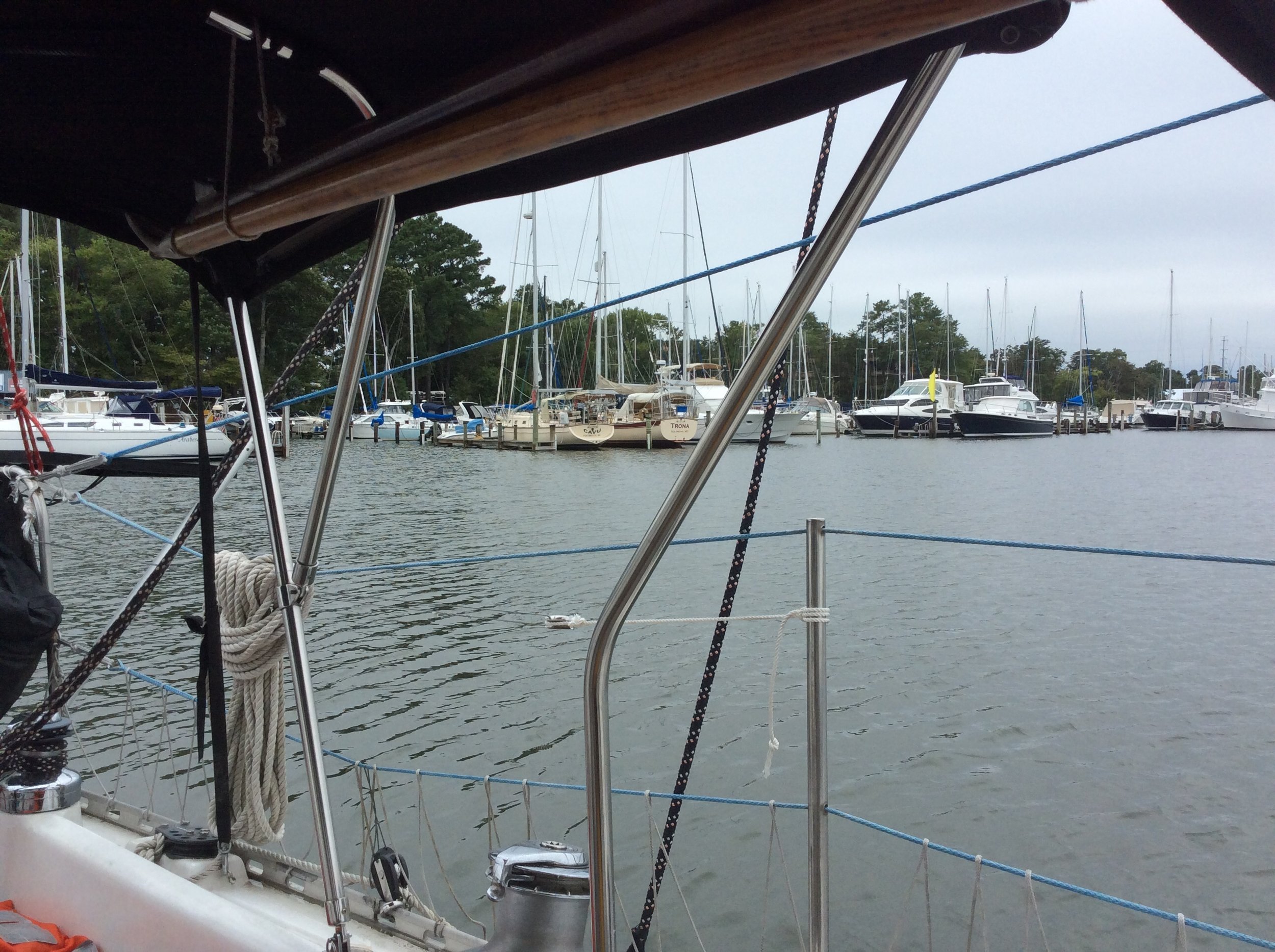
Some morning we find ourselves in a quiet creek surrounded by trees and birds. Other mornings we are anchored next to a small island in the bay. Today, we awoke next to Solomon's Island surrounded by marinas and yachts of all styles.  

image.jpg

We plan to stay here for a few days while we work on a few projects as this creek is very close to a West Marine, a prominent boating supply store. If we find that any of our gear needs replacing while we are doing maintenance, that store will carry the parts that we would need. The constant change in scenery makes every morning special as you travel across the waters of the world. 

Navigating the Blog

Welcome to the Blog!  Maddie and I have been living on a 1968 Morgan 45 for a few years before we set out cruising on her. She is our project, our home, and our adventure machine!

This blog covers topics pertaining to sailing and all the parts of a sailboat. There is a special focus on rigging, but rigging is just a small part of a sailboat, and the sailboat should always be the main emphasis of rigging. 

What is the point of perfectly tuning your standing rigging if it doesn't let the boat sail well? Rigging should always be thought of in a dynamic way, where it influences the sailshape as much as the running rigging. Together, all of these factors join forces to create a sailing experience! 

The blog is more of an "information dumping ground" rather than a carefully laid out book, the topics from one blog post to the next are typically unrelated. One day it might talk about cap shroud tension, the next post might talk about anchors, and the next one be about pets on a sailboat.

To help sort through the random array of topics of the blog, it is best to search exactly what you are looking for in the search bar, located on the top right of the blog page. 

IMG_1692.JPG

When you type in your topic, it will search the blog for those keywords and tags to generate a list of that specific topic. If you want to look up how to tighten your standing rigging, type that in and look through the posts that it brings up. If you are more interested in Barber Haulers, type that in and enjoy the results. 

At the bottom of each post, there are tags that you can click on to bring up other posts that share the same tag. At the top of each post, near the title, there are categories that you can click on. The tags are much more specific while the categories are much broader. The categories of the blog are: Cruising, Electric Propulsion, Knots, Life Aboard, Navigating, Plastic Pollution, Running Rigging, Sails, Standing Rigging, and Tiny House.

Below the search bar is a rolling set of photos from our Instagram account. You can enjoy the passing images that we have taken while we are cruising, or you can click on them to follow us on our adventure through Instagram.  

We also have a YouTube channel http://www.youtube.com/riggingdoctor where you can subscribe to follow along with our journey in a video format. 

IMG_1694.JPG

At the very bottom of the page, you will see a black section and in the middle it will say "Life Aboard Index." This is the index to the blog which will pull up every post ever written and list them by the date they were published. If you feel like perusing the catalog of blog posts, you can click here and browse over the titles to see if anything strikes your interest. 

IMG_1696.JPG

The blog may seem a bit confusing to navigate at first, being how there is no logical order to the posts you will find in it. We publish a new post everyday at 9AM EST about a different topic. I recommend stopping by daily to check out the latest post, this way you can broaden your understandings about the inns and out of sailboat living and all the components that make it work. If you have a specific topic you are researching, I would suggest starting with the search bar.

I hope you enjoy the read, and please share the website with your friends and family who might be interested in sailing and cruising. 

Riding a Storm Front

Weather is an unavoidable phenomenon to the cruising sailor. Day sailors have the luxury of choosing which days they wish to leave their marina berth to go sailing. Cruisers, on the other hand, are always out there. On blustery days, they will have to hunker down in a protected cove or rage on with their storm sails flying proudly.

Weather doesn't just creep up out of nowhere though. It comes in and goes out in a manner that is very visible. We found ourselves sailing along down the Chesapeake Bay between Chesapeake Beach and the Potomac River. This stretch of water offers few opportunities to duck in and wait out the weather, so we had to continue on as we saw our sky deteriorating.

We started off sailing along under clear blue skies without a cloud to be seen. As the day progressed, whisky cirrus clouds began to roll in and soon the front of a low pressure was chasing us. I laid down on the bow of the boat and stared up at the front, noticing that the clouds were moving at roughly the same speed we were, and if we could keep our speed, we might just make it to the anchorage ahead of the storm.

Usually, we reef down as a storm front approaches, but in this case, we kept on under full sail, riding along on a beam reach as the low pressure behind us slowly crept up. All went well until sunset. All of a sudden, the winds died down and our speed dropped. The moon became obscured by hazy clouds until it was fully blocked out. We were nowhere near our anchorage, but we lost the race with the sky. The low pressure front crept over us and we were now in its grasp. We quickly reeled the sails even though the winds were light because we knew that at any moment, strong gusts would start coming our way and we had nowhere to hide.

Dangers of Roller Furling in Ocean Sailing

When heading out on an ocean voyage, safety becomes paramount and a lot of preparation will be taken to ensure that the boat is in tip top order. Extra safety gear, such as flares, life rafts, EPIRBS, and the such are considered vital pieces of equipment to carry on board while crossing oceans. Most everyone thinks about what to add to their yacht to improve safety, and sadly only few think about what to remove to improve safety.

Roller furling is a wonderful invention that allows the captain to sail short handed. Working a single line, the furler line, a single sailor is able to set as well as retrieve a massive 180% genoa without ever leaving the cockpit. Roller furling also makes it very easy to get out sailing quicker, as there are no sails to hank on. Best of all, when you arrive at port, it is very quick and easy to put away the sails as the headsail will simply furl up on the headstay in a neat and concise package.

All of these facets make roller furling a wonderful feature on a coastal cruiser, but coastal cruising is far from ocean cruising. Out in the ocean, there is no safe harbor to run to as a storm approaches. If gear fails, there are no repair facilities nearby. No, you are alone in a huge ocean and need to be completely self sufficient and storm ready.

The most dangerous thing to have during a storm is too much sail up. If your furler jams as a storm approaches, you could find yourself in a horrible predicament! This huge massive sail now needs to come down but your gear is failing you when you need it most! If the sail is partially furled when it jams, you will be unable to lower the sail by releasing the halyard since the luff will be tight against the foil.

If you do manage to get the sail to come down, you will now have to deal with a massive sail that is being blown around on the deck with no attachment to the luff. Being how furling headsails tend to be massive, this will further complicate the situation. To add fuel to the fire that is raging out of control at this point, you must also contend with the fact that you are out of practice at removing, flaking, and stowing your headsail being how you never need to do it. In the midst of a storm is not the ideal time to practice something you are rusty at!

Just because your furler is working well as the storm approaches and you can safely and successfully roll up your sail doesn't mean you are safe as the storm rages on. A furled sail will only remain that way as long as the furling line is present and made fast. Should the furling line slip off its cleat, or worse, chafe through and break, the entire sail will come out at the worst possible time.

A rapidly unfurled sail in a storm will quickly overpower your yacht and pull you along violently at the mercy of the winds. Worse yet, the flogging sail will quickly destroy everything involved due to the repeated forceful cyclic loads. The flogging sail will quickly destroy the sail as the leech beats back and forth in the wind, meanwhile, the headstay which holds the sail will also be abused. The repeated loads will stress and strain the headstay and its fittings. If any of the numerous parts of the headstay fail, the entire mast can come crashing down onto the deck in a violent de-masting.

Headstays are more likely to fail inside of a roller furler because the furler itself constantly impacts the headstay, leading to work hardening of the metals involved. Secondly, the furler covers the entire headstay assembly, making it hard to inspect. Being out of sight, also puts it out of mind. If a cotter pin were missing, no one would know. The force of a flogging headsail will take swift advantage of any weaknesses and bring your mast crashing down in the storm.

While this may sound like furlers are a horrible thing to have on a sailboat, and that ocean sailing is dangerous, this is far from the truth. Furlers are wonderful contraptions for coastal cruisers and day sailors. They make headsail management a breeze and are very convenient. Ocean sailing is not dangerous if you have the right equipment, and one of the best setups for a headsail on an ocean voyaging yacht is a hank on headsail.

Hank on sails are attached to the bare stay, allowing you ease of inspection. They are raised and lowered with a halyard, so in a horrible blow, they can always be dropped in a hurry and lashed onto the deck. When they are lowered, they offer less air resistance up high as compared to a bulky furled sail. Lastly, if the sail is tied down onto the deck, or even better, removed from the stay entirely, it will not present any risk of bursting into the wind during a gale.

A hank on sail does what you want it to do. When you want to set it, you raise it up. When you need to reduce sail area, it will come down. They are reliable and trustworthy sails on an ocean yacht, but they are a lot more work and require you to go forward to the headstay while out at sea. This necessitates extra care to make all the crew members safe during foredeck work, but at the same time, provides the reliability needed to keep everyone safe and ensure you arrive at your next shore.