
Life Aboard

Fastening the Transom

With the transom dry fitted and a proper fit verified, the time to permanently attach the transom board to the sternpost had come. The sternpost is 2.5 inches wide, offering plenty of space to hold the bronze wood screws that would be driven in. 

If the screw holes were all set down the center of the transom, the combined force of the screws would cause the sternpost to split! To avoid this, the screws were staggered across a one inch span, alternating their position. To do this, I marked the centerline of the transom board and then marked one half inch to either side of the center. Using a straight edge, I then traced a straight line that runs down the off center lines. These lines will serve as the guide for the pilot holes. The pilot holes were drilled along this line, spacing them out evenly along the transom board, producing a regular and pleasing to look at pattern down the middle of the transom.

The holes were then countersunk by running a power drill in reverse at high speed. The drill will not dig in as the drill bit is spinning in the wrong direction, instead the heat will slowly cause the the drill to burn into the holes while the soot is whisked away by the passing drill bit. The procedure only takes a few seconds and will produce an even counter sunk hole with no tearing or damage to the surface of the wood you are working on. 

With plenty of bedding compound on the screw holes, stern post, and keel rabbet, the transom was screwed into place with bronze fasteners. Excess bedding compound that spilled out of the screw holes was attempted to be cleaned off with acetone but it ended up just spreading it everywhere. Once it cures fully, it will be sanded off and removed before the transom is varnished.

Jump, Steps, or Gangplank

The biggest difference between living in a house and living on a boat is the walk to your car. The inside of a boat can be exactly what you want it to be since can pick and choose what kind of boat you want to live in. Regardless of what kind of boat you have, the walk will always be the same. Getting off the boat can be accomplished by either jumping the gap to the pier, walking down a series of steps, or walking down a gangplank.

From here, you will walk down a pier where birds and fish will be a frequent sight. There will be wind in your face and sun on your skin as you make the trip.

I used to jump the gap between the boat and pier for a few years, but I don't recommend it. If you miss your step, you can fall into the water and get completely soaked right when you were ready to leave. This can easily make your day turn for the worst.

Steps are the other alternative for getting on and off your boat. Steps do make it easier and reduce the risk of falling in, but they can be hard to navigate when you are carrying a large load. Imagine your hands are filled with laundry and you can't see your feet. Now walk up a small set of stairs and get into a boat without seeing any visual ques as to where your feet should go. Yeah, not so easy.

The next option is to use a gangplank. A gangplank is a much simpler device as it is just a ramp that runs up to the boat. There are no steps to trip on, just a ramp that takes you from the pier to the boat. The best part about a gangplank is the ability to get large items into the boat. If you are pulling a cart up to the boat, you can now easily bring the cart up onto the deck.  If you had steps, you would have to leave the cart on the dock and carry your items into the boat.

Fitting the Transom

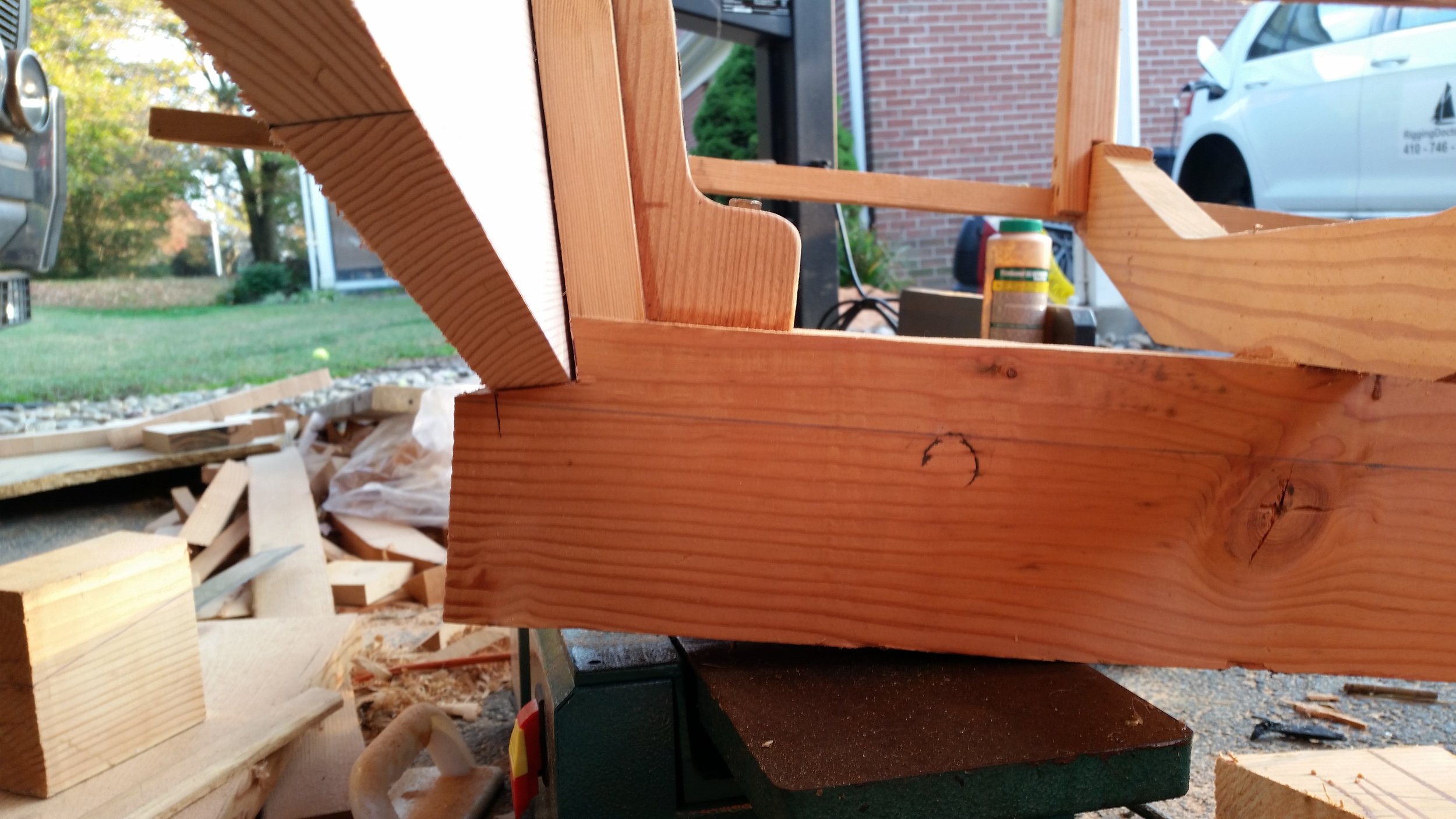
The transom board will be fastened to the stern post and will set into the keel below the stern knee. This will let the bottom planks flow effortlessly from the keel and rabbet line into the transom where they will fasten at the end. In order for the transom to fit into the keel, a notch must be cut to allow the transom a void to fill.

A square was set on the sternpost and was slid one inch past the top of the keel. The outline was traced as this would give me the profile of the transom board. I did not cut any bevels into the transom board as keeping its sides set to ninety degrees make assembly faster.

Using a miter saw, I carefully cut the notch into the keel, making sure that the saw was cutting parallel to the keel and not beyond the cut lines drawn on either side of the keel. The excess length of the keel was cut off using a regular hand saw and the transom board was dry fitted. The inside corner of the cut was refined using a series of files, converting the cut surface from a rough cut down to a fine and smooth surface that will closely accept the transom board. 

The faying surface was bathed with bedding compound and the transom was mated to the keel in a water-tight fashion. The added surface area offered by the rabbet will help ensure that unwanted water intrusion is avoided.

Towing Windpuff

In preparation for going cruising, we needed to get Windpuff out of the water and onto the hard. Windpuff lives near us in the marina, so we check on him all the time to make sure that none of the scuppers are covered with leaves that would cause rain to back up and make a mess. Since we are going cruising, we won't be around to check on him as often as we currently do, so we decided to pull Windpuff out and shrink wrap him. 

Windpuff will remain on land while we are away, safe and protected from the elements until we return.

Cleaning up the Forefoot

Now that the bedding compound has fully cured, it is time to clean up the forefoot and make it look like the front of a boat and not a pile of scrap wood scarfed together.

The excess bedding compound was easily peeled off by hand, leaving a clean line that is (hopefully) water tight. The next thing to do is to cut the finger joints off the front of the keel. The finger joints were going to support the stem in a plumb position, but this plan was changed when the stem was not properly aligned with the frames. Setting the stem raked was the only option to salvage the stem, otherwise I would have needed to make a new stem that would fit plumb bow. 

The stem line was continued onto the keel, where it was then cutoff with a handsaw. This rough cut was simply to tone down the front of the dinghy and is by no means the final shape of the forefoot.

20161019_171307.jpg

Should the stem and keel junction leak, I have two choices: add lots of caulk and pray or cut and fit in a gripe.

When viewed from the front, the bookmatched grain is very apparent. This grain pattern will offer greater holding power to the planking screws when the rabbet is finally cut in and the garboard fitted. Until then, the forefoot will continue to be an overly bulky and clunky block of oversized wood.