Life Aboard

Attaching the Sheer and Shelf Clamp

With the chines in place, it is time to attach the sheer and shelf clamp. These two strakes will tighten up the top end of the dinghy frames and make the framework look like a potential boat instead of a possible boat. 

image.jpg

The sheer and shelf clamp need to be installed at the same time since they are riveted together. I began with the first three stations, setting the two strakes on the third station with a C Clamp to hold it in place while I worked on stations one and two. Once the first two stations were secured, I could remove the clamp as I worked my way aft.  

The bend in the hull proved to resist accepting the strakes. These strakes wanted to remain straight and were not keen on being bent into shape. The downfall of these strakes is their length, providing me with the leverage I need to bend them into place and rivet them together. 

image.jpg

Work proceeded quickly, first connecting all the sheer and shelf clamps with a single row of rivets at the top of the frames, followed by a second row of rivets to further attach the bottom of the sheer strake. The stem is still not present so the strakes are set longer than the length needed in both fore and aft dimensions.  
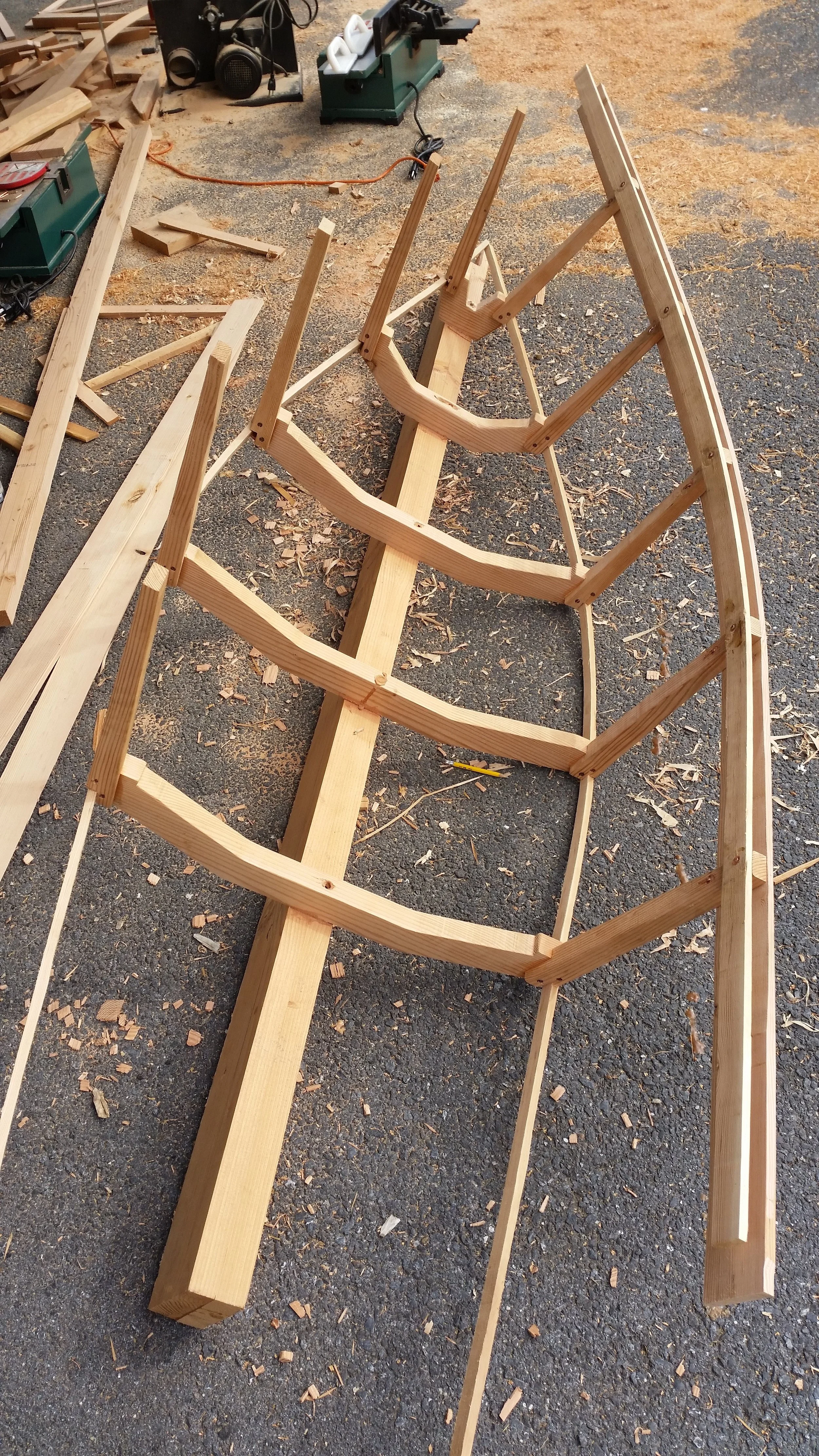
image.jpg

In the end, the starboard sheer and shelf clamp were securely fastened to the frames. This solidified the starboard half of the boat and tied all the frames together. The dinghy is really beginning to look like a small boat instead of a pile of random cuts of lumber. 

Provisioning

When provisioning for a trip, don't make the same mistake we made. We went out to the grocery store and purchased a massive amount of food! 

We had two full carts of food with everything stuffed into them. We had cases of waters, chips, fruits, vegetables, and canned foods, as well as everything else you can think of. 

We ate what we normally do, and all this extra food simply began to rot! What's worse is the canned vegetables were disgusting, so aweful that they are still in the back of a locker, just waiting to be thrown out. All the money we spent on wasted food could have been used towards anything else on the boat, but instead was thrown out as rotten lettuce.

Thinking that we learned our lesson from this fiasco, we decided not to go overboard with food provisioning on our future trips. When we set off for a 2 week cruise, we once again bought what we thought would be an adequate amount of food for the trip. Once again, the extra food we purchased began to rot and had to be thrown out.

The moral of the story is, only buy the normal amount of food that you would consume on a regular basis. If you buy extra food, it will go bad and you will have wasted that money. Instead of "provisioning" for a trip, what we do now is cast off. If we find that we need more of something, we will pull into a port and pick it up. 

This is an easy approach for us since we liveaboard. Our regular grocery shopping is what we consume in a regular amount of time. We typically go shopping every other week, so we know that we have around two weeks worth of food on board at any given moment. Instead of wasting money on extra food, we simply shove off and provision along the way.

Another word of warning: Canned vegetables are disgusting and there is nothing you can do to make them better. I have tried everything like adding them to delicious dishes, but all they do is ruin everything. Canned string beans are the worst offenders, followed by canned carrots and canned peas. Canned corn isn't that bad, and can be hidden in chili, but fresh corn is a million times better. Canned beans on the other hand are wonderful and they will keep for years!

While we don't stock up on extra fresh foods or foods that need refrigerating, we do stock up on rice, beans, and canned meats (Vienna Sausages are amazing) as these foods won't go bad and make a great meal that can be eaten while on watch.

Rivet Tool

Copper rivets are a wonderful fastener to connect planks to frames. They combine the advantages of through bolting and screws with only one pitfall.  

Through bolts provide tremendous clamping pressure without relying on the substrate for resistance. A through bolt is places the forces on the opposing side which has its force disseminated via a washer or backing plate. The nut and bolt pull tightly towards each other and compress everything in between them.. The problem with through bolting is the ends are bulky. The nut protrudes and can offer a place to hook clothing and lines.  

Screws on the other hand are very low profile with only the head of the screw protruding. This head can be minimized by either using flat head or counter sinking. Screws go deep into the wood and leave nearly no trace behind. The problem with screws is they rely on the substrate for resistance to extraction. The little threads are all that offer mechanical resistance to their extraction. If the substrate is soft, the screw can pull out. At the same time, the material is under constant strain from the screw being forced into the substrate.  

In short, screws are low profile but place strain on the material they are inserted into. Bolts do not place strain on the material and instead place strain on the fastener itself, but are rather bulky. 

Rivets are both low profile, place the strain on the fastener, and are not bulky. They function by inserting a copper nail through the material and then mushrooming the end to lock it onto a copper rove, sort of like a copper washer. The only problem rivets have is they are time consuming and technique sensitive to install. 

As with any fastener, specialized tools make work much easier. Screws use screw drivers, nuts and bolts use wrenches, and rivets use clamps, hammers, and dies. 

The rivet clamp is a great tool for inserting rivets and fitting the rove tightly to the strakes. It uses the mechanical advantage of an inclined plane in the form of a screw to tightly compress everything in the system. 

image.jpg

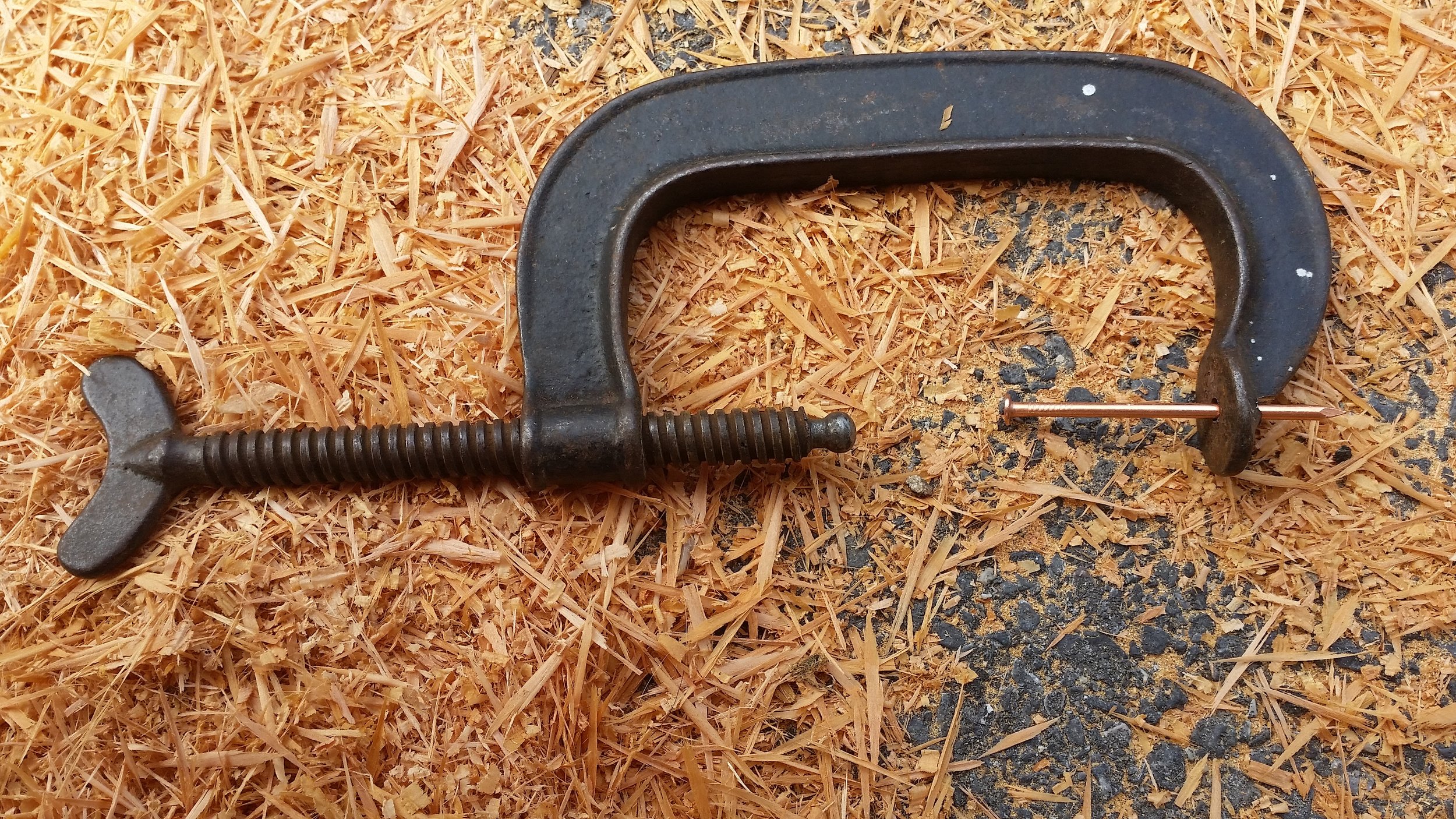
To make a rivet clamp, all you need is a large C-Clamp. Remove the lower pad from the ball and drill a hole through the top of the clamp. The ball at the end of the screw is excellent for compressing the head of the nail into the wood while the other end of the nail exits through the top of the clamp. 


image.jpg

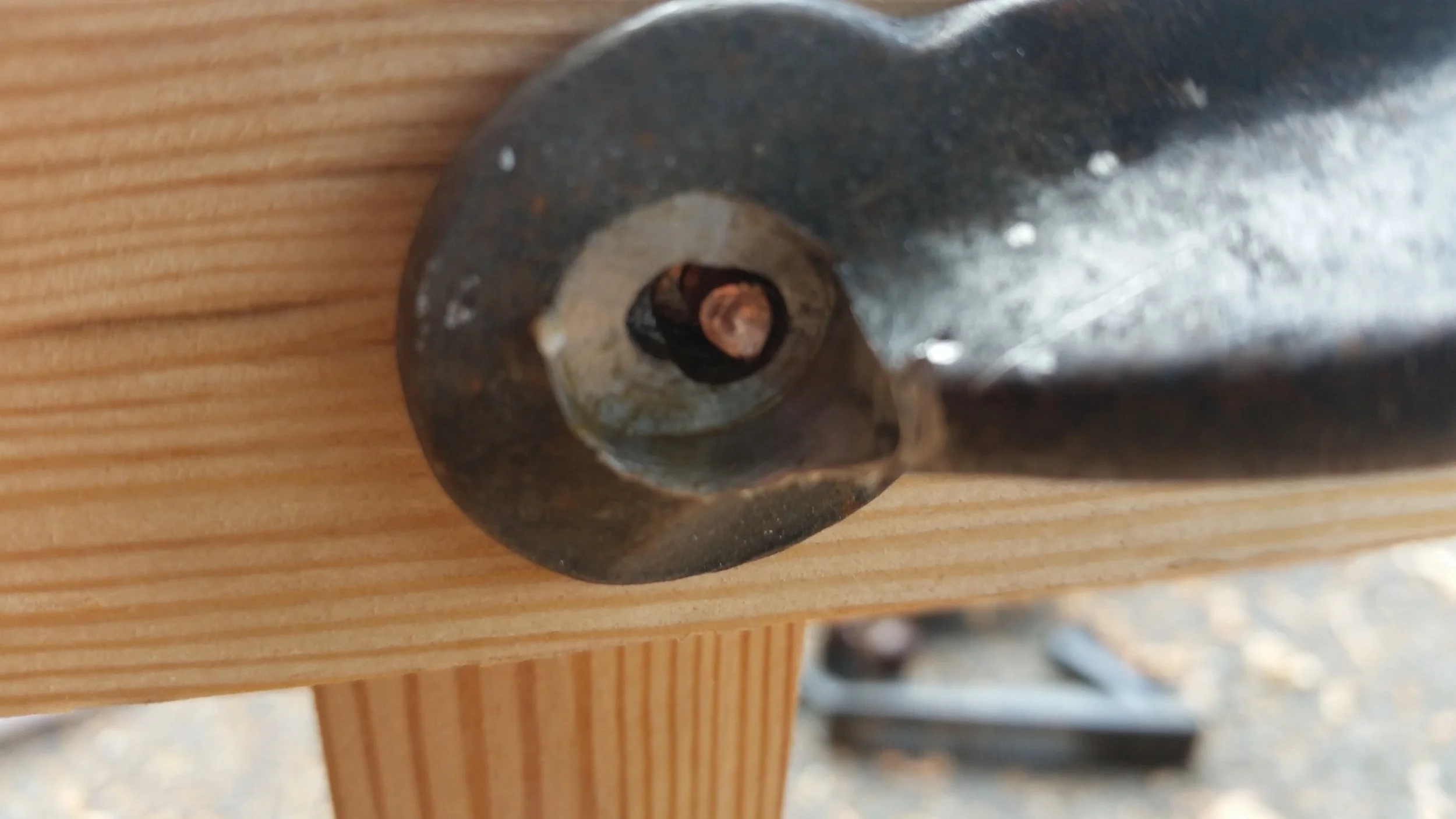
Removing the lower pad allows the ball to fit into smaller spaces without distortion. If you are counter sinking the nail heads, the ball will fit down the hole with ease. 

image.jpg

Drilling small hole for the nail to pass will keep the rove in place as you clamp the unit down. Drilling a larger hole part way down the clamp will let you insert center punches into the unit to mushroom the head of the rivet while it is still under clamping pressure! When you remove the clamp, the rivet will continue to hold the strakes tightly as the mushroom head will not allow it to expand. 

This simple modification will let you insert rivets in a much more systematic way which will increase your speed and advance the progress of your projects.  

Connecting the Sheer and Shelf Clamps

On our little dinghy, we are tying the frames together with stringers. The sheer and shelf clamp are being riveted to the frames. Copper rivets offer a lot of resistance to corrosion, offer the same benefits of through bolting, and are less bulky. 

The head of the nail lays flush with the planking on the outside while the head of the rivet is pounded smooth with the inside of the hull. There are no hex heads or nuts to get hooked up on, instead only smooth rivet ends. 

image.jpg

A pilot hole is drilled through the sheer, frame head, and shelf clamp. The strakes need to be in their perfect final location as there will be no moving once the hole is drilled. 

image.jpg

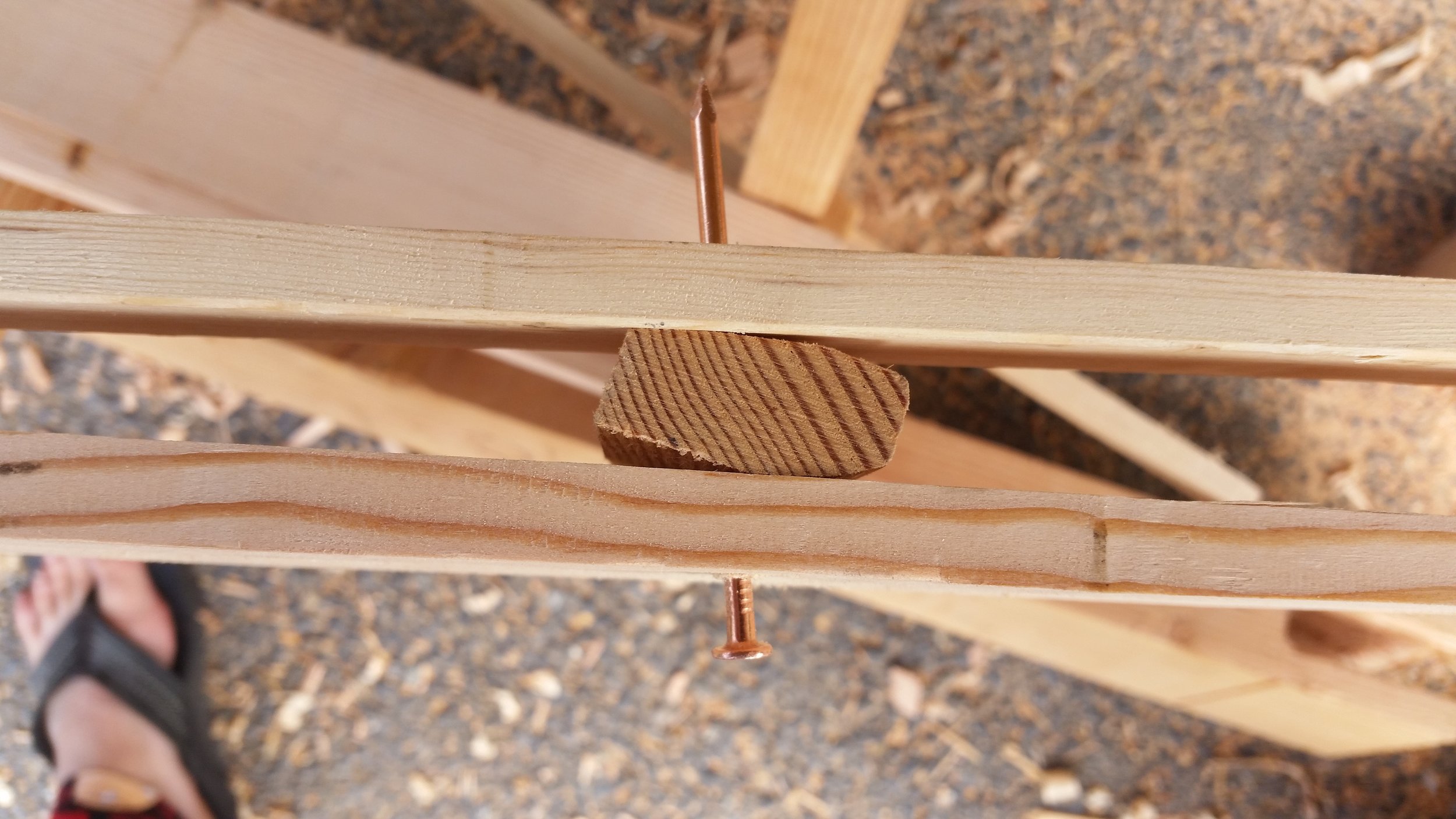
The copper nail is tapped through the wood members until it projects out the other side. This nail will be used to create the final rivet that will connect these stringers. 

image.jpg

The rove was driven over the copper nail using a modified clamp. As pressure is applied to the clamp, the rove is driven all the way down until the strakes compress over the frame head.  

image.jpg

The copper nail is then cut short and the end of the nail is mushroomed. 

image.jpg

At this point, the clamp can be removed as there is no risk that the rove will slide off the nail. With the clamp off and out of the way, the end of the head can be mushroomed to tighten up and finish off the rivet. I like to secure another regular C-Clamp next to the rove and over the head of the nail. This will keep the nail from backing out while I shape the head and will tighten the boards together and produce a very strong connection between the frames and the stringers.

Life Aboard vs. Life Ashore

People often ask us how safe it is to live aboard and to go long distance sailing. While life aboard can have its risks, life on land is not devoid of dangers either. 

20161217_113027.jpg

We woke up on the winter morning of December 17, 2016 and found the boat covered in ice. The deck was a bit slippery, but we were able to walk on the deck by chocking our feet into the toe rail. We held onto the lifelines and grab bars as we worked our way to gangplank. 

20161217_113146.jpg

The gangplank was completely covered in ice, and traction was non-existent. Thankfully, the rat bars offered a way to hold our feet in place and keep us from sliding down the gangplank onto the pier. While this entire journey was not the most graceful nor quick, it was also never risky to our safety.

20161217_113138.jpg

Walking down the pier, our neighbors wooden yawl had gorgeous icicles hanging from his mizzen boom. The ice covered everything and made the boats look like a magical wonderland! I decided to go visit my parents this morning, so I made my way to the car and found life ashore to have a completely different outlook to the winter wonderland.

Cars in the city were spun around and smashed into light poles and walls, but city drivers swerve around the city streets like madmen. The fact that they may have spun out on a patch of ice was of little surprise to me. I continued to make my way towards the country, where my parents live, when I came upon a massive disaster on the highway!

In the early hours of the morning, a fuel tanker slid on ice and went over the barrier wall, exploding into a blaze of fire that engulfed the highway. Approaching traffic slammed on their brakes as they approached the inferno, but they slid on ice and began crashing into each other. By the early morning, the cars and trucks had been turned into scrambled eggs as they kept compacting into each other.

When people question how safe living aboard or cruising is, I must ask, how safe is it to live on land and commute on crowded highways traveling very fast and close together. If a driver error were to occur, the consequences could be dire! This mornings collision involved more than 50 automobiles and caused at least 2 deaths!

Sailing in the exact opposite, everything happens very slowly and you always keep plenty of space between you and the next yacht. When we are in the bay, we set the proximity alarm on our AIS receiver to 0.25 nautical miles. In the ocean, we increase the alarm range to 2 nautical miles! If someone were to come within that distance, we begin to worry as we are getting "too close for comfort". Yes, on a sailboat traveling 6 knots, 0.25 miles is too close for comfort, whereas on a highway, cars traveling over 65mph are only a few feet apart!

When landlubbers seem concerned about the safety of sailing, I wonder what they think about the safety of driving.