Life Aboard

Floors

With the measurements transferred back to the backbone and verified on the deck for fitment, it is time to continue with the construction of the hull. 

The measurements from the keel were transfered to a large paper which served as lofting paper to cut out the floors. The marks were connected by way of a batten, producing a fair line that flows from bow to stern.

The floors will end at the chine and the frames will attach to them. The chine will be 2 inches inward of the gunwale, producing a curve to the hull that is pleasing to the eyes.

The floors need to follow the angle of the hull, allowing the planks to lead into the rabbet line on the keel. These points are all known, since the chine is set 3 inches higher than the rabbet, adding three inches to the floor marking and connecting the dots produced a floor template. Then the top of the floor was added to give the unit strength. Based on Herreshoff's Scantling Rules, I knew that the floors need to be 2.2 inches high, so 2.2 inches were added to height of the floors. This means that the ends where the corners taper down to nothing are too small to function. Normally, the floors would taper and come to an end, and the bottom futtock would attach to the floors, but this hull is so small that it doesn't make sense to make a floor, bottom futtock, and top futtock. 

Instead, the floors are going to extend all the way to the chine and serve as the bottom portion of the frames, with the top futtock fastened to the end of the floor/futtock.

Based on these measurements, the frames were drawn on the boards available and set to be cut out.

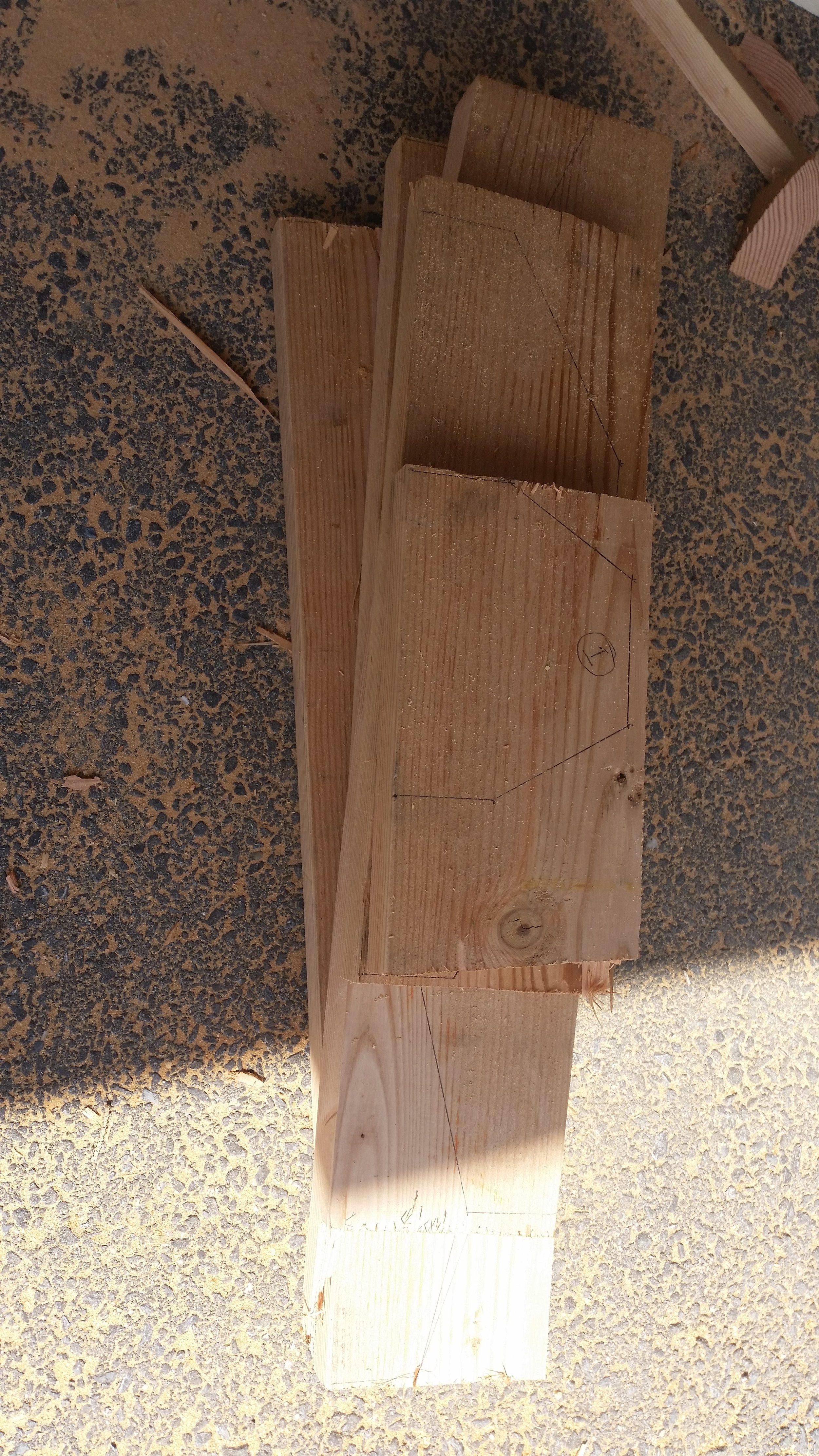
The bandsaw made quick work of the boards, cutting the floors basic shape out in very little time. The floors received an individual number identifying them to their corresponding station.

With the floors set on the keel, the bottom hull profile is beginning to take shape. The next step will be to fabricate the frames and connect them to the floors, making the characteristic "ribs" of the boat.

Visual Inspection

The importance of visually inspecting your equipment can not be underrated!

This battery was removed during a survey of a power boat. The owner claimed that the battery works fine, as he used it to start the generator yesterday! Turns out the generator is connected to this battery and in parallel with the engines starting batteries. When this battery died (and exploded), the owner never noticed because the generator kept starting. 

The inside of the battery is severely corroded and all the cells are dry!

"Maintenance Free" doesn't mean "Inspection Free". Even if you don't need to add water to your cells, it is still a good idea to look at your equipment periodically to make sure you don't have something like this lurking beneath your cabin sole.

Redesigning the New Dinghy

With the maximum dimensions of the dinghy measured in place on the deck, it is time to finalize the design of the dinghy.

Using a hull design program from Carlson Design, I was able to place specific stations and allow the program to produce a fair line. This program also allows me to evaluate the maximum displacement of the craft and evaluate where the center of buoyancy will lie. The program is available for free from Carlson Design.

http://carlsondesign.com/projects/hull-designer/

Follow the link above to the webpage where the calculator can be found and downloaded.

Clicking the link below the yellow arrow will download the file which can be opened to run the program. The program works wonderfully, and provides a wealth of information in just moments. 

With the maximum and minimum measurements, I was able to design a dinghy that fit within these tolerances. I then received approval from Maddie and got the go-ahead to build such a dinghy.

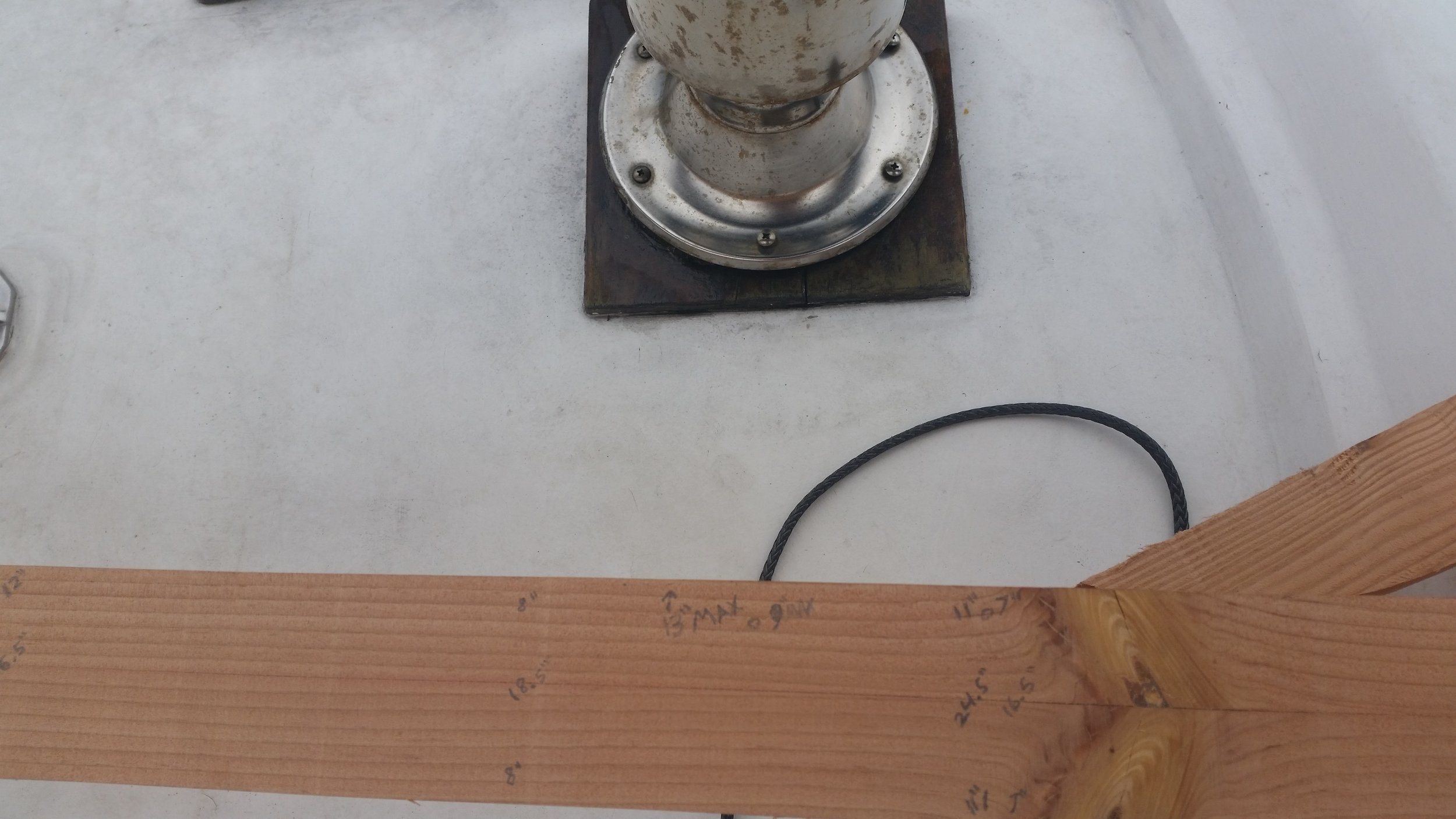
The measurements were then transferred back onto the dinghy and verified on the deck, making sure that the chimney will not be obstructed and that the hatch will be fully covered. 

Building the Backbone: Test Fitting

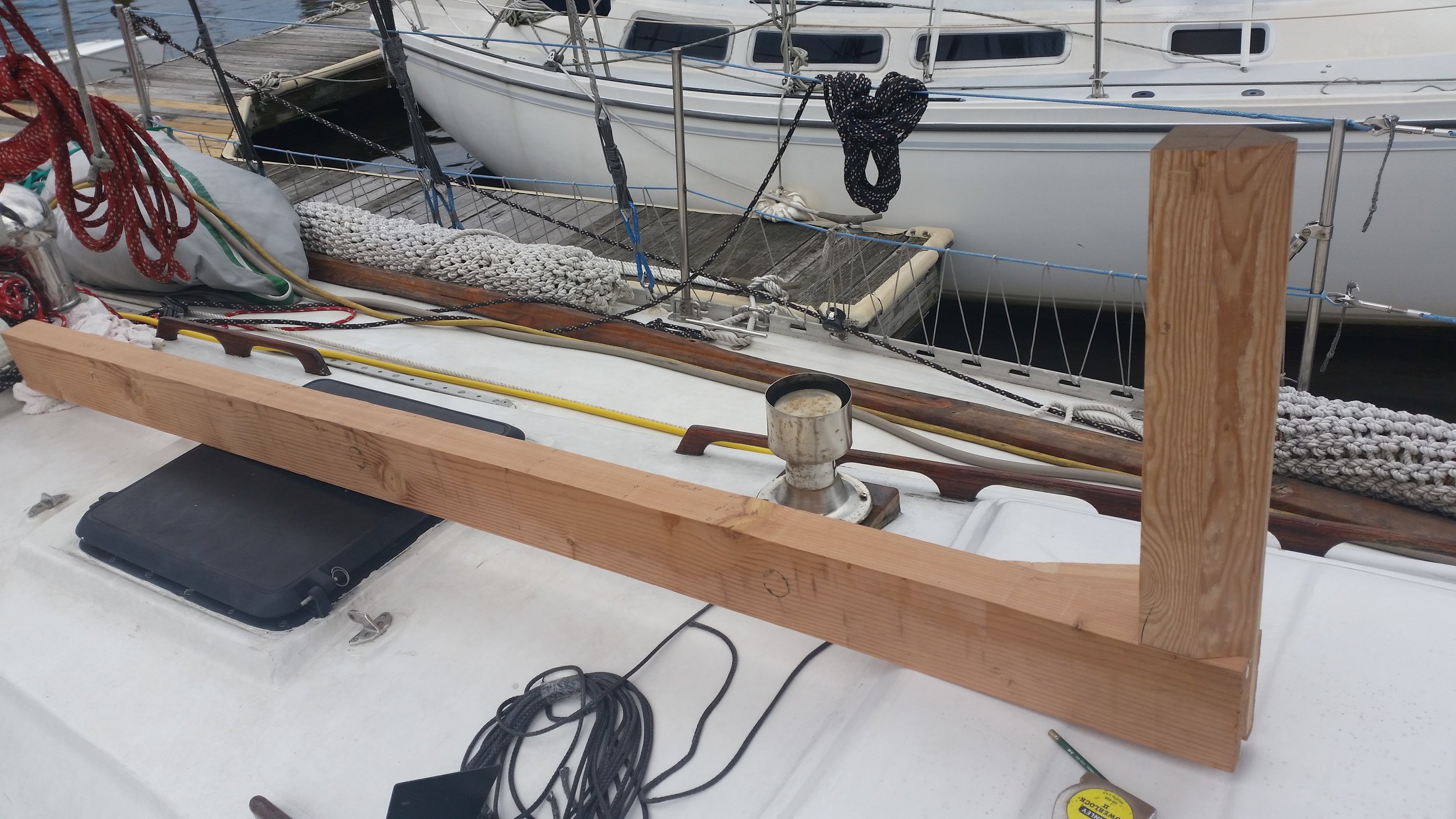
When I built Tooth, I never actually measured the space on the deck. I loaded Tooth onto the deck and realized that it didn't actually fit between the mast and dodger. I felt like a fool for not actually measuring the space available before building the dinghy. To avoid repeating that mistake, I am test fitting the backbone on the deck before further construction.

The dinghy needs to serve as our dinghy, but it also needs to cover the salon hatch (which leaks) and not cover the chimney. Since fitment is not a simple length requirement, I wanted to see it on the deck and make sure everything had plenty of space.

I tried positioning the backbone in various positions, measuring to see which position would give me the most displacement capacity. My requirements are it must cover the hatch and not cover the chimney. To avoid covering the chimney, the dinghy will be mounted backwards on the deck, stern facing forward and bow facing aft. 

Two positions shined as the most feasible, straight, with a carrying capacity of 897 pounds, and angled with a carrying capacity of 1091 pounds. The angled position would allow the bow to be bulkier, which is where the difference in displacement is made, but the stern needed to be a bit narrower. The bulkier bow would not be big enough for cargo but would offer more resistance when working into waves. The straight position offered a more slender bow with a narrow angle of entry, allowing the bow to cut through waves more easily and a wider transom which will offer more cargo space in the stern.

The final decision was actually based off of aesthetics, and not function. If the dinghy were set at an angle, it would look odd. Because of this, we decided to build the dinghy based on the straight orientation.

The keel was separated into 1 foot sections and the maximum distances for beam were measured. These distances would not produce a fair hull, but they are the maximum size that would fit.

Now that I know that the backbone fits on the deck and I can finalize the design and finish building the rest of the dinghy!

Building the Backbone: Part 2

The stem and keel are connected via a finger joint, which is strong, but not strong enough. All the force of waves hitting the bow will stress this joint, trying to push back into the boat. To further strengthen the stem, a knee is placed to transfer the load to the keel.

To fabricate this piece, a large cutoff was placed over the stem-keel junction and skewed at an angle, allowing us to create a slightly larger knee than if we used the board set ninety degrees to the joint.

A pattern was drawn on the board, giving me a guideline for the pattern to cut out of the board. I don't want to use the portions of the wood with large knots, so I sketch out a pattern that will cut out the knots and just leave clear clean wood with good grain orientation. The faying surface of the knee is verified to be square, ensuring that the stem will remain plumb. The finished knee is much smaller than the original sketch, as all the bulk simply adds weight to the bow and takes up interior volume.