Life Aboard

Morty Knows Where He Is

Morty, our boat dog, usually sleeps in the car seat as we drive around running errands. On a trip to my parents house, where he gets to play with my parents dog, he smelled the air coming through the vents and perked up. 

He perked up and took a glance out the window to see familiar trees. From that point on, he stood like this as he excitedly awaited meeting my parents dog again for an afternoon of playing and fun!

Why are Screws Right Handed?

A right handed screw is driven in by rotating it clockwise. A left handed screw is driven in by rotating it anti-clockwise. What does the rotation of a clock have to do with handedness? 

The truth is, there is nothing about the screw that gives it the designation of right handed or left handed, in fact, this designation comes from our anatomy and physiology.

When you hold your arm straight out and rotate your hand so that the palm is up, this is called a supine position and the act of rotating your hand is called supination. When you rotate your hand so that your palm faces down, this is called a pronate position and the acto of rotating your hand is called pronation. Awesome, now you can get that question right at your local pubs trivia night! But what does it have to do with the handedness of a screw?

Simple, the muscle that supinates your hand when your arm is stretched straight out is called the Supinator. The muscles that pronates your hand are called the Pronator Teres and Pronator Quadratus. These muscles are all very small and weak, making this motion a rather weak movement. This is why it is hard to get any leverage on a screwdriver with your arm outstretched. If you bend your arm, the biceps brachii comes into play and can help supinate your hand with a lot of force, driving the screw all the way down!

As you may have noticed, your hands supinate in opposite directions, your right hand supinates in a clockwise direction while your left hand supinates in an anti-clockwise direction. This means that you can drive a right handed screw with your right hand using your supinator and bicep, while your left hand would only be able to use the pronator muscles. Hence, a right handed screw can be driven in with the greatest strength when using your right hand.

This little mnemonic helped me learn supination and pronation while in dental school:

You hold the soup, and you "pro" it out.

To hold the soup, your hand needs to be supine. Turning your hand into a pronated position would throw out the soup.

The take home message is when you need to put in and take out a bunch of screws that are all right handed. Drive them in with your right hand but back them out with your left hand. This will make sure your strong biceps do all the work and your forearms will not get fatigued. 

Manual Bilge Pump Supports

After deciding where we wanted to stand while pumping out Wisdom in the event of an emergency, it was time to actually install the pump. Maddie wanted to be near the companionway so that she could hear me if I were at the helm while still being safely protected inside the cabin. 

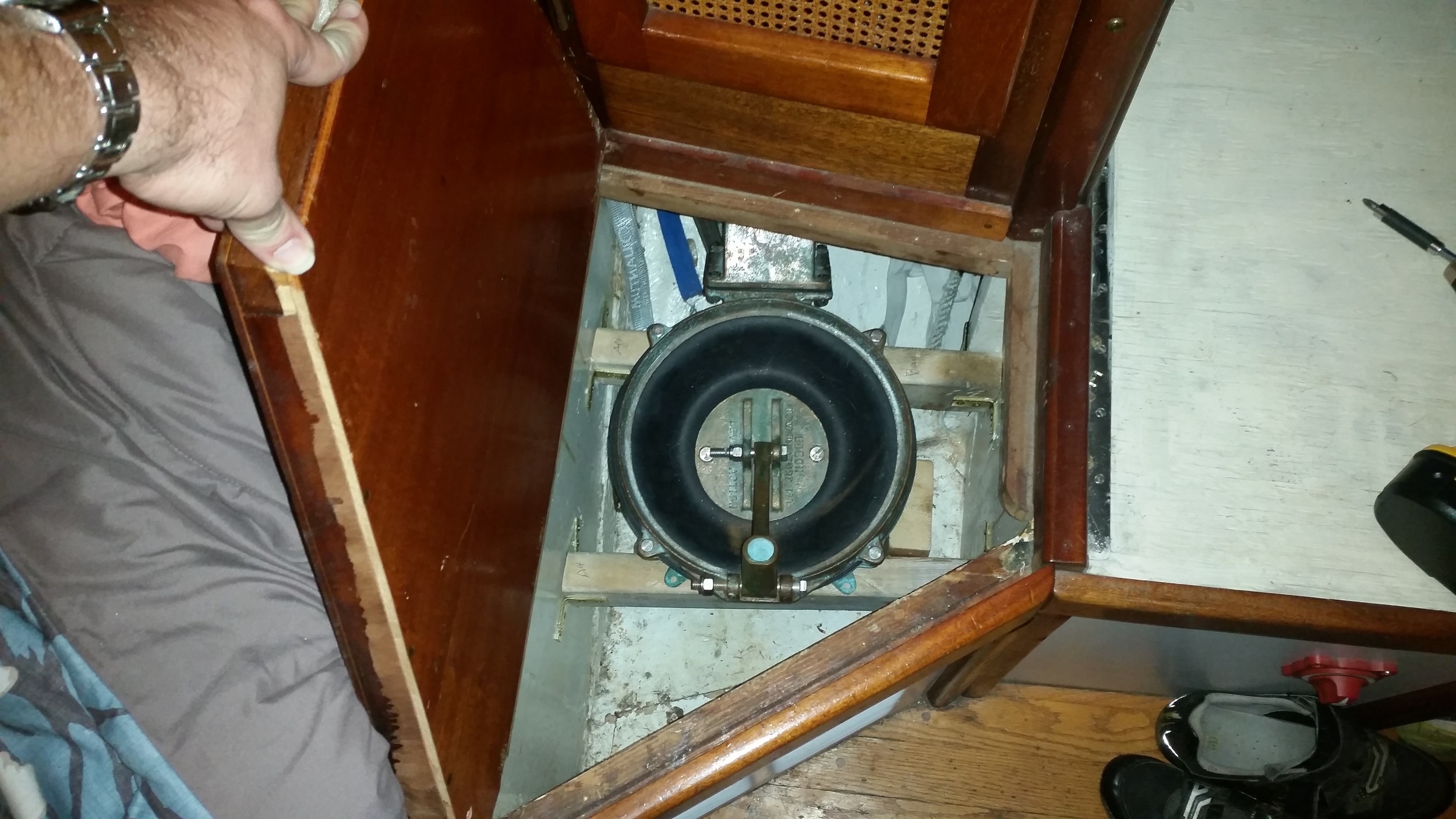
The bottom of the wet hanging locker seems to be the best location for the pump, it can be easily operated by lifting a lid and inserting the pump handle into the top of the pump. Now we just need to make this location a reality!

First, we need to locate the pump in a position where we can comfortably swing the lever arm without the risk of striking nearby objects. Next, we need to make sure that all the plumbing can run to and from the pump with ease. To meet these two conditions, we decided to mount the pump as close to the top of the compartment as possible and angle the pump towards the midship a bit. This will set the pump lever further from the cabinet next to it and allow you to pump without leaning over the unit the whole time. 

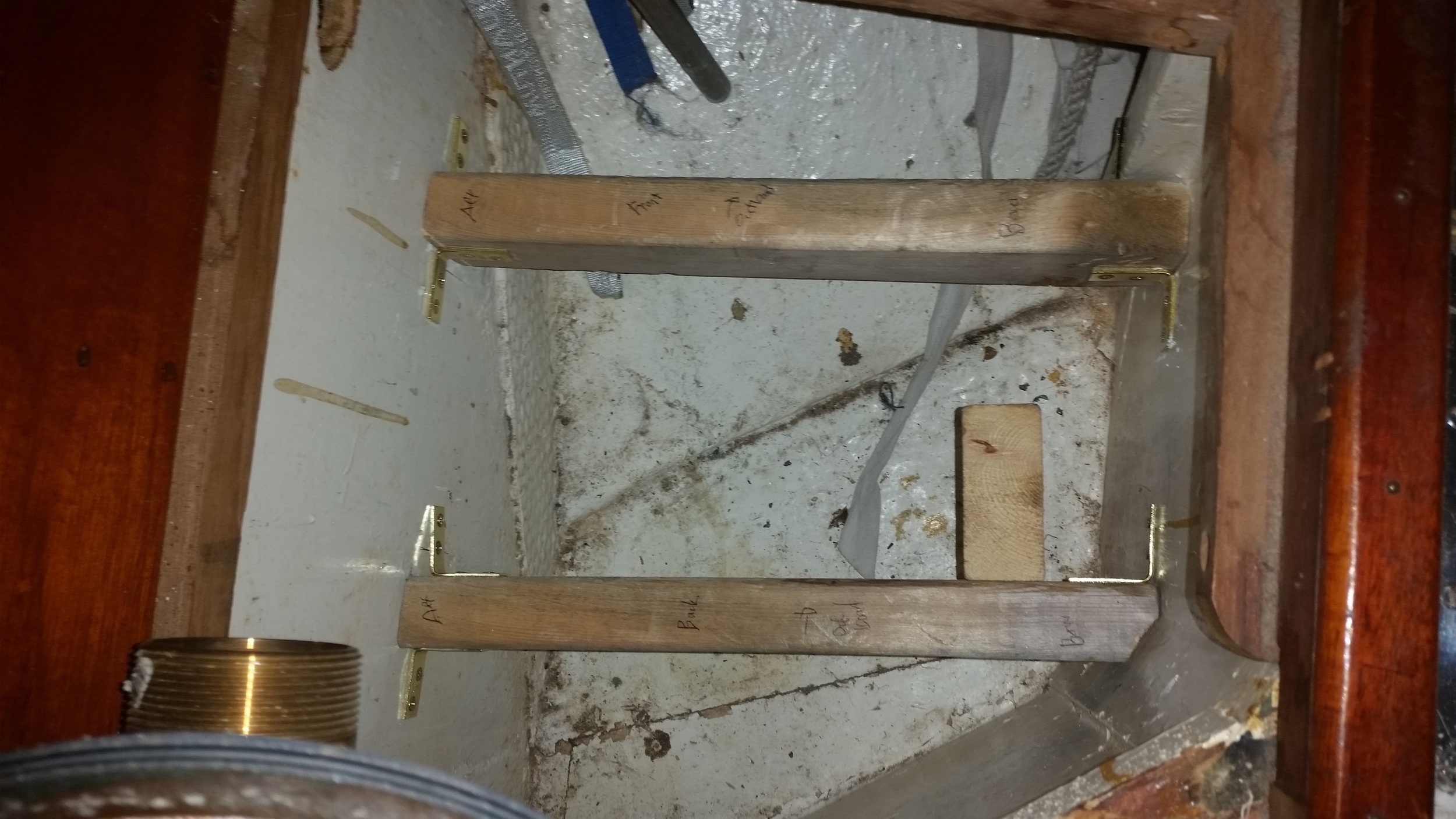
Wooden supports were set in place to keep the pump just shy of the inside of the lid, and then marked and secured. I am securing the supports with brass L brackets during the mock up procedure. 

Once the position on the support boards is finalized, I will drill the large holes through the bulkheads to pass the 2 inch hose to feed the bilge pump. The output end of the bilge pump will run up the back of the closet and out the side of the hull, just under the rubrail. 

After all the holes are drilled, I will remove the wooden support boards and prepare the area for fiber glassing. The ends of the boards will be tabbed and filleted onto the bulkhead to produce a very strong connection which will augment the strength of the screws and brackets. After everything is glassed up and cured, the pump can be installed on its very strong and secure base. The hinge might end up being removed from the lid, converting it to a regular lid which can be placed out of the way should we need to gain access to the pump.

One last point about where to position the pump in the locker, if we had placed it at the bottom of the locker, junk would end up piled on top of the pump. By locating the pump at the very top, nothing will fit over the pump and we won't be tempted to pile junk on it. Should clutter accumulate under the pump, it will not impede our quick use of the pump in an emergency.

Electric Motoring

When you decide you want to crank up your electric motor to reach a destination, there are some important steps to follow.

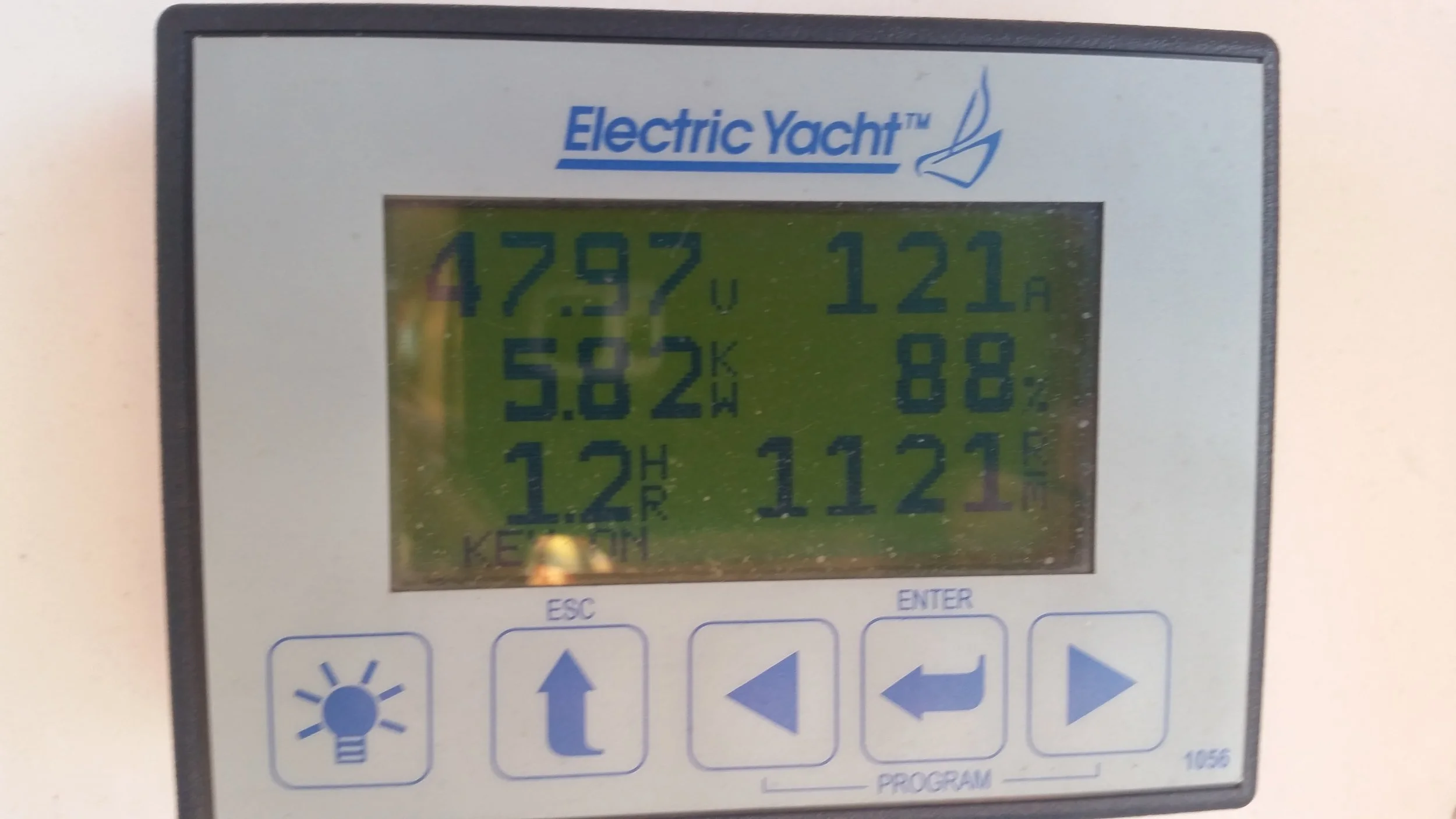
First, you should understand how to read the display from the electric motor.

The display is organized into two columns. The left column shows: Battery voltage (V), Engine power production (KW), Time remaining at current draw rate (HR). The right column shows: Motor consumption in Amps (A), Battery charge remaining (%), and Propeller RPM (R/M).

In this example, the battery has 47.97 volts DC, the motor is drawing 121 amps, producing 5.82 KW, 88% battery remaining, making the propeller spin at 1121 RPM, and has a remaining run time of 1.2 hours.

The reason this is important is if you are trying to motor somewhere, this information will be very important in determining if you will make it or not. A good chart plotter with navigational functions can provide you with an ETA to your destination. The ETA is your Estimated Time of Arrival. If your ETA is longer than your remaining battery run time (lower left corner), you are not going to make it at your current speed. 

At higher speeds, you will have less run time because the engine will be drawing more amps to move your vessel. Slower speeds will provide more run time, but it will also take you longer to get anywhere. On Wisdom, we can travel at full throttle (7.5 knots) for 24 minutes. This will give us a range of 3 nautical miles. At 2 knots, we consume around 10 amps and have a run time of around 20 hours, giving us a range of 40 nautical miles.

As you can see, moving slower will give you more range, but it will also take you forever to get there. This is why I use the ETA readout on the chart plotter in combination with the remaining run time in the lower left corner to find a speed that will get us to our destination with at least an hour of run time remaining. This extra hour will provide us with some buffer to changes in weather or currents, and avoid a complete discharge of our engine battery bank (which would destroy the batteries). 

Zipper Maintenance

Dodgers, sail covers, and canopies all rely on zippers to operate. Zippers also allow you to add panels to keep sun or weather out of your cockpit. All of these features require the zipper to function effortlessly, letting you easily position two portions of canvas and slide the zipper to unite them.

Exposure to salt spray and UV degradation can make a zipper anything but effortless. When you are adding a canvas cover to your cockpit and it is sunny and hot, the last thing you want to be doing is struggling with a zipper as you bake in the heat! You stand there knowing that once you get this zipper working, your life will be so much better. You will be able to relax in the shade, shielded from the elements, as soon as this stubborn zipper decides to slide!

Simple maintenance can provide years of flawless and easy utility to your zippered enclosures. Simply spray silicon spray onto the zippers to keep them sliding smoothly. It is recommended to use this spray at least once a year to keep zippers operating with ease, but if your zippers are old and chalky, more frequent applications can prolong the inevitable replacement of them.

A simple shot of silicon spray will keep your zippers sliding easily, giving you more "happy years" out of your zippers.