Life Aboard

Refrigeratior Gasket

A leaky gasket will let more moisture into the fridge, which will then build up on the freezer plate via deposition. Deposition is the phase change between gas (vapor) and solid (ice). It will build up like snow on your freezer plate, taking up all the space and making it impossible to fit your frozen foods into the compartment. This picture was taken after I had poured some warm water on the ice in an attempt to remove it from the freezer plate. 

Warm water works well, but it is very time consuming. A heat gun is another and quicker alternative. The slowest option is to leave the freezer off and simply waiting for it to melt off. Under no circumstances should you ever take an ice pick to the ice! One small puncture will destroy the freezer plate and drain your system of its refrigerant. If you damage it with an ice pick, the only solution to repair the system is to purchase a new freezer plate and recharge the system; which will set you back several hundred dollars!

Top loading fridges have weather stripping gaskets that get old and beat up over the years, loosing their seal and allowing moist air to enter the fridge. The best solution is to remove the old weather stripping and replace it with new weather stripping. 

Removal is very simple, as weather stripping is attached with a weak adhesive. Simply roll up a corner and begin peeling it off. Once removed, I suggest a thorough cleaning of the lid and sides of the fridge as the weather stripping can make cleansing difficult.
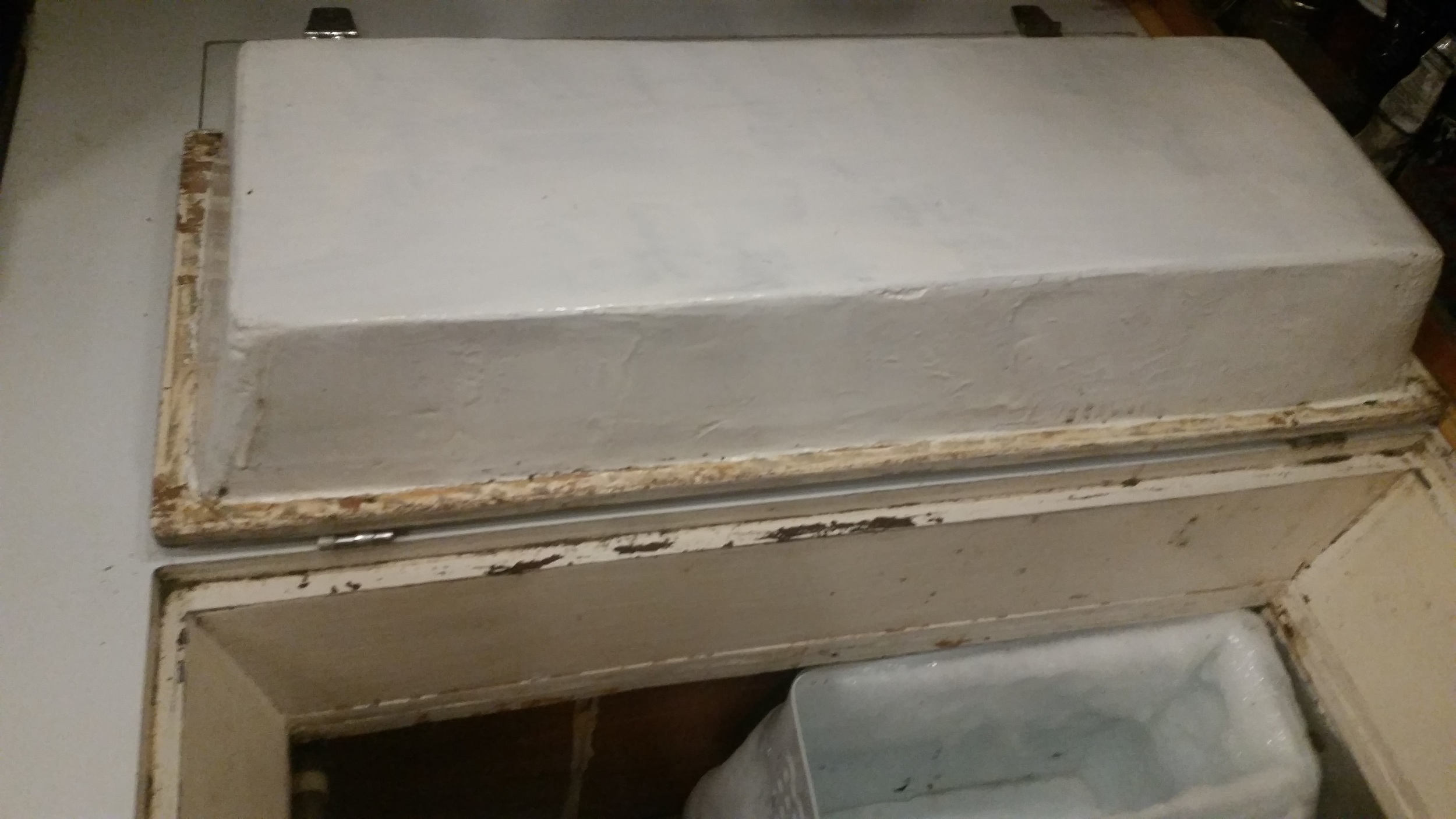
Once everything is cleaned to a satisfactory level, begin laying down the new weather stripping. Set the weather stripping at one corner and unroll it as you adhere it to the edge. Pull it all the way to the other end and then cut it with scissors in place. 

Once it is stuck down, peel the white backing paper off weather stripping. Always pull the backing paper off at a sharp angle to avoid lifting the weather stripping off the flange. If the weather stripping does lift up, simply re-position it and push it back down to adhere everything.

Once finished, check for any open corners where the weather strippings might have pulled back and opened up as these openings will leak in warm and moist air. If the corner is open, lift up the last few inches of the weather stripping and tack them back down in contact with the other leg of the seal; this will ensure that you end up with a tight seal which will keep out moisture and make your fridge run more efficiently!

Sunsets

A major advantage of living aboard is you can enjoy sunsets from various places without straying far from your home.

When you sail offshore, you can enjoy watching the sunset over the ocean (which is a treat for those of us who live on the East coast). 

You can also tie up in a marina located near or in the heart of the city, putting you within walking distance of bars and restaurants!

We have been living aboard for 4 years now (I started in 2012, Maddie started in 2014) and we have really enjoyed the flexibility of living so close to the city night life, yet removed in our own little world inside the boat. The only reminder that we are in the city is the glow of the city light pollution peering in through the hatches and portholes, not much different from a full moon night.

For being in the heart of the city, we certainly don't pay as much as the neighboring land lubbers. Rent in our area is around $1800 per month for a one-bedroom apartment, and the condos cost $250,000 for a small one-bedroom (with $500 per month condo association fees). Our slip fee runs around $500 a month (including electric and water) for a 45 foot sailboat. Spending less on where we live lets us enjoy the area more and still save up to go cruising!

When you live aboard, the different sunsets are a delightful part of daily life.

Fiddle Blocks

Maddie is working on writing thank you cards after our wedding and had everything setup on the table, but we were about to go sailing in a stiff breeze. Instead of clearing everything off the table, we decided to put the fiddle blocks in so that everything would stay put!

This is one advantage of a fixed table (over a folding table), there is space in the salon for the table to be set up with your current projects and go sailing! Without the fiddle blocks, all of her notes and boxes would have slid off the table as soon as we heeled over; instead, everything stayed on the top of the table.

These fiddle blocks are also removable, allowing us to have a smooth and flush table when in port. I must admit that these fiddle blocks get in the way when eating on a regular basis, but are nice for moments like this.

Bikes On Board

Each bike is designed to excel in a specific field of biking, usually sacrificing the other fields of biking. 

  • Road bikes are great for long distance and efficient riding
  • Mountain bikes are great for off road use, but not as efficient as a road bike
  • Folding bikes are great at folding

Folding bikes are very handy! They provide wheels when you make landfall, and tuck away into tiny spaces while underway. While folding bikes may be very good at fitting into small spaces, they are not the best type of bike for covering long distances or varied terrains. Folding is about all they excel at.

Road and mountain bikes on the other hand are better at covering longer distances. Mountain bikes tend to be heavier and have wider tires which allow them to withstand the abuse of off road riding; whereas road bikes are much lighter and have narrower tires, allowing them to move along with significantly less rolling resistance.

Road and mountain bikes are great at covering distances in new places, but they can never fold up as tightly as a folding bike. This is where the space available in the boat comes into play!

Modern road and mountain bikes have quick release wheels, allowing you to easily transform a large bike into a frame and two wheels with no tools and only a few minutes. The separate pieces can be neatly tucked away into a locker, if the space allows.

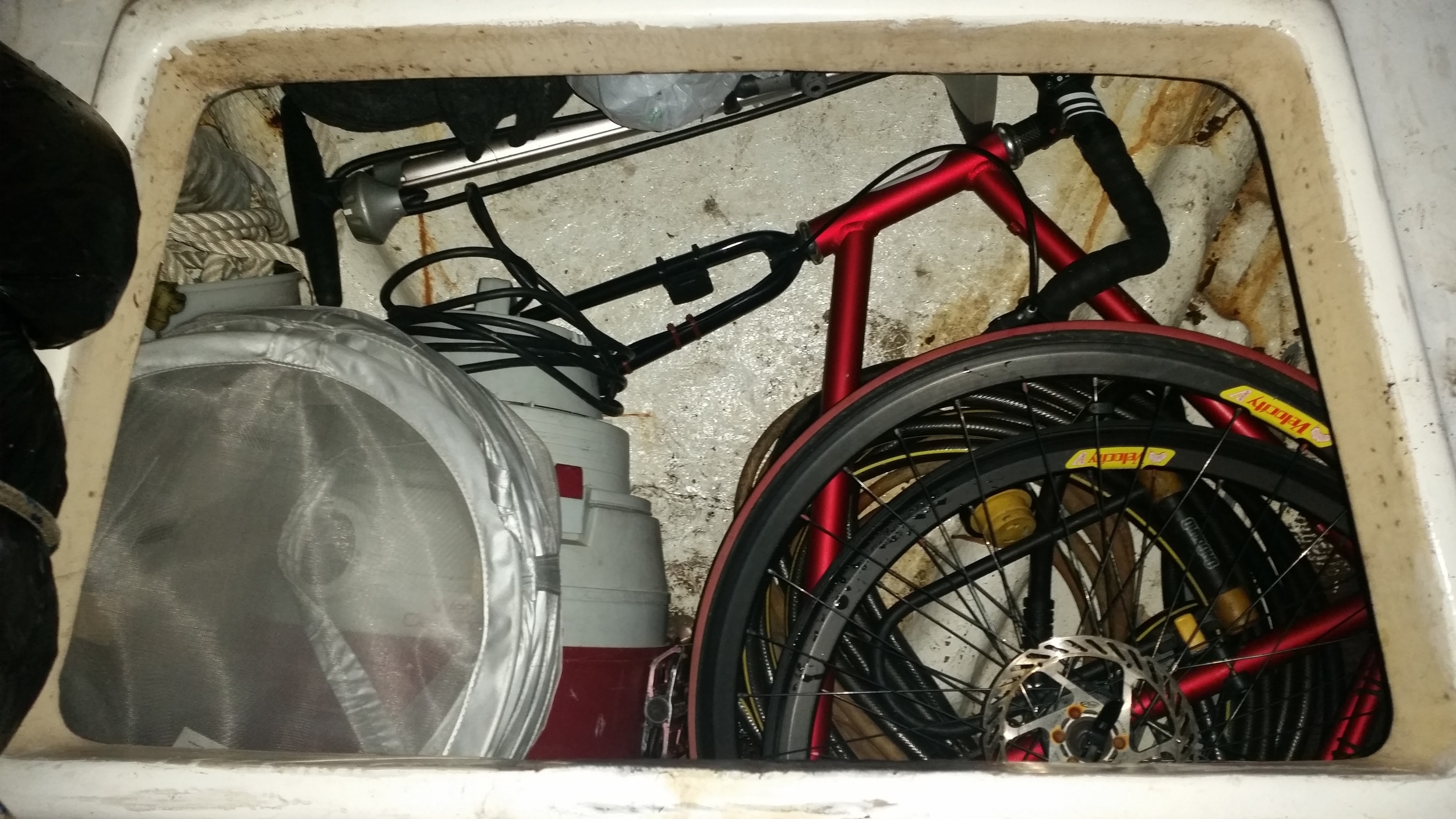
If you manage your space well, you can fit many large items in the lazarettes on a sailboat. In the aft lazarette, we keep a 5 gallon pail full of rope for the stern hook, a shop vac, water hoses, shore power cables, and a large size frame (60cm frame) road bike! The wheels are removed and the frame is tucked into this storage locker. 

I chose to take a road bike with us on our trips because most of the places we arrive are near roads. While I have to carry the road bike across the beach and in to shore to reach pavement, it pays off when I then need to ride a few miles to get to my destination. A mountain bike would let me bike up the beach and into shore, but would not ride as efficiently on the pavement as a road bike would. These are all compromises that we must choose to live with when deciding which bike to take along on a journey.

While a folding bike will tuck away into a much smaller locker and take up much less space on board, it would not be able to bike along the soft sand of a beach, nor cover the miles of pavement as efficiently as a road bike would. If you have the space for a real bike on board, I would highly suggest it over a folding bike. If you do not have the space on board to fit a real bike, a folding bike will still provide you a set of wheels when you make landfall.

Lord of the Flies

Flies are a frequent problem on the boat. It's not because we are messy or because we have a composting toilet (no bugs come out of there!) but because we sail near places that are riddled with flies.

We will be sailing along when a swarm of flies will descend upon us! These flies seem to be very hungry because they will begin biting us and Morty. Maddie and I are not fans of pesticides, due to their toxicity, and conventional fly swatters don't seem to put a dent in the number of flies buzzing about us.

We have seriously thought about breaking down and using chemical pest control devices (bug sprays), but they are very toxic to parrots and birds. Being how we have Sammy (our parrot) on board with us, bug sprays are never going to be an option.

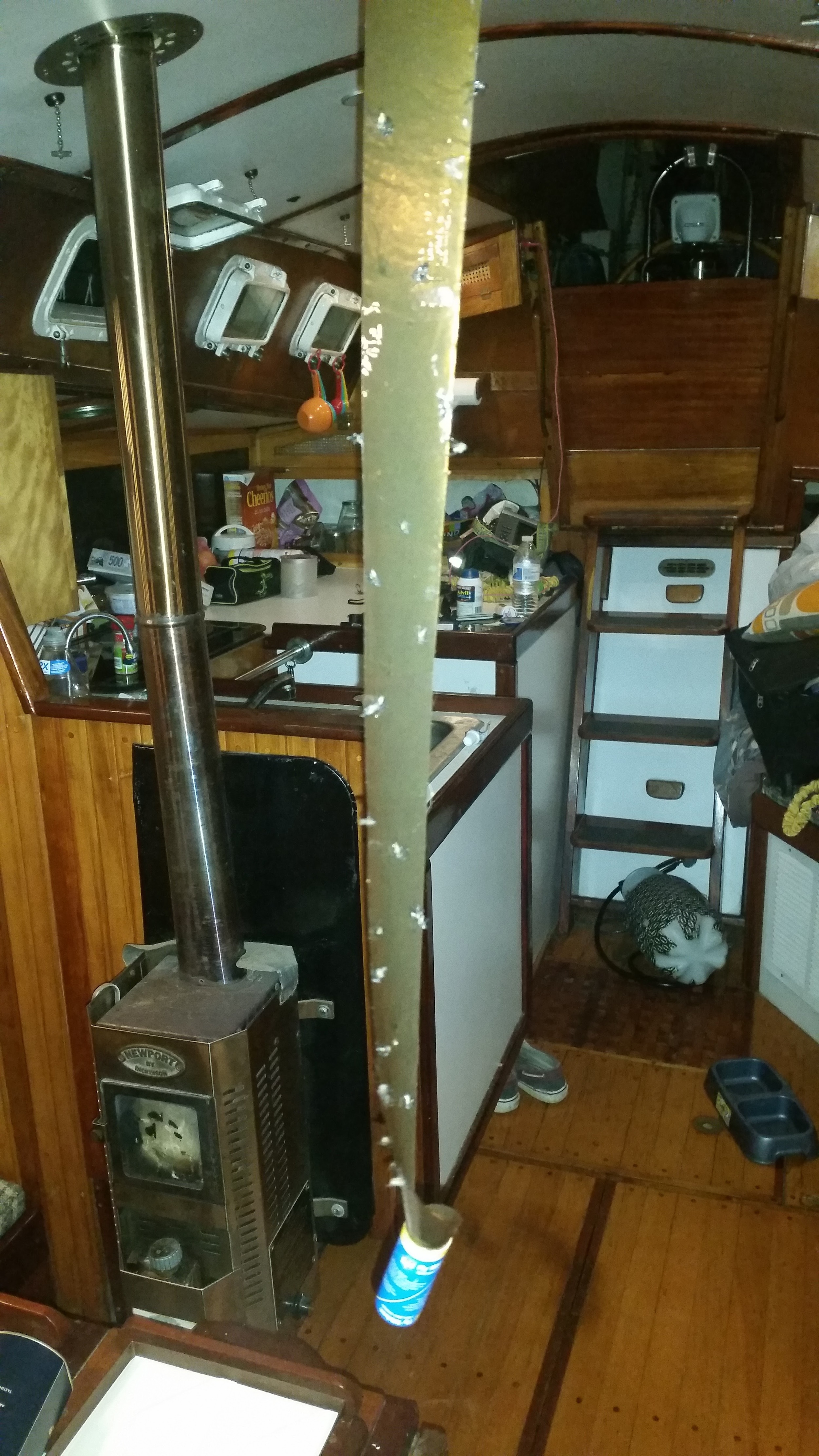
In our search for a better alternative, we stumbled upon fly paper; you know, the stuff you see in cartoons that gets stuck on the characters face and arms. These fly paper coils contain no pesticides or volatile organic compounds (VOCs), they are simply sticky glue on paper and work wonderfully!

Fly paper is not as immediately gratifying as bug spray though, it does not work instantly and it does not attract the flies to it. The fly needs to buzz around and land on the paper for them to get stuck. When you first hang up the paper, it seems that the flies will land on everything but the paper! Over time though, the bugs will land on it and their numbers will reduce.

In order to get more flies to land on the fly paper, you need to make the fly paper more appealing. If you sit back and watch the flies behavior, you will notice that they only land on things that do not move around in the wind. If you have a steady lifeline or back rest, they will walk all over it; but your flapping canvas will not get much fly traffic. 

Following the same logic, if you hang your flypaper in the middle of the cockpit where it will flap around all the flies as the wind makes it dance, not a single fly will land on it. While this may seem like the best place to put the fly paper due to the high concentration of flies, its constant motion will render it worthless. Hanging it inside the cabin where it will stay still will prove much more effective. 

We set up the fly paper one afternoon after we were bombarded with flies and by morning the paper was covered in the annoying insects while the air was clear of any nuisance. If you need immediate bug relief until the fly paper can decimate the numbers of buzzing buggers, try wearing long sleeves and long pants. Keeping the amount of exposed skin to a minimum will provide the insects that much less skin to attack. Rubbing OFF! on your hands and feet can help keep them protected as well. 

With the fly problem under control, we are able to cruise in much more comfort!