Life Aboard

Bargain Bulk Buys on a Boat?

People on land love to shop at stores where you can purchase goods in massive bulk quantities. My mom shops at Costco all the time and is always storing cases of foods and other items. This is fine if you live in a house with small rooms called pantries. 

On a boat, space is a luxury! There simply isn't enough space to store such large bulk purchases all the time. We usually purchase items in much smaller quantities more frequently.

Instead of having a case of spaghetti sauce in a cabinet, we have a single extra jar. For items that we don't use as often, we might not have a spare on board. When we run out, we run out until we get to another store to purchase a replacement.

This leads us to be more aware of what we have on board the boat, since we recently put it there. If we had stashed the case of spaghetti sauce away last year, we would have probably forgotten about it hidden away in a cabinet. Since we frequently use them and replenish them, we are very aware of what we have and where it is.

This lifestyle is fine, until you come across a really great deal!

I was at West Marine one day when they told me that they were having a crazy sale on bottom paint. I plan to haul Wisdom and Windpuff this fall to paint their bottoms, and will be needing a lot of paint. If I buy it in the fall, it will cost me a lot of money. If I buy it now, I will save a lot of money but will need to store the cans until the fall. So begins the liveaboard dilemma! 

As you can see, I decided to buy the paint and stash it away in a locker until the fall.

Maddie wanted to paint pretty labels on the outside of the doors indicating what we stored inside the cabinet when she first moved in with me. I advised her not to do that because the storage in the boat is very dynamic. What we store in the lockers changes with the seasons as well as with a whim.

This locker used to hold canned meats and beans. Now it holds bottom paint! A little reorganizing helped shuffle the stored items around and make room for this one time great deal. If we bought everything in bulk, we would not have been able to accommodate such a large, spur of the moment purchase. 
Solar Panel Mounting

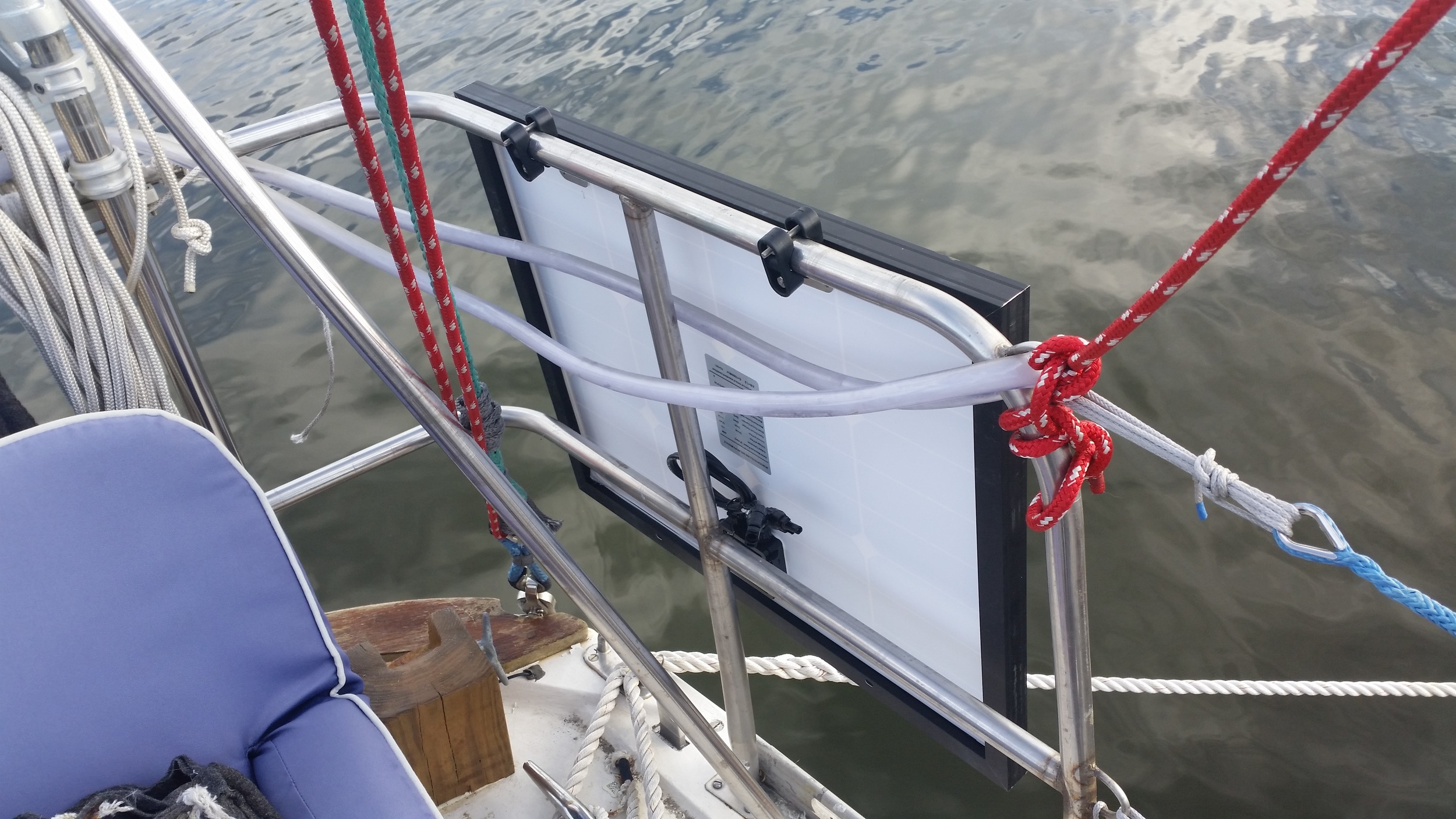
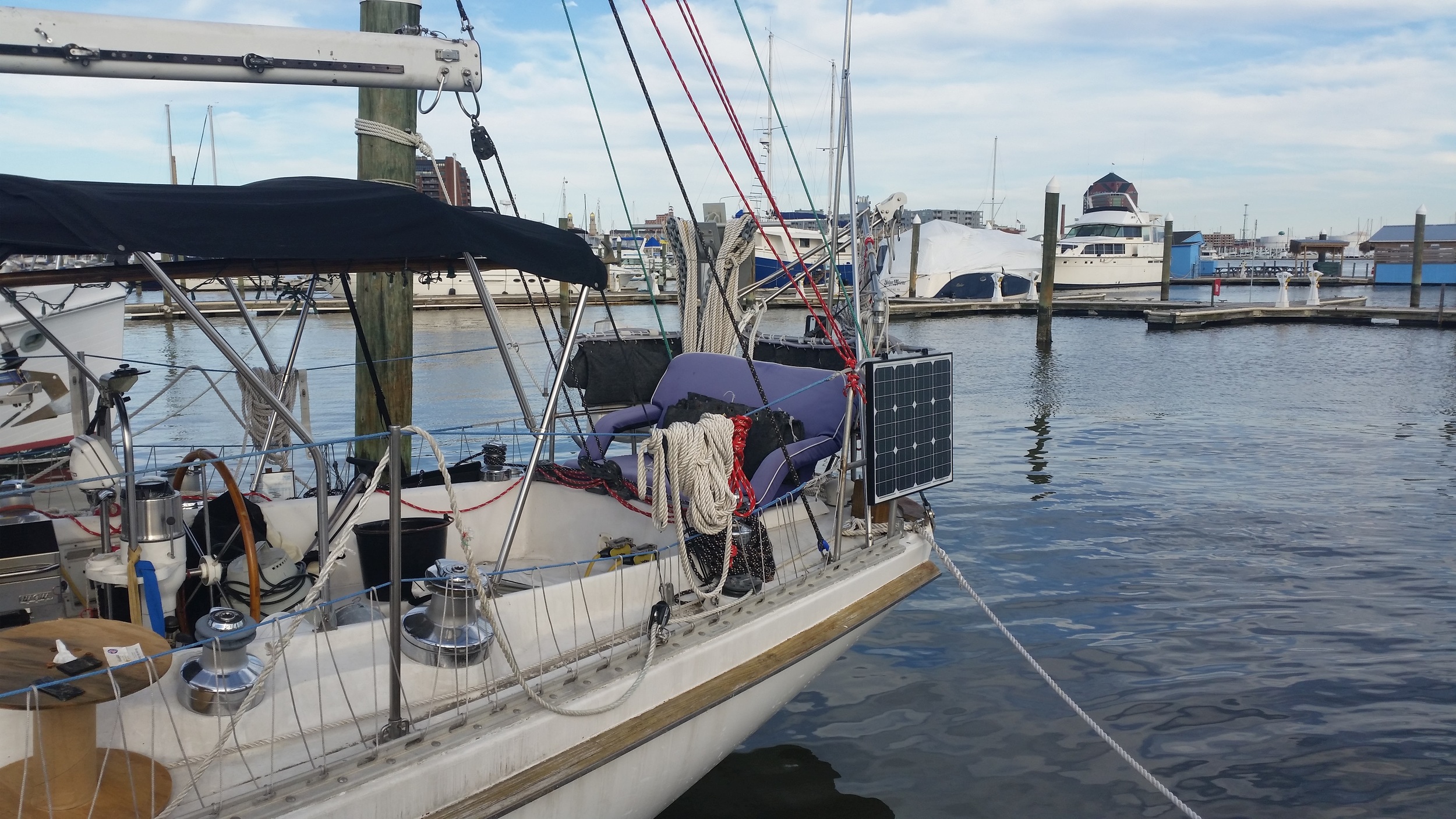
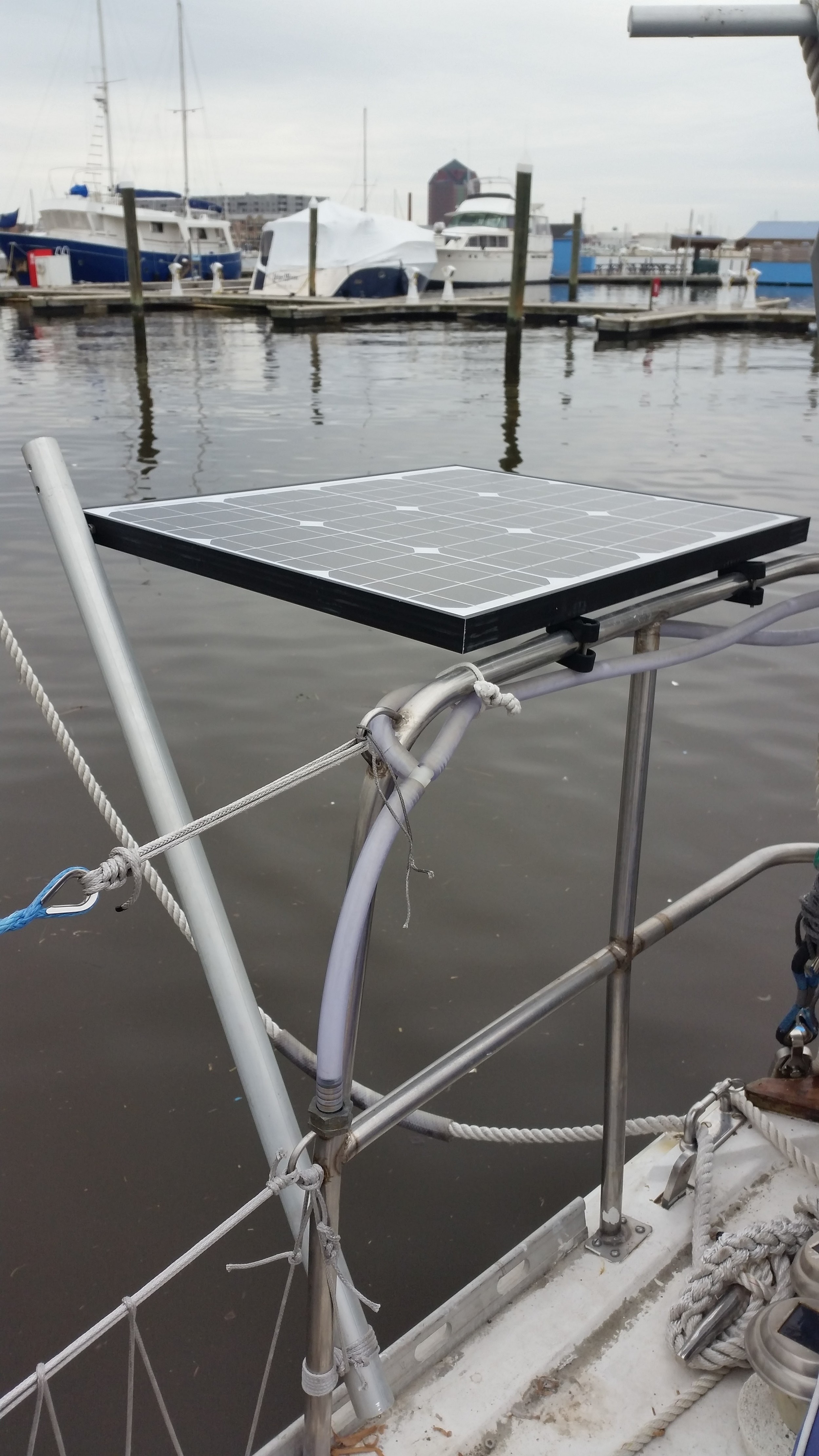
The solar panels are to be mounted on the stern rail, supported by a strut to hold them towards the sun, as well as able to be folded down when docking or during storm conditions. Now we have to turn this goal into a reality!

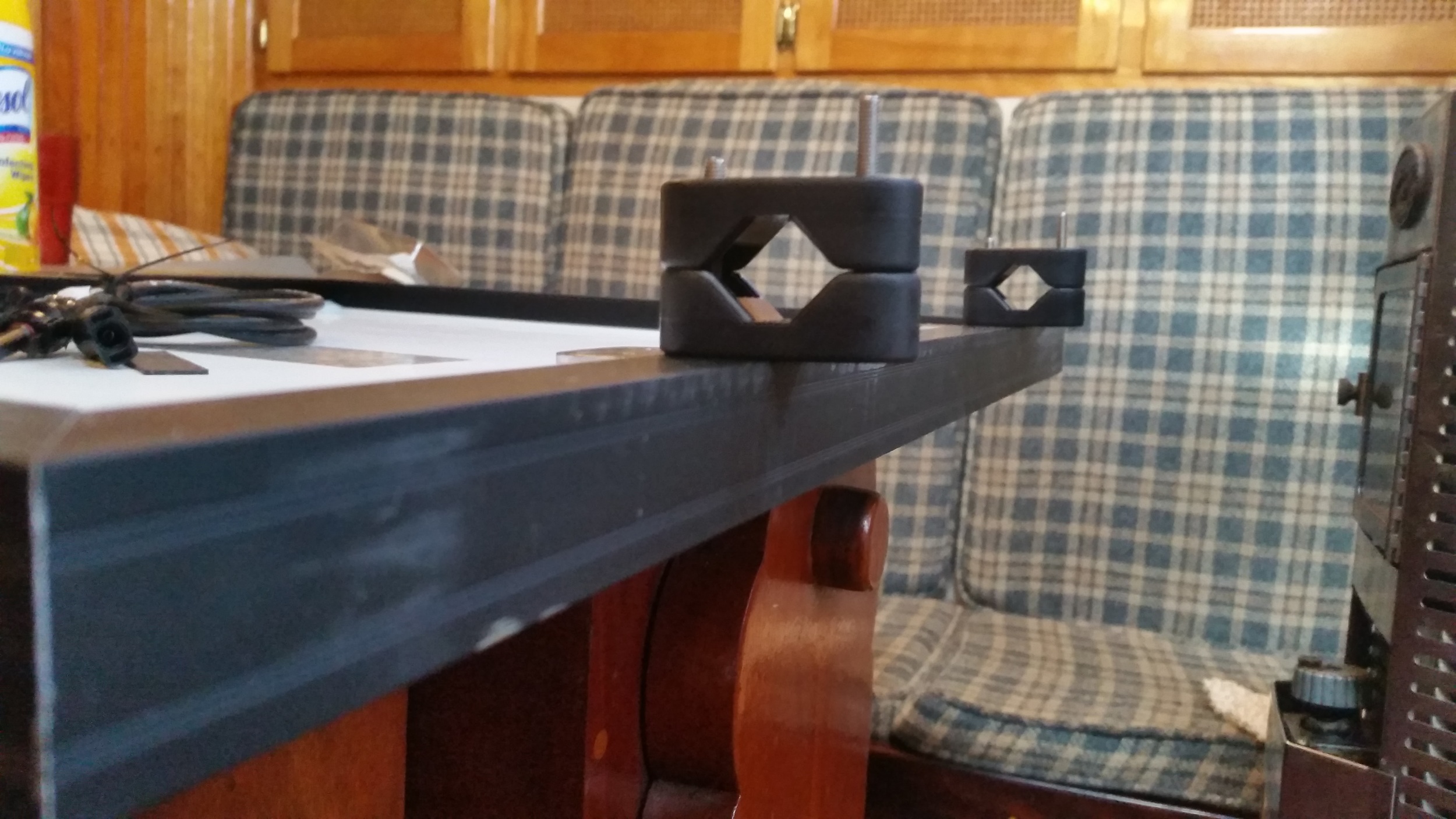
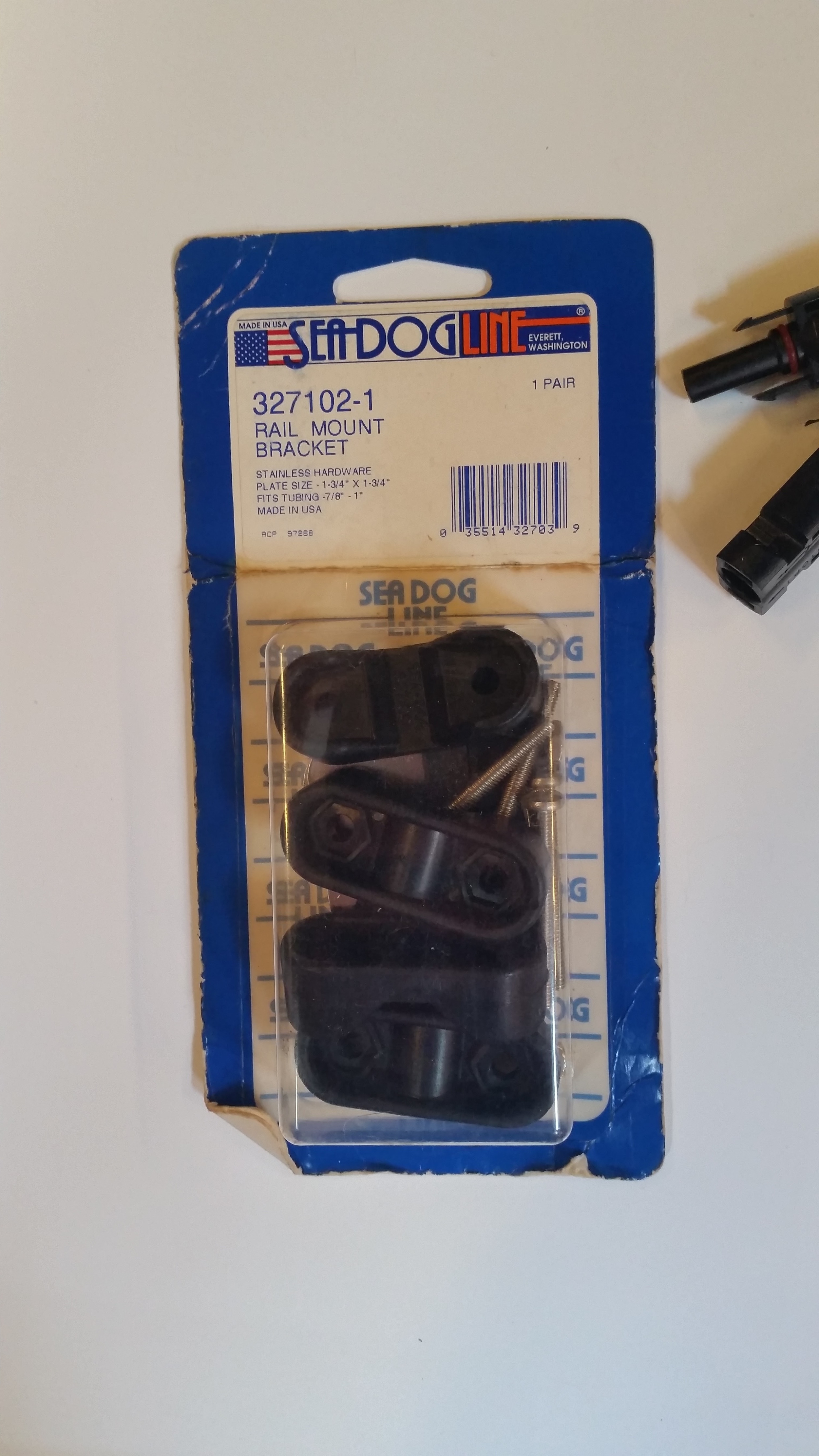
These clamps were in a locker on the boat when I bought her. I have no idea how old they are, but they worked great!

These clamps were in a locker on the boat when I bought her. I have no idea how old they are, but they worked great!

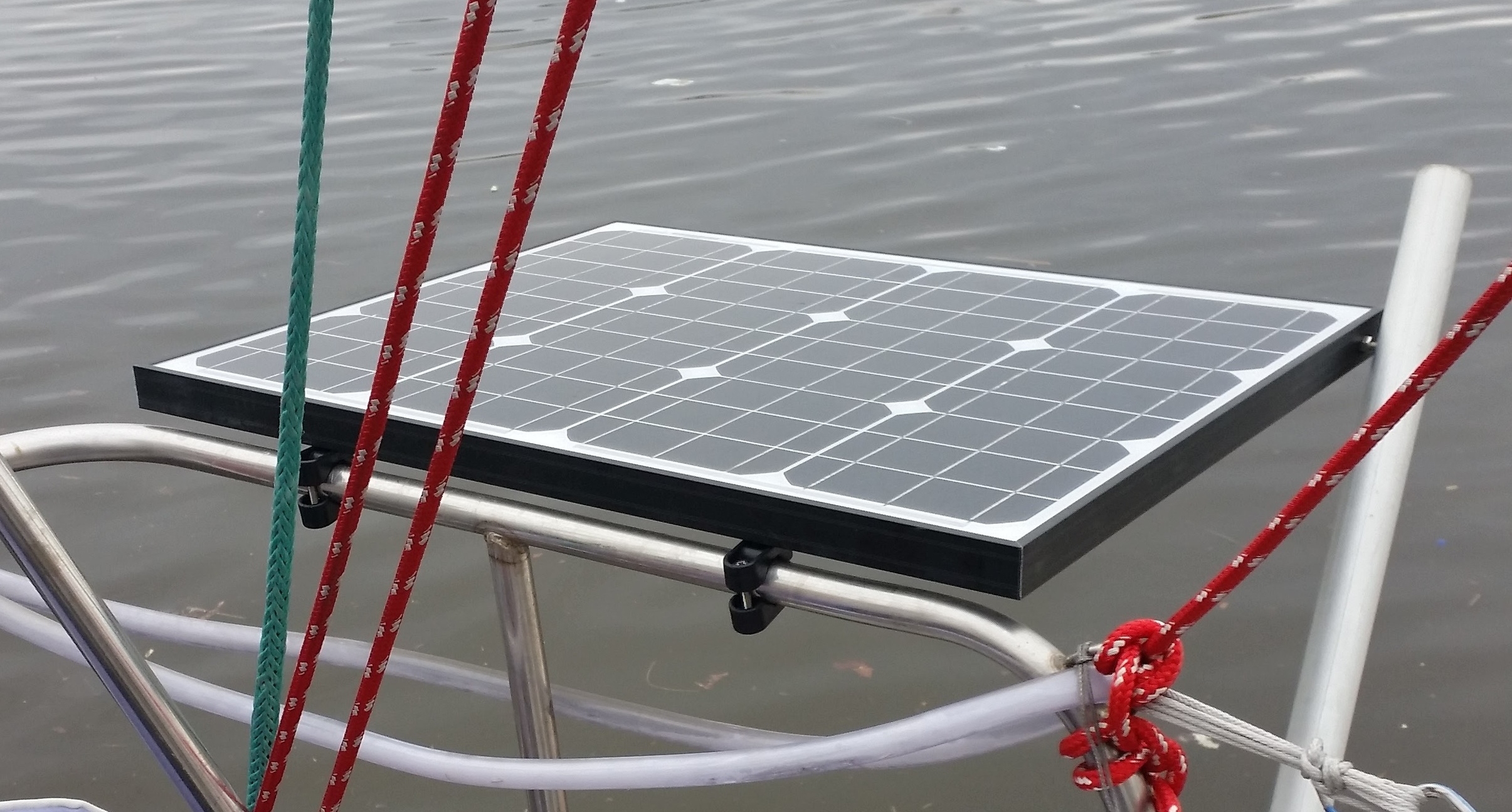
To mount the panels on the rail, I used Sea Dog Rail Clamps. These nylon rail fittings will allow the panel to bolt up to the rail, while still allowing the whole assembly to pivot and hinge. This was accomplished by not tightening the clamps all the way and by not using the rubber insert (which would keep the clamp from rotating around the rail). 

The solar panels fit well, and still allow access to the stern cleats when in the folded position. By folding down, they are safely hidden inboard of the rub strake, keeping them safe during docking and close quarters maneuvering. 

While the rail clamps allow the panels to hinge, they offer no help to keeping the panels deployed to collect the suns rays. This is where the support strut comes into play!

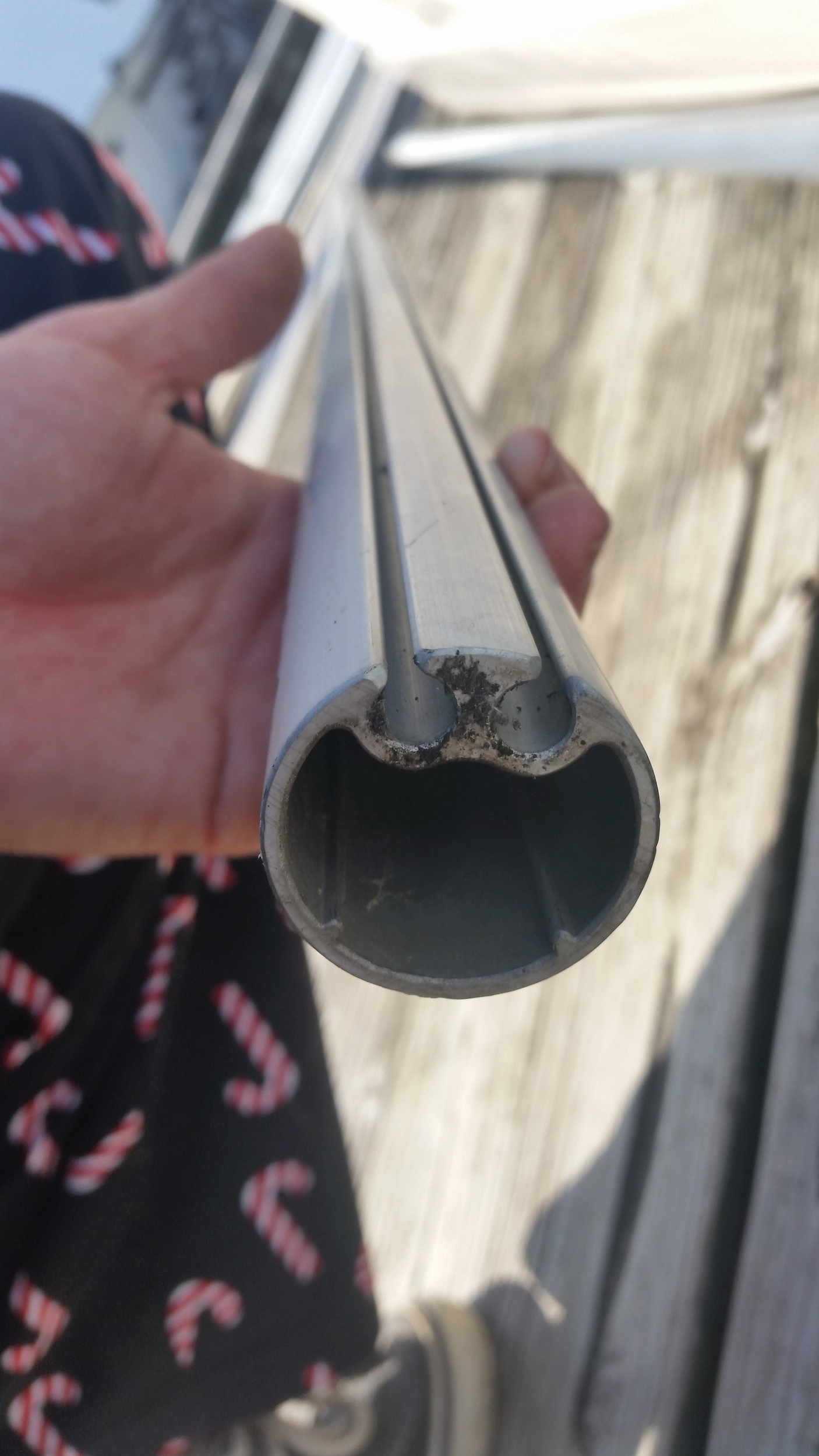
I drilled out the rivets connecting each extrusion, allowing me to separate the furler extrusion into more manageable pieces.

I drilled out the rivets connecting each extrusion, allowing me to separate the furler extrusion into more manageable pieces.

After disasembly, I had a whole bunch of really strong aluminum pipes for random projects around the boat.

After disasembly, I had a whole bunch of really strong aluminum pipes for random projects around the boat.

I kept the furler parts from my headstay when I converted from from roller furling to hank on because I figured these pieces of hardware would come in handy at some point! Today was their day to shine! The aluminum extrusions would serve as a very stout (and free) support arm for the solar panels. I just needed a way to attach them to the panels and to the boat.

To connect the support arm to the solar panel, I used a stainless steel bolt that I had already. This bolt was mounted on the side of the panel sticking out to the side. The support arm has holes drilled in the side of the tube where the bolt can rest. I will add a safety line that will tie the support arm to the solar panel to prevent it from popping loose. This solves the problem of keeping the panel deployed for the sun, now I just needed to connect the support arm to the boat. 

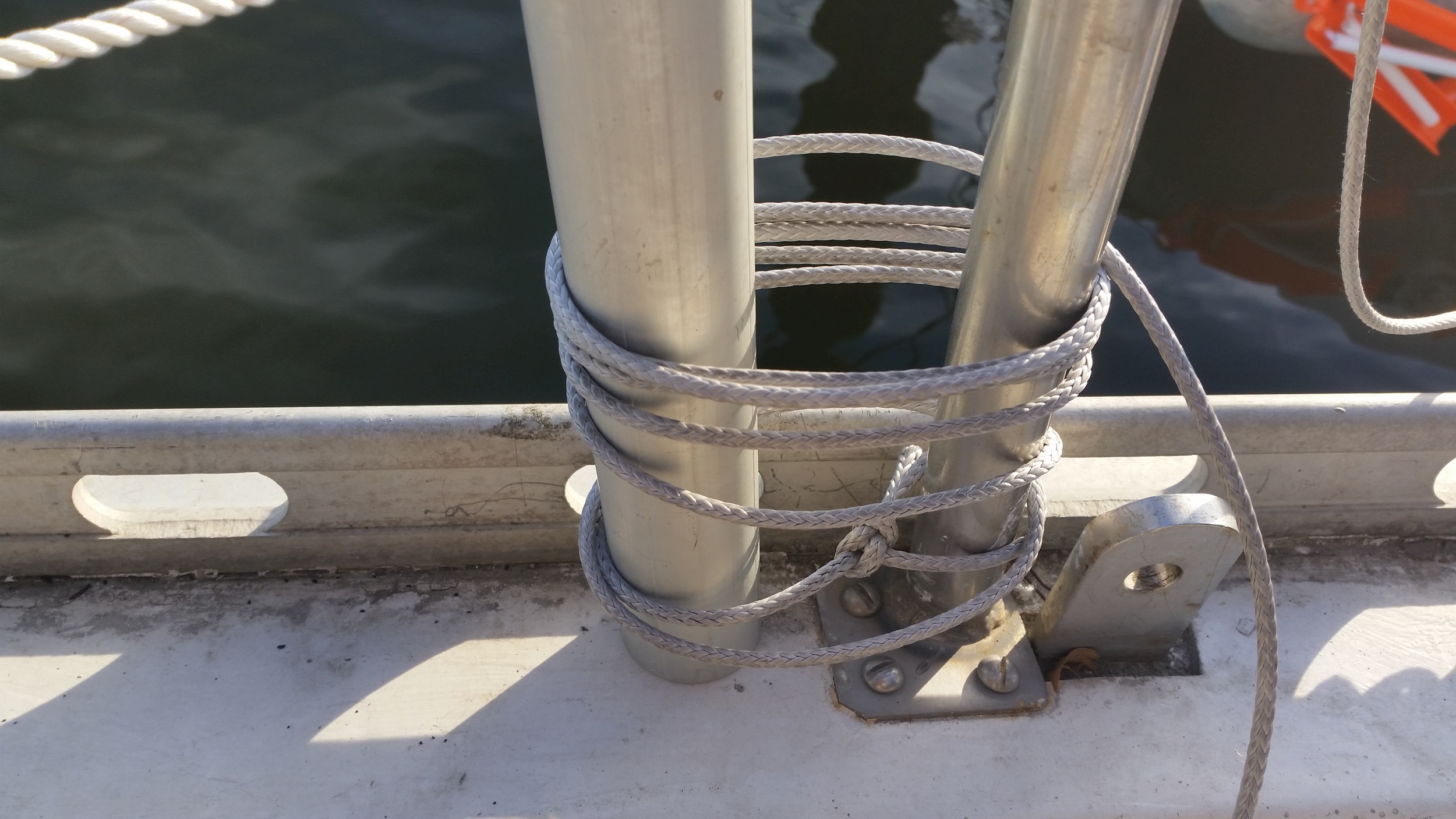
I need a connection that will firmly support the tube while allowing it to move about freely while minimizing the number of holes I need to put in the deck during installation. I decided to use a knot instead of a metal fitting. It uses no holes, and can be created to achieve what I need with the ability to be tweaked if necessary.

This knot is simply a modified flat seizing knot. The line was loosely looped around the support arm and stanchion various times, then brought together by the frapping turns. The frapping turns were tightened up by using a marlin spike hitch and all of my strength! This holds the support arm in space while allowing it to move around and articulate freely without a single hole in the deck for a bracket. 

This rope contraption worked well to support the panels and allow them to be easily collected and deployed.

The solar panels blend in nicely with all the other contraptions on the Stern of the boat without drawing too much attention to themselves, like a radar arch with panels mounted over top would have caused. Maddie and I were concerned that a large solar array would end up being an eyesore, this small solar array blends in nicely with the lines of the boat. Now we just have to wire them up to the charge controllers and batteries.

Companionway Slats

Sailboat companionways are an interesting doorway to land lubbers. They sometimes create some confusion, but I can assure you that every part of them serves a purpose.

The sliding hood is very important. Without it, the companionway would need to be much taller and it would be hard to fit that on a smaller sailboat. It also serves to keep water and spray out of the companionway and cabin. If a storm quickly approaches, simply sliding the hood will greatly reduce the amount of water that will ingress the cabin. It also allows good ventilation of the cabin by removing the slats and closing the hood.

The slats are the next point of contention. Doors would be much easier, and do not need to be stowed when the companionway is open, why must we have these boards? The boards serve many purposes:

They are stronger than doors
They protect against water entry to the cabin
They can be removed in stages
They work

Doors are convenient, but if a wave hits them, they will burst open and allow the force of the wave into the cabin. Boards will help resist this force! 

Doors are either open or closed, they can't be anything in between. Slats offer many options. Have all the slats in and the companionway is shut. Take the top one out and you can get air flow through the cabin while keeping rain out. Take out all the slats and it's an open door. Leave the bottom slat in and you have insurance against wave ingress into the cabin. If a wave boards your yacht and the companionway is open, all of that water is going into the cabin. Leave the bottom slat in and you have greatly reduced the amount of flooding below. 

The bevels on slats help keep out water. When a wave smashes into them, they will squeeze down on each other and close the gaps, yet they can be removed with one hand. You can't do that with a door!

In time, you will find that you don't have to remove all the slats to get through the companionway. We usually only take out the top one and step over the lot of them. This makes for quick and easy entry and exists while still having the protection offered by the slats.

It may seem cumbersome at first, but with practice, companionway slats will become second nature and you'll be able to do it in the dark! 

If you are in the market for a new yacht or are building one yourself, try to find one with some taper to the companionway opening. Parallel sides will cause the boards to get stuck and bind as you try to put them in or take them out. Some degree of taper will reduce this problem and make the process of inserting and removing the slats very easy. If you are already the proud owner of a yacht and you have parallel sides on your companionway, try keeping the sides of the slats lubricated with soap. This will help them to slide more easily without binding as often. 

As always, practice makes perfect! Do resist the temptation to switch from slats to doors. There is a reason they have been the standard form of closure on sailboats for many years, it's because they work!

Checking Off The List

This past winter, I was feeling kind of down due to the never ending project of making the rope fenders. I felt like everyday was wasted on making fenders and keeping the boat warm. 

I outlined a list of projects that I want to tackle instead of the rope fenders, and this year has been off to a great start! 

The list included:

Wedging the mast partners [Completed]
Make a sail bag for the jib (Josh)
New check stays with baggy wrinkles to avoid chafing the main again
Install solar panels on the transom [In Progress]
New house battery bank (our batteries are close to 10 years old and very dead) [Completed]
Build a wooden tender to Wisdom that fits on the deck
Install a Monitor windvane on the transom

As soon as the fenders were finished, I started knocking out the projects on the list rather quickly. As always on a boat, there will be an endless supply of new projects to do as well. 

Repair chafe on main halyard
Build a tiny house

The tiny house will be a studio for Maddie built on a trailer platform. This project will happen around the same time I build the wooden dinghy, since they will be using the same tools and materials. 

I was feeling some serious winter blues a few months ago, but now that the weather has changed (and I finally finished the rope fenders) I feel great with the projects getting completed!

Solar vs. Wind vs. Hydro

In the realm of alternative energy production, there are three main players: Solar, Wind, and Hydro.

Each of these systems has its advantages and disadvantages, making none of them a magic bullet on their own. When used in combination, they will overlap and cover for each others downfalls.

To be happy with any of these, you must understand what they can do and what they can't do. If you want it to do something that it can not, you will be very displeased. Learning how to work within the limitations will lead to a very pleasant cruising life.

Solar works by converting the suns radiant energy into electricity. It works completely silently without any moving parts! While this sounds incredible, it does have its limitations. Solar panels need direct sunlight to work their best. If a shadow is cast over a small portion of the panel, its energy production will drop drastically. They also do absolutely nothing during the night hours, as well as on cloudy days.

While cloudy days and darkness will limit your ability to keep your batteries topped off, solar generators can help alleviate this issue by helping to bridge the gap until the sun returns and you can resume producing power. A comprehensive evaluation of different solar generators, as well as a look into "what is a solar generator" can be found by following this link:  http://www.allthingsboat.com/best-solar-generator-reviews/

Source: http://d19vj6yy87fjj8.cloudfront.net/wp-content/uploads/2009/08/wind_generator_cruising_boat.jpg

Source: http://d19vj6yy87fjj8.cloudfront.net/wp-content/uploads/2009/08/wind_generator_cruising_boat.jpg

Wind works by converting fast moving wind into electricity. These devices have many moving parts and are anything but silent. The quiet ones sound like a wispy whistle howling through the air while the loud ones sound like a helicopter. They do wonders for night cruisers, as they can produce loads of electricity on an overnight passage to keep the electronic autopilot energized. The problems with wind generators is they require fast moving apparent wind to operate; this means you will not generate any electricity in a protected anchorage or while sailing downwind. If you only have a wind generator and stay an extended period of time in a quiet creek, you can expect your batteries to run down after a few days. While sailing downwind on long crossings, you may find that the light apparent wind will not be enough to produce the necessary amounts of electricity your vessel demands.

Source: http://www.wattandsea.com/sites/default/files/Hydro-cruising-5-617x292.jpg

Source: http://www.wattandsea.com/sites/default/files/Hydro-cruising-5-617x292.jpg

Hydro is a relatively new player on the scene, it works via a similar concept to the wind generator, but the blades run through water instead of air. These units will produce massive amounts of power under the right circumstances. Hydrogenerators require a lot of boat speed to produce their power, so sailing downwind in the trades will produce plenty of power, even with the light apparent breeze; while ghosting along on a quiet day will not produce much power.

As you can see, none of them work perfectly all the time. If you have all three, you will always be able to rely on at least one of them to produce enough power to meet your needs.

The electric motor we installed from Electric Yachts also works as a hydrogenerator. As we sail quickly, the water rushing past the propeller causes the prop to spin, which in turn spins the motor. In these situations, the electric motor functions as a massive generator, cranking out the amps! 

When we did our summer trip in 2015, we only had a Hydrogenerator (the electric motor) and it did supply us with our needs for electricity when sailing quickly. The problem was we were not always moving fast enough to generate enough to meet our needs. A few consecutive days of light airs would cause our batteries to run down. We are now in the process of installing solar panels to help fill in some of the gaps. 

If you ever feel like charging your batteries through alternative methods, consider the pros and cons of each system. If you can accept each system for how it works and live happily with the energy produced within its constraints, you will be able to maintain your battery bank while supplying your electrical needs without the use of fossil fuels!