Life Aboard

Marina community

When I first moved onto the boat with Herby, the thing that struck me as most exciting (besides living with him) was the vibrant boating community that surrounded us in the marina.  In general, people who live on boats are very nice.  We all look out for each other in a number of ways and are more than just neighbors.  We’re friends.  Herby and I like to joke that there are four types of people that live on a boat: divorced men who didn’t get the house, retired couples living out their life-long dreams, those who actually work on boats for a living, and crazy young people with wide eyes for adventure.  We joke, but it’s actually quite true.  Herby’s the crazy one and I’m just the one who fell in love with him. 

Living on a boat creates an instant bond between live-aboards in a marina.  We all have similar challenges and passions.  When any of us goes away for a while, the whole community looks after their boat, whether that means pumping out their dingy or keeping an eye on the water line.  We all know each other by name and make an effort to stop and talk if we pass one another on the pier.  It’s a quirky bunch of people who have decided to live this way, but quirky is fun! 

I’m the youngest in the Marina, but I don’t feel out of place with my neighbors at all.  Paula, who lives across from us, insists that Herby and I call her “mom” and our friend Tammy cuts our hair while her husband Bill works on welding projects in Baltimore.  We frequently have dinner with a couple down the pier from us and game nights with a firefighter couple that is close to us in age.  One of the dock masters created a “sunset lounge” on the pier in front of his boat with a few comfy porch chairs and a cooler where a few people join him most evenings to watch the sunset and have a beer or two.  Every year there is a crab feast that includes everyone in the marina who wants to join in the fun.  And so, we all make excuses to spend time together and chat.    

Now, this is not to say that we absolutely adore every person who lives in the Marina.  There are those who have built up certain undesirable reputations, but we all generally steer clear of them.  It is a special quality of boat life, however, to have such accessible friends all around you.  Everyone knows that if they need help with something mechanical or personal, all they have to do is knock on our hull at any time of day or night when we are home.  We have been able to help our neighbors out of their slip or even assist during a midnight emergency after someone fell in the water.  We know that any one of our friends would do the same for us.

This community is close and welcoming in a way that made me feel like I belonged here from the start.  They were quick to offer up helpful advice to me for making the sudden transition from land to water.  Many people think that living in a boat is a lonesome existence, but in reality, it connects you to an entire community of caring people that I have come to know and love.  

Connecting to the Internet

The internet is very important to some people, and life without it may seem unfathomable to them. I go both ways when it comes to internet connectivity, I need it to post on this website and I don't care for it at the same time. As you may have noticed, electronics are a source of frustration to me. I expect them to fail in a marine environment as corrosion sets in. I don't like to rely on electronics, but at the same time I appreciate the conveniences that they have to offer.

Connecting to the internet on a boat is different from a land based structure. Verizon or Comcast won't run a line out to your anchorage! 

For liveaboards who don't take their boat out of the marina, plugging a coax cable into the pedestal will provide the fastest connection available. This will connect them to shore side internet using a "pretty reliable" system. The pitfalls of this system have to do with corrosion. The coax hookup is outside and exposed to the elements, leading to a faulty connection. In time, the terminals will need to be cleaned or replaced to maintain a proper connection. 

If you take your boat out a lot, this will become a nuisance and will quickly be abandoned. The cable is very small and hard to get into the plug without damaging the terminal. The repeated connection and disconnection will lead to premature failure as well. 

The alternative to wired connectivity is to use wireless connectivity. You can tap into local WiFi signals, allowing you to get online quickly and easily. The problem is you are forced to stay in close proximity of the WiFi antenna. If you are in a big city or popular harbor, WiFi will be plentiful and a good connection will be more likely. Sometimes the local WiFi signal available is worthless and you won't be able to load a single webpage. I have dealt with these companies who give you excuse after excuse explaining the poor connection, and then a look on yelp will reveal that they tell these excuses to everyone every time. While some WiFi signals are worthless, others are wonderful! 

Connecting to local WiFi signals is a nifty trick to get online, but it is not as reliable as you might wish it to be. If you like to get online from time to time to check emails and look at weather forecasts, this might be sufficient for you. On the other hand, if you need to connect to the internet everyday for work or other reasons, spotty WiFi signals may become the bane of your cruising life.

The last option to allow reliable internet access is to carry your own WiFi Hotspot. It works off of your cell phones data plan and lets you easily connect to the internet with a reliable and repeatable connection. There are no wires involved and no complex systems to maintain, simply turn it on and connect to the internet.

I use the Jetpack from Verizon. It gives decent speed and works everywhere that Verizon has signal. This lets us reliably connect to the internet, no matter where we are. It also seems relatively resistant to corrosion, I have been using the same unit for over 3 years and it has not died on me yet!

As always, there are drawbacks to every alternative. The Jetpack works great, but only where we have phone signal. Out in the ocean it is worthless, as well as in remote creeks and rivers where there is no signal. The other issue is they work off of your cell phone plans data, meaning that all those videos you stream on YouTube will tick away at your month's data allowance. We survive on a relatively small data plan (keeps the bills down) but we do not have the luxury of Netflix or endless hours of surfing the web. 

When deciding to disconnect from land and live aboard, you don't have to worry about giving up the internet! You just change the way that you connect to it and use the internet. While it may seem like a shock to not watch YouTube for hours, but you will be surprised how many other ways you can unwind with that amount of time while living in a small space on board a boat!

Comfortable Shower

Boat showers are much less glamorous than those on land. They don't have fancy tiled walls, or pretty shower heads; they typically look like a cheap shower head on a hose stuck in a corner of the boat. 

On Wisdom, this is no exception. I changed the disgusting looking plastic stick of a shower head with a more acceptable looking one, but there is no shower curtain or divider. The shower is crammed between the mast and the composting toilet. Maddie was a good sport about this fact when she first moved in, accepting the truth that a large shower is a waste of space in a small boat.

The part of the shower she did not accept was the fluctuating water temperature. The water would fluctuate between scalding hot and freezing cold every few seconds. When she questioned me about this horrid situation, I demonstrated the "shower dance". 

The "shower dance" involves listening to the water pump and careful setting of the water temperature. I would set the temperature at a time when I heard the pump running. As soon as the pump would cycle off, I would get out of the water stream because it was going to get really hot. When I heard the pump turn on again, I would hop back into the stream and rinse the soap off. Maddie was not impressed by my dancing skills; she wanted to set the temperature and enjoy steady water temperature.

Why does the temperature fluctuate and how can this be fixed? The temperature fluctuation is due to resistance in the water system. The hot and cold water systems run through separate piping with different resistances. The cold water runs from the pump to the expansion tank to the shower. The hot water runs from the pump to the water heater to the shower. They run different lengths, and have a different number of turns and twists in the hoses. This means that they run at different rates. When the pump is on, the whole system is pressurized, when the pump turns off, it becomes a race for the pressures to run out. 

In my case, the cold water stops flowing almost instantly when the pump stops pushing but the hot water keeps flowing a while longer, causing the spike in water temperature. Once the pump cycles back on, the cold water flows again and cools the mixture. This constant back and forth can be easily fixed by keeping the pump on constantly.

The choices available to fix this problem include

Perfectly balancing the water systems
Installing a manually activated water pump
Installing a switch that bypasses the pressure switch
Adjusting the pressure switch on the pump
Installing a system to trick the pump into running constantly

Balancing the water systems is not practical, it would involve equalizing the resistances in the plumbing so that they will both respond the same way. 

Installing a manually activated water pump is a very good choice. You simply flip a switch and enjoy a perfect shower with consistent temperature control. This does involve the purchase of a new pump that does not have a pressure switch.

If you already have an automatic water pump, you can adjust the water pressure sensor on it to make it run continuously when the shower is on. There is usually a screw on the sensor switch that allows adjustment. Once the switch is calibrated to keep the pump on instead of cycling on and off, the shower temperature will be perfect!

If your automatic water pump is not adjustable (the way mine is), you can connect a bypass switch on the pump. This switch will bypass the pressure sensor and keep the pump on continuously. The switch can be mounted in the shower, allowing you to easily turn on the pump at the start and off when you are done with your shower.

If you don't want to add more points for corrosion to start on, there is a non electronic method to trick the pump into staying on. A bypass circuit will trick the pump into running continuously. The bypass circuit is a hose teed into the inlet and outlet of the waterpump. A gate valve in the hose will allow for a controlled opening of the circuit. When the bypass is opened, pressurized water from the outlet will be dumped back into the inlet side of the pump; this will make the pump think it needs to keep pumping and that will keep the water temperature consistent in the shower.

By opening the valve, the "out" flows back into the "in". This causes the pressure to drop in the system and the pump will stay on while trying to maintain water pressure. This makes the pump stay on to maintain and even temperature.

By opening the valve, the "out" flows back into the "in". This causes the pressure to drop in the system and the pump will stay on while trying to maintain water pressure. This makes the pump stay on to maintain and even temperature.

To trick the pump, simply open the valve a little at a time. Once the pump runs continuously, you are ready to shower. If you have insufficient pressure, try closing the valve a smidge. The circuit will let the pressurized water escape into the pump inlet which will cause the pump to detect a drop in pressure and stay on as it tries to pressurize the system. 

When you are done with your shower, simply close the valve and the pump will work as normal again. It is not as convenient as the switch, but it involved zero wiring and was very easy to install and operate. Maddie was able to get the hang of adjusting the valve and now enjoys her comfortable showers, no dancing involved!

Closer to Nature

Living on a sailboat, you find yourself much more aware of your natural surroundings. When I lived in my apartment, I only noticed that it was raining when the drops would hit the windows loudly. I was really unaware of what was going on in the world around me.

In the sailboat, I am very aware of any changes in the weather. When the winds blow from a different direction, the docklines will creak as they change the direction of their loads. The wavelets will slap the hull from a different side, making a slight lapping sound. The slightest of changes are made blatantly clear when you are living in a boat. 

These changes can be easily ignored if you so desire, but they are much more apparent then when you sit in a brick apartment.

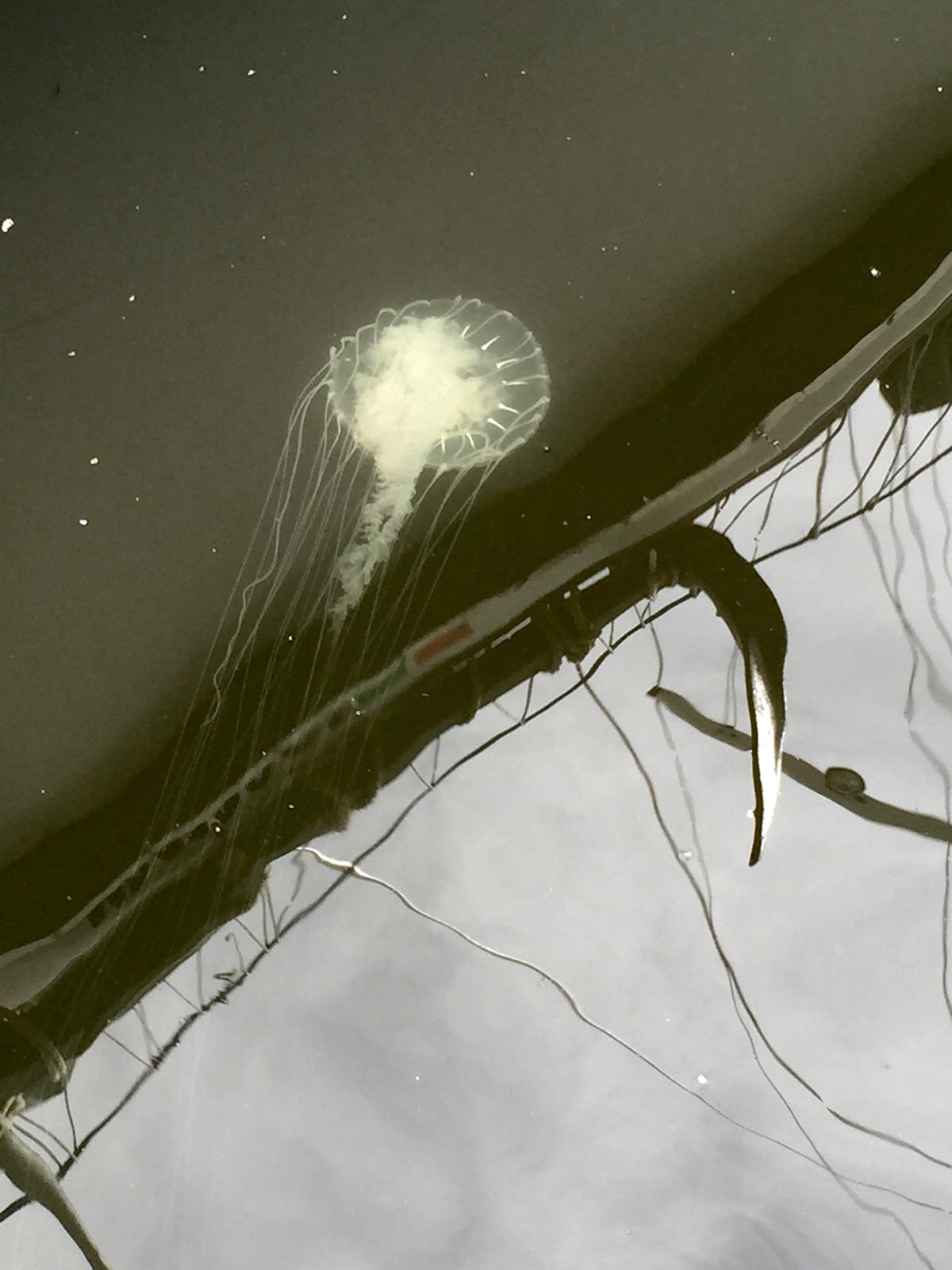
My favorite part is seeing the wildlife that is so close to the boat. We have different birds and jellies that come by, displaying themselves in the wild.

IMG_20140130_153433_338.jpg

When on the hook, these features in the natural world are even more impacting. There is nothing more amazing then waking up at anchor in a secluded creek with no other boats around!

20150731_134536.jpg


Back story

I didn't grow up planning to live on a boat, nor did I ever dream of owning a sailboat. I grew up on a Caribbean Island called Puerto Rico where the water was a part of daily life. My whole family loves power boats, I'm the odd one out.

When I was very young, my family had a 13 foot Dell Quay Dory (looks very similar to a 13 foot Boston Whaler) and we would go out on it every weekend. We would tie up to a reef islands and explore the mangrove or snorkel in the corals.

Then when I was a young teenager, we upgraded to a 23 foot Four Winns. This was a huge upgrade since now we had a cabin and could sleep anchored out instead of returning to shore before sunset. This is when I decided that I wanted a boat when I was older so that I could sleep out as much as possible. 

When I was 13 years old, I learned to windsurf rather quickly. The concepts of how to harness the wind to move me came naturally and I was covering great distances in no time! While I was never formally taught the finer points of sailing at this time, basic concepts just made sense to me. I knew I could hit my fastest speed on a beam reach, running was slow, and you could never go directly into the wind. I would play with the dagger board and explore new reefs that I had never visited with my family before! This opened a whole new world to me and I loved the wonders that could be discovered at the next reef over. Some reefs had higher sea urchin populations, others had more starfish or conch shells. Every reef was a new adventure waiting to be discovered and observed. 

When I got a bit older, my parents got me a kayak and the windsurfing came to an end. I would paddle around the reefs and explore, just as I did with the windsurfer, but the shallower draft allowed me to get further into the reefs without fear of grounding. Once again, I was enthralled with the new places that I could go; albeit at a much slower pace.

Being very pale, my skin would burn in a matter of minutes under the strong tropical sun. I would wear a long sleeve rash guard to protect my arms, along with gloves and a hat; but my legs would always burn up! I decided to cover my legs with a bed sheet which led to my rebirth of sailing. 


In the mornings, I was in charge of taking our dog to land for her to do her business. Instead of going to the land of the reef we were on (top map), I would paddle out to the reefs on the horizon (bottom map).


In the early hours there was no wind and the swell was very minimal. By the time we made it to the reefs and she was finished running around, the sea breeze had picked up and we would return to the boat. 

I found that the sheet I carried for my legs could be tied to my paddle and raised in the shape of a square rigger! I would sail back to the boat from the horizon in the morning and enjoyed every moment of it. I experimented with different ways of tying the sheet to the paddle to sail on various points of sail. Being how the kayak had no keel, I was never able to do more than a beam reach. I pretty much paddled upwind and sailed back to the boat.

In the past, my sister would run the jet ski next to me while I sailed to estimate my speed. My top speed on the windsurfer was 45mph, and only 18mph on the kayak. While it was considerably slower than windsurfing, it was still much faster than paddling back!

As I grew up, I still looked forward to my weekends on the water! We would visit the same few reefs but what we would find there was always different. I had planned to live in Puerto Rico when I was older, somewhere out in the country where I could still go out on the water every weekend; but then the political situation on the island changed and we left.

We moved to Maryland when I was in college and stopped going out on the water. Once I went to dental school in Baltimore, MD, I began making choices about how I wanted to live once I graduated.

I knew I wanted a boat that I could sleep on so I could once again experience the waves rocking me to sleep. Many of my classmates were buying houses and I began to look at where I could live after I graduated. This ended very abruptly when I saw the price tags on these houses! If I bought one of these homes, I wouldn't even be able to afford a dinghy! 

I was experiencing a dilemma. I wanted to have a boat, but couldn't figure out how to afford one while paying for a house. The solution was simple: No house! At first I thought this was ludicrous. I didn't think that people lived on boats! I looked around the internet and came to find that living aboard was actually a thing! This opened up a whole world of opportunity.

I gave it some thought and decided that I didn't want a power boat because I couldn't relax while thinking about the fuel costs to operate a motor yacht. The choice was simple, I would live in a sailboat!

Then it struck me that I had no idea how to sail a sailboat! When you steer a windsurfer, you tip the mast fore and aft. To steer the kayak, I would put my foot in the water to create drag on the side I wanted to turn towards. Sailboats looked awfully complicated with all the ropes running everywhere! This is when I began my studies into the art of sailing.

Any free time I had between studying for dental school was spent reading about sailing and combing yachtworld for a potential cruising home. I read forums and stories, watched videos on YouTube and absorbed as much information as I could get my hands on. This went on for 4 years while never actually touching the water. 

Once I graduated, I took an "introductory" weekend class on sailing to finally put all the theory I had collected to use. Luckily it all came together for me and I was completely hooked! That weekend I sailed a 23 foot Sonar around the Baltimore Inner Harbor for 2 days. My third time sailing was when I brought my 45 foot Morgan back to Baltimore (luckily that also worked out well).

I bought Wisdom with the plans to take her across the oceans, she just needed some work first! She had a noisy diesel engine that I hated and was in need of a major refit. The sum of these situations is what has led me to become the sailor I am now. I'm always looking for a better way to do things and wondering why things are done the way they are. 

Since I did not grow up sailing, everything on a sailboat is new to me and I question the purpose and function of it all. This leads me to develop a deeper understanding for how and why things are done on a sailboat. Curiosity and the desire to learn have driven me to become the person I am today and will continue to shape me into who I will be in the future.