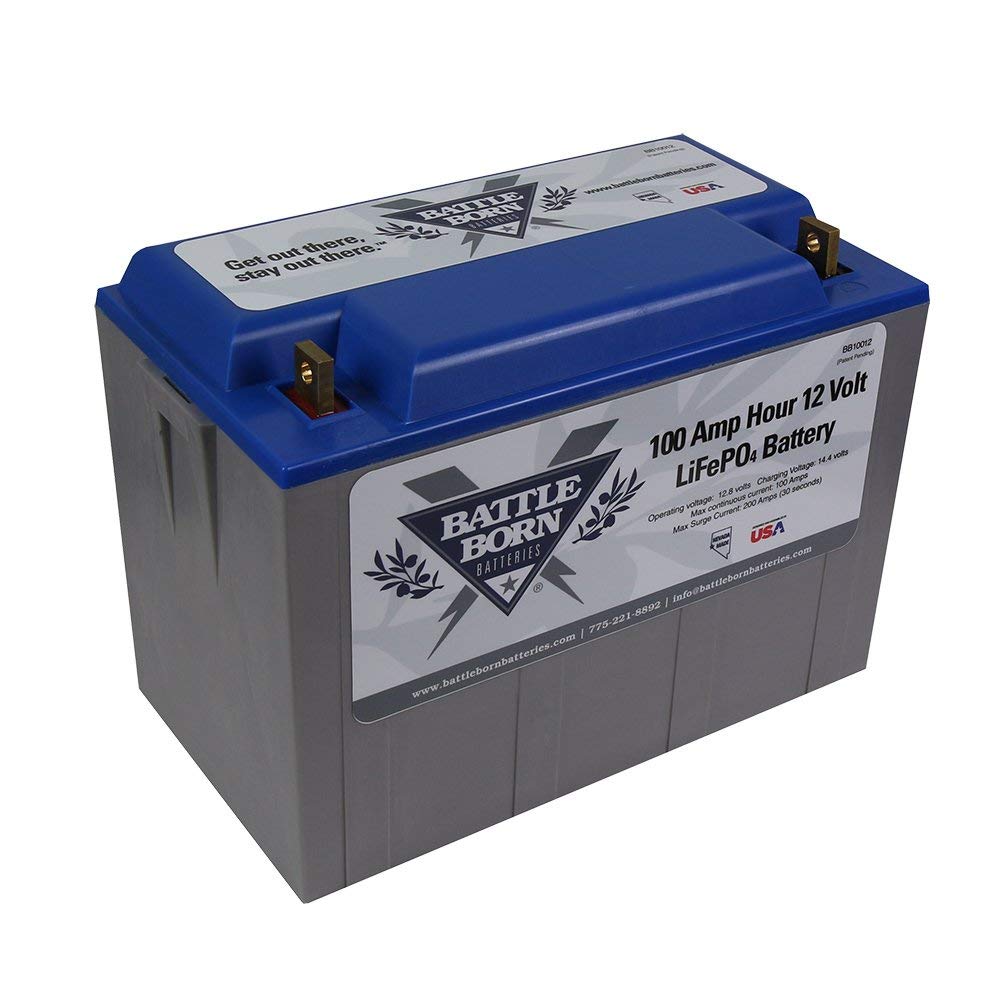
Renogy Batteries are also direct replacements for lead acid and AGM batteries, but these are even lighter in weight! Their 100ah battery weighs in at only 28 pounds!
Now that we know the major players in “direct replacement” batteries, lets look at why they are more sought after than a regular lithium battery. The first thing is familiarity. For our entire lives, batteries have been this rectangular box that sits in our boat or car and has two terminals on it. Lithium batteries can come in a huge variety of shapes and sizes, which sadly leads to people wondering “which side is the top?” Direct replacement batteries do away with this metal block to lithium by packing it into a familiar shape and size.
The second advantage comes with the voltage. Lithium batteries are made up of cells, and the entire battery pack can have any voltage value you want! This once again becomes a problem since people are used to a battery being 12 volt. In our case where we run a 48v motor, we simply have four 12 volt batteries hooked up in series to create the 48 volts we need to operate. Instead of Battle Born and Renogy offering their batteries in “custom voltages” they packaged them as 12 volt batteries.
You might be wondering, why switch to lithium at all if they take up practically the same space and give you the same amount of power? There are two answers to this question. The first is weight, and the second is usable power.
Lithium batteries weigh less than half of a regular battery. The best way to visualize this is to look at the Amps per Pound at 12 volts.
AGM batteries hold 105 amp hours and weigh 67 pounds
This is to say 1.567 amps per pound
If you want to have a 800 amp hour battery bank, it will weigh (800/1.567) 510.5 pounds.
Battle Born batteries hold 100 amps and weigh 31 pounds.
This is to say 3.225 amps per pound
That same 800 amp hour battery bank would now only weigh (800/3.225) 248 pounds
Renogy batteries, being the lightest, hold 100 amps and weigh 28 pounds
This is to say 3.571 amps per pound
The same 800 amp hour battery bank would weigh just a smidge less at (800/3.571) 224.0 pounds.
So, you might be wondering now, aside from weighing half as much, why bother with expensive batteries? They take up about the same space, and if the boat isn’t overloaded, why bother? Well the truth is, all batteries hold power, but they don’t all let go of the power the same.
Think of batteries as a jar of jelly. They all hold the same amount of jelly, but they differ in how the jar opens.
Lead Acid and AGM batteries have a small opening at the top of the jar, so you can get your spoon straight in, but you can’t get to the sides of the jar. When you have gotten all the jelly you can reach, you notice that there is still a lot of jelly left on the sides, but you just can’t seem to get to it!
Lithium batteries have a much larger opening at the top, so you can get to the sides of the jar much more easily. This lets you get to more jelly and leave the jar more empty when you are finished.
Lead Acid and AGMs can safely discharge down to 40%, while Lithium batteries can safely discharge down to 10%. This means that in a 100 amp hour battery, an AGM can give up 60 amps while a Lithium can give up 90 amps.
So, back to our hypothetical 800 amp hour battery bank, made up of eight 12 volt batteries. The batteries sitting in their box hold 800 amps hours. If these batteries are AGM or Lead acid, they could only give out about 480 amp hours. This identical battery bank made of Lithium batteries could now give out 720 amp hours. That’s an additional 50%, from half the weight!
So, bringing the battery bank and electric motor out of the hypothetical realm and into reality: