Steel Squarerigger

While visiting New York City, we stumbled upon this old square rigger. Unlike the wooden tall ships that we have encountered over the years, this one was built out of steel!

IMG_3326.JPG

Steel boats hare their distinct advantages, being a very strong but also thin material to build the hull. You can see that over the years though, corrosion has played a role in the stem and cutwater of this ship. The pitted appearance of the old steel tells of its age like the patina that forms on a bronze port light. It’s not shiny, but its age displays its beauty.

At first glance, I didn’t really notice the pitted nature of the steel plates, but then when compared to the new smooth steel plates that have mended the hull, the story of time becomes evident and powerful.

Cut-in Waterline

Cut-in waterlines are a truly useful tool. Their primary purpose is to permanently scribe the waterline of a yacht into the topsides, that way it can not be erased or lost. Aside from this purpose, it also serves a few other wonderful services as well.

FullSizeRender.jpg

The most famous is the ability it affords you to paint your bottom without masking off the top. The bristles will simply fall into the groove and stop there. This allows you to simply paint up to the cut in waterline with ease and care without accidentally getting bottom paint on your topsides.

Taping off your waterline might not sound like a big ordeal, but when you are painting in a tidal grid, time is a very important item and one that is very limited.

As the tide is going out, you will begin scrubbing and scraping, then you have to chip off any loose paint, followed by fairing in any rough edges. This is a lot of work and adding one more step of taping off the waterline is not usually appreciated.

Having a cut in waterline allows you to simply start painting after the bottom is clean. The edge is there and unmistakable.

FullSizeRender.jpg

The second advantage of a cut in waterline is it makes it easy to see where your waterline is supposed to be, even if you raised the bottom paint as your cruising home becomes overweight. The cut in line will never move, and you can gauge how over loaded you are by how far under the water the line is.

FullSizeRender.jpg

The last and probably least thought of advantage of this scribed line on your hull is the ability to record and protect your waterline information, no matter what your yacht goes through.

We are repainting our topsides, and the bottom edge of the topside paint will go all the way down into the bottom paint area. The worker wanted to know how far into the bottom paint to sand, and the answer was easy to give and hard to forget: “Down to the cut in waterline”.

Now I could leave the country while the boat was sanded without worrying about where the worker was sanding. Best of all, when we repaint the bottom, I know how far above the cut in waterline to raise the boot stripe.

Having a cut in waterline boasts many advantages, ones that are typically only thought of as the moment they are needed arises. If you have one, enjoy it, and if you don’t have one but do have spare time to kill, consider adding it to your cruising yacht.

Taping Off for Spraying

With the topsides sanded away, it is time to mask off the areas that are not going to be sprayed. In the United States, this would typically occur inside a tent, where everything is covered in plastic.

In the Azores, regulations are severely more relaxed.

IMG_3263.JPG

Newspaper taped to the waterline seems to be sufficient for the local workers, and no tent required, even when painting next to a dark blue yacht.

IMG_3262.JPG

Yes, with some pages of the local newspaper, we are ready to be sprayed with primer. When I asked about the boat next to us, his reply was simple yet honest: “We wait for a day with no wind".

It is refreshing to step outside of the United States where people are so hung up on every little detail that they forget about reality and practicality. The cost to have work done in the Azores is approximately 1/10th of what the cost is in the United States. This may be because of the lower cost of doing business thanks to the relaxed restrictions. They don’t need tents, tarps, or collectors, they simply wait for the weather to cooperate and take it from there.

The painter doesn’t want to get paint on the next yacht, so he is extra careful to make sure that his over spray doesn’t travel in that direction. Believing in a workers skill allows them to work without all this red tape that we have in the states.

Preparing for New Topside Paint

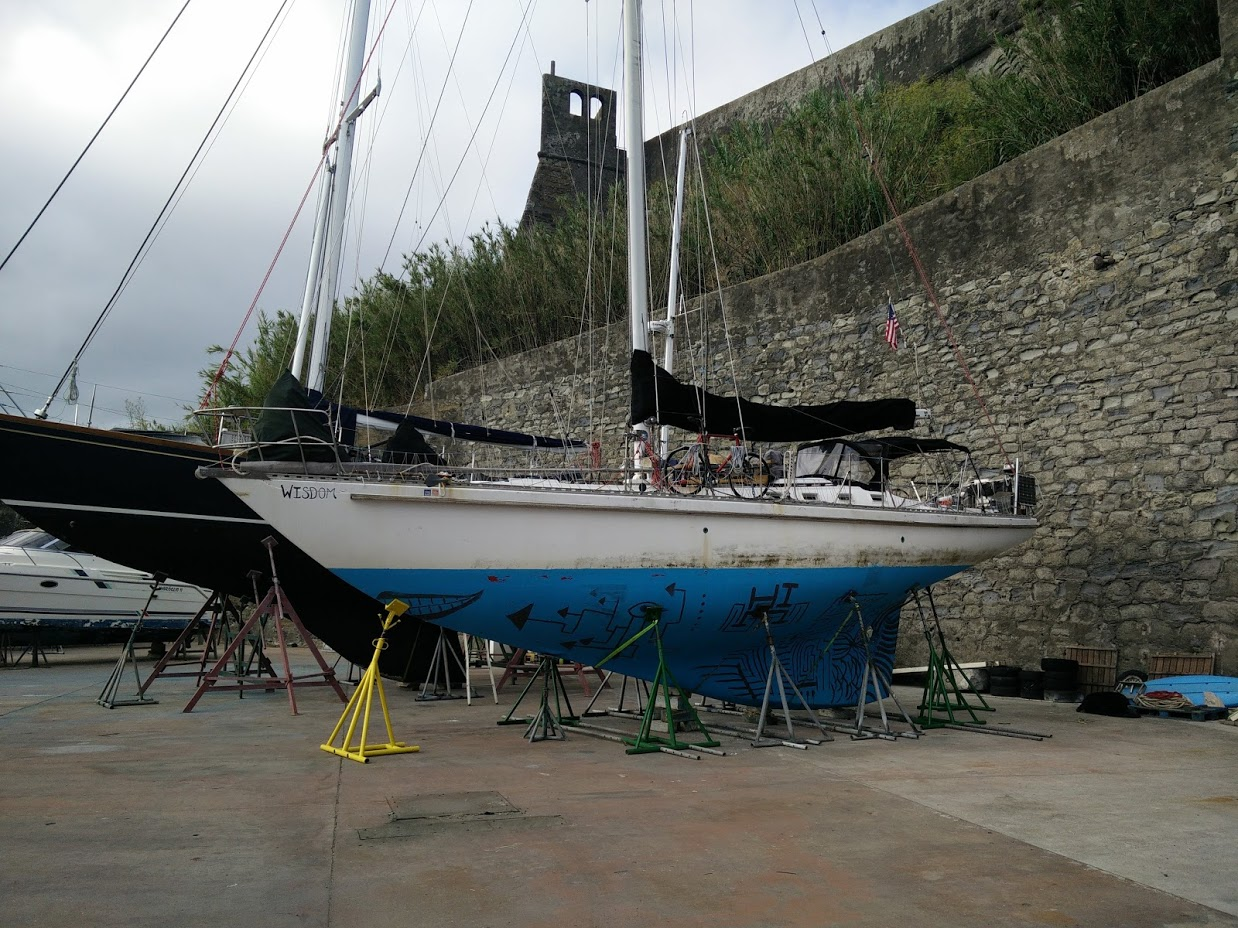
We made it across the ocean purely by sail, with an electric motor, and most of all, without a diesel motor! While we felt accomplished by this feat, Wisdom was looking pretty tired.

IMG_2756.PNG

Since we never motored, and instead were under sail the whole journey, we were also heeled over the whole time. We usually sail at around 10 to 15 degrees of heel, and that means that our topsides go into the water on the leeward side. This has never been an issue, even in the pea soup waters of the Chesapeake Bay, because they were never under the water for very much time. We would sail by day and anchor by night, most importantly, we would dry out by night.

IMG_2757.PNG

Our topside paint was old and beginning to peel, making the surface porous and prime to grow fouling growth. Being heeled over with the topsides under water for days on end the paint grew some nasty fuzzy fuzzies. We knew we needed more than just a good washing; for it was time to repaint the topsides.

FullSizeRender.jpg

Labor in the Azores is very reasonable. 6 years ago, I painted the topsides myself because the cost of having the topsides painted was prohibitive! I received 3 estimates, all ranging around $20,000 to paint the topsides. Needless to say, I painted it myself for a grand total of $800 in materials.

Maddie and I were planning on painting the boat ourselves, until a worker in the yard offered to paint us for € 2,000. We quickly discussed the offer and decided that I could go back to the states and work as a Dentist for the same amount of time that it would take for them to paint the boat, which would pay for the project but be a lot less taxing on my body. The decision was made, and a handshake agreement sealed the deal. I now owed Paulo € 2,000 and he owed me a bright white hull.

FullSizeRender.jpg

Painting is easy, but prepping the topsides is where the real labor lies. The first step for Paulo was to sand off all the old paint and take the hull down to the gel coat, which in our case, was a lovely shade of Fighting Lady Yellow.

The long and laborious project has begun, which has snowballed into a long list of projects that are going to take place while we are on the hard.

Horta, Azores

Our first landfall in the Azores was Horta, Faial, Azores. This tiny harbor is actually the 4th busiest marina in the world! 

We passed through after peak season and were amazed at how packed the place still was. Yachts tie up to the piers rafted up to 4 deep, but luckily we were only 2 deep when we first arrived, and shortly thereafter, we were the ones up alongside the pier.   

The pier is a massive concrete sea wall which is murder on your hull, so be sure you have plenty of really strong fenders. We deployed our rope fenders and were safely protected from the rough concrete, but a few air fenders did pop on other yachts while we were there. 

IMG_2838.JPG

An important point to ponder when you tie up is that your mooring warps will not only need to support your yacht, but the weight of three additional yachts that are tied up to you. As yachts come and go, a dockline shuffle will take place where the yacht up at the sea wall wil leave and all the other yachts will move around it to let it slip out. 

While we were there, mini-transat yachts arrived from mainland Europe and were going to be leaving in a few days for the start of their race. 

IMG_2847.JPG

If you are concerned about costs, it is worth tying up because they charge you to anchor at a similar rate as tying up. The holding is less than ideal, so you might as well tie up and have the convenience.

IMG_2857.JPG

After we tied up, Maddie and I went for a hike up into the mountains around the town, and at one point, we had this great view of the marina.