How Do We Power Our Yacht While Crossing an Ocean?

Having an electric motor means that we can't fire up the old diesel to charge up the batteries. When we crossed the Atlantic Ocean in July of 2018, we carried with us three methods of charging. The first is our solar panels. We have 200W on the deck and 100W on the stern as fold out wings. We also have a Honda Generator (EU2000i) and lastly we have the electric motor that functions as a hydro generator.

The solar panels started out as a great method of charging when we were anchored, but failed us on the ocean. The deck panels get stepped on accidentally, or things fall on them, or the salt finally kills them. Either way, both 100W flexible panels are dead and not producing any power.

The 100W on the stern is composed of two 50W rigid panels. One works fine, the other panel corroded away at its terminals, literally corroding away to the panel itself with no way of reworking it!

So, our 300W solar system is limping along at 50W.

Thankfully we have the generator! Right?

Actually, the electric motor functioning as a hydro generator has produced all the power we need and fully met our demands. We have yet to turn on the generator and are nearing land after 22 days at sea.

Right now, as I write this, the motor is producing 4.8amps @48vDC. When this is converted to 12vDC with a step down converter, it becomes 19.2amps @12vDC; silently!

Yes, the electric motor that has a very limited range of motoring offers unlimited and quiet electrical production for us as we sail across the vastness of the Atlantic.

We left Bermuda with 15 gallons of gasoline, and it appears that we will arrive with the same amount in the Azores.

Observation About Headsail Tack Location and Motion Through Seas

We have crossed the Atlantic on a 1968 Morgan 45 with a full keel and cutter rig. This is a CCA style boat with a LOD of 46 feet and a 32 foot waterline. Yes, 14 feet of the boat hover above the water while at rest.

Our bow has a far amount of overhang, with the staysail's tack just behind the beginning of the waterline and the headstay's tack located several feet ahead of the waterline.

One consistent observation we have noted when sailing, particularly when beating, is the way the yacht moves through the seas depending on which headsail is flying. If we have the job lowered and are only flying the staysail, we will ride up and over the waves. This gives us a much drier ride but a significantly bumpier one. Each wave is a wall that must be scaled and climbed down. This greatly adds to the distance we sail as we are now climbing the face and back of each wave, but we do so in a very calm and collected manner. Our speed suffers significantly as each wall almost stops us in our tracks! The end result is a very slow, albeit dry, passage to windward.

The alternative has also been noted. When we fly the jib on our headstay, we no longer ride up and over waves. Instead, we plow right through them. Water pours over the bow as we turn into a submarine and a river of seawater runs down the deck and off the stern. The river can be quite deep, reaching a few inches deep when beating in heavy conditions. This makes deck work less enjoyable and much less safe. Everything is slippery and a few inches of water rushing past can take away your footing, causing you to slip and fall!

On the other hand, our speed drastically improves as we no longer ride over waves, or slow down for them either.

Having a cutter allows us more versatility in Headsail arrangement and sail balance over a sloop, but now I wonder about sloops with their tack location. Most sloops, but not all, have their tack at the tip of the bow; some have them a few feet back. We have the choice of a fast wet ride or a slow dry ride through the seas, a sloop has the setup given to them by the naval architect.

Please let me know in the comments section below about your experiences with tack positions relative to the waterline and how the yacht handles beating into the seas. Also, I would love to hear from those with a bowsprit, does it provide even more drive through the seas?

Doubling Up Your Fenders

Massive rope fenders are great for tying up in a storm to an unforgiving concrete sea wall. They won't pop, they won't tear, and they won't give. The problem is they also won't hold their shape when pounding into the wall for days! 

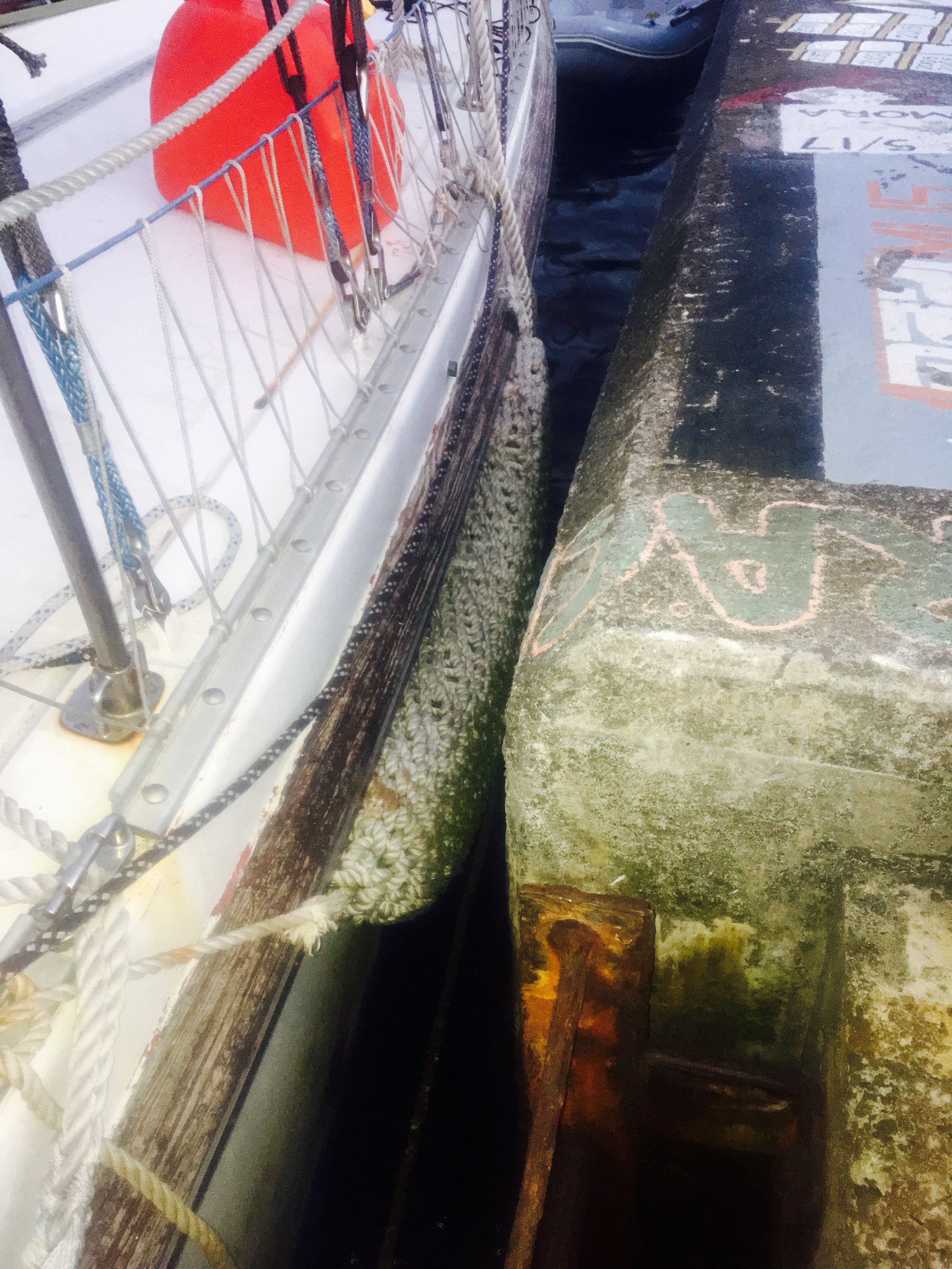
We were tied up to a wall in Terciera, Azores and the weather picked up. The swell inside the marina became rather unrelenting and we were being hammered into the wall every few seconds. The fenders soon became flattened and our wood rub rail was only inches away from scraping away on the stone. It was time to double up! 

FullSizeRender.jpg

I simply tied a second fender over the current fender and let the two of them share the abuse! You can see how the rope got very chafed during the next two days, leading to a matted mess of fibers that have been lifted from the three-lay rope.

FullSizeRender.jpg

The fenders got very scuffed, but our topsides survived flawlessly! The flatness of the fender rolls out easily when you put it away in storage, only to reform the next time the fender is deployed. 

Keeping plenty of strong fenders on board is crucial if you plan on cruising to new countries where the mooring situation might be a bit risky to your yacht and anchoring is nearly impossible. 

Rope Fenders

Several years ago, I began building a set of rope fenders. They are big, heavy, and honestly serious overkill for stateside cruising (especially on the East Coast). Our journey down the East Coast of the United States and into the Bahamas involved anchoring everywhere we went (where fenders are not needed) or tying up in a marina which had padding on the finished wooden edge of the pier. The weather is always calm and there is little wave action inside the marina that would push your topsides up against the pier.

I honestly began to view our old rope fenders as overkill and dead weight on the deck, until we made landfall in the Azores! 


FullSizeRender.jpg

The Azores are small volcanic islands in the Atlantic with no protection from the weather. If the seas are big, they will be powerful inside the breakwater as well. The marina i also made of a few floating slips and a lot of large concrete sea walls that you tie up to. Pounding into these is a sure way to pop an inflatable fender!

FullSizeRender.jpg

Fenders alone will not save your topsides here, you need fender boards. Luckily, I made the rope fenders long enough that they themselves function as fender boards. This kept our hull a few inches away from the unforgiving concrete pier and large rusty ladder that sits in a small recess. 

If you plan on voyaging to distant lands, do your research about the mooring situation before you leave that way you can arrive prepared to safely tie up! 

Finding Land

FullSizeRender.jpg

LAND HO! 

After a long time at sea, land might become more of a distant memory than something that you think is out there on the horizon. You have been sailing for weeks and are heading towards a new land, but what will it look like as you get closer? Will land just jump out over the horizon? Will you even notice it off in the distance? 

FullSizeRender.jpg

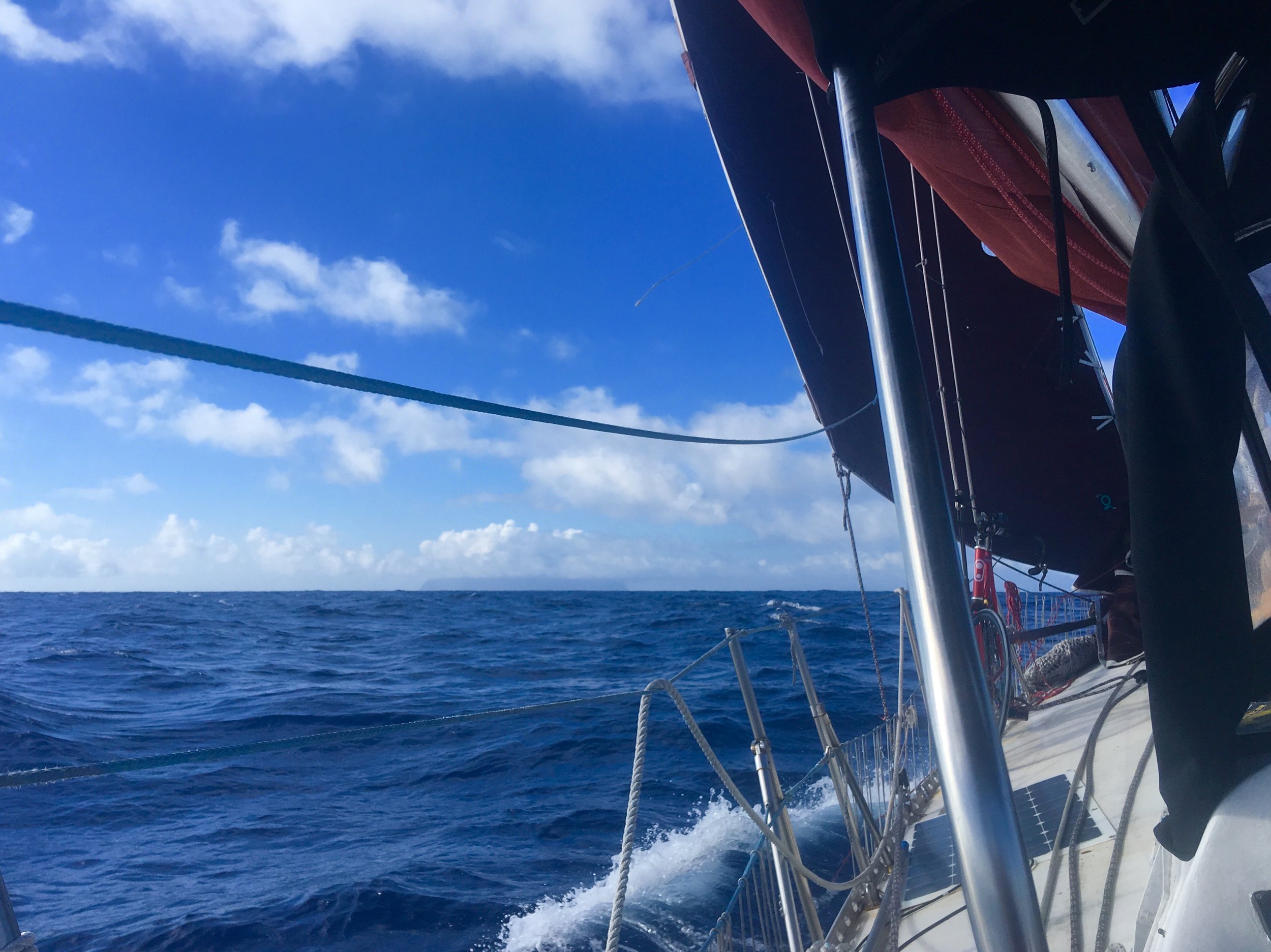
Land on a clear day is visible far off on the horizon as a grey haze. After weeks of sailing, the land will appear as an oddity on the horizon rather than appearing as "land". Upon, closer inspection, you will then realize that you are looking at your destination!

FullSizeRender.jpg

While you might think it will jump out at you, the truth is, land will silently hide on the horizon. It will not call out to you, and it will not attempt to make its presence known, unless you know what to look for. Land, especially tall land, will usually have a permanent cloud cap. After a long voyage, you will be accustomed to looking at the clouds and determining which direction they are moving. This has been your method for spotting and tracking storms for the entire passage, and by this time you will be an expert at watching clouds. Clouds over land will call on your attention because they will not move! 

You will notice a permanent and stationary cloud that does not move on the horizon, long before you will see the land beneath it. As you sail closer to it, the landmass will appear from over the horizon.  

FullSizeRender.jpg

Once you get closer, the outline of the land will become clearer and you might even be able to make out identifying features of the terrain.  

FullSizeRender.jpg

Land will make itself clearer as you continue to sail closer to it, but spotting it from a distance can be an entertaining challenge! Most islands out in the ocean have mountains or other high features that will make them visible from a distance; some islands will try to hide in the misty edge of visibility by laying low to the seas surface with no identifying features. 

FullSizeRender.jpg

The Bahamas are famous for having very flat islands that are difficult to spot at a distance, but they do offer another trick to finding land. The shallow turquoise waters of the island chains will shine up into the clouds, giving the bottom of the clouds a turquoise tint. The islands in the Bahamas are very low and hard to spot, but this will give you the indication of their presence hundreds of miles away!