Electronics on a Yacht

If you have been reading the blog for some time, you might have noticed that while I try to offer a equal view on various topics, I, like all people, have my biases. I work really hard to keep them from influencing my writing, but I know they are always looming in the background, and you may have noticed that over the years too. 

I do not trust electronics. They are convenient, they are easy, and I feel they will let you down. 

The reason I don't trust electronics is simple, I have trouble fixing electronic items. Since I can't always fix it, I can't always get it up and running again, and that means that it will die on me before something mechanical would. 

When our Monitor Windvane broke, I fixed it with a single new bolt. It was an easy fix that allowed us to keep going without any hiccups in our sailing. When something electronic breaks and I open it up to find the fault that caused the entire problem, I am confronted with a tiny green board that is covered with electrical connections. Each connection is important and is prone to death by corrosion in the harsh marine environment. When I look at the green board and everything looks clean and fine, I get even more frustrated because, unlike the big bolt on the Monitor Windvane, I can't see the problem on the electronic board. 

Worst of all, I expect electronics to fail when I need them the most, and when they fail, I won't have the time or knowledge to fix them and keep them running longer.

This frustration presented itself today when we were getting ready to set sail on a broad reach to a new port. The anchor windlass is manual and easy to repair and maintain. The halyards and sheets operate on mechanical winches. Our charts are paper and I am proficient enough with a sextant to find our position. While this may seem old-school, I do dabble in the realm of electronic conveniences. 

We have a GPS chart plotter in the cockpit, our VHF radio also displays our coordinates. We have Navionics software on our iPad and iPhone, allowing us to view detailed charts in the palm of our hand and sail through unfamiliar waters without fear or concern of unknown shoals. 

These devices make our lives easier, but they can always fail us. The phone and tablet computer can easily fall overboard or get hit by an object, breaking their screen or rendering the device inoperable. The chart plotter could one day not turn on. The radio could stop working. All of these devices can die silently and without warning on a boat, only demonstrating their passing when you need them and go to use them, finding their current situation and reveling in frustration.

This happened to us on our voyage south. We are in the ICW, waters that are known as being unfriendly towards sails. We have previously avoided these waters since we have a rather deep keel and an electric motor. The motor is more of an accessory that we use to help us dock, not our primary mode of powering the yacht, that is what the sails are for! 

In the ICW, we had to put our trust in the electric motor, as it would be the main mode of propulsion as we moved along these narrow and shallow waters. We motored into an anchorage that is small and shallow, but also very well protected. There is a strong current near the rocks, but this is no problem with a motor that can keep you clear of the jetty and in the middle of the channel. 

Then one day, we decided to leave the anchorage because the winds would be in our favor as we headed to our next destination and the motor would not work. 

I do not know when the motor died, because we used it getting into the anchorage. We also used it in the anchorage to get us off a shoal that we swung onto, putting its last use only a day ago; but here it sits inoperable and silent. We were planning to leave, only discovering its deceased state when we needed it and went to use it, luckily before the anchor was raised off the bottom! This changed all our plans, as we had planned to leave today and head to a new port, but instead are now going to stay here longer as we await the arrival of replacement parts by mail. 

Electronics are fun and convenient, but I do caution one to not rely on the solely, as they could fail and leave you stranded if you do not have a manual backup. 

Trouble in Paradise

We left Hatteras, NC and sailed down the Pamlico Sound on a broad reach in 25 knot winds and a light chop. The sail was fast, maintaining a speed of 6-7 knots for a majority of the passage. Then we anchored in the harbor at Oriental, NC which is a very boater friendly town. 

They have marine consignment shops, and co-op stores that stock everything a cruiser will need to provision, repair, or relax as they cruise! They even loan bikes to boaters for free so you can explore the town with ease. The local grocery store also has a shuttle that will pick you up at the pier and take you to the store, and take you back to the pier with all your groceries! 

We greatly enjoyed our stay here in this small town where everyone knows each other and is very friendly towards us and other cruisers. Then the winds shifted and were blowing towards our next destination. 

I was preparing to raise the anchor when I decided to test the motor first: nothing. 

The engine display would not turn on and the motors did not respond when I would put the motors in forward or reverse. It seemed that our reliable and maintenance free motors were not responding and were not going to work today. 

I began trouble shooting everything, tracing wires and checking voltages. We had 51.3 VDC leading into the motors, and all the connections seemed to be corrosion free. I also checked for continuity in the circuits, and everything was operating as it should, yet the motors would not spin. 

Then I thought: "What if the propeller is fouled and wont allow the motors to spin!" So I tried turning the shaft by hand, and sadly, it spun freely without any hesitation. I was stumped, as everything seemed to be in working order, yet it was not responding. 

After talking with the manufacturer of the electric motors directly, they deduced based on the information that I had given him that the main controller has died and there is no way to fix it without a new control unit. 

The company is very kind, and since the unit is only a few months old, it is covered under warranty and they are going to ship it out to us so that I can swap the parts and get running again. 

We are anchored in a beautiful harbor, surrounded by many nice people, yet we wanted to go and were not able to. It looks like we will be here in Oriental, NC for another week as we wait for the parts to come in. Such troubles! 

We did consider raising anchor and sailing away without the motor working, but decided against it. Yes, we usually sail into and out of anchorages, traveling many miles without the use of our engine, but those are in much wider waters with calmer currents. Here, the current flows at around 2 knots down a very narrow channel with lots of shoals and obstructions along the way. We could brave it and venture off under sail alone, but it would be very unwise. The ICW is in the motor boats domain. The water is narrow and shallow, and the winds are blocked by trees and buildings along the way. There are also bridges that open on a schedule and a motor is needed to fight the current and hold one in place as all the boats wait in a line. 

Trying to sail through narrow Adams Creek and into Beaufort, NC is foolish. So instead we decided to stay where we are and wait for the parts to arrive so we can join the ranks of the motor boats that transit these narrow and crowded waters. 

Generators on Cruising Boats

Generators are compact motors that convert fossil fuels into electrical power. They can produce power in the form of Alternating Current (AC) or Direct Current (DC). They can also be wound in a way to create various voltages, allowing you to select the ideal generator for your yachts electrical needs. 

Generators offer the convenience of electrical production from the easily carried and energy dense fuel source known as diesel, propane, and gasoline. At any time, the motor can be started up and a stable and reliable flow of electricity will flow from it into your yachts power system. This power can be used to recharge the batteries, power appliances, and even give you the comfort of air conditioning while away from the dock.

While these conveniences are nice, they are still just conveniences and not necessities. There is no reason to postpone your cruising departure because you don't have a generator yet. Generators should be viewed as a "nice to have" and not a "need to have." 

Generators offer a lot of convenience, but this luxury does come at a price. Generators take up a considerable amount of space, energy, peace, and cost. Cheaper generators tend to be in large metal frames. These generators will only set you back a few hundred dollars, but they are loud and guzzle gas and oil as they produce their power. These generators are easy to find at almost any hardware store near a port. If you need a generator in a pinch, this option could set you up with the power you need, and not break the bank in the process.

A smaller and quieter option comes from Honda, in the form of their EU line of generators. These generators are much more fuel efficient, allowing you to power your boat for hours on end with a single gallon of diesel. They work by actually throttling the motor to meet the electrical demand placed on it. Think of the metal frame generators as a power plant with an on/off switch. When it is off, it produces no power, and when it is on, it is running at full blast producing all the power it can. You simply draw what you need from this pool of power until it runs out of fuel. The Honda EU series will throttle back, giving you much greater run time and save a lot of fuel.  

We bought the Honda EU2000i and it has a 0.94 gallon fuel tank that is capable of running for more than 7 hours! The manual states that at full blast, it will run for around 3 hours and under no load around 8 hours. 

As it throttles back, it not only saves fuel, but it also makes the entire process much quieter. Less umph from the motor means a more silent experience for those that are near by. The Honda EU line is considered to be the quietest on the market (which is a big factor into why we chose this model) and it is still pretty loud in our opinion. It never hurts your ears, but it is a constant low drone in the background that never seems to go away until you shut the generator down. 

One more added benefit with these compact generators is they are lighter and often come in a nifty case that makes transporting easier. This makes it easy to stow it somewhere in the boat and set it up on the deck when you need to fire the unit up. 

Our Honda EU2000i cost us about $1,000. This was by no means a small purchase for us and we thought about it for a long time. The turning point in our decision came when we found ourselves forced to transit the ICW on the east coast of the United States due to the present and deteriorating weather we have been having. Motoring for a long time is not possible with our electric motor, as it will drain the battery banks.  

We looked at all the options and weighed out the facts of the decision. If we chose to tie up in a marina to recharge, we would spend around $90 per night to recharge the batteries. This means that in roughly 11 marina nights, we could have purchased our own generator and charged the batteries up at anchor for the price of gasoline. 

While these cheaper options involve gasoline motors and low power outputs, there is an entire other level of generators to look at. 

Diesel generators will produce massive amounts of power at a very efficient rate. They are also safer to operate because diesel is not explosive like gasoline is, greatly decreasing the risk of a fire or explosion on your boat. 

Diesel generators also cost a significant amount more, most of them start around $5,000 and quickly climb in price from there. These generators are heavy and by no means considered portable, as they are mounted on their own engine beds in the hull. These motors will have their own cooling system and exhaust system that needs to be maintained, just like on your primary diesel motor.  

The complexity of installing a diesel generator is greatly amplified as it needs its dedicated space, and this dedicated space needs to allow the operator access for maintenance that needs to be carried out on a regular basis. 

Generators are by no means mandatory, but they do allow for more comforts on board if you are willing to spend a little more money. 

The Waiting Game

While you might think that cruising is an endless vacation with no schedules or time constraints. The truth is, time is always around us. 

Yes, cruisers will lose track of time and might not even know what day it is, but time and schedules are still a very real part of their journey. The weather and its weather patterns run on the same time that the rest of the world operates on.  

When you decide to leave a destination is up to you, but when you can leave a destination depends entirely on the weather. In the right season, you can leave any day, but in the wrong season, you might find yourself waiting for days, if not weeks, for the weather to cooperate. 

Cruising is much more relaxed than working life, but it still follows the rules of time. Instead of a boss telling you what to do, you have nature telling you what to do. 

2 Year Headstay Inspection

Wisdom, our 1968 Morgan 45 was re-rigged with synthetic standing rigging back in 2015. The headstay has endured use, abuse, and a lot of weather over these two years. Our headstay's deadeye got severely damaged by our anchor and needed to be replaced, giving us a wonderful opportunity to evaluate how the stay is holding up at the bow.​

The bow is known to be the harshest place on a yacht for rigging. Every single wave that splashes up will wet the stem and the lower part of the headstay in a fine misting of salty moisture. This mist will work its way into the tiniest nooks and crannies in your headstay, causing devastating corrosion from the inside out.​

IMG_1830.JPG

To make life for your stem fittings even harder, being up at the tip of the bow, they are often ignored and forgotten, as the rest of the boat gets cleaned regularly, but the headstay might only get a quick splash with a hose.​

On most yachts, the headstay lives inside the furler, where it is forgotten and ignored until something breaks. On yachts with hank on sails, the headstay is easily inspected, but still neglected.​

Synthetic rigging prevails in these hardships, as the Dyneema fibers are made out of plastic and are immune to corrosion caused by moist salt spray. Let us see what lies beneath the surface of our headstay!​

IMG_1873.JPG

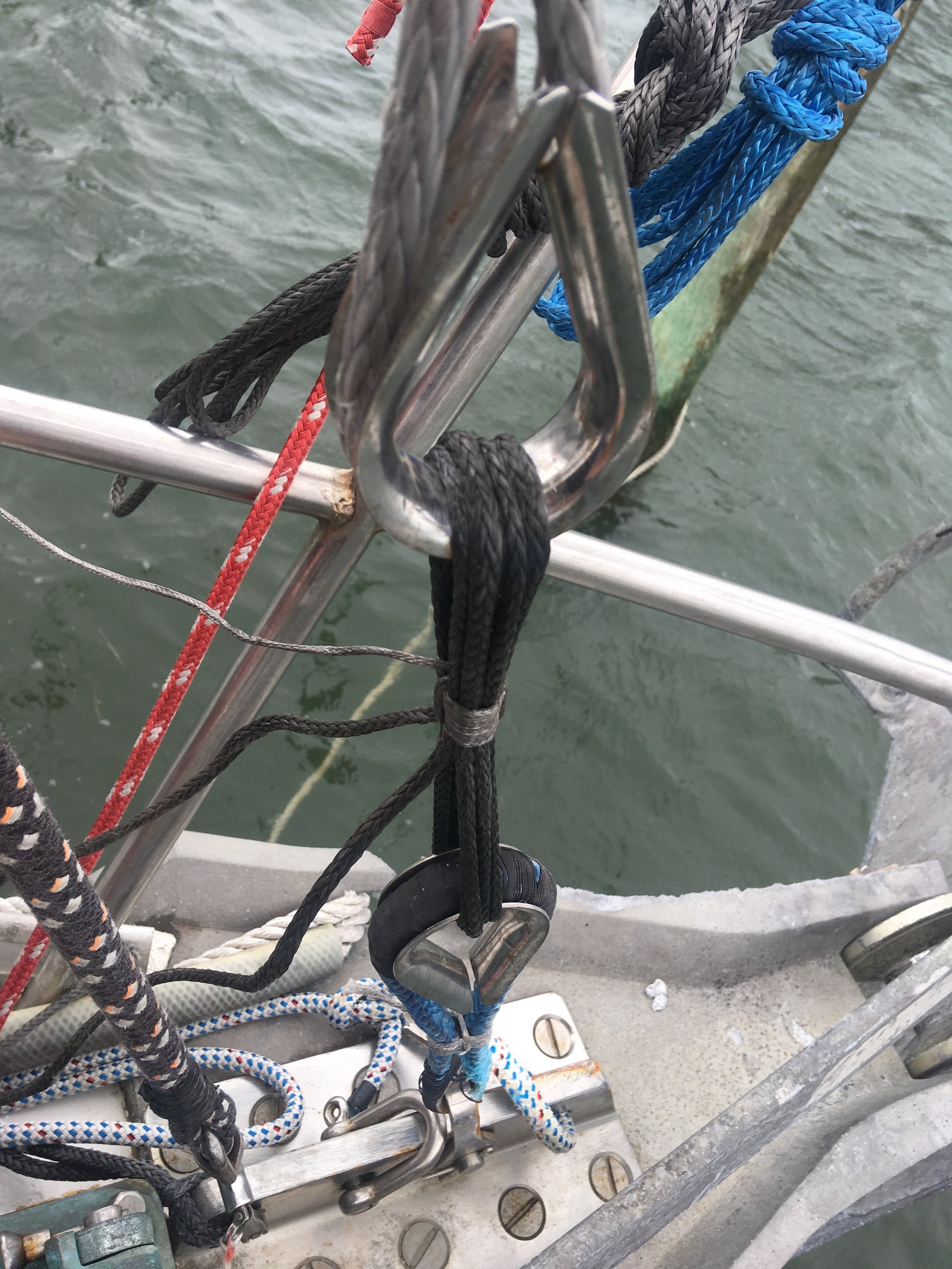
Under all those wraps, you will find the true knot that holds the entire stay in tension: The Shroud Frapping Knot. This knot pinches and seizes the lashings together with such ferocity that even slippery Dyneema can not escape its hold.

IMG_1846.JPG

This knot is tied while the tails of the lashings are under tension with the entire tensioning system. While the lashings are tight and under load, the Shroud Frapping Knot pinches them in place, allowing you to remove the tensioning lines without losing any tension in the headstay. 

IMG_1848.JPG

This relatively simple knot can be a bit time consuming to tie, taking me close to 20 minutes, but it will hold steadfast for years, never yielding nor giving way as you sail. 

IMG_1868.JPG

On stays that will require a significant amount of tension, it is best to use oversized thimbles as they will accommodate more wraps with the lashings, giving you significantly greater mechanical advantage to properly tension the stay. They also provide a wider radius turn which imparts less stress on the fibers of the lashings.

IMG_1852.JPG

With the tension removed and the lashings untied, you can see the inside of the eye splice at the end of the stay. The fibers have flattened out as they have been pressed into the thimble for two years. There is some slight corrosion staining that appears on the eye splice, and this is from slight surface rusting that occurred on the stainless steel thimble. 316 Stainless Steel is famed for being corrosion resistant, yet in two years on the bow, it has begun to corrode in places that are not visible to external inspection. Imagine if this were a steel headstay with steel fittings swaged together up here. Corrosion would have already set in and it would be a countdown until something failed in a catastrophic manner. 

Synthetic standing rigging is immune to these sorts of problems and the steel components utilized are small and easy to inspect, making their impact on the entire situation much less grave.