
2 Year Headstay Inspection

Wisdom, our 1968 Morgan 45 was re-rigged with synthetic standing rigging back in 2015. The headstay has endured use, abuse, and a lot of weather over these two years. Our headstay's deadeye got severely damaged by our anchor and needed to be replaced, giving us a wonderful opportunity to evaluate how the stay is holding up at the bow.​

The bow is known to be the harshest place on a yacht for rigging. Every single wave that splashes up will wet the stem and the lower part of the headstay in a fine misting of salty moisture. This mist will work its way into the tiniest nooks and crannies in your headstay, causing devastating corrosion from the inside out.​

IMG_1830.JPG

To make life for your stem fittings even harder, being up at the tip of the bow, they are often ignored and forgotten, as the rest of the boat gets cleaned regularly, but the headstay might only get a quick splash with a hose.​

On most yachts, the headstay lives inside the furler, where it is forgotten and ignored until something breaks. On yachts with hank on sails, the headstay is easily inspected, but still neglected.​

Synthetic rigging prevails in these hardships, as the Dyneema fibers are made out of plastic and are immune to corrosion caused by moist salt spray. Let us see what lies beneath the surface of our headstay!​

IMG_1873.JPG

Under all those wraps, you will find the true knot that holds the entire stay in tension: The Shroud Frapping Knot. This knot pinches and seizes the lashings together with such ferocity that even slippery Dyneema can not escape its hold.
IMG_1846.JPG

This knot is tied while the tails of the lashings are under tension with the entire tensioning system. While the lashings are tight and under load, the Shroud Frapping Knot pinches them in place, allowing you to remove the tensioning lines without losing any tension in the headstay. 

IMG_1848.JPG

This relatively simple knot can be a bit time consuming to tie, taking me close to 20 minutes, but it will hold steadfast for years, never yielding nor giving way as you sail. 

IMG_1868.JPG

On stays that will require a significant amount of tension, it is best to use oversized thimbles as they will accommodate more wraps with the lashings, giving you significantly greater mechanical advantage to properly tension the stay. They also provide a wider radius turn which imparts less stress on the fibers of the lashings.

IMG_1852.JPG

With the tension removed and the lashings untied, you can see the inside of the eye splice at the end of the stay. The fibers have flattened out as they have been pressed into the thimble for two years. There is some slight corrosion staining that appears on the eye splice, and this is from slight surface rusting that occurred on the stainless steel thimble. 316 Stainless Steel is famed for being corrosion resistant, yet in two years on the bow, it has begun to corrode in places that are not visible to external inspection. Imagine if this were a steel headstay with steel fittings swaged together up here. Corrosion would have already set in and it would be a countdown until something failed in a catastrophic manner. 

Synthetic standing rigging is immune to these sorts of problems and the steel components utilized are small and easy to inspect, making their impact on the entire situation much less grave. 


Deadeye Torture Test

Synthetic standing rigging, made out of Dyneema, is stronger than steel rigging but several times lighter. This allows your yacht to have less weight aloft while having more strength to hold the mast upright. The result of this is your yacht will become less tender and perform better in all wind conditions. 

As if all of these facets of synthetic standing rigging were not wonderful enough, it has yet another shining attribute of greatness, it can't corrode!

Dyneema is made out of UHMWPE, which stands for Ultra-High-Molecular-Weight-Poly-Ethelene. The important part in that long word is Poly-Ethelene, another word for plastic. We all remember those commercials from the 1990's when they would show some miracle being performed, like saving a premature baby, or transporting clean drinking water, and they they would finish with "Plastic makes it possible." Once again, the world of plastics has had yet another breakthrough and can now create fibers that are stronger than steel, weigh next to nothing, and (since they are plastic) never corrode.

Your standing rigging faces a harsh life on a yacht. It is often ignored or overlooked while constantly bathed in moisture and salts. The stays are all crushed at the ends, making them grasp the wires as they slowly but surely begin to rust. In time, the corrosion will become so severe that the stay will break and fail, all because of a little moisture on its surface. 

Synthetic stays are immune to this issue, as they will not absorb, nor will they interact with moisture on their surface! While freeing your mind from the concern of corrosion may sound grand, there is one weakness specific to synthetic standing rigging: chafe. 

Chafe will break individual fibers on the stay, gradually weakening it until it will fail under the load it is frequently subjected to. Chafe, however, is easily avoidable. If you see your sheet rubbing on your stay, simply re-route your sheet to avoid this contact. If you know the stay will be chafed to carry out its task, simply add a chafe sleeve to it, or if the chafe will be severe, add service wrappings to provide an even more durable layer of sacrificial protection. 

This is all well and good, but what happens if you overlook something? What if a part of your rigging becomes chafed quite severely before you notice it? How bad can it get?

While sheets chafing on your stays is bad (in the long run), they are not your worst of concerns. You should look at all items on your yacht as potential chafe offenders and secure them in a way that they can not cause any harm. I protected my headstay against chafe from the hanks, but I neglected to consider what could happen if chafe between the deadeye and the anchor occurred.

IMG_1793.JPG

In this destructive experience, the anchor lept out of its roller and laid against the deadeye for 3 days while in a storm. The results were quite devastating. 

IMG_1839.JPG
IMG_1861.JPG
IMG_1837.JPG

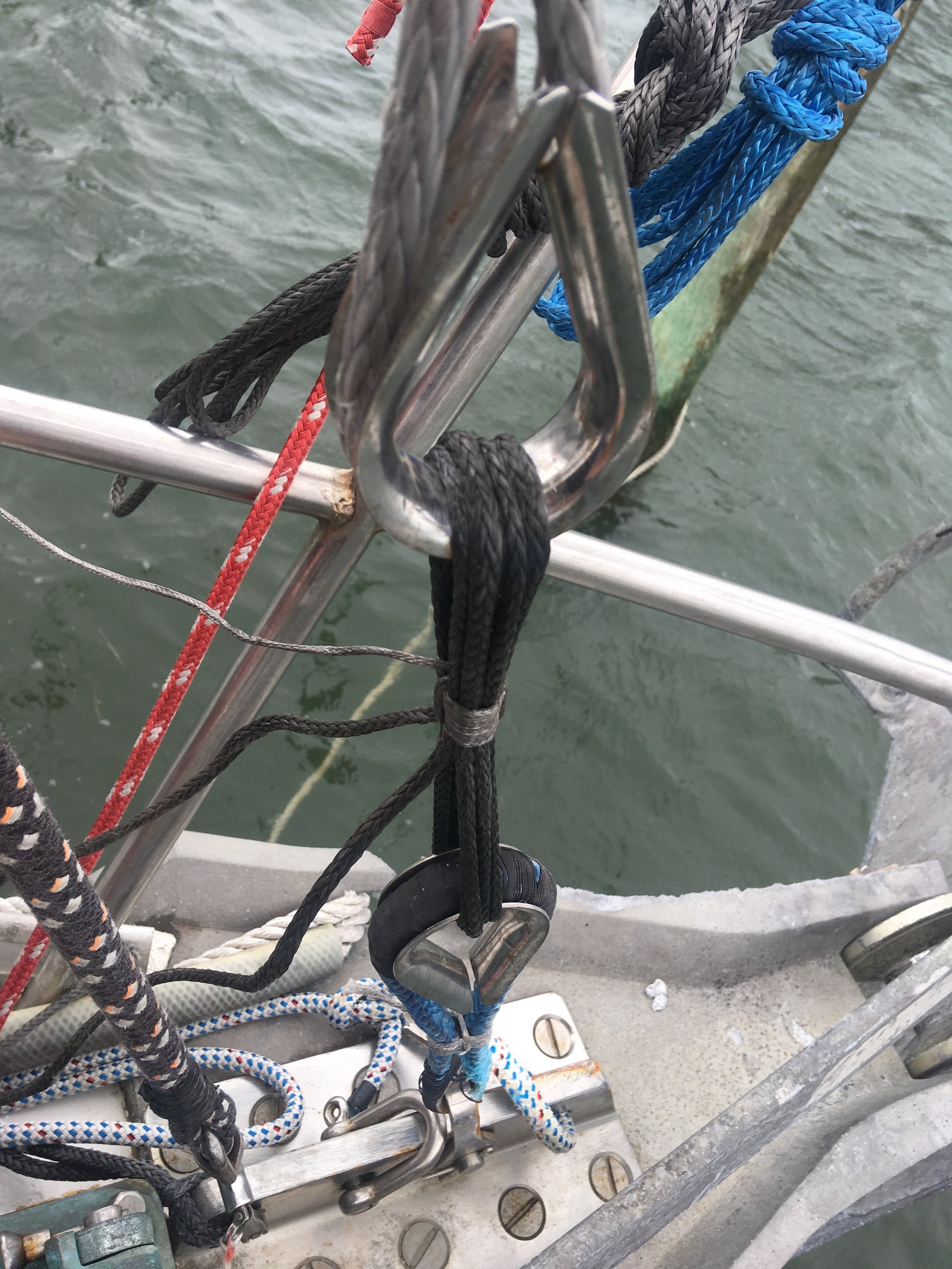
First, the thimble that produces a nice and appropriately radiused bend was bent fiercely by the shank of the anchor. The Dyneema of the deadeye was the next piece in this destructive path. Several strands of the grommet were chafed through completely, making this component severely weakened and in immediate need for replacing. 

IMG_1865.JPG
IMG_1847.JPG

The damage only occurred on one side of the deadeye, as the anchor only laid on one portion of it as it chafed away. This did mean that several of the strands were still intact, though they were weakened by the tight radius bend through the toggle. The toggle itself also appears a bit flustered by the entire situation, as surface rust is present (thankfully, the surface rust is actually rust from the anchor that rubbed off on the toggle) and the corner of the toggle is a bit rounded from the constant pounding. This constant impact will work harden the metal in the toggle and make it more prone to cracking in the future.

Now, while this damage may seem severe, it was easily avoidable by properly securing the anchor, and it was also easy and inexpensive to repair. 

The cost of materials for a new deadeye are merely the cost of 4 feet of dyneema in the size you used. This particular deadeye was made out of 9mm SK-78 dyneema and the materials only cost around $20. The deadeye itself takes about an hour to make, making the entire repair not that intrusive on the wallet. Should a situation like this arise, I carry a "pre-made" deadeye in our box of spares, that way I can get straight to work and not worry about taking the time to manufacture one should the need arise.  

While synthetic rigging is stronger than steel, it is quite fragile by comparison. Special care should be taken to ensure that no chafe occurs. If a component becomes chafed, you can always refer to this post for guidance as to its continued serviceability. 

https://www.riggingdoctor.com/life-aboard/2015/10/16/how-much-chafe-is-too-much

Chafe is a fact of life on a sailboat, but thankfully it is an easily inspectable problem that shows signs externally, unlike steel rigging which can corrode away internally and only show problems that are detectable to a trained and professional eye.  

One last point about the durability of Dyneema. This deadeye became severely chafed during a gale that lasted for 3 days. After the gale, we sailed 80 miles around Cape Hatteras in winds ranging from 30-45 knots and the deadeye remained functional, holding the mast up. We did not load the headstay with a sail, as that might have pushed it beyond its remaining strength, but we did fly a staysail and double reefed main in these wind conditions as we beat to windward. The deadeye was under intense and severe load during this ordeal, and yet it remained intact during the whole event. If chafe is a concern in your mind, let my misfortune of a mangled deadeye demonstrate to you that even in a disfigured state, Dyneema is rediculously strong and will stand up to the abuse to get you home safely! 

Off Season

Those with daily jobs have to go to work everyday. Weekends will give them a bit of a rest, as they gear back up for Monday! 

When these people take an extended break, they want to do it at the "best time." Collectively, everyone wants to do it at a similar time frame and this creates the "tourist season" in destination towns. People don't want to visit a place if the conditions are not optimal, so no one goes when it is not perfect. 

As a result, the stores and restaurants will hire more staff during the "season" and slow down or close entirely during the "off-season" since there isn't really a market to stay open for. When you arrive somewhere by boat, you might get there during the "season" and be surrounded by tons of other tourists who have descended on this area in a swarm. You will get to experience the pre-planned and orchestrated spectacle that the town has put on for its guests. 

Unlike all these other guests that need to return to work after a fun-packed vacation, you get to stay, as you are on your boat and in no hurry to be anywhere. Life is an adventure and you are going to cruise through it at a very relaxed pace. 

When the "season" comes to a close and the "off-season" begins, these towns will roll up their sidewalks and shut down.  Maddie and I find that this is actually the best time to visit a place, as you will get to know the locals and experience what life there is really like.

We arrived in Hatteras, NC just as the season was coming to an end. It was fun going to different restaurants and walking around the town looking at the items the shops had on display. A few days later, all the stores started to shut down because the "season" was over. Restaurants would open on their last day in a blaze of glory! All items on the menu were 50% off, as they wanted to clear out their freezer before closing for the "off-season."  Luckily, each of our favorite restaurants was closing on a different day, so we had the opportunity to attend the closing of each of them!

Once the party was over, the town was much quieter and only a few places stayed open. At the moment, there is a place that is open for lunch, another place open for dinner, a coffee shop, and a general market (which stocks fresh vegetables and other foods). You will soon come to know the locals, as everyone is going to be in one of these places and you can really get a feel for the true town. 

The facade has come down, the makeup has been washed away, and you can see what the town is really like. Hatteras is a town of fisherman who are all welcoming and friendly! While here, we have watched and learned how to clean a fish like a machine (6 quick cuts to extract a fillet) and felt welcomed by the locals.  

We are the only sailboat that has come here in a long time, so everyone knows about it. When we are talking with them and tell them that we are cruisers and we were sailing by, they will interject "Oh, you guys are the sailboat." Then they will usually offer us a ride to a neighboring town if we need supplies or parts. They have all been very helpful, but thankfully we haven't needed to go anywhere as our parts arrived by mail shortly after we got here. 

I don't mean that they have offered to drive us, I mean they have offered us the keys to their car! This is someone who met us 5 minutes ago. The people in this town, truly are kind and generous people who all look out for each other and everyone in their town. 

When planning your cruise, don't discount a destination because you would arrive there after the "season" has ended, or because you will arrive near the "end of the season". Value these opportunities to see and experience these places the way the locals do. You will get to see a side of these destinations that few ever even dream of! 

Sandpipers

Sandpipers are small birds that feast on creatures that lie just below the sand in the wet/dry portion of a beach. These little birds will run up and down the beach like children who are afraid of incoming waves yet want to be at the waters edge. 

IMG_1851.JPG

As the waves pull back, they make their way down the beach and onto the wet sand. When the wave comes back in, they all scamper up the beach to the dry part. As they run back and forth, they will stick their slender beaks into the sand in search of prey, quietly eating each morsel with each wave. 

IMG_1862.JPG

It really makes you sit back and think when you see such a sight. You may have sailed many a mile to reach this beach, braving storms and being becalmed, but these little birds have been here the whole time, feasting on the bounty of this beach. 

It may seem like a small thing to focus on, but this large world of ours is full! Every place you go, you will encounter something or someone who has been there as long as they have lived, and will remain there long after you have moved on. It's like if the whole world is a net, and everyone is a fish. They are snared and stuck in that specific place, always been there and always will be there. Cruisers are those who have managed to escape, and swim through the holes to travel to new parts of the net. We have slipped through the cracks and managed to free ourselves as we move about unnoticed. We are here today, but who knows where we will be tomorrow?

Sunsets

While sunsets over the water are gorgeous, there is something special about seeing a new sunset on a distant shore, far from your home. 

IMG_1856.JPG

You get off your boat and walk around the new landscape all day, lost in your mind as you aimlessly wander about, taking in the scenery as it unfolds before you. 

Then the sun gets low on the horizon and the sky turns into a blaze of fire, and the wet sand on the beach matches it in shimmer and beauty! You quickly get out your camera to snap a few pictures as the moment displays its beauty before you and you think to yourself "I'm here!" 

Sailing will take you far and away, and each day, you will watch the sun set as you relax in the cockpit as you await your next landfall. Sunsets over water are gorgeous, as the sea and sky begin to glow the same color and the horizon transforms into a singular radiance of beauty; but a sunset over a new land brings new meaning to the entire voyage. 

Standing on a beach as you watch the shadows stretch out on the sand lets you know that you made it here and all those days at sea were worth it!