Off Season

Those with daily jobs have to go to work everyday. Weekends will give them a bit of a rest, as they gear back up for Monday! 

When these people take an extended break, they want to do it at the "best time." Collectively, everyone wants to do it at a similar time frame and this creates the "tourist season" in destination towns. People don't want to visit a place if the conditions are not optimal, so no one goes when it is not perfect. 

As a result, the stores and restaurants will hire more staff during the "season" and slow down or close entirely during the "off-season" since there isn't really a market to stay open for. When you arrive somewhere by boat, you might get there during the "season" and be surrounded by tons of other tourists who have descended on this area in a swarm. You will get to experience the pre-planned and orchestrated spectacle that the town has put on for its guests. 

Unlike all these other guests that need to return to work after a fun-packed vacation, you get to stay, as you are on your boat and in no hurry to be anywhere. Life is an adventure and you are going to cruise through it at a very relaxed pace. 

When the "season" comes to a close and the "off-season" begins, these towns will roll up their sidewalks and shut down.  Maddie and I find that this is actually the best time to visit a place, as you will get to know the locals and experience what life there is really like.

We arrived in Hatteras, NC just as the season was coming to an end. It was fun going to different restaurants and walking around the town looking at the items the shops had on display. A few days later, all the stores started to shut down because the "season" was over. Restaurants would open on their last day in a blaze of glory! All items on the menu were 50% off, as they wanted to clear out their freezer before closing for the "off-season."  Luckily, each of our favorite restaurants was closing on a different day, so we had the opportunity to attend the closing of each of them!

Once the party was over, the town was much quieter and only a few places stayed open. At the moment, there is a place that is open for lunch, another place open for dinner, a coffee shop, and a general market (which stocks fresh vegetables and other foods). You will soon come to know the locals, as everyone is going to be in one of these places and you can really get a feel for the true town. 

The facade has come down, the makeup has been washed away, and you can see what the town is really like. Hatteras is a town of fisherman who are all welcoming and friendly! While here, we have watched and learned how to clean a fish like a machine (6 quick cuts to extract a fillet) and felt welcomed by the locals.  

We are the only sailboat that has come here in a long time, so everyone knows about it. When we are talking with them and tell them that we are cruisers and we were sailing by, they will interject "Oh, you guys are the sailboat." Then they will usually offer us a ride to a neighboring town if we need supplies or parts. They have all been very helpful, but thankfully we haven't needed to go anywhere as our parts arrived by mail shortly after we got here. 

I don't mean that they have offered to drive us, I mean they have offered us the keys to their car! This is someone who met us 5 minutes ago. The people in this town, truly are kind and generous people who all look out for each other and everyone in their town. 

When planning your cruise, don't discount a destination because you would arrive there after the "season" has ended, or because you will arrive near the "end of the season". Value these opportunities to see and experience these places the way the locals do. You will get to see a side of these destinations that few ever even dream of! 

Sandpipers

Sandpipers are small birds that feast on creatures that lie just below the sand in the wet/dry portion of a beach. These little birds will run up and down the beach like children who are afraid of incoming waves yet want to be at the waters edge. 

IMG_1851.JPG

As the waves pull back, they make their way down the beach and onto the wet sand. When the wave comes back in, they all scamper up the beach to the dry part. As they run back and forth, they will stick their slender beaks into the sand in search of prey, quietly eating each morsel with each wave. 

IMG_1862.JPG

It really makes you sit back and think when you see such a sight. You may have sailed many a mile to reach this beach, braving storms and being becalmed, but these little birds have been here the whole time, feasting on the bounty of this beach. 

It may seem like a small thing to focus on, but this large world of ours is full! Every place you go, you will encounter something or someone who has been there as long as they have lived, and will remain there long after you have moved on. It's like if the whole world is a net, and everyone is a fish. They are snared and stuck in that specific place, always been there and always will be there. Cruisers are those who have managed to escape, and swim through the holes to travel to new parts of the net. We have slipped through the cracks and managed to free ourselves as we move about unnoticed. We are here today, but who knows where we will be tomorrow?

Sunsets

While sunsets over the water are gorgeous, there is something special about seeing a new sunset on a distant shore, far from your home. 

IMG_1856.JPG

You get off your boat and walk around the new landscape all day, lost in your mind as you aimlessly wander about, taking in the scenery as it unfolds before you. 

Then the sun gets low on the horizon and the sky turns into a blaze of fire, and the wet sand on the beach matches it in shimmer and beauty! You quickly get out your camera to snap a few pictures as the moment displays its beauty before you and you think to yourself "I'm here!" 

Sailing will take you far and away, and each day, you will watch the sun set as you relax in the cockpit as you await your next landfall. Sunsets over water are gorgeous, as the sea and sky begin to glow the same color and the horizon transforms into a singular radiance of beauty; but a sunset over a new land brings new meaning to the entire voyage. 

Standing on a beach as you watch the shadows stretch out on the sand lets you know that you made it here and all those days at sea were worth it! 

Teak Wonder

As you may have noticed, I am a huge fan of wood on a boat. I think wooden boats are gorgeous to look at, which is probably because I live in a fiberglass boat where the maintenance is significantly less. The little wood that we do have, I like to keep varnished. This is a personal preference, as there are millions of options available for taking care of your trim wood. 

Varnished teak looks pretty in my opinion, but it is rather slippery to stand on. Also, if you don't give it a new coat of varnish every month (or more often if it gets damaged by the elements) then you risk the varnish starting to crack and peel which would bring on a very large job of scraping, sanding, and re-varnishing the wood. 

Cetol and other resin coats are a popular choice, as they paint and encapsulate the wood in a plastic coating that looks pretty. They might be favored because of their masking abilities, but when the coating starts to peel, it is a job that is even harder than varnish! If you are thinking of using Cetol, or any similar coating, I highly recommend using anything else! If you don't want the work of any other coatings, I would then suggest that you leave the teak natural, as all of these options are better than the mess and labor involved in removing peeling Cetol. 

While varnish has that gorgeous look to it, the penalty for not staying on top of the varnish is pretty intense! Once the varnish starts to peel, you are faced with a labor intensive job to bring it back to its beauty. To get a similar appearance with less work and almost no penalty for skipped maintenance, there is yet another class of coatings available: Oil. 

Oils are wonderful for teak, a naturally oily wood, as they will make your teak shine like new. Freshly oiled wood looks just as bright as varnished brightwork, as they both have that honey gold glow. Unlike with varnish, if you neglect the wood for a few months, there is no peeling that could occur; the oil simply washes out with time and the wood begins to grey as it dries out. 

I would say that the most popular oil out there for teak is called "Teak Oil" and it is honestly the reason that oils have a bad reputation. Teak Oil is expensive and it doesn't last for any amount of time. I tried to maintain my teak with teak oil for a few months and got quickly frustrated. Upon first application, it looked amazing, the teak was bright and shined, and the grain looked amazing. This beauty lasted until the first rainstorm which was about a week after I had oiled the teak. With a few hours of rain, all the oil was washed away! I found the same problem to be true when I would go sailing and waves would splash onto the deck, the simple act of wetting the wood seemed to wash away the teak oil. Soon, I was oiling the teak after every rain storm and every time I dropped anchor. It quickly transformed from a labor of love to a ritual of futility. 

Fed up with teak oil, I then tried various other oils. First was Tung Oil. This coating showed great promise at first. The oil lasted many many months, holding up well in the sun, rain, and spray from waves. The problem with this oil is it seems to soak up dirt and turn dark. The wood that started out as a bright honey golden color turned to a dark mahogany color. 

I then gave up on oils and went back to varnish. Since I liveaboard, I'm always around and the thought of varnishing the brightwork once a month seems pleasant to me. This is probably because I enjoy varnishing wood, and I find it cathartic.

But what if you don't want to varnish? What if you want to stick with oil and not have to worry about peeling coatings, nor worry about the oil washing away quickly or turning black?  

IMG_1833.JPG

While sailing through Hatteras, North Carolina, I saw this boat. The teak looks new and perfect! Like it was just lightly sanded this morning. It has a light honey golden glow to it, is not slippery, and there are no signs of checking! 

This then struck up a conversation with the owner, Dale, who runs this boat for fishing charters. A sure fire way to strike up a conversation with another boater is to ask how they maintain their brightwork! He told me that this boat was built in 1988, and he bought the boat back in 2011. In the past 6 years, he has only sanded the teak twice, and these were light standings to knock down some raised grain that was developing.  

Dale told me that he uses "Teak Wonder" on the teak, and that is all he does to it! 

IMG_1835.PNG

I didn't get a picture of the can he had on his boat when he showed it to me, but I did find an image of it on Defender.com. Dale buys it by the gallon and keeps it on hand for when he needs to do another coat. 

Dale does two coats every six months, but he does to touch ups from time to time if the wood looks like it needs a bit before the six month mark. Dale applies it to his teak with a rag, making it easy to apply as he simply dips the rag in the gallon can and then rubs it all over the teak. 

While I am committed to varnish on Wisdom, I will definitely keep this option in mind if I ever decide to switch to oil in the future. Sadly, I am staying with varnish because I don't want to go through the job of scraping off all the varnish on the toe rail. Instead, I am bound to continue the monthly task of coating the wood in a fresh layer of varnish to keep the wood looking pretty and happy. 

Repairing the Monitor Windvane

When the gale was approaching, we hove to and settled in to ride out the storm. Since we were not going to be sailing for the next few days, and instead simply drifting through the water sideways, I lifted the paddle out of the water on our windvane. This presented extra stress to the Monitor windvane and led to the following failure.​

Had the storm been as predicted, blowing only 20-30 knots, no damage would have occurred. The storm increased in intensity and duration, building to 40-45 knots for several days. During this time, various rouge waves bypassed the slick and broke onto the boat. These waves imparted a furious amount of energy onto the boat and all of its equipment. ​

FullSizeRender.jpg

The Monitor windvane was hanging out on the stern with the paddle raised high to avoid being pressured by water as we drifted laterally. The issue was these powerful breaking waves would slam into the paddle and cause incredible stress in the form of shock loads onto the equipment.​

Through out the storm, only one piece of the Monitor windvane broke. Thankfully it was an easy piece to replace, but sadly it rendered the entire unit inoperable until the part was replaced.​

IMG_1831.JPG
IMG_1832.JPG

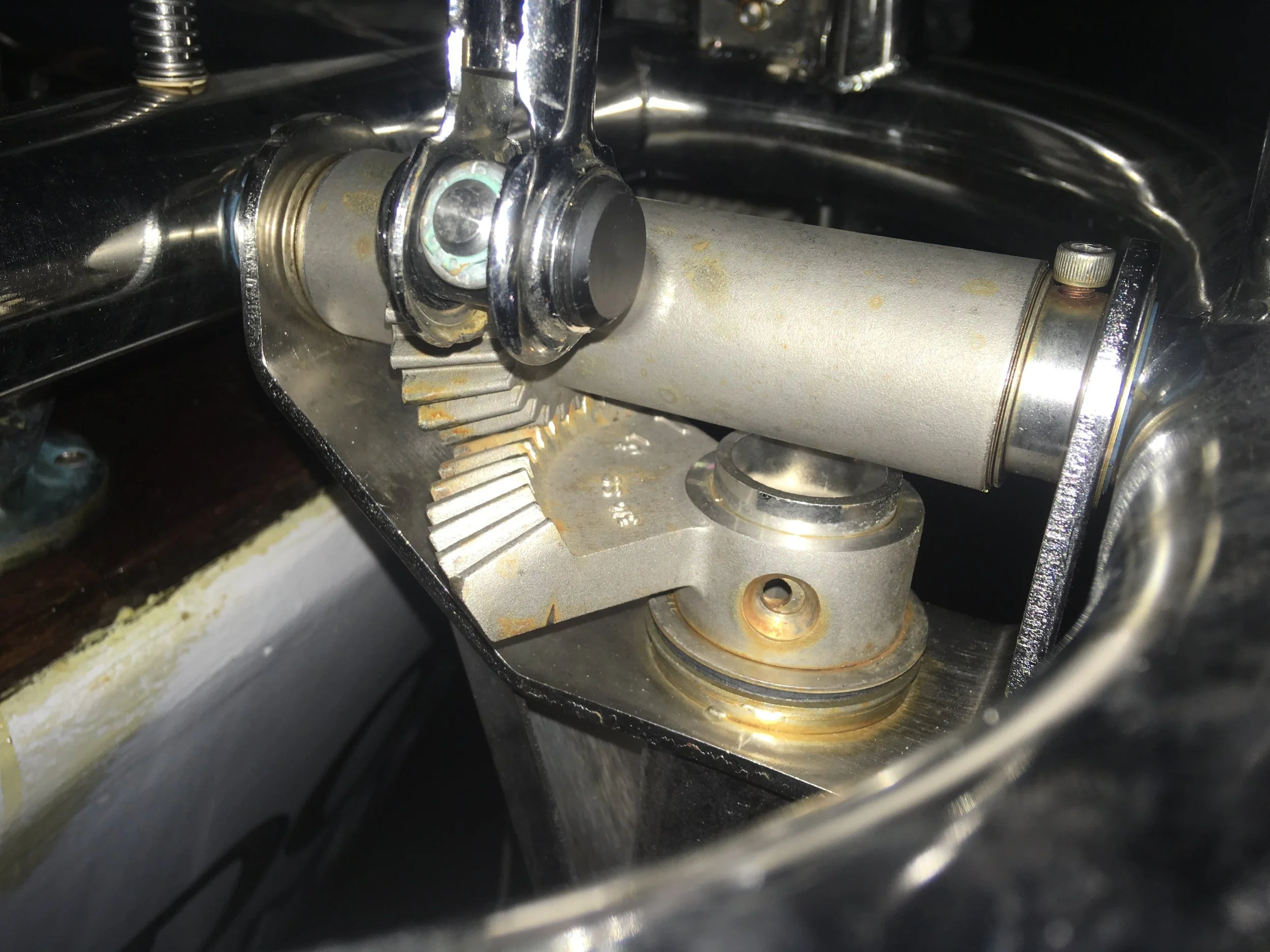
The head of a 1/4 inch stainless steel bolt sheared off! This caused the lower gear of the unit to rotate slightly and allowed the entire unit to come undone. While out in the storm, I was not able to look at everything closely enough to determine the problem, so I hand steered for over a day to get us back to shore. Once in the safety and tranquility of a safe harbor, I gave the unit a much closer inspection and located the problem.  

Luckily, there was a hardware store within walking distance of the boat and the replacement bolt was had for only $0.55! I used a rubber mallet to tap the gear back into alignment with the shaft and the bolt hole so that I could easily slide the new bolt through the hole.  

I then called the company because I was unsure about how the gears should interact, as in which teeth of the top and bottom gears are supposed to rest on.  You see, when the bolt sheared and the lower gear rotated slightly, it then allowed the top gear to slip out of place! When I first looked at it, the top gear was facing up and was not contacting the bottom gear at all. I noticed the small arrow on the bottom gear pointing at the first groove and figured that must be there to indicate something.

Upon speaking with the owner, that arrow points to the groove that the left most tooth of the top gear is supposed to rest in as the gears first come together. With that knowledge I was able to get the unit put back together and calibrated, giving me the ability to leave it in charge of steering us on our next ocean voyage. 

One thing that is still unclear is how the paddle should be placed during a storm. If you leave it down while hove to, it will be under intense lateral stress as you drift through the water. If you raise it up, the paddle is no longer under the same stresses, but any impact to it will be accentuated by the long lever arm it has created. The manufacturer told me that they are not yet completely certain which configuration is best for a storm which has led me to my next decision. 

If the weather is calm enough before the storm, I plan to climb out on my stern and remove the paddle from the unit. If the paddle is not there, then it doesn't matter if it is up or down! The paddle and the air blade are the two largest surfaces of the unit, and if they are removed, the remaining structure will be able to live out the storm without fear or risk of damage.