Off Season

Those with daily jobs have to go to work everyday. Weekends will give them a bit of a rest, as they gear back up for Monday! 

When these people take an extended break, they want to do it at the "best time." Collectively, everyone wants to do it at a similar time frame and this creates the "tourist season" in destination towns. People don't want to visit a place if the conditions are not optimal, so no one goes when it is not perfect. 

As a result, the stores and restaurants will hire more staff during the "season" and slow down or close entirely during the "off-season" since there isn't really a market to stay open for. When you arrive somewhere by boat, you might get there during the "season" and be surrounded by tons of other tourists who have descended on this area in a swarm. You will get to experience the pre-planned and orchestrated spectacle that the town has put on for its guests. 

Unlike all these other guests that need to return to work after a fun-packed vacation, you get to stay, as you are on your boat and in no hurry to be anywhere. Life is an adventure and you are going to cruise through it at a very relaxed pace. 

When the "season" comes to a close and the "off-season" begins, these towns will roll up their sidewalks and shut down.  Maddie and I find that this is actually the best time to visit a place, as you will get to know the locals and experience what life there is really like.

We arrived in Hatteras, NC just as the season was coming to an end. It was fun going to different restaurants and walking around the town looking at the items the shops had on display. A few days later, all the stores started to shut down because the "season" was over. Restaurants would open on their last day in a blaze of glory! All items on the menu were 50% off, as they wanted to clear out their freezer before closing for the "off-season."  Luckily, each of our favorite restaurants was closing on a different day, so we had the opportunity to attend the closing of each of them!

Once the party was over, the town was much quieter and only a few places stayed open. At the moment, there is a place that is open for lunch, another place open for dinner, a coffee shop, and a general market (which stocks fresh vegetables and other foods). You will soon come to know the locals, as everyone is going to be in one of these places and you can really get a feel for the true town. 

The facade has come down, the makeup has been washed away, and you can see what the town is really like. Hatteras is a town of fisherman who are all welcoming and friendly! While here, we have watched and learned how to clean a fish like a machine (6 quick cuts to extract a fillet) and felt welcomed by the locals.  

We are the only sailboat that has come here in a long time, so everyone knows about it. When we are talking with them and tell them that we are cruisers and we were sailing by, they will interject "Oh, you guys are the sailboat." Then they will usually offer us a ride to a neighboring town if we need supplies or parts. They have all been very helpful, but thankfully we haven't needed to go anywhere as our parts arrived by mail shortly after we got here. 

I don't mean that they have offered to drive us, I mean they have offered us the keys to their car! This is someone who met us 5 minutes ago. The people in this town, truly are kind and generous people who all look out for each other and everyone in their town. 

When planning your cruise, don't discount a destination because you would arrive there after the "season" has ended, or because you will arrive near the "end of the season". Value these opportunities to see and experience these places the way the locals do. You will get to see a side of these destinations that few ever even dream of! 

Sandpipers

Sandpipers are small birds that feast on creatures that lie just below the sand in the wet/dry portion of a beach. These little birds will run up and down the beach like children who are afraid of incoming waves yet want to be at the waters edge. 

IMG_1851.JPG

As the waves pull back, they make their way down the beach and onto the wet sand. When the wave comes back in, they all scamper up the beach to the dry part. As they run back and forth, they will stick their slender beaks into the sand in search of prey, quietly eating each morsel with each wave. 

IMG_1862.JPG

It really makes you sit back and think when you see such a sight. You may have sailed many a mile to reach this beach, braving storms and being becalmed, but these little birds have been here the whole time, feasting on the bounty of this beach. 

It may seem like a small thing to focus on, but this large world of ours is full! Every place you go, you will encounter something or someone who has been there as long as they have lived, and will remain there long after you have moved on. It's like if the whole world is a net, and everyone is a fish. They are snared and stuck in that specific place, always been there and always will be there. Cruisers are those who have managed to escape, and swim through the holes to travel to new parts of the net. We have slipped through the cracks and managed to free ourselves as we move about unnoticed. We are here today, but who knows where we will be tomorrow?

Sunsets

While sunsets over the water are gorgeous, there is something special about seeing a new sunset on a distant shore, far from your home. 

IMG_1856.JPG

You get off your boat and walk around the new landscape all day, lost in your mind as you aimlessly wander about, taking in the scenery as it unfolds before you. 

Then the sun gets low on the horizon and the sky turns into a blaze of fire, and the wet sand on the beach matches it in shimmer and beauty! You quickly get out your camera to snap a few pictures as the moment displays its beauty before you and you think to yourself "I'm here!" 

Sailing will take you far and away, and each day, you will watch the sun set as you relax in the cockpit as you await your next landfall. Sunsets over water are gorgeous, as the sea and sky begin to glow the same color and the horizon transforms into a singular radiance of beauty; but a sunset over a new land brings new meaning to the entire voyage. 

Standing on a beach as you watch the shadows stretch out on the sand lets you know that you made it here and all those days at sea were worth it! 

Synthetic Headstay Weakness

Dyneema is a wonderful material for use on a sailing yacht for standing rigging. It is immune to rust and corrosion, and it is incredibly light weight! Placing it at the stem of your yacht, where salt spray and moisture are a daily fact of life is a wonderful idea as this powerful plastic will take the charge and never let you down.  

While it may seem that synthetic standing rigging has no weaknesses, this would be false. Synthetic standing rigging has one tragic weakness that can destroy it in a moment: chafe! 

IMG_1812.JPG
IMG_1804.JPG

In a gale, our 65 pound Mantus anchor broke out of its roller and gnawed on the deadeye for three days. The damage suffered to the headstay was extensive and precluded us from using our headsail as we limped along for 80 miles to return to shore. 

IMG_1798.JPG
IMG_1794.JPG

The shank of the anchor chewed and chafed on the dyneema deadeye while also mangeling the thimble inside the lower part of the deadeye.

If the damage to the dyneema had been less extensive, it would still had been risky to load this stay as the thimble was no longer in function.  

The purpose of the thimble is to smooth the bend at the bottom portion of the deadeye. Dyneema is strong, but sharp bends will cause the fibers to crack and break, leading to premature failure. 

We have a cutter rig, meaning that we have a second headstay further inboard, but it is by no means destined to resist the forces of the backstay and sails while trying to power to windward. These forces fall onto the headstay and are rather extreme, especially when the stay is further loaded with a large jib in high winds.  

Our rigging was crippled and we were 50 miles off the coast in a gale with another more powerful gale on its way! 

Now, to ensure this doesn't happen to you, there are a few suggestions I would like to make. 

First, if you are going off shore, stow the anchor somewhere away from the headstay. We keep various anchors that we use infrequently tied to the boat, and when heading off-shore, your bow anchor should be treated like any other anchor as you won't be using it for some time.  With your anchor secured and tied up very well, it won't be able to leap out of its roller and chafe away on your standing rigging.

Another trick would be to install a sacrificial piece in front of the deadeye. This would take the damage of anything that wants to destroy your rigging by getting destroyed first and hopefully you will find the problem and correct it before it gets worse. This line could be attached through the eye of the headstay and simply run down to a further forward hole in your stem fitting. 

To ensure that you will be able to make it home, it would be a good idea to carry a spare deadeye, already assembled with its thimbles and the fairleads needed to tension your rigging. If you lose your headstay, you are at the mercy of the currents! Having the tools and parts on board with you will grant you the ability to make it back to port on your own. 

The reason to have a deadeye already made is because they are rather tedious to make. I take about an hour to make one in calm conditions, at home, with no stress of a storm situation. Imagine trying to make one of these while out at sea as you worry about where and how fast you are drifting? Having it already made will also reduce the amount of time it will take to install the new deadeye, which sadly is a rather lengthy process. Headstays require a lot of tension and can take close to an hour to setup with a deadeye. 

Now, if you would allow me to lead by example on this front. This damaged headstay occurred on my own personal yacht that I rigged several years ago with synthetic standing rigging. I carry all the tools and parts needed on board to rig her again at sea if we needed. I also feel that I take every precaution possible to ensure the longest life for the rigging. This situation occurred and I can not guarantee that it won't happen again, so I am converting my headstay with a deadeye to a turnbuckle. I feel that a piece of bronze with stainless steel screws will hold up better should this freak occurrence happen again. We will certainly be restraining and stowing the anchor differently from now on to hopefully eliminate any other anchor related damages, but accidents are never planned and I feel that a piece of metal is a better security blanket than a piece of rope at the lower part of the stem. 

Synthetic standing rigging is awesome and deadeyes take away any fear or concern of corrosion, but the pulpit is a dangerous place when laying right next to the anchor. If you have a racing sailboat where the anchor is not stored on the bow, or your anchor roller is far away from your headstay, then by all means, keep with the peace of mind of deadeyes. If you have a similar setup to mine, then strongly consider setting it up with a turnbuckle and be sure to oil and inspect it regularly and frequently for any signs of corrosion. 

Sailing in a Gale

When we plan our ocean voyages, we all picture smooth sailing with fair winds and following seas. The truth is, most of your days will be in these conditions; some of your days will not. 

FullSizeRender.jpg

When we first noticed the clouds approaching us, we turned the VHF radio over to the WX channels to listen to the forecast. When we left, the winds were supposed to be from the North to North West the entire voyage! This is great as we were heading South and this would put us on a run to broad reach the whole way. Then the forecast was calling for a bit of a storm for two days, blowing 20-30 knots from the South. 

Maddie and I discussed our options: We could beat into the weather for two days under reduced sailplan, or we could heave to and relax for a few days, continuing our journey once the winds were in a more favorable direction. 

We chose to heave to. 

At first, the winds were just as predicted, 20-30 knots from the South, pushing us North at 0.5-1 knot. We rocked around as we slowly drifted through the water. In a 48 hour storm, our drift would only be 24 to 48 miles, easily recovered on our next day of good sailing. We made the choice to simply wait it out and ride the storm inside the cabin where we would be warm and dry while the boat hove to and looked after us. 

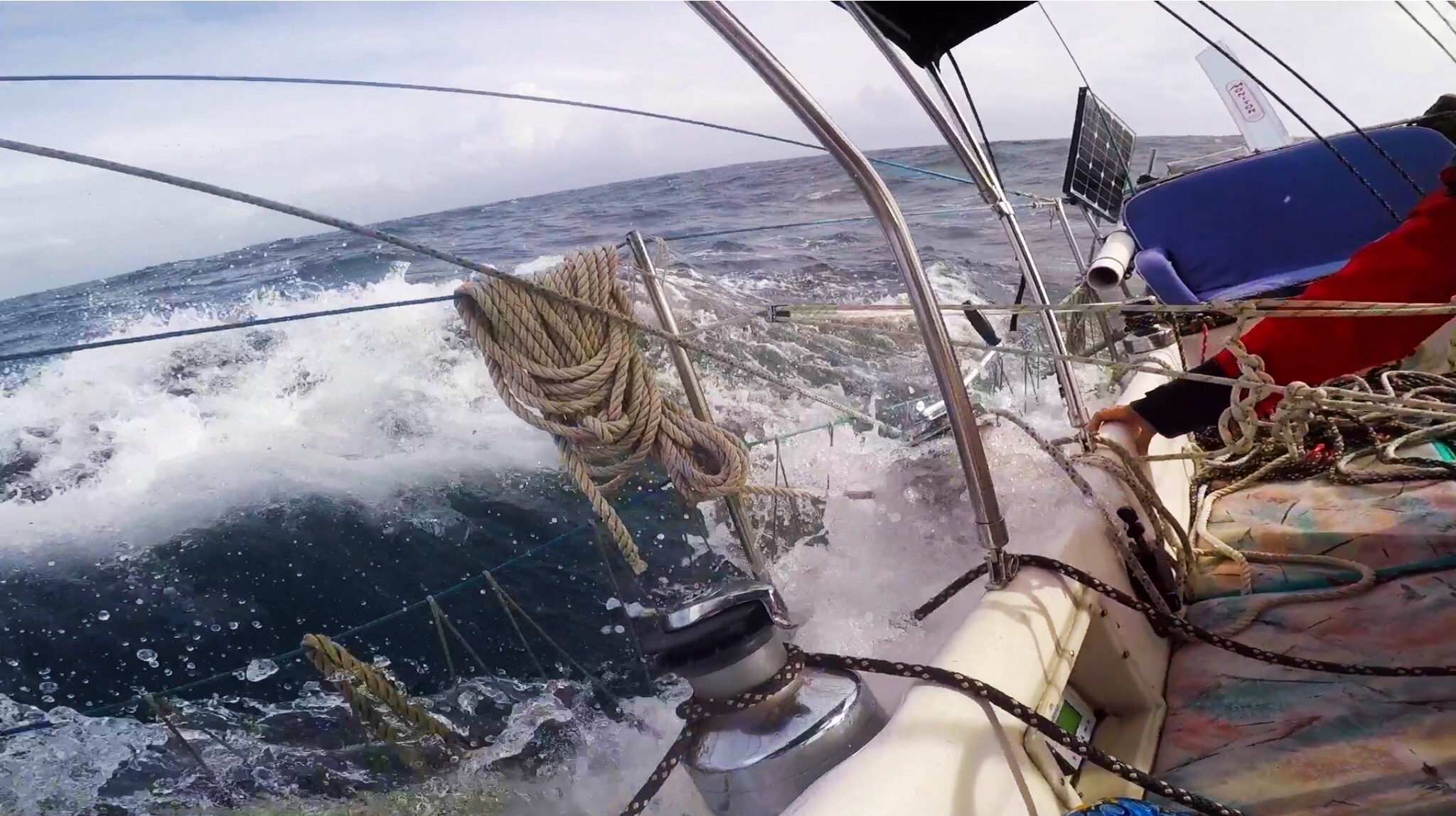
At nightfall on the first day, the winds began to build. They intensified from the 20-30 knots up to 30-37 knots. This doesn't sound like a huge change, but the power of this added wind caused the seas to rise up and we were glad to be hove to! The next day, the winds had climbed even further, holding at a steady 40-45 knots with gusts over 50 knots. The seas became huge towers that made our home bob up and down like a cork in a washing machine! 

This is when the situation changed. The winds were different from the forecast, blowing stronger and also blowing in a different direction! Instead of being blown North, we were being blown East. Normally, this would not be a problem, but for us it was! 

Our anchor had jumped out of the bow roller and had gnawed on the headstays deadeye. Dyneema is very strong, but its weakness is in chafe resistance. The anchor severely crippled our headstay, making it risky to fly any jib on that stay. If we lose our headstay, the mast will want to fall aft and present us with a whole new world of problems. 

Being 50 miles off the coast at this time, we decided that we needed to start limping our way back to shore to carry out repairs of our crippled headstay. This is where knowing how to sail in big seas and high winds pays dividends. 

The first thing you want to do is have the appropriate amount of sail flying. If it's blowing 40 knots with 30 foot seas, don't go full sail! You need to reef down for comfort and for safety. 

The mainsail should be reefed down as far as it can while still providing you drive to windward. Your headsail should be reefed down to balance out the sailplan and provide control to the helm so you can power through the seas. 

If you are sailing off the wind, a trysail would be a better fit instead of the mainsail for a few reasons. First, it spares the mainsail from any stress caused by the high winds. Second, it removes the boom from the equation which makes jibing safer and less stressful. Third, the sheets are run to the toe rail, making the risk of an accidental jibe much less likely. 

With the right amount of sail up, the boat will handle normally, just like if you were sailing along on a nice calm day! The difference between a calm day and your current day are obviously going to be the seas. Large waves present a few problems. They will cause your speed to fluctuate and they will rob your wind.

When you are in the trough of huge waves, they will actually steal your wind! You will notice this if you are flying your trysail, as its head is usually around the height of your spreaders. When the waves are taller than your spreaders, your sail will go limp in the trough as it has no wind. When you climb to the crest again, the wind will hit your sail with full fury! 

The other issue has to do with your speed, and your ability to make way to windward. Your keel depends on speed through the water to provide resistance to leeward. If you are not moving fast enough, you will begin to slide sideways and not move in the direction you are pointing or desiring. You may have to sail further off the wind than you would like simply to keep your speed as you ride up and down the waves. 

When climbing a wave, your speed will decrease drastically. As this happens, you want to fall off to help keep some of that speed and keep your keel working. As you fall down the wave, you will pick your speed back up and can point higher than you need to. Sailing with large seas is a constant give and take as you rise and fall, where you will fall off and then pinch on each wave you encounter. 

This can be very tiring after several hours, not to mention days, which is why we choose to simply heave to and wait for more favorable winds to return. If conditions demand that you sail though, this is the way to do it and practice is the only way to perfect the skill. 

Having a basic understanding of what is needed to make your yacht perform is critical as you will need to interpolate all your knowledge to get your yacht to move in a safe and desireable direction.