
The Water Problem

Water is an invaluable commodity when cruising, and though it is easy to come by in each port, you are never guaranteed drinkable water.  We anticipated this problem across the ocean and in the various small islands that we plan to visit, but the problem surfaced before we even left Maryland.

We had allowed ourselves to completely run out of water with the knowledge that we would be able to fill up in the marina where we were docked, but as luck would have it, the entire water system there had coughed out its last spurts that morning and the owner had no plans of fixing it as the price was far too high for him.  It was a minor inconvenience for us since luckily there was another marina within a short distance.  As we were filling up there, however, the owner came out and informed us that though we were welcome to fill up with this water, he did not deem it drinkable due to its high levels of Nitrates.  It did indeed taste rather terrible, but we didn't have much choice.  We needed water for much more than just drinking since we had dirty dishes piling in the sink and we ourselves weren't exactly specimens of cleanliness.

So, this isn't an unusual thing.  One can never depend upon clean drinking water where he is headed, so we prepare for these sorts of circumstances.  Rain water is a big way of dealing with the problem, but what if it doesn't rain when you need it to?  We needed a backup for our backup, so we went to Costco and bought 180 liters worth of bottled water.

You read that correctly.  It may have been slight overkill, but if we are forced to go for a few months without finding drinkable water, we will be glad that we added this ridiculous amount of ballast to the boat.  We were able to fit all of the bottles into compartments underneath each birth quite neatly.  They're stacked in such a way to minimize friction.  We didn't forget about the fact that too much friction could cause the bottles to release their contents and waist everything.  To be honest, it's worth it simply to know that if we did get stuck at sea due to weeks of doldrums, at least we wouldn't go thirsty. 
Solomon's Island

Solomon's Island is a famous cruiser destination of which I had never visited! Many friends and other cruisers all mentioned it, telling me that I had to stop there before we left the Chesapeake Bay.

The entrance to the river was very well marked, but also rather narrow. The sides of the river are completely built up with marinas creeping out into the water on both sides, making it a little nerve wracking to tack through, as one missed tack might mean a collision with a million dollar yacht!

To avoid any close calls, we motor sailed our way up the river, using the slight thrust from the electric motor to keep us moving forward as we slowly short tacked up the narrow creek.

We anchored just past a mooring field near a sandy beach that only exists there at low tide and enjoyed the scenery around us. Solomon's Island used to be littered with decaying fishing boats strewn along the shores and dilapidated piers. The area has since undergone a massive revitalization to transform it from a dumping ground to a ritzy spot to stop.

The problem with fancy places is they want you to pay for everything, and when you are cruising on a tight budget, this can be a challenge. Walking Morty, our corgi, also proved to be a challenge. There was only one area of undeveloped waterfront, and luckily we were anchored in front of it. At low tide, Morty could run on the exposed sandy beach, but at high tide, this entire area disappeared into the water.

Anchoring in Solomon's also proved to be a challenge. We are using a 65 pound Mantus anchor that is well oversized for our boat with an all chain rode, yet we still had trouble getting it to hold on the bottom. The anchor never dragged, instead it just migrated along the bottom. Every few days, we would drift back about 300 feet, causing us to need to reset the anchor in a new position as we would drift back on the marinas around us.

Solomon's Island did have a very cool museum though, where they cover the history of the neighboring cliffs which used to be underwater a few million years ago. They also had a great exhibit on the history of the light houses in the Chesapeake Bay.

I am glad that I visited this little gem, but I am also in no hurry to return to this anchorage. If you do decide to go to Solomon's Island, you might sleep more comfortably with your boat tied up in a marina instead of anchored out, but you must be prepared to pay $2.95 per foot per day!

Together Time

Cruising has many advantages that dirt dwellers often fantasize about: the lack of a schedule, the relaxed attitude about each day, and the carefree living that goes with cruising.

These are all true, but there is yet another major benefit of cruising: Together Time.

When I worked on land, I would get up early in the morning, say goodbye to my wife, dog, and bird, then head to work. I would return home very late in the evening, in time for a late dinner and then bed. It seemed that the weekends were the only time I had available to actually be with them.

IMG_1698.JPG

Now that we are cruising, everyday is spent together, all day long! When we are anchored, we all go to shore together and explore the new land we have arrived at. When we are sailing, we all hang out in the cockpit as we make our way to the new anchorage!

While Maddie and I have really come to enjoy being together all the time, I think that the pets are the ones that enjoy it the most. They used to see us in the early morning when we woke up. We would take them on a walk and then say goodbye as we headed to work. I went to work at 5:30am, Maddie a bit later at 6:00am. Then we would be away all day until we got home, Maddie at 4pm, and me at 9pm. Our pets spent the entire day sleeping in the boat as they awaited our return. Each day as boring as the last.

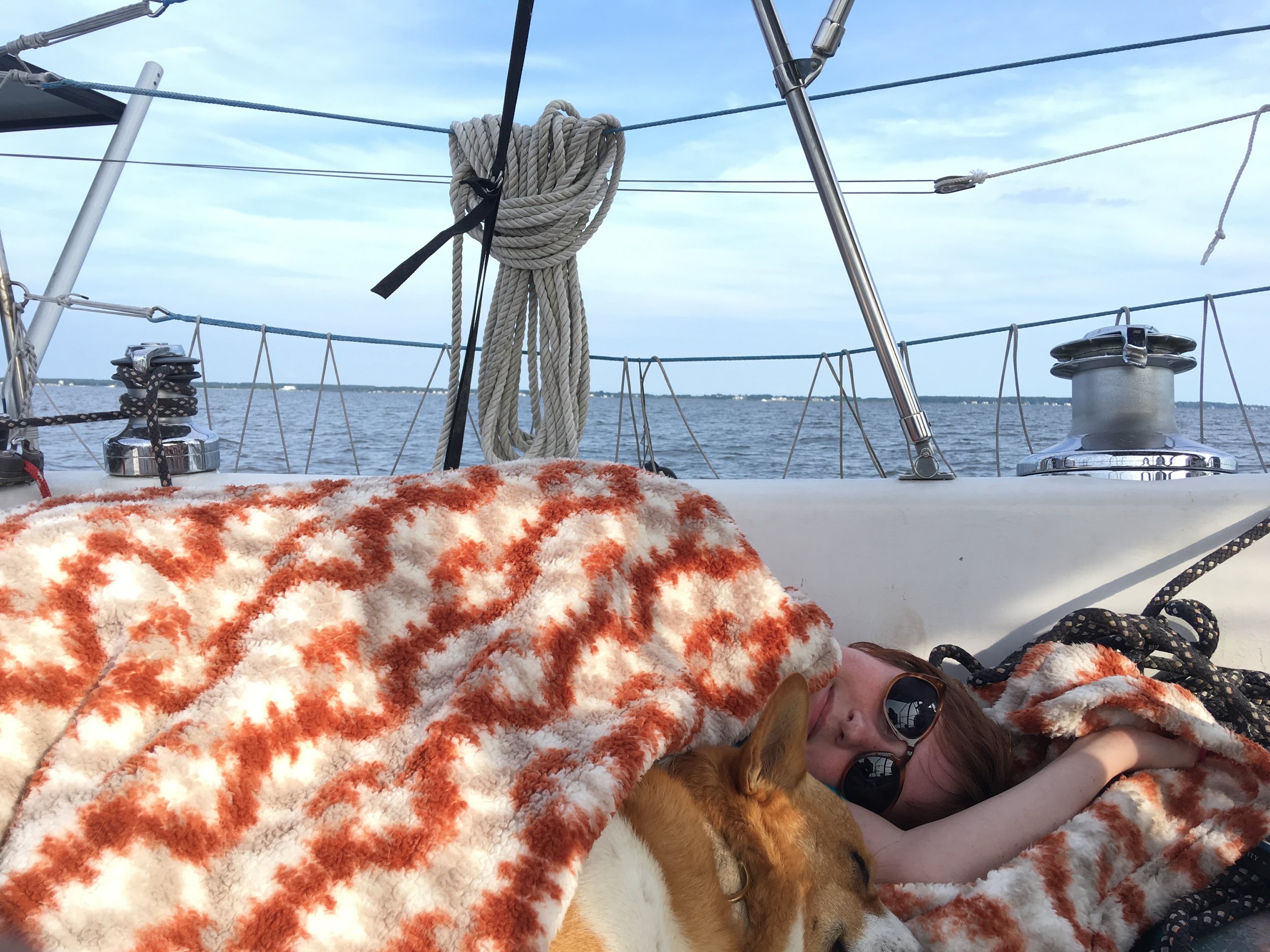
Now that we are cruising, we are all together all the time! We never need to say goodbye or leave them alone, as they come with us everywhere we go! When we go to shore, they get to come along on the journey. When we are sailing, they get to snuggle up with us as we make our way through the waves.

In the end, we never look back on the time we spent at work and wished we had done that more. No, people always wish they spent more time traveling, or with their families. We have decided to take that route in life and live it to the fullest, together!

Onboard Radar

I've been told repeatedly that I need to have radar on my boat to go cruising. "Crossing an ocean without radar is just plain dangerous!" Radar is one of those devices that cost a lot, not just money to buy and install a unit, but also a lot of electricity to run. Being how we have a small electric motor, we have no way of actually producing the power needed to run such a unit in a storm, especially since our solar panels would not be operational in the cloud cover.

The choice to go without radar was not chosen lightly, we simply had to look at what radar is, what is it used for, and why do we need it.

Radar is a method of detecting other objects by sending out high frequency electro-magnetic pulses and then reading the returning signal. With weather, denser clouds will reflect more of the pulses and appear as a denser object on the screen.

Radar is typically used for spotting other vessels in the distance, as well as seeing land masses and weather systems. This is really important if you plan to sail by night, especially if you plan to enter a new port in the dark. The radar screen will display any unlit vessels, as well as show you the cliffs and hills of the land masses around you.

If you are not very brave, you can also heave to outside of a new area and wait for dawn to make your entrance. With the sun, you will be able to see everything that was obscured by the darkness.

As far as seeing weather systems, this is an important facet of radar. Light clouds will appear as light signatures on the screen, while dense storm clouds will appear as heavier signatures on the screen. Radar also lets you track the direction of the storm and lets you know if you need to prepare for it or not.

Sailors feel the need to have radar on their yachts because it gives them eyes in the night, and shows them things that they do not know how to look at. We live in a technological age where we would rather stare at a screen than look out at the horizon.

As far as seeing land formations and ships in the dark, if you do not sail in the dark or enter new harbors, this is a mute point. Weather on the other hand is rather handy.

Radar displays of weather systems tells you how bad the storm will be and if it will hit you. You can track how fast it is moving and know when it will strike you and with how much severity.

I do feel that radar is very important when on inland water ways, such as the Chesapeake Bay, where sea room is limited and storms are fierce. Knowing how and when a storm will hit lets you know if you have time to run for shelter or if you need to get away from a lee shore now.

Instead of going through the expense of buying, installing, and maintaining a radar on your yacht, you can just use the one you have in your pocket!

IMG_1705.JPG

​Your smart phone has the capability of tapping into the Doppler radars that surround you! These radars are far more powerful than anything you could carry on board, and let you see the entire system, instead of what is just a few miles around you.

IMG_1703.PNG

​These apps are free, and work as long as you have internet signal to your smart phone!

If you are in coastal waters, you will have signal and can track these storm systems as they move around you, thus negating the need for a fancy and expensive radar system. But what about if you are off shore? How do you deal with storm systems then without the smartphone radar?

Well, all you need to do is look around you. Storm systems will pop up on the horizon and can be seen from over a hundred miles away. You can easily watch the clouds and see how they move, how fast, and in which direction. If they are constantly approaching you, it might be a good idea to get the storm sails out. If they are getting closer yet, it is time to set the storm sails.

Setting storm sails is easy to do during calm weather, not so much during the storm itself! We usually set the storm sails and wait hove to in the calm before the storm for a few hours as we await its arrival. When it hits, we then sit and wait for it to pass. Once it has moved over us, we resume sailing again as if nothing had happened.

Having radar in this situation would not change anything. You can see a storm on the horizon long before it shows up on the radar screen, and if it does hit you, you have plenty of sea way to drift in as it rages over you. There is no "out running a storm to safe harbor" in the ocean, as there is nowhere to hide. Instead, you simply need to be prepared to ride out the storms that come upon you as they do.

Based on these reasons, we have opted to forego the installation of radar on our boat as we cruise the Atlantic Ocean, and instead prefer to watch the horizon for dangers that are around us.

Blackout Curtains

Sleep hygiene is very important for good overall health. To accomplish this, you will need to get around 8 hours of uninterrupted sleep at a regular time each night. You should also be in near or in total darkness during your sleep. Here lies the problem while cruising.

Cruising means that you will have to sail from one place to the next. If the winds are unfavorable, or they die down, you will take on her to get to your next anchorage. This could mean that you will miss your regular bed time, and instead, need to stay awake for many hours longer than usual as you sail into your destination.

We were sailing from Solomons Island into the St. Mary's river one day. This is a simple 18 mile sail, so it should theoretically only take us a few hours to make the trip!We left at 10am, and were moving along at around 6 knots, meaning that the whole journey should only take a bit over 3 hours. Then the winds shifted and our track was no longer going to bring us directly into the next river south. Instead, we needed to tack back and forth as the winds kept shifting and loosing intensity.

We finally arrived at our anchorage at 2am, a full 16 hours after we had left.

At this late hour, I had to drop the sails and the anchor and get ready for bed. This might not seem like that big of an ordeal, since I can simply sleep in the next day to get my full 8 hours of sleep. The problem is the sun is rising at around 6:30am, meaning I would get about 4 hours of sleep before the sun would peer in the hatch over our bed and wake me up in the morning.

IMG_1704.JPG

Here is an unsung benefit of hank-on, tanbark headsails. They can double as black out curtains!

I draped the dark sails over the hatch and went below to sleep. When I awoke, well rested, at 11am,, the V-Berth was still a black cave, devoid of light!

Another benefit of draping a sail over the hatch is you can open the hatch under it to get some airflow through it without getting any nightly rain through the hatch as well.

Using this nifty little trick, you can get a good night sleep even after a long and tiring sail!