
Cruising Gear: What do you need?

When you set off cruising, you may be tempted to purchase every accessory that you think will make your life easier. The truth is, all these accessories will become a monstrous headache!

The gear that you do need to go cruising is a good rudder, steering, sails, and good rigging. This will make your boat move forward toward your destination. All other accessories are just that, accessories and not necessities. As long as you remember that these are accessories and not necessities, you will be much happier as you sail along and these accessories fail and break down along the way.

A sturdy rudder and steering system is crucial as it will give your yacht directional control. If you lose your rudder, you lose the ability to steer the vessel and reaching your destination will become a lot more complicated!

Be sure to inspect the rudder blade and the attachment of the rudder to the rudder post. Should the connection to the rudder post fail, the rudder will simply flow in the water behind the keel and not steer you along.

The next point of failure is the steering system. The simplest method to steer would be to use a tiller connected directly to the rudder. A tiller provides a direct and secure method to steer the boat that is as non-complex as possible. The other option for steering is to use a wheel which is connected to the rudder post via a system of linkages or cables. Wheels are considered more comfortable by some, but they do provide a place where failure could occur.

Sails are what give a sailboat its name. If you didn't have sails, your yacht would be called a powerboat! Sails will power you through the water indefinitely. There are no fuel levels or concerns with sails as they are powered by the wind, and wind exists everywhere on the water. Carrying the right sails and flying the appropriate sails will allow your yacht to sail through the seas to anywhere your hear desires. 

The final ingredient in the required gear to carry is the most important in my opinion: Good rigging. Rigging will hold the sails up so that they can power your vessel and move you along. If your rigging is bad, it will not be able to safely fly your sails, meaning that you won't be able to move along towards your destination.

This may sound overly simplistic when it is broken down to these four essential items, but the truth is that it is this simple! A sailboat only needs a rudder, steering, sails, and good rigging to sail. Everything else on the boat is an accessory and should never take priority over these four on the repair list. If you arrive somewhere with a torn sail and a dirty fuel filter, the sail repair should be addressed before the fuel filter. 

Keeping your priorities straight will allow you to keep sailing for longer and happier. If your refrigerator dies while sailing or your water heater stops working, you will still be able to sail as long as you have a sound rudder, steering, sails, and rigging.
Electronics You Need

While I am not a fan of electronic gizmos on a boat, there are two electronic items that I feel are indispensable: Radio and EPIRB.

The EPIRB is a distress beacon that will signal your position so that rescue ships can locate you. EPRIBs will greatly reduce the time to find and rescue you, which increases your chances of survival. EPRIBS are not perfect though, as they send a signal about where they are, not where you are. If you have to abandon ship, be sure to stay with the EPRIB as the rescue crews will come looking for it.

The second crucial piece of equipment to carry is a radio. Radios allow for you to communicate with other vessels in a very quick manner. Yes, Morse Code and flag signals can be used to communicate, but for communication to function, both parties need to be able to understand. If you hail a boat on the radio and they flash a search light at you, will you understand what they just said?

Modern radios also give weather warnings when severe weather is approaching and some have built in AIS receivers. This lets you spot commercial vessels that are far away and make sure you are not on a collision course with them. Another wonderful features of these radios is the ability to see the name of that ship on the horizon. This lets you hail a vessel by name so that you know you are in contact with the correct ship.

These two electronic devices are crucial to carry on board your vessel and maintained in proper working order.

Costs of Living Aboard

A liveaboard has great flexibility in deciding where to live. If the water is deep enough for your boat, you can live there!

From a cost stand point, this makes choosing where to live more flexible. If you live in a house and your taxes increase, you need to sell the property to move away. Until your property sells, you are forced to continue to pay these fees or face the consequences. On a boat, if your slip fee goes up, you can very easily untie your yacht and sail to a new place with a more pleasing slip fee.

The best part is, the slip fee is optional! If you choose to live in a marina, you will need to pay a slip fee. If you choose to not live in a marina, you don't have to pay any slip fee! Living on the hook is by far the least expensive way to liveaboard, as there are no costs associated with mooring the yacht.

There are pros and cons associated with the price you pay! Most marinas will charge by the foot, so the larger your yacht, the higher your slip fee will be. In general a 40 foot yacht can expect to pay close to $10,000 a year to live tied up in a marina in the heart of a city. If you move to a much more rural area, the cost goes down significantly. That $10,000 buys you an electric hookup, water hookup, septic hookup, and the ease to get to and from your yacht for an entire year! 

If you live on the hook, you need to produce your own electricity, either through solar, wind, or by running the engine. Water needs to be carried out in jugs to your yacht and poured into your water tanks. Lastly, getting to and from your yacht requires the use of a dinghy. 

Every gallon of water you use is a gallon you need to bring out to your yacht. Every watt you consume is a watt that needs to be replenished by your own yachts systems. Every anything you use must make the journey from land to your yacht by dinghy.

The dinghy you use needs to be reliable and comfortable. It will be your only contact to the outside world, and it will be subjected to everything the outside world can throw at it. If you are trying to get to shore during rain and high winds, it will be a very wet and bumpy ride. If it is freezing out, you will get cold. If it is very hot, you will bake in the sun as you make your way to shore.

This can be viewed as part of the life, which is fine while cruising and exploring new waters, but when you need to commute to work everyday and have to get to your car to get to work, the joy of adventure can get lost in the mundane repetitive nature of the daily commute.

If it is raining really hard, you will get soaked before you reach your car. This means you need to carry dry clothes and change in your car. If it is very cold and windy, you will probably get splashed by the chilling waters and need to, once again, change into dry clothes in your car. If it is baking hot, you will get sweaty as you work your way to shore and will need to, once again, change into dry clothes in your car.

Lastly, moving your car around to different areas is not as easy as moving your yacht around. Finding a place that will let you park your car as you commute to and from by dinghy can be challenging. Worst yet is if you move your boat, now you need to orchestrate how to get your car close to your boat for the next days commute.

All of these factors make you wonder if living on the hook while working a daily land job is worth the $10,000 you are saving? The alternative is to pay $10,000 for a slip with a parking space and all the conveniences of being tied up in a marina. 

An easy walk down the pier, a place to keep your car, and all the power and water you could need right at your slip. While it may be costly, it is awfully convenient!

While $10,000 a year for a slip and amenities may sound steep, it is worth looking at it from a different angle. Your yacht will be tied up in the water next to towering apartment buildings. The rent for a studio apartment in these high rises can easily be $2,000 per month, or $24,000 per year. The cost to purchase these condominium apartments can be upwards of $250,000, with Condo Association Fees and taxes which can also be obscenely high. 

Where I live, the building that looks out over the marina has condominium apartments starting around $750,000. The building behind it has apartments starting around $250,000 with Condo Association Fees of $500 a month and taxes of $500 a month as well. This means that the cheap condo has $6,000 per year in taxes and fees after you fork over $250,000 to own the place. Mind you, all of these building look out at the water and are considered "Water front" or "Water view". Imagine paying that much money to live in the heart of the city and overlook someone who sits in their yacht and pays only $10,000 per year.

While living on the hook may be free, the cost to live in a city marina can be more than justified by the amenities and conveniences awarded by the slip fee.

Living Aboard and Taxes

One of the seldom discussed topics of living aboard is taxes. When you live and work in the United States, you need to pay state income taxes, federal income taxes, and property taxes, along with any other taxes that apply to your local area. Living aboard really simplifies things, you own no property and are therefore not subjected to any of these kinds of taxes.

As a liveaboard, the only taxes you need to pay are your state and federal income taxes. No other taxes apply to your boat, as it does not own the water that it floats in, nor does it have to pay for the municipal budget of the town it is closest to.

I lived in Maryland during a period of time when the state governor was on a tax rampage! Martin O'Malley was creating all sorts of new taxes which added lots of expenses to all the land owners in the state. One of his famous and controversial taxes was nicknamed "The Rain Tax" which taxed people on the square footage of their property that is not greenery. The idea was well grounded, but the implementation of the idea failed miserably.

The reasoning for this tax was simple and logical. Paved areas do not absorb water and add to runoff. This runoff then has to be managed as it ends up in the Chesapeake Bay. This runoff tends to carry a lot of sediment and debris which pollutes the bay and damages the delicate ecosystem which lives there. 

If someone owns a large piece of property which is covered in green plants that absorb rain water and then builds a large house with a huge driveway, tennis courts, and paved walkways, this land will no longer absorb as much rain water and will lead to more runoff. This runoff needs to be managed to reduce its effects on the bay, and this management costs money. The plan was to tax landowners based on how much of their property will not absorb rain water and use these funds to build and maintain water treatment facilities. 

The road to hell is paved with good intentions, and this tax went right there when the money collected never reached its intended target. Instead, the money collected was used to cover other state deficits. 

While people on land were complaining about all the new taxes that were being tacked on to their properties, those on boats were un-phased as we kept floating along without any taxes, other than income tax. 

Large cities tend to have added taxes, known as "city tax" for those who live within the city limits. The land owners in the cities pay a lot of money for a small property which is heavily taxed. Large cities also tend to be built around old ports, and old ports means deep water for boats to float in!

Living aboard in a marina in the heart of a city will not subject you to these added taxes. All you need to do is pay your slip fee and enjoy living in the heart of the city for very little money!

Full Keels

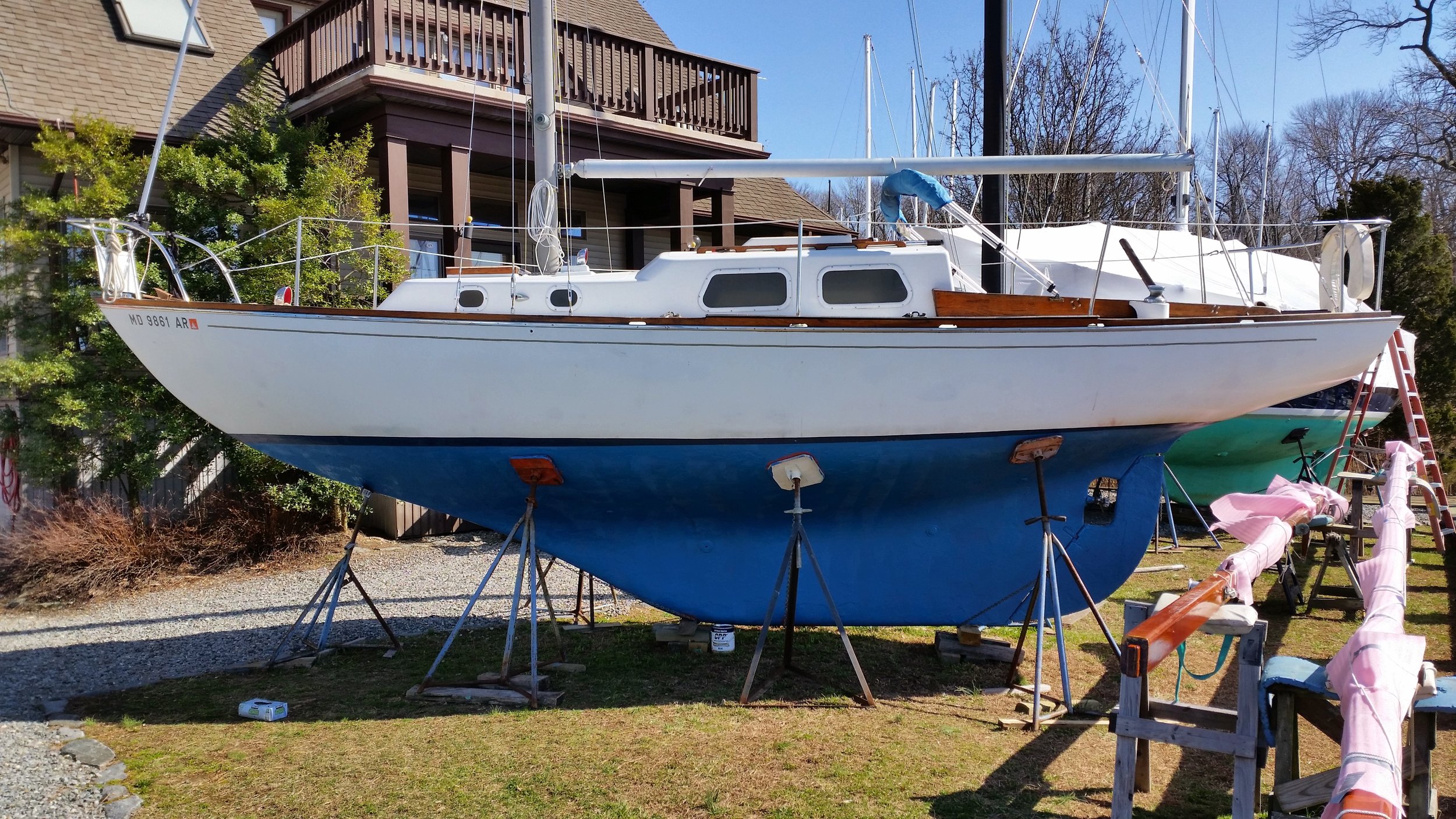
A full keel sailboat is not known for high speed or performance, they are known for being sturdy. The full keel provides a lot of wetted surface area which leads to more drag through the water and slower speed. The low aspect ratio appendage extends out below the hull and provides little lift for its size which translates into less ability to point into the wind.

This may sound like a horrible keel design, but it does have some very promising attributes. A full keel offers a lot of strength to the bottom of the boat. The keel attaches to the full length of the bilge and the forces exerted on the keel are transferred to the hull over a very large area. 

This extensive contact between the keel and hull means that the keel will be better able to withstand the normal and the extraordinary forces that can be applied to it. If you are sailing along in a storm, the forces on the keel are going to be tremendous and well distributed to the rest of the hull. If you aground, your biggest concern will be getting off the shoal and not getting a haul out to check for damages.

When a fin keel runs aground, the forces can lead to cracks in the keel and hull from the amplification of these forces. When a full keel runs aground, it sits on the bottom awaiting the captain to kedge off. The yacht will rest on the bottom on the long edge of the keel. Forces will be well distributed and subsequent damages will be minimal.

While full keel vessels tend to be slow and unable to outrun a storm like a high performance fin keel yacht could, they are very capable of comfortably riding out the storm. The large keel will produce a significant slick to windward as the yacht drifts laterally while hove to. This slick is comprised of disturbed water that will act to calm breaking waves into simple rollers. Heaving to with a full keel will produce a powerful slick that will magically calm large breaking waves well before they reach your yacht, keeping you safe and dry as you wait for the storm to blow past.

The last issue with full keels is they love to go straight. They will track in a straight direction all day long without little input from the helm, no matter the winds or sea state. If the seas are rough and pounding into the bow or stern quarter, a full keel yacht will hold a straight course. This does make it very easy to balance the sails and lock the helm, as the keel will keep you on a straight track for quite some time with no input from the captain. The problem with a full keel shows up when you want to turn and the keel wants to continue straight. You will find that you need to move the rudder much more to get a reaction on a yacht with a full keel as opposed to a yacht with a fin keel.

A fin keel yacht will turn with the slightest twitch of the helm, a full keel yacht will require you to turn the helm quite a bit and then wait for the yacht to respond to the new rudder position. Tacking really exemplifies these issues, as full turns through the wind are desired and expected. A fin keel will turn through the wind and continue moving quickly in the new direction without losing speed. A full keel yacht will slowly turn through the wind and then come to a complete stop. 

The full keel is now laying perpendicular to the direction that the yacht wants to travel and the yacht will come to a stop. The large keel will act as a large wall in the water that will stop all forward progress of the yacht. The rudder is useless as there is no speed and no water moving over it to provide steerage. The yacht will then lose forward momentum and the wind blowing on the headsails will cause the yacht to be pulled downwind. The wind will push your yacht to leeward as it begins to gain speed. Once you have enough speed, the rudder will become effective again and you will be sailing on your new tack. This slow tacking makes short tacking very difficult and each tack will cause you to lose some ground that you have fought for while working to windward. Combining these facts with less ability to point to windward and you can quickly see why it is so important to plan your tacks ahead of time to minimize your losses and get you to your windward destination.

While full keels are by far the least efficient design, they do offer incredible strength and versatility on a sailing yacht. If you want to explore new waters where you may run aground and wish to travel across large open waters, a full keel will keep you safe and on course.