
Living Aboard: Powerboats

Powerboats are nice! They have lots of space in them and are typically made to feel plush and lavish. Aside from houseboats, powerboats take as much advantage of the beam available to provide a large interior living space. 

The most common type of liveaboard powerboat we have come across in marinas has been the motoryacht. Motoryachts are simply huge wide boats with as many rooms as they could cram into them. The bows of these boats will flare out quickly as they develop their full beam very far forward and this full beam will extend all the way back to the transom, usually ending in a very large owners cabin. These boats are expensive to operate, but if all you do is stay tied up in a marina, they only cost the slip fees. 

Motoryachts will tend to have a stateroom aft, also known as the "owners cabin", a stateroom forward; and if large enough, a third stateroom midship. They will usually have at least two heads (boat bathrooms), one forward and one aft. The galley will be located near the salon near the middle of the boat, where the large windows will let in plenty of natural light to make the interior bright and airy. In the winter, these huge windows will be a huge source of heat loss, which can be easily remedied by shrink wrapping the boat. While motoryachts will have plenty of closet space, most liveaboards will convert the forward stateroom into a storage room and closet for their off-season clothes. These boats are tend to be considered "floating condominiums" by their owners, as they never leave the slip.

Sport fisherman boats are the next most common motor boat we come across being used as a liveaboard. They are very similar to a motoryacht in hull size, but the entire aft cabin and deck is lost to give way for a massive cockpit. These cockpits are nice during the warm months, when these owners will typically entertain a party in this open area. Cockpits are a good place to host an event because if someone spills a drink, it can be easily washed away with a hose. There is no concern of staining carpet or hurting interior grade wood soles. Cockpits are designed to pull bleeding fish into and be washed out later. In the winter, most sport fisherman liveaboards will set up a frame in the cockpit, allowing the shrink wrap to make an additional room that would otherwise be lost in the cold months. Of the liveaboards I know personally, the ones who live on sport fisherman boats tend go out for the weekend more often than those who live in motoryachts. I also find that those in sport fishermans will have less house type items, such as large TVs standing on their unsupported base in exchange for a bulkhead mounted TV that will not fall over when they bounce around in the Chesapeake chop. 

Express cruisers are much sleeker looking than a motoryacht, and tend to be very plush! They typically have a full galley inside and a small galley in the cockpit, where drinks and snacks can be stored and then presented to guests. Inside, these boats tend to be smaller than a motoryacht. Motoryachts are massive blocks on the water, offering loads of interior volume with subtle features to make them hydrodynamic, where express cruisers are very sleek, sacrificing interior volume. The massive engines also tend to be in the back of the boat where the owners cabin would be on a motoryacht, meaning one less cabin inside. Even at very long lengths, these boats do not offer much interior space. They tend to be setup on one level, where a comparable motoryacht will have two levels, giving you twice the interior space. The sleek lines and massive engines of an express cruiser make them notably faster than a motoryacht or sport fisherman. One of our neighbors is very pleased that his express cruiser can do nearly 30 knots!

On the other end of the powerboat spectrum are trawlers. Trawlers have less interior volume than other motoryachts, but are very fuel efficient. Trawlers are based off of the fishing trawler style of boat, moving slow and steady through the water with its high bow and transom. Trawlers are practically sailboats with a tiny mast and a large motor. They do not plane and are limited to their hull speed, but this also means that they do not consume much fuel. Most of my friends with trawlers consume around two gallons per hour. While most people with trawlers are retired sailors, some of them are actually first time boaters who decided they like the look of these boats. Thanks to their low fuel consumption, these powerboats are very economical to run and the owners will take them on very long distance voyages. Most of the people who live on trawlers in the marina are snowbirds, spending the summers up North and the winters in Florida. They make the trek down the East coast in the ICW every year in these boats, greatly demonstrating the long distance capability of trawlers. 

Trawlers tend to have a more traditional interior, with varnished wood on every surface instead of soft fabrics and coverings. There are also two common styles of trawlers, tri-cabin and sedan. The big difference is a tri-cabin has an aft stateroom under the dinghy platform where the sedan has a larger salon with no aft stateroom. Basically, two staterooms for the tri-cabin versus one stateroom for the sedan.

The sedan trawler has a much larger salon with a lot of natural light, but you are forced to sleep in the bow and there is no additional stateroom for guests. The tri-cabin has three smaller rooms, a central salon with steps forward that lead down to the forward stateroom and steps aft that lead to the aft stateroom. The engine is under the raised floor of the salon, allowing plenty of access for maintenance and engine repairs on both styles of trawlers. They tend to only have one engine, but some of the larger models have two motors which gives you added maneuverability as well as added fuel consumption. Most trawler owners are retired sailors as they are well versed in maneuvering single screw vessels and are accustomed to the slow voyaging speeds of a displacement hull.

If you are thinking of living aboard a powerboat, consider what you want from your boat and what you want to do with your boat, then try to find one that you also think has pretty design lines. If you want a dockside condo that will never leave the slip or fuel costs do not concern you, consider a voluminous motoryacht or sport fisherman. If you are more fuel conscious and also want to travel great distances, consider looking at trawlers. Lastly, if you want to go really fast and are willing to sacrifice interior space, you would greatly enjoy an express cruiser.

Decisions about Living Aboard

When you decide to leave your land based home and move into a boat, there are a lot of decisions to make at the beginning that will drastically affect your life on the water for years to come. The biggest decision you need to make is "What kind of boat?" 

The three biggest categories that your choice can fall into are: Sailboat, Powerboat, and Houseboat. Within each of these categories, the choices will be nearly endless, but in a broad sense, these three options will pave the way for a very different liveaboard life.

Houseboats are practically floating homes. They have house sized appliances, and plenty of space inside. If your dream is to live on a boat in a marina, plugged into shore power and water, a houseboat may be the answer. If you would like to take your boat out for the weekend or longer, you might want to keep looking at other styles of boats. Houseboats are roomy, but not very sea worthy. They are designed to be comfortable homes, not capable cruisers. While this is a general statement, and there are always exceptions to the rules, most houseboats fit this mold. Even the houseboats that are marketed as "performance cruisers" can only handle mild seas. 

Powerboats trade some of the comforts of a houseboat for added performance and sea worthiness. Powerboats range a huge spectrum from tiny express cruisers to titanic mega-yachts. Common liveaboard boats are sport fishermans, motoryachts, and trawlers. Each of these types have their benefits and drawbacks, you simply have to see which one strikes your fancy. While living in a powerboat gives you the comfort of space and the ability to go out for a weekend or extended cruise, you will have to pay for it. Powerboats consume fuel to get anywhere, and this means you have to pay to go places. Typically, the faster you go, the more you pay: trawlers typically consume 2 gallons per hour and move around 5 to 6 knots while sport fisherman and motoryachts will consume 40 gallons per hour or more while planing along the surface of the water. If you have places to be and money to burn, a powerboat will keep you to your schedule.

Sailboats are the polar opposite of a houseboat and quite far off from a powerboat. They offer the least amount of interior space while living at a marina when compared to their beamier brethren, and they don't move very fast either. Sailboats have tapering bows and sterns, allowing them to glide through the water more efficiently. This means that the beam of the boat is only the beam at one point of the boat. If a sailboat has a 14 foot beam, that means that the middle of the boat will be 14 feet; as you move forward or aft from this point, the boat will taper down to only a few feet wide. By contrast a powerboat with a 14 foot beam will be 14 feet wide from the stern almost all the way up to the bow, where it tapers to a point. A houseboat with a 14 foot beam will be 14 feet wide from bow to stern, because they are a floating box which offers maximum interior volume.

It might seem that sailboats are the worst choice to live in when powerboats and houseboats are available as well, but they do have one strong point: they can sail! Sailboats are powered by the wind, which is free, giving them a nearly unlimited range. What sailboats lack in interior space they make up for with travel space. Sailboats can take you to countless places, letting you explore new waters and voyaging off into the distance.

If you plan to stay tied up the a pier and never leave the marina, a houseboat might be your best bet. If you want to take your boat out of the slip from time to time, a powerboat will grant you that versatility for a price. Lastly, if you plan to travel a great distance and don't want to pay for fuel, a sailboat can take you there!

On a less "performance" point of view, you should also live in a boat that you like the lines of. If you think houseboats are ugly, try a roomy powerboat. If you like the look of a sailboat and are willing to sacrifice interior space, get a sailboat! It should start with what you want out of the boat and then move towards what you like best in a boat. 

Islander 36 Conversion: Making the Deadeyes

Once the length of the stays has been measured, manufacturing of the synthetic rigging can begin! The total length of the stay is a combination of all the components involved. 

At the top of the shroud, you will have the mast attachment components, and at the bottom of the stay, you will have a system for tensioning the stay. The length of all of these components needs to be subtracted from the length of the shroud to tell you how long your synthetic stay needs to be from eye splice to eye splice.

Before you can make the eye splices in your stay, you need to know exactly how long all of these components are, meaning you need to assemble everything before you can put the eye splices in the stays. 

The first step will be to manufacture the deadeyes. Each deadeye consumes four feet of line and is a bit of a tedious process. It is important to make all the deadeyes first, before you start making the stays. Having the finished deadeyes will let you measure the entire ends of the shroud and calculate how long the stay needs to be.

For the Islander 36, we will need to make one deadeye for the backstay and eight deadeyes for the shrouds, since it is a double spreader rig. This means that nine deadeyes in total must be manufactured. 


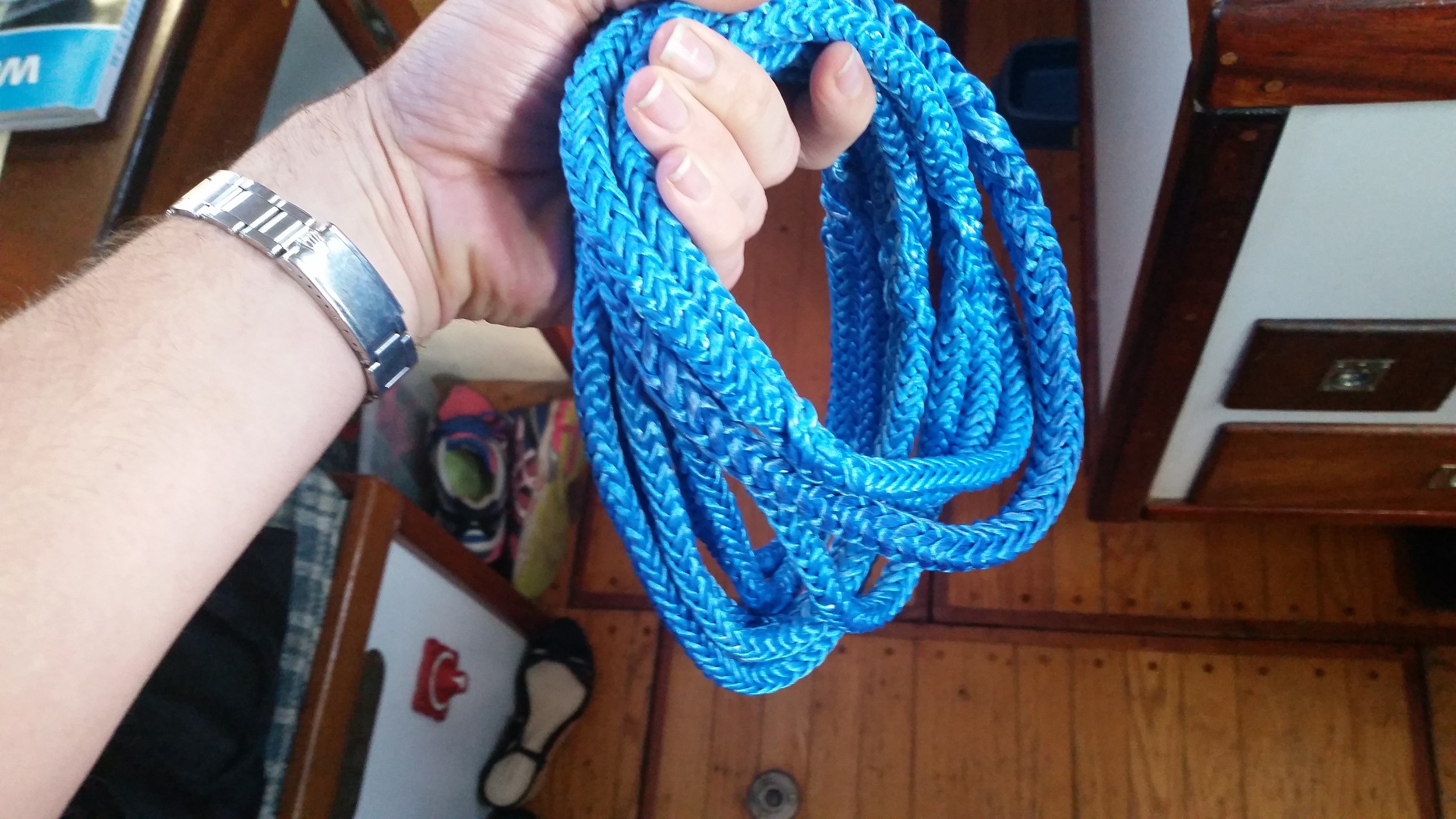
These dyneema loops are called grommets. They are made by creating a mobius brummel splice in the line, connecting the two ends together in a way that they can not slide open under pressure. The splice actually locks the two ends together in a fair and low stress method with the tails buried within the length of the grommet. 

The lot of these grommets took me just under seven hours to make, and it was a very tedious process. The next step will be to insert the stainless steel thimbles and tie a seizing knot in the middle to hold everything together. For more details on how to make a dyneema deadeye, check out the link below.

I didn't service the ends of these deadeyes like I did when I made my first set because the service is completely unnecessary. My thought process when I made the first ones was that the lashings might chafe the fibers of the deadeye as they run by it. The reality is the lashings do not chafe on the deadeyes because they are led by the thimble and never contact the deadeye. Secondly, as the deadeye creeps into place, the bluk of the deadeye thins and the service become loose on the deadeye and begins to unravel. Servicing the ends of the deadeyes took more than an hour per deadeye and was completely unnecessary. While it did add a splash of contrasting color to the deadeye, it ends up being a rather expensive feature that offers no additional benefit to the deadeye. If it is requested, the ends of the deadeye can be serviced with whipping twine, but it will add considerably to the labor time involved in manufacturing the synthetic standing rigging.

Converting an Islander 36 to Synthetic Standing Rigging

I am now working on an Islander 36. The port and starboard cap shroud and Intermediate chainplates have been replaced with new chainplates that I fabricated out of 316L stainless steel. 316L is the ideal form of stainless steel for chainplates. The "L" stands for "low carbon" which gives the metal more resistance to crevice corrosion. 

Summary Block
This block has no content yet. Items you add to the page connected to this block will display here.

The cap shrouds and intermediate shrouds connect to the same chainplate, and since the port chainplate had fractured and come through the deck, it wasn't safe to climb the mast until these new chainplates were installed and connected to the old rigging. 

Once everything is setup and stable, we can go ahead and measure the rigging with the mast in its current position. The measurements are then taken to calculate how much dyneema we need to complete the re-rig. 

When you order your line, be sure to add in the amount of line that will be consumed by splicing. In our case, we are using 7mm New England Ropes STS-HSR for the backstay, and 6mm New England Ropes STS-HSR for the shrouds. The headstay will be replaced with 316 Stainless Steel 1x19 wire so that the owner can retain his roller furling headsail. 

The amount buried in a splice is 72 times the diameter of the rope. For 7mm line,  that's 504mm or 20.1 inches per splice. This means that each stay needs an additional 20 inches on each end, ordering a few extra inches is advisable as it is always easier to cut off a few extra inches than to fix coming up a few inches short!

The deadeyes will consume 4 feet of rope each, and each stay needs one to connect it to the chainplate. There are 2 cap shrouds, 2 intermediate shrouds, 4 lower shrouds, and 1 backstay to replace with synthetics. 

Once the total amount of line is known, an order can be placed and fabrication can begin once it arrives!

Getting Married While Living Aboard

The boat comes into the relationship as baggage, and the living aboard is part of the package deal. How do you get her to move into the boat with you after your married? Easy, have her move in while you are still dating!

The sooner she moves in the better, because the "happy to know each other" butterflies will still be flying and all the quirks of boat life will be lumped in with your own personal quirks. If she gets to know you first, adjusting to life aboard might not be viewed with rose colored glasses.

When Maddie moved in, we had newly installed air conditioning, running water, and a comfy bed. The fact that the shower was tiny and the water temperature would fluctuate wildly, the closet was minuscule, and the water pressure was low, was accepted as part of her new life with me. We worked through our differences as they came up while also acclimating to both of us living in a tiny sailboat. 

There are some girls that really want to live on a sailboat, and they will be the easiest to adjust to this way of life; but for all the rest of the women out there who want a really big house with an extensive yard, boat life might come as a shock! 

It's true, living on a sailboat in a marina is rough. There is very little space available to live in, and you really have to be happy living with few things. We spend most of our time on one settee, where we have the table to work on our projects. Maddie wanted more space, but we didn't have that inside the sailboat. Instead, Maddie started working at a local art gallery which kept her busy and out of the boat for most of the day. When she came home to the sailboat in the marina, the small space was cozy instead of confining.

When we did our long trip out into the ocean, she really came to love living on a sailboat. All of our worries, time constraints, and cares were left in our wake as we sailed off into the distance. We did this long trip after Maddie's first year on the boat, and when we returned, she was in love with the idea and lifestyle of life aboard a sailboat. 

The most important thing about marrying someone while living aboard is to have them move in with you before you get married. Since we had ironed out all these liveaboard details before we got married, marriage is pretty much the same as living together while dating; the only difference is we have rings on our fingers.