Parrots On Board

When most people think of having a pet while living aboard, they usually think of cats and dogs, rarely anything else. We have a nine year old parrot name Sammy who has successfully made the transition from a house to an apartment to a sailboat.

The hardest part of making the boat parrot ready was finding a place to mount her cage. Since she spends very little time in it, I decided on a hamster cage mounted on the salon table. I tied it up in such a way that it would hold still when we heel over. 

This was well and fine, but Maddie is not fond of the mess Sammy makes when she eats. We are now in the process of finding a new place to mount Sammy's cage, but space on a sailboat is limited, so the search for the right spot is on! 

Raising a Boat Dog

I have friends who have successfully converted their pooch into a boat dog, and others who were not as successful. The worst story I have seen was a Golden Retriever that would throw up (and it was a lot!) every time they would set sail. He was fine if the boat was upright, but he would hurl the moment the boat started to heel. Aside from the sea sickness, he was a great boat dog! He would stay on board and resisted chasing ducks and going swimming.

Most of the horror stories I have heard involved converting a dog from land-based life to life aboard. On the flip side, most of the success stories I have heard involved dogs that were raised as puppies aboard and that was all they knew!

Going the puppy route is not a guarantee of success, but it seems to improve the chances of a positive outcome.

I had my selection criteria:

Shorter than the lifelines to avoid falling overboard
No tail to get ripped off in a winch
Good with birds

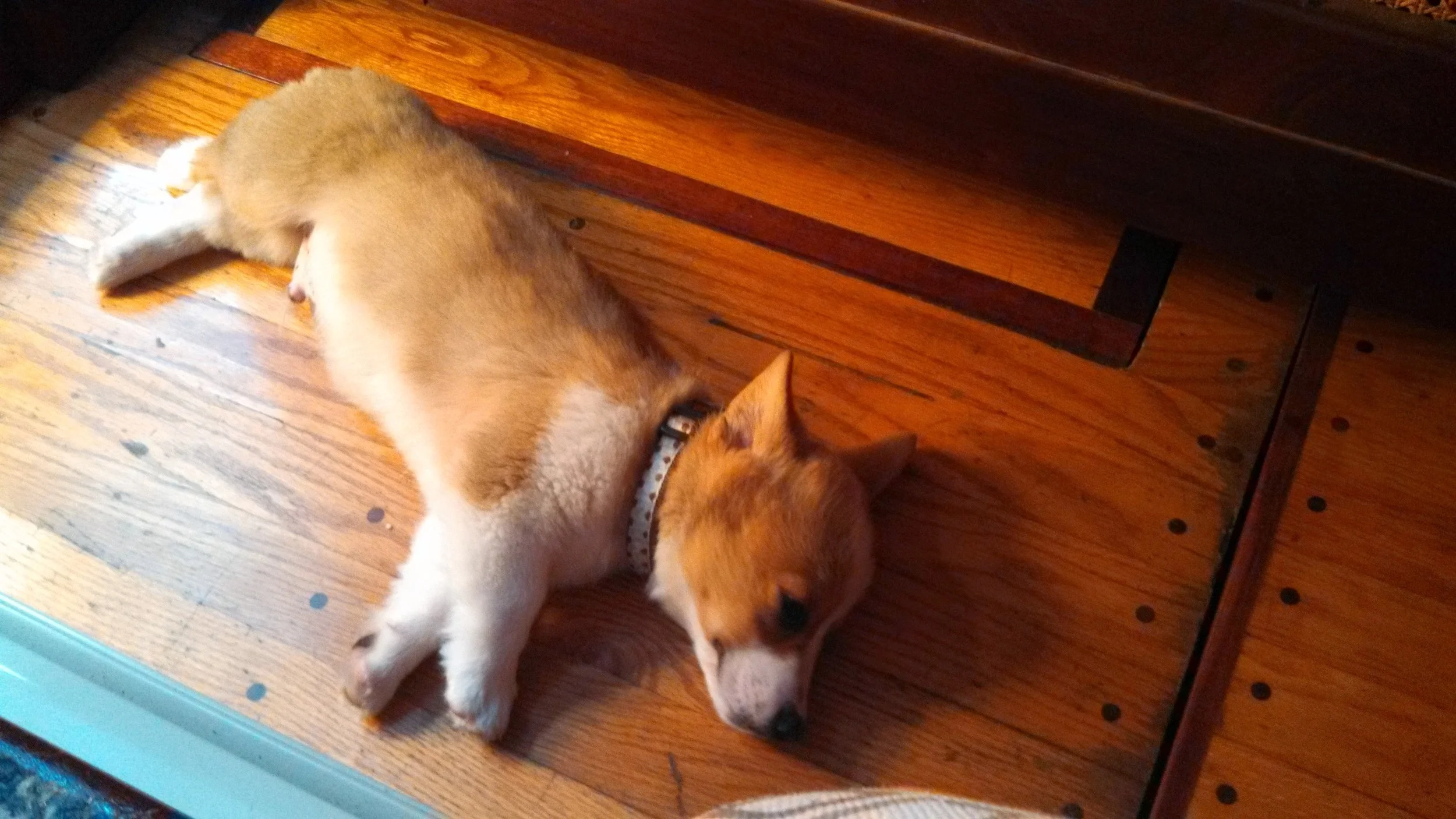
This pretty much narrowed my choice of breeds down to the Corgi. They have stubby legs, no tail, and are used to herd sheep, cows, and chickens! Just be sure to get the most calm puppy in the litter.

Potty training was rather easy to accomplish. Since it's a small space, I was always there with him. If we were watching a movie and he got up, it probably meant that it was time to go outside. Also, if he were thinking about doing something inside, I would see him getting ready and be able to take him out before the accident occurred. 

He became boat broken right away, but since we were rarely inside a building, it took a while to get him house broken. My most embarrassing moment was when he peed and then pooped in a West Marine. He was completely boat broken by around 4 months, and house broken by 2 years.

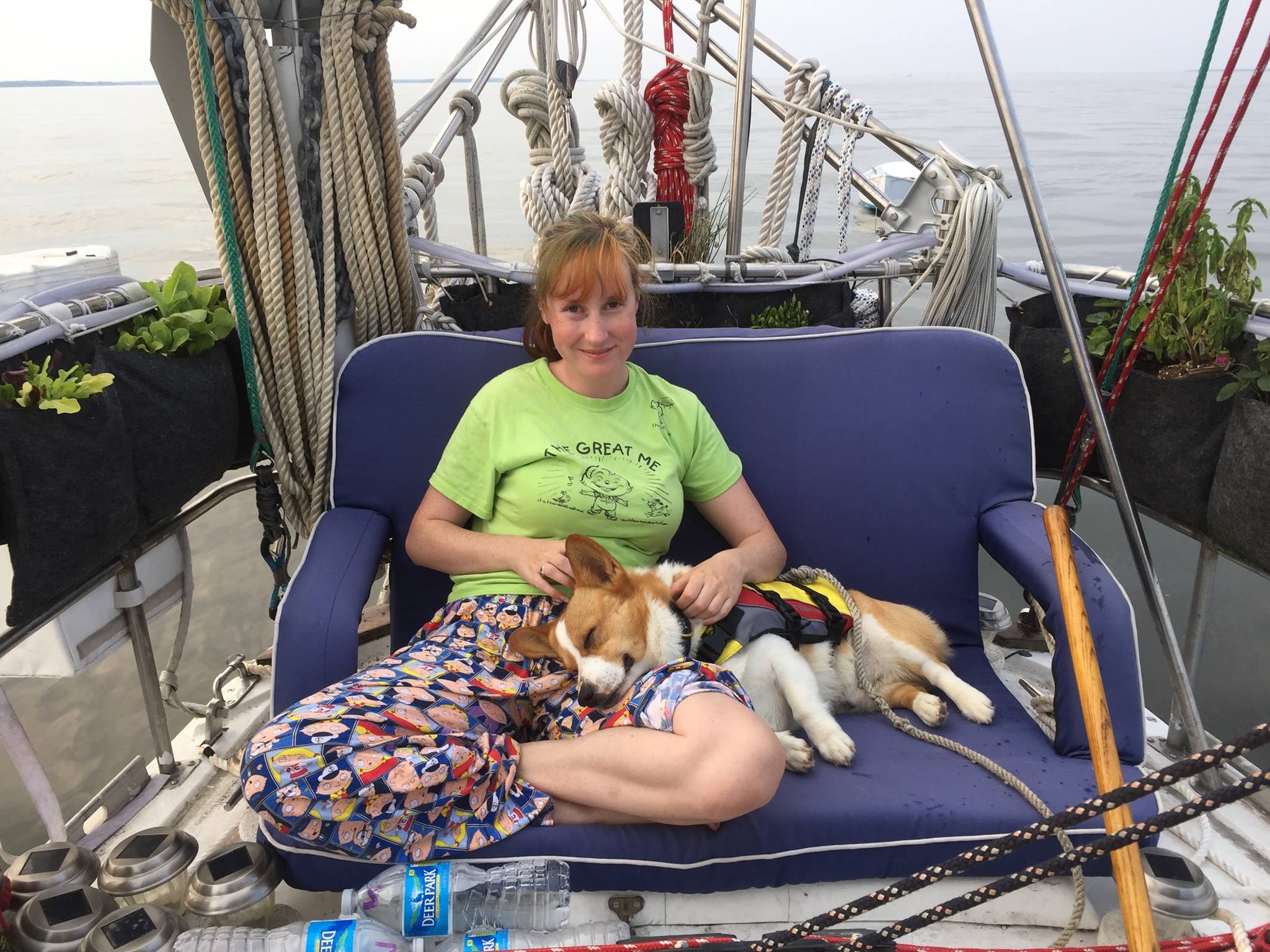
When he was a tiny puppy, he would lay at my feet with his life jacket tied to the binnacle. 

Now that he's older, we let him roam the deck by tying his life jacket to the jacklines, but he usually just finds a comfy place to sit and relax while we are out.

He even stays calm in rough weather. When we had to broad reach off of a lee shore while a few miles off the coast of North Carolina, he was calm as can be (and stayed in the cockpit with us instead of walking all over the deck like he usually does).

He is now 2.5 years old and we can't imagine life without him! There are disadvantages to having a dog on board, such as dog hair everywhere, needing to take him to shore to go to the bathroom, needing to carry extra food on board for him to eat, going to the bathroom inside out of protest, and dog hair getting in the bilge pump intakes. Despite the downsides of a dog on board, he is an awesome crew member and we love having him around!

Porthole Fun

We often get asked if Morty can play on board Wisdom. I find this to be an odd question because a dog will always find some way to entertain themselves. One of his favorite games is where he sticks his head through the portholes and looks in at us. When we call his name, he will pull his head back and run to another porthole to stick his head in again. We only have eight portholes but he will do this game until we get tired of it.

Pet Net

Morty is our Boat Dog, he has stubby little legs and no fear of heights. He will insist on walking right along the edge of the deck, moments away from falling in.

He has fallen over board in the past, but always from the dinghy. This is because he will insist on standing on the very edge of the gunwale. 

When he falls off the row boat, it is no problem as he is right there and can be easily retrieved by his life vest. If he falls off of Wisdom, recovery would be much more complicated.

To avoid this situation, I wove a net around the lower lifelines. 

The first net was a simple zig zag made out of clothes line. This seemed to serve its purpose, but he would push his head through it and jump off like if it was nothing there at all.

Then I wove a second set, making diamonds. He still popped through the large holes.

Then I wove a third line through the middle, making it a series of triangles that he was sure to not be able to squeeze through. Success!

He chewed through the clothesline. I once watched him do it, taking his razor sharp teeth only 5 seconds to cut the line like a warm knife through melted butter.

When he would make a hole, I would quickly mend the net by tying in a replacement piece. Soon, his favorite areas were more mends than original pieces.

When we changed the lifelines from steel to dyneema, we had to install a new netting, and we decided that we would use dyneema with a very open weave. The idea for dyneema netting was to avoid the chafing that would occur from nylon/dyneema contact as well as to avoid problems with sun degradation. The reason for the open weave is: He will get through it anyways, we might as well not have him cut the dyneema and leave me with more work to do. We figured if he really wanted to get off the boat, he would jump right through it without hurting the netting. For the most part he has behaved himself, and the netting is holding up just fine!

Gardening Aboard

I often hear people say they don't want to move onto a boat because they don't want to give up their gardening. There is no reason you can't have a garden on a boat!

I have a green thumb, so making the plants grow is not hard for me, the trouble was finding a place to grow them on a sailing sailboat! 

I began by hanging pots from IKEA on the stern rail and lashing them to the rail so they wouldn't fall off when we heeled over. I also tied the stem of the plants to the rail so if they did fall out of the pot, they wouldn't be lost. These pots didn't let me maximize the available real estate, but they got me started.

Then we had a storm on the Chesapeake which ripped the leaves off of all the plants and then whipped the dirt out of the roots. Needless to say, they all died.

IMG_20140402_162719_522.jpg

My next version was made out of recycled water bottle felt which was sewn to the rails. They provided plenty of space for the roots with a small opening. The idea was to reduce the amount of dirt that could be blown away as compared to the pots. 

The planters themselves were stitched together using polyester line (UV resistant) and the holes had grommets placed in them to keep the line from tearing out the top.

The plants liked it! I was able to grow lettuce, chard, peppers, strawberries, tomatoes, snow peas, basil, chives, and pansies (my favorite flower)

The garden grew wonderfully, but the salt spay we experienced on our summer cruise in the Atlantic killed the garden. They fair well up in the Baltimore Inner Harbor because the water is mostly fresh. If we had flushed the plants more often with fresh water, they might have survived. We didn't want to waste water, so we neglected them. The chives survived, but the rest died. 

If you are trying to convince your significant other to move aboard and they express concern about losing their garden, just remember that there is always a way to accomplish your needs aboard.