
Life Aboard

Ideal Sailing Conditions

When people dream about sailing, they often picture a steady breeze and full sails set as they power through the seas. In a dream world, this may be fine, but in our world, ideal sailing conditions refer to winds that allow us to get to where we want to go as quickly and comfortably as possible. 

We have found that when we are full sail, the winds are actually a bit on the light side and we aren't going as fast as we could be if we had more wind. 
IMG_1699.JPG

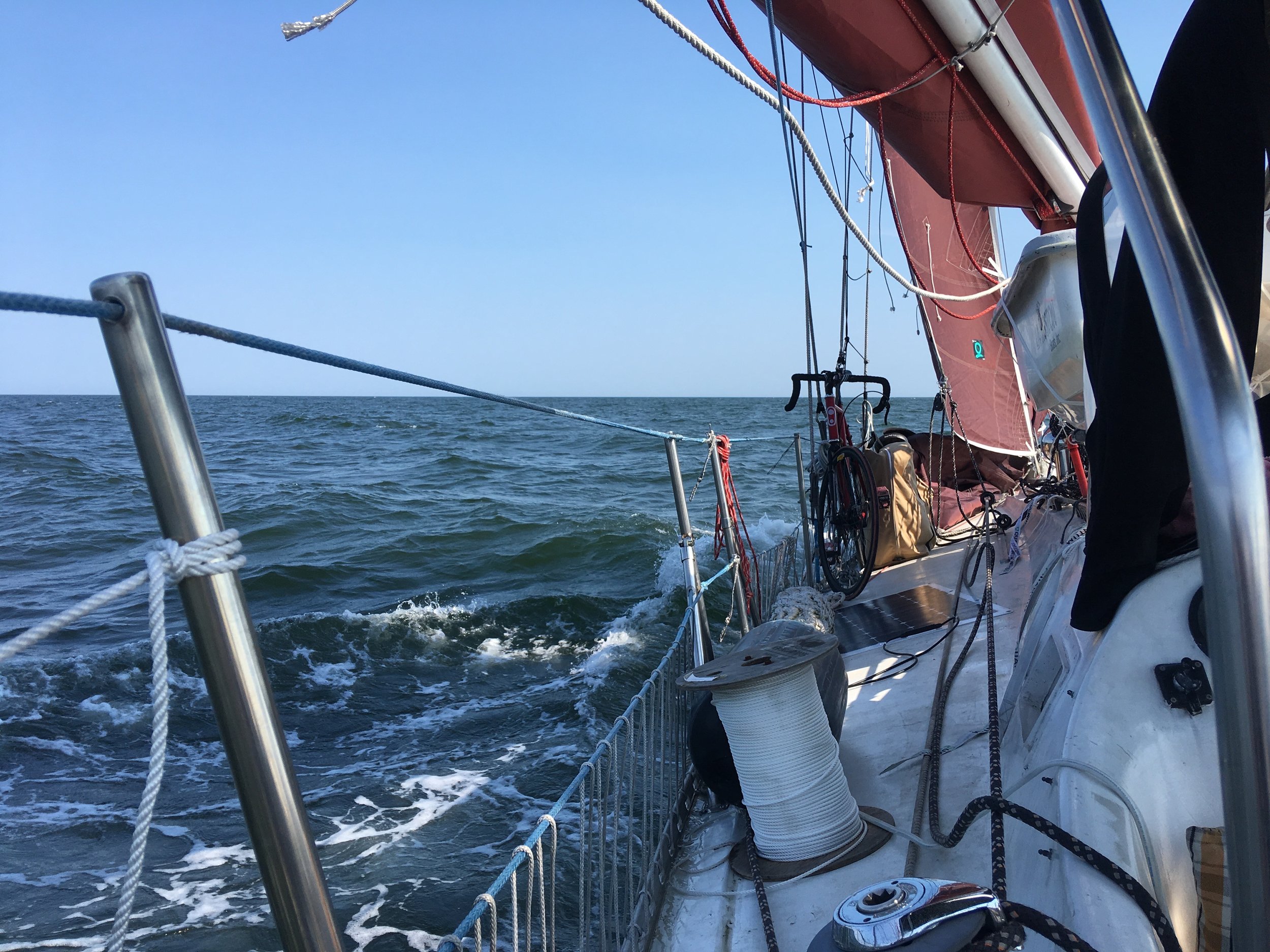
To us, ideal sailing conditions often involve a reefed sail plan. If we are reefed, we always have more sail available to us than what we are using. This means that if we feel the desire to go faster, all we need to do is set more sail! If you are full sail, then you have no recourse left, you are already at your maximum and have nowhere to go from there! 

In this situation, we were close reaching under our staysail and our mainsail with one reef in it. We were still able to achieve 5.5 knots with ease without heeling over much at all. This keeps the boat level and life aboard more comfortable as we don't have to worry about stuff sliding off of horizontal surfaces in the cabin.  

The only way this could have been more ideal is if we had been on a broad reach, there the seas come from behind and help push you along, instead of beating into them as you work to windward. 

All in all, when there is plenty of wind, you can reef down for comfort and still maintain your boat speed through the water. This will keep you moving fast, morale high, and dream sailing a reality! 

Making Your Own Ice

Ice can be purchased, but what if you can't afford it, or if you find yourself far from civilization? If you have mechanical refrigeration, you can simply make your own ice! 

While working on the hard in the beginning of our cruise, we met some other cruisers who seemed to have mastered the art of ice! They let me in on a few tricks that they have found to make ice living very easy. 

During the day, when the sun is shining and the solar panels are producing, they run their refrigerator. In the freezer compartment, they keep several water bottles, which are not for drinking, but instead for keeping their food. 

When the fridge is running, these water bottles will freeze! At night when the sun disappears behind the horizon, they turn off their fridge to save their batteries the abuse of keeping the food cold over night. By this time, all those water bottles have frozen solid and are now ready to do some work. With the fridge off, these frozen water bottles will become their ice source, and that keeps their meats frozen and cold as well. Over night, the water bottles might melt a bit, but the water is kept in place by the plastic bottle and when the sun rises, the entire process repeats itself!

We keep two 500mL bottles in our freezer for this purpose, but have also take it one step further.  

When we are tied up in a marina and connected to shore power, we no longer have to worry about solar panel production. We can run our fridge full blast day and night! Instead of freezing water bottles, we switch over to gallon ziplock bags filled with water. We fill them pretty full, but still able to keep thin and stack them in our freezer in pairs. As the time passes, these bags of water will freeze into blocks of ice that can be used to keep our food cold when we are no longer plugged in. 

The blocks of ice offer us a few options. We could either peel off the plastic and throw them into the bottom with the other blocks of ice, or keep them in their plastic and place them in our other fridge compartment that does not have a drain. As the ice melts, it would simply remain in the bag and not cause any problems of water needing to be removed from the bottom of the fridge. 

The other advantage of making your own ice while tied up in a marina is it saves you the cost of buying said ice. A 10 pound block of ice can cost around $4 in the Chesapeake, and that is saying that you can even find a place that sells it. When you are tied up, you are already paying for the water and the electricity, so why not use your time there to save you some money and create your own ice? 

Salt Water Plumbing

A trick to save on water when cruising is to make all forms of water as available to you as possible. Salt water is by far the most plentiful water an ocean cruiser will come across, why not use it! 

When doing chores like washing dishes or brushing your teeth, you are probably going to use fresh water from your tanks. This is fine, but that water is the only water available to drink and keep you alive. The dishes and your teeth don't actually care how fresh the water is as you scrub them clean, the only time fresh water is actually needed is at the last stage, the final rinse for the plates. 

Now, you could easily grab a bucket and haul up some sea water from the side and use that to clean your dishes. Truth is, this is a lot of effort and the tap is right there on the galley sink! In the end, the sea water is present but never used because the tank water is easier to get at and thus will be used for superfluous uses. 

To avoid this problem, the sea water needs to be as easy to reach as the tank water. This means that you should have the same water pump setup for the fresh as well as the salt water sides. If the fresh has an electric pump and the salt has a manual pump, the salt will still go unused! 

In our case, the fresh water pump is a 2 gallon per minute electric pump. Therefore, the saltwater pump is the same sized 2 gallon per minute electric pump. I tapped the salt water plumbing into the hot water side, making it equally easy to use salt and fresh in any part of the boat. 

It is important to make sure you install a valuing system though, that way salt water can't backfeed into your fresh supply and destroy all of your drinking water!  

When washing dishes in the galley, the hot tap is now salt and the cold tap is now fresh! I can scrub and wash until my heart is content with all the salt water I want, and then at the end, I rinse all the dishes together with fresh water. This lets me finish the dishes with a fresh rinse and use much less water than I would have if I washed everything with fresh. 

With brushing your teeth in the head, the salt water is all you really need! The hot tap is salt, so you can wet your brush, scrub them clean and then rinse with salt water. Seawater is actually very good for you gums and you don't need to rinse with fresh (unless you can't stand the taste of salt). As a dentist, one of the treatments for people with severe bleeding gums (gingivitis) is to rinse with salt water after they brush because the salt water helps their gums heal faster! Why not take advantage of this on a daily basis while out at sea! 

To Cover or Not To Cover Your Sails

When you anchor for a storm, you might be focused on such things as bottom conditions and the amount of scope to let out. While anchoring techniques are very important for safely riding out a storm, another part of storm preparedness is how you ready the rest of your yacht.

The anchor will be forced to hold your yacht against the water pressure from waves and tides, as well as the wind pressure from the air on your yacht.

Bulky items on deck, as well as dodgers and rigging will all add wind resistance to the equation and put more strain on the anchor as it struggles to hold you to the bottom. Reducing the strain on the anchor is wise, as it gives all your gear an easier time during the blow. Roller furling headsails are bulky and offer a great deal of windage, especially up high! Hank on headsails offer the distinct advantage that when the sail is lowered to the deck, the stay is bare and offers minimal resistance to the wind. But what about the sail that is now on the deck?

Should you bag your sails or simply lash them to the deck before a storm approaches?

Bagged sails offer the advantage that they are inside a smooth covering. This will reduce turbulence as the air passes over the sail and will in turn create less drag. If the sail is simply lashed to the deck, the luff of the sail will be flacked at the stay and will offer a lot of resistance to the wind.

Looking at the situation from this standpoint only, it would make sense that bagging the sails would be ideal before a storm, as it would make everything on your yacht more streamline and thus less drag.

The problem with bagging your sails is that if you begin to drag anchor and need to sail away to safety, your sails are all bagged up! You now need to take additional time to uncover the sails and get everything setup so that you can sail away to safety! In moments where you are dragging anchor onto a lee shore, every second counts and having the sails bagged up might result in you being careened on the lee shore!

If you simply lashed your sails down, all you would need to do in this scenario would be to untie the and begin working your way to safety!

Based on these assumptions, and the fact that we don't have a diesel motor to power us to safety, we choose to lash the sails down to the deck when anchoring for a storm. The sails are kept with halyards and sheets attached, but lashed to the toenail with sail ties. Should we need to start sailing for any reason, all we need to do is untie the sails and raise them up to begin clawing our way off the lee shore.

Storms are never comfortable events to endure, but careful preparation can make your memories of the storms much less eventful.

Awaiting for Weather to Improve

We are anchored in the harbor of Tangier Island, where we have good protection from the seas to the West and North of us. This works well for us, as a cold front is forecasted to be coming in and blowing from the North-West! Tangier Island is flat and low, so it will not offer any protection from the wind, which means that the seas in the harbor can get rather choppy.

We explored the town and rowed back to the boat the day we got here, arriving back to the boat in a surreal world of absolute stillness. It was hard to imagine that such a world would turn into a chaotic whirlpool in just a few hours!

Around 3am, the winds began to build, and I let out a bit more chain to give our anchor extra help in holding us still in the water. I also tied on the snubber to reduce the noise transmitted through the chain as well as to reduce the shock loads when we ride up a wave crest. After everything was well set, I went back to sleep, knowing that the conditions were only going to deteriorate as the night progressed.

When the morning arrived, the winds were blowing a steady 20 to 25 knots with gusts to 30 knots. The seas in the harbor are 3 feet, and we are really lurching around! We had plans to go to shore today with our bicycles and ride around the island, but all that had to be put on hold.

The seas are rough and the wind is intense! We knew that attempting to row the quarter of a mile to shore in these conditions would be ludicrous, especially with two bicycles thrown in the dinghy!

Instead, we slept, read, and ate as we waited for the winds to calm down. Listening to the forecast provided sour news. The high winds were slated to last the entire day and into the next morning. With this news, we knew that we had no choice but to hunker down and wait it out.

It is actually hard to find things to do when you know you are stuck in one place. You feel like everything you try to do is simply being done to waste time and make tomorrow come faster! The good side to this situation is we know we aren't going anywhere, so we can spend time making all sorts of delicious foods to eat to pass the time!

The rocking of the boat can make such activities harder to do, as your whole world is being tossed around you as you wait out your time. The important thing to remember is that it is temporary and as soon as the winds die down, we will be able to resume our usual exploring and adventures!