
Maddie was working on her computer when Morty decided that he wanted to be pet. Morty has a keen method of pushing your arm in a way that your hand will land right where he wants it to be, this way all you have to do is start scratching!
Bottom Paint
Bottom paint is one of those things that people only seem to think about when they are on the hard. When the boat is wet, the bottom paint is hidden beneath the waves and forgotten from all thoughts.
This is probably a safer way to think about bottom paint, as the alternative is to research and compare all different types and formulations to see which works best. Research is largely a waste of time since the amount and type of growth you will develop is particular to where you are. Where you are is not as diverse as a general area, and if a study was performed in your same general vicinity, the water qualities might be slightly different and the growth you will develop will also be different from where the study was performed.
Your next option is to try out every single bottom paint that exists. This would be a very long study, as bottom paint tends to last for at least one year. Basically, you would paint the bottom and give it a shot. Next year, you will choose a different paint and try it again for a year. The following year, you will try another paint. At the end of a lifetime, you will find that the paints you tested in the beginning are no longer available and your data is irrelevant now.
The other option is to ask around and buy the cheapest option. If you move your boat often, CPP from West Marine is a good option. It is labeled as "house brand" but is actually manufactured by Pettit, a maker of high quality bottom paints. This cheap paint has enough copper in it to keep growth from taking over your bottom. A lot of cruisers use it on their bottoms, and they all say it works great as long as you keep moving. If you sit still for a few weeks, a layer of slime will develop that will rob some speed. This thin layer can be easily removed with a brush or a scrub pad, renewing your bottom to a smooth slick machine!
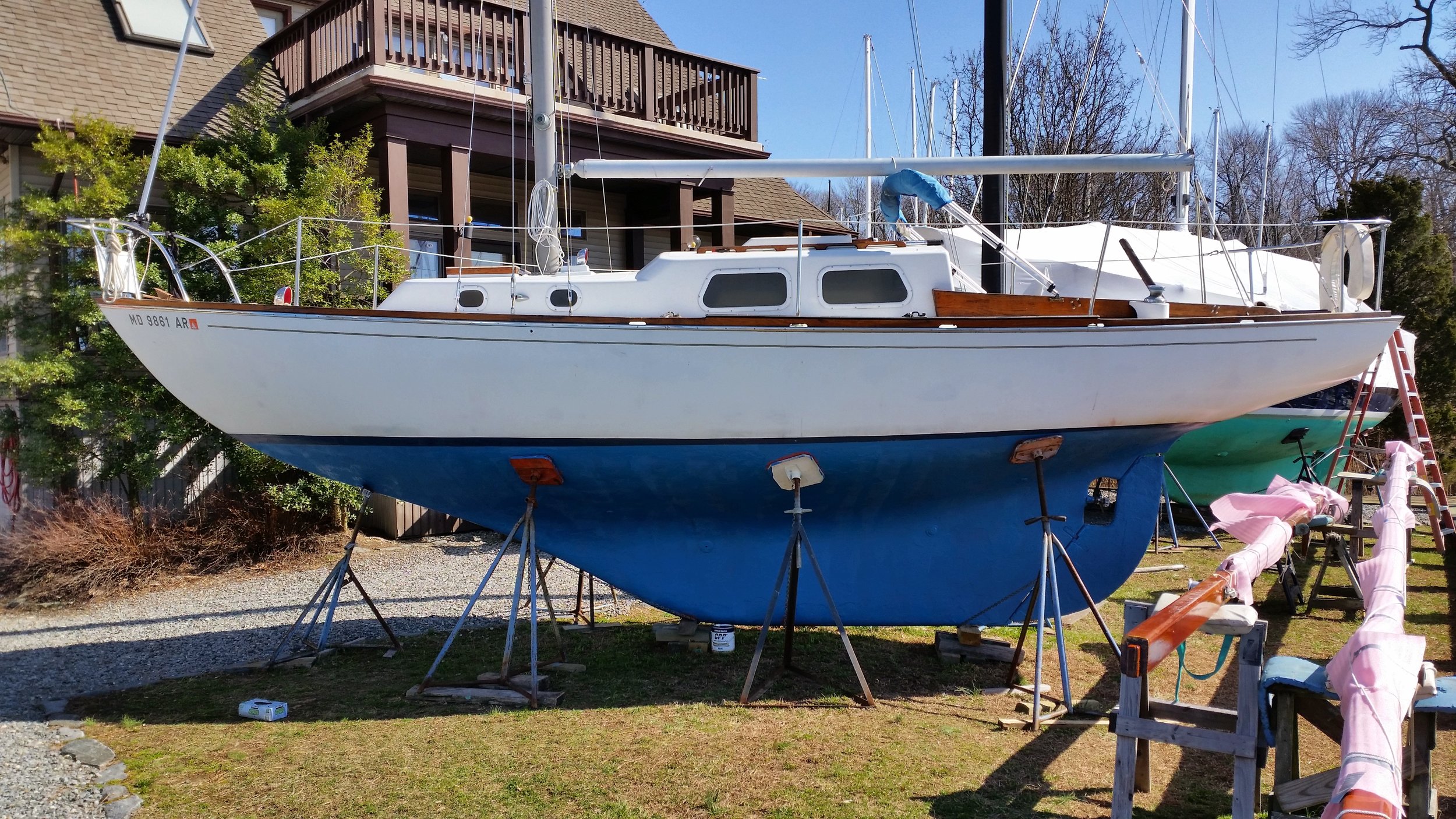
Windpuff was painted in April 2015 with one coat of West Marine brand CPP.

Twenty months later, Windpuff was pulled out of the water to be put on the hard while we go cruising. The bottom wasn't that horrible, considering that we haven't moved Windpuff in a while. There were a few barnacles here and there, and the bottom was covered in a thin layer of slime that wiped away easily.
I'm not saying that CPP from West Marine is the best bottom paint ever, but I am saying that it does the job and it's cheap!
Cutting Plank Stock
In order to cut evenly sized planking stock, you need a way to make the same cut on a lot of wood and get reliable and repeatable results. Cutting by hand will include too much variability, for a job like this, you will need to use machinery that is set up to mill the lumber over and over without change.
To guide the planks through the bandsaw, you will need a rip fence; which is nothing more than a fixed wall that you slide the wood past. The rip fence is set next to the blade, and the gap between the fence and the blade will be the width of the resulting board. The kerf of the blade will be deducted from the stock, so it doesn't need to be factored into the measurements at this time.
Rip fences are available from hardware stores for a significant price. Most bandsaws will sell you a model specific rip fence that will fit their unit perfectly. The alternative is to make your own for cheap!
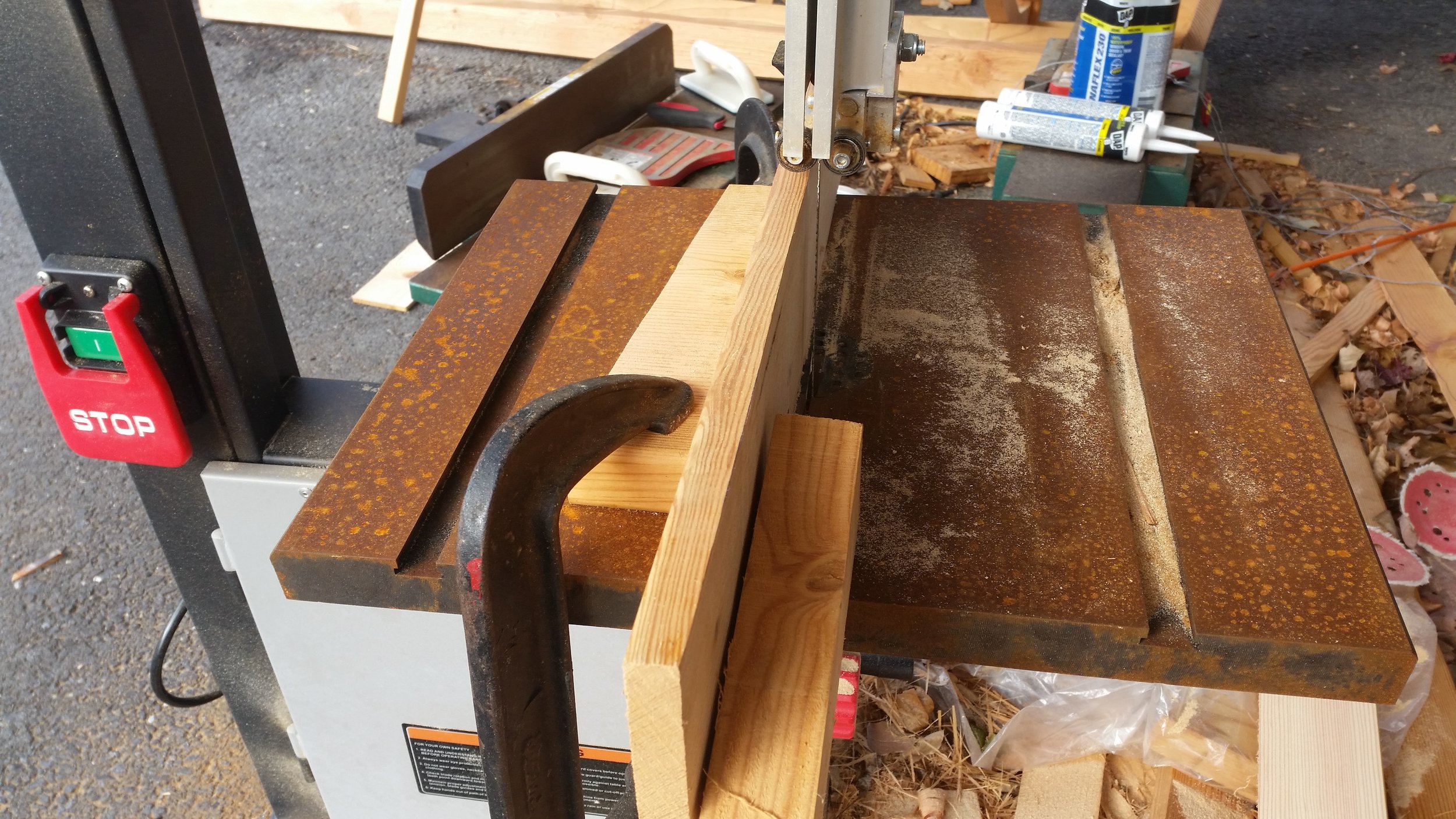
In the simplest of forms, a rip fence is just a vertical stop that is set square and perpendicular to the bandsaw's deck. All you need to do is attach a flat and vertical board to a flat and low board. Screwing them together in a square will ensure that your rip fence is square. If there is any discrepancy, a few passes over a jointer will restore this ideal right angle that you are searching fore.
With the rip fence assembled, you simply need to attach it firmly to the deck. Simple C clamps work well for this. The compression force the exert on the fence will remove the possibility of any movement.
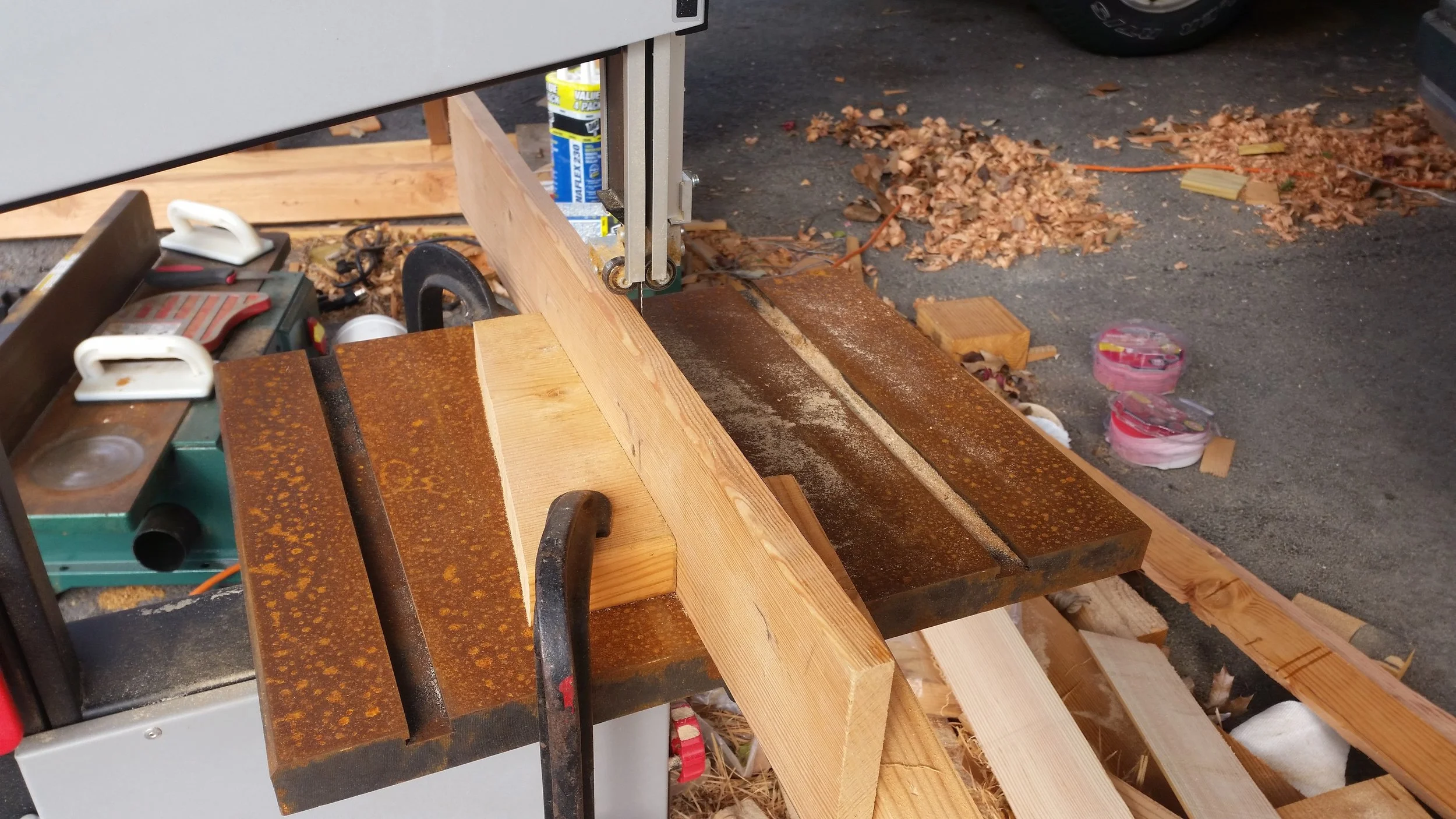
The concept is very simple: clamp the fence to the deck at the desired distance from the blade, then pass a test board through.
The test board needs to be measured for consistency. If the bandsaw blade is too slack, it will bow out and result in a thicker and off angled board. If the blade is too tight, it will snap! You always want your guides as low as possible and the blade as slack as allowable.
With everything setup and verified for accuracy, you're ready to start milling your lumber!
With a rip fence on the bandsaw, resawing planks is very easy. All you need to do is push the boards through the saw while keeping pressure on them against the rip fence. It is always a good idea to use other sticks or boards to push the wood you are cutting. This is especially true of the last few inches of the cut. When the blade exits the end of the board, it will continue to cut whatever it comes in contact with. If your fingers are pushing the wood through, your blood will stain the wood as your fingers are sliced open (and possibly off) by the blade.
A push board will allow you to safely push the wood through the blade without any fear of amputation. I prefer to use a large block from the scrap pile. When it gets too cut up, I just switch it for another scrap piece.

Now you can safely mill your own planking stock instead of buying loads of expensive boards from the lumber yard!
Fiberglassing the Bilge Pump Supports
The bilge pump supports are positioned with lots of chop strand mat wedged between the endgrain and the stripped bulkhead. All we have to do now is glass everything together!
Being how this project site is also my home, I need to make sure that no mess occurs and all the work is contained. By working with smaller sizes, I am able to keep any issues to a minimum and produce a good final product with minimal disturbance to the rest of the boat!

The pure epoxy can be brushed onto the wooden supports with a paint brush just like if it were varnish. It is best to use a disposable chip brush with bristles as a foam brush could dissolve in the epoxy, destroying your ability to apply it and your batch of epoxy resin.

Be sure to saturate the chop strand mat at the ends. The idea of the chop strand mat is to hold wet resin in position as it cures. If you fail to wet the chop strand mat, there will be no bond to the bulkhead! Everything is covered in an even coat of epoxy, the frame, the ends, and the bulkhead as well. I used fast set epoxy simply because it is winter and the low temperatures will greatly delay curing. If it were warmer, I would be using slow or ultra slow hardener, as it would grant me more working time.
Adjusting to Life Aboard
I won’t lie. It took me about a full year to appreciate living on a sailboat. When I moved in with Herby, I was accustomed to a life of walk-in closets and nick nacks, and while I still appreciate and admittedly sometimes dream about those things, I feel like I’ve solved some sort of life puzzle by letting go of the concept of “extra.” I feel like I’ve figured something out and somehow cheated the system. We grow up with one image of how our lives will play out. We will go to school for thirteen years, enter straight into college where we will decide on a career, go to grad school for said career, and then immediately enter into that career before it’s too late because…..why? Why would it ever be too late to start that job? Where is it going to go if I make it wait for a year? Why are we so tethered to society’s expectations of life as if it’s a straight line that never veers off in new directions before reaching its destination? My life was on a straight trajectory towards the thing that I love; teaching art. I was even offered a job, which was admittedly very difficult to turn down because everyone was saying I was crazy for doing so. They would say things like, “That job will not be there in a year! What if that opportunity never comes back?” I’m not worried, though. I know that I’m still going to teach art because that is what I’ve been working towards for the past three years of education classes and student teaching. But if living on a boat has taught me anything, it’s that life constantly offers you opportunities that don’t exactly fit into your plans, but taking them does not mean that those plans won’t happen. It simply means you’re taking a more adventurous route.
When Herby mentioned his dream to sail across the Atlantic in our home, I thought he was crazy to ask me to put everything on hold for a year. It wasn’t something I’d considered. It was so off course if you’ll excuse the pun, and I’d been told all this time that I had to get a job as soon as I possibly could before someone else snatched it up. But the longer I thought about it, the more I asked myself, “why don’t I want to do this?” Why don’t I want to take advantage of this time before I have a serious job and kids? The plan was to take the trip in 2018 and the longer I thought about it, the less that made sense. One night we were lying in bed and I blurted out my feelings. “Why are we waiting? Let’s just go this year!”
Since making this decision, Herby and I have both faced opposition and questioning from collegues, family, friends, and complete strangers. Most of them want to know if we’ll be safe and how we can possibly afford to take a year off from our lives here in Maryland. The answer is simple. Yes, we’ll be safe. We wouldn’t just go do this without having done the proper research and attained all of the necessary equipment. And as for how we can take a year off? We’re just doing it. There will never be a better time. I was never destined for a normal life, and I sealed that deal when I married Herby.
When I first moved into the boat, I did so with the sure knowledge that this was a fun little phase. Someday we would move into a house and have the normal life that everyone expected for us. Life has thrown my straight path into a wavy uncertain squiggle and I’ve never been surer of anything before. My life is an adventure.

