Life Aboard

Fiberglass

Fiberglass boats are also called FRP or GRP, which stand for Fiber Reinforced Plastics or Glass Reinforced Plastics respectively. This is because the hull is actually made of plastic that is reinforced by fibers made of glass. Since the fibers are made of glass, FRP and GRP can be used interchangeably. 

The factor that gives the plastic its strength are the fibers that run through the plastic. As with anything placed by engineers and builders, there are many ways to do the exact same thing! The three most common ways to add fibers to the plastic are:

  • Chop Strand Mat
  • Woven Roving
  • Woven Cloth

These three methods all serve the same principle of adding fibers to the plastic. The difference is how they align the fibers that are added. Fibers offer strength only along the long axis of the fiber.

If all the fibers are arranged from left to right, the final product will only have significant strength when forces are applied laterally from the left or the right.

If all the fibers are arranged from top to bottom, the final product will only have significant strength when forces are applied vertically from the top or the bottom.

If you combine both fiber directions, and apply fibers running vertically and laterally, you will now have a final product that will have significant strength when forces are applied vertically and/or laterally! Woven cloths and woven roving offer fibers arranged in both lateral and vertical orientation, all in an easy to handle material. This may seem great, but it does still have one major pitfall, vertical and lateral oriented fibers are weak when diagonal loads are applied.

To offset this problem, woven fibers can be arranged in two different directions. The first layer will be oriented with the fibers running vertically and laterally, and the second layer will be oriented diagonally with its fibers running diagonally up and diagonally down! Now you have strength in vertical, diagonal, and lateral directions! Success! 

If you can imagine, applying many layers involves more labor. More labor means more work and more cost. This is where Chop Strand Mat (CSM) comes into play. CSM is literally chopped up strands of fiberglass held together in a mat. CSM has no special orientation to the fibers, and the fibers do not run very far. They are randomly arranged and offer strength in all directions, but the fibers are all short and offer little strength to the plastic. The only reason CSM is widely used is it is cheap, quick, and easy! Woven fibers take skill and attention to detail, CSM can be applied with a gun that literally shoots it into the area. 

We know that CSM is randomly arranged small fibers, but what is the difference between cloth and roving? Both cloth and roving are woven fibers arranged into a sheet that can easily be managed and worked with, but they do have their significant differences.

Woven roving is made of very large clumps of fibers that are woven together. Woven roving offers a lot of bulk and a lot of strength in a single layer of fabric. The problem with woven roving is it results in a much lumpier surface. If the outside of your hull was a lumpy mess, you would either have horrible resistance while moving through the water, or you would spend a really long time trying to fair the hull.

Woven cloth is made out of very small fibers that are woven together. Woven cloth offers very little bulk and very little strength in a single layer of fabric. While it is very weak, it does offer a very smooth finish layer to the hull. This will mean less lumps and less time spent fairing the hull!

You might be wondering why would you ever use CSM or Roving when you could simply build the hull out of woven cloth and have a very smooth finish with no lumps to contend with. The reason is the needed bulk to build the thickness of the hull. Making a hull sandwich with woven cloth for bread and woven roving or chop strand mat for the meat will result in a smooth, thick, and strong hull with plenty of strength in all directions!

In general woven cloth offers a smoothing finish layer to the meat beneath the the FRP work. Woven roving offers a lot of meat and strength to the FRP work. CSM acts mostly as a bulk filling sponge that holds plenty of plastic as it bulks up the FRP work.

Next time you are working on a fiberglass project, you can choose the correct fiber for the job and create a strong and durable result.
Making Long Bolts

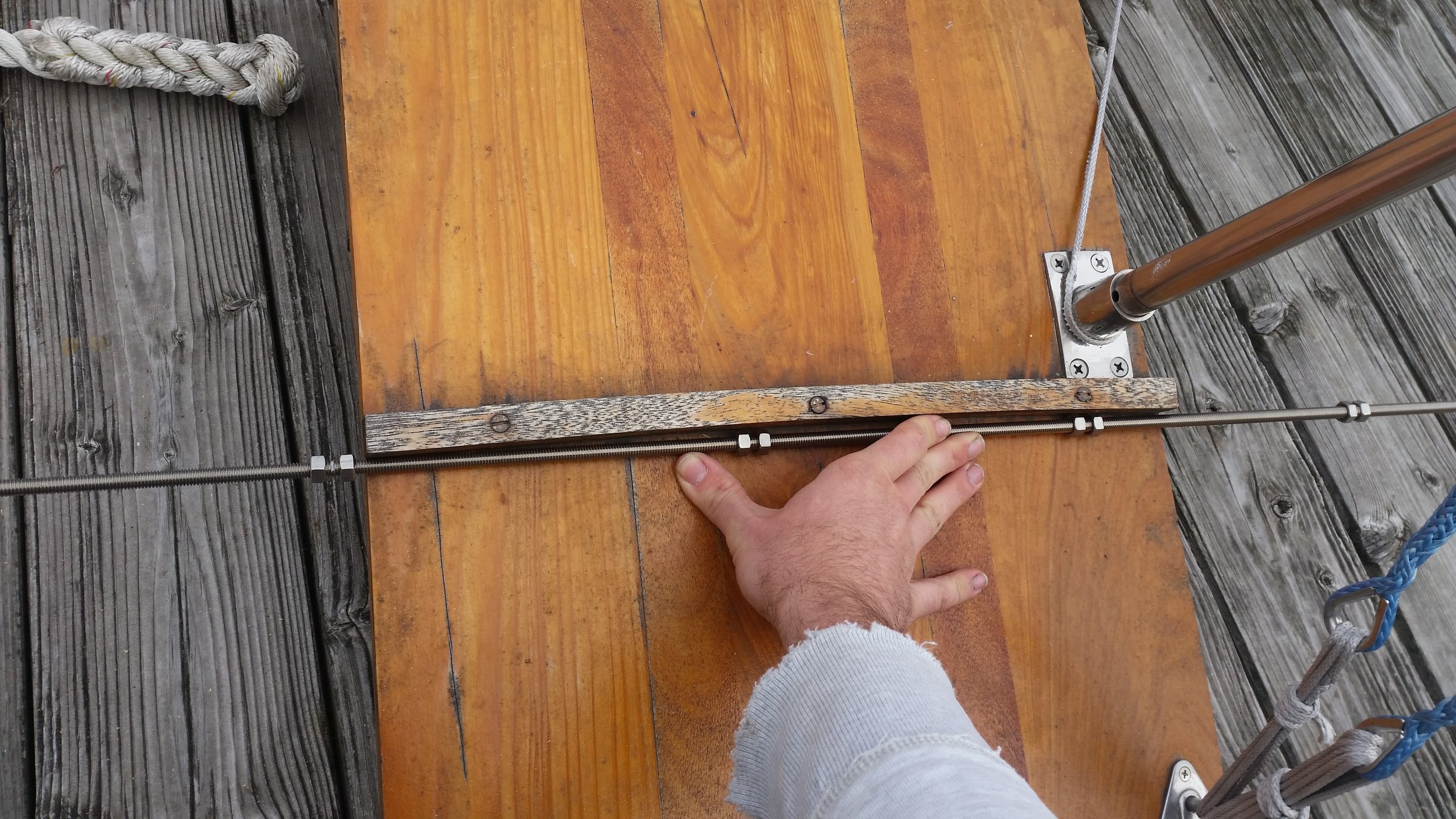
When you need a very long bolt in a specific size, you might become frustrated with the limitations in supply. This whole process came to be when I was installing the Monitor on the back of the sailboat and needed an exceedingly long bolt to attach it to the deck. The bolt needed to be at least 7 inches long, while 8 inches would be preferable. The problem is the bolt had to be 5/16" in diameter.

They do not readily manufacture 5/16" bolts in excess of 6 inches because the forces on these bolts are so great that they could break if used in the wrong situation. Mounting the Monitor was not one of these "wrong situations", so I would be fine with this thin long bolt; as long as I could get one!

My choices were to search specialty stores for this extra long bolt and pay a premium for each or make my own! I chose to do the latter. 

I ordered a 5/16" threaded rod from Jamestown Distributors and proceeded to make my bolts from this. The rod itself was only $4, but shipping was $12. This means that a set of 4 bolts would cost $4 each. Luckily, my dad also wanted to order some things from Jamestown Distributors so we split the shipping charges. Now the threaded rod was $4 and the shipping was only $6! At a total cost of $2.50 per bolt, I was well on my way toward saving money with these fittings.

The plan was simple, cut the 36 inch threaded rod into 8 inch sections and turn them into bolts! One important point with cutting threaded rod that you plan to use as a bolt later, the cut threads will usually get mangled, prohibiting any nuts from threading on. What you need to do is "refresh" the threads after you make the cut. 

Refreshing the threads is simply the act of unscrewing a nut over the freshly cut threads. This is simple to do and only requires the forethought to put a nut on the rod before you make your cut. With the nut present, all you need to do is unthread it and the threads will be refreshed.

The 8 inch sections were demarcated by a set of nuts, all I had to do was cut between the two nuts and I would produce four 8 inch sections with nuts ready to refresh the threads.

A hacksaw made quick work of the threaded rod with little effort on my part. A hand file took down must of the irregularities before I proceeded to unthreading the nuts to refresh the threads.

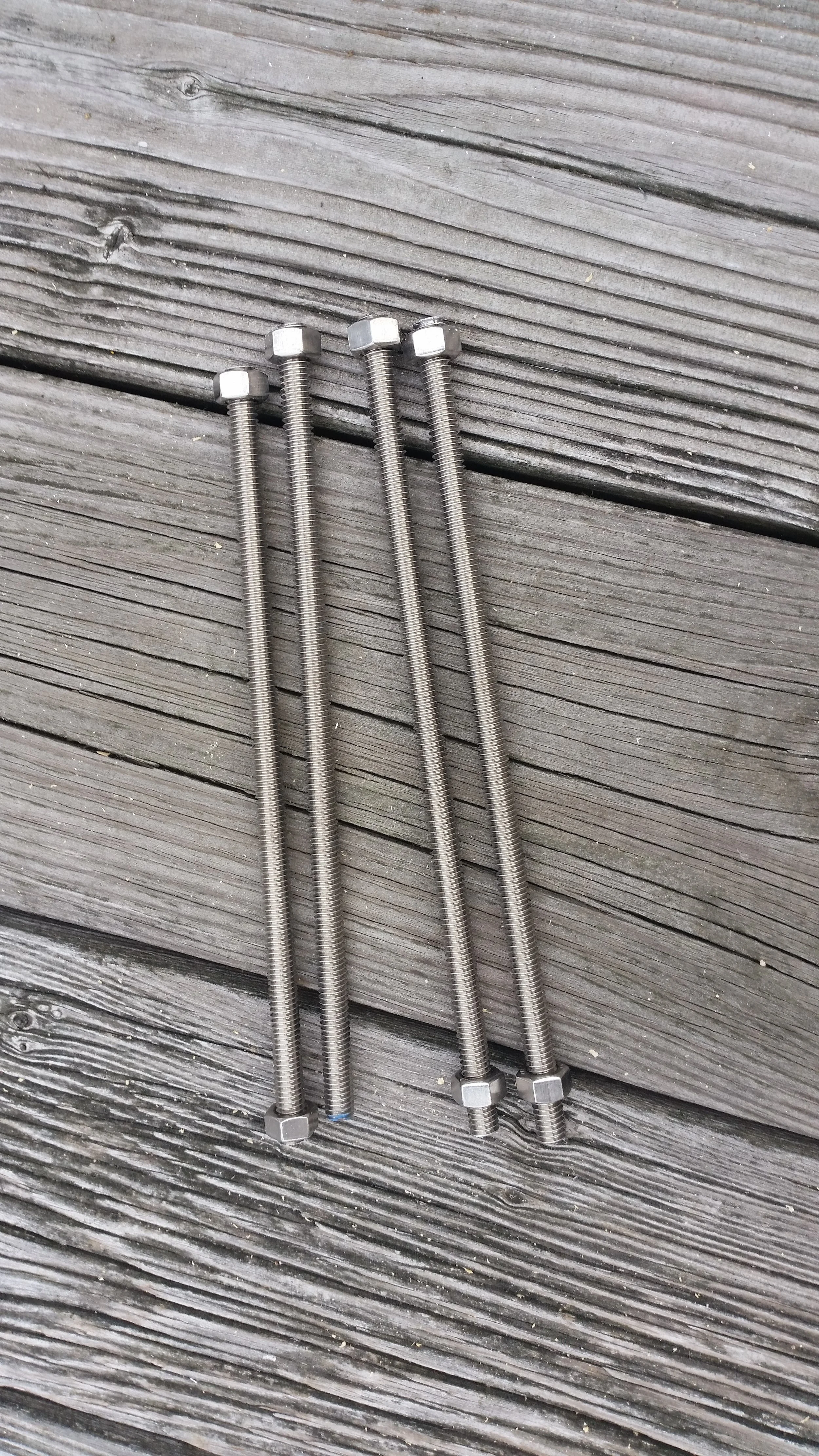
To turn threaded rod into a "bolt" all you need to do is firmly attach an acorn nut to one end. This nut will lock onto the threads and never let go if tightened down properly. 

To tighten the acorn nut onto the rod, you will need two nuts on the other side. The two nuts can be tightened by hand against each other until they gall and bind onto the stainless steel rod. With one wrench on a nut and another wrench on the acorn nut, you will be able to tighten the acorn nut onto the threaded rod to a degree much higher than could ever be achieved without the locked nuts on the other end. It is not uncommon to hear a grating sound as the acorn nut galls into the threads, locking it on forever!

With two wrenches working opposite each other, the two nuts can easily be freed and removed. 

Using these simple steps, you can create a very long bolt for much less money than a regular custom made bolt would cost. Best of all, it will have threads on the entire unit, as opposed to typical long bolts with only the last inch having threads.

Cutting the Rabbet

The dinghy is taking shape and it is time to flip it over and cut the rabbet into the keel. The rabbet is simply a notch in the keel where the garboard, the first plank, will connect to the keel. Most leaks occur from a poorly cut rabbet that was not wide enough, allowing water to slip by the plank and get into the bilge. It is best to think of the rabbet, not as a feature in the wood, but as a surface for a gasket that will keep water at bay. If you make a really small gasket, water might get through. If you make a larger gasket, water will have a harder time getting through. 

The first step is to determine what size the keel needs to be. In our case, the keel timber is 2 3/4 inches wide and I want the keel to be 1 inch wide. This means that 7/8 of an inch need to come off of each side to place the 1 inch keel in the center of the boat.  

FullSizeRender.jpg

The keel was marked at 7/8 and 1 7/8 and lines were drawn the length of the keel. Following these lines, I made the first cut proud of the line with my skill saw. The deepest I can cut is 2 3/8 inches, so my cuts were precisely that depth. 

FullSizeRender.jpg

A proud rabbet was cut into the side of the keel to meet with the first cuts I had made. This allowed me to remove the piece of wood from each side of the keel timber to begin the actual trimming process where I refine the keel into its desired shape. 

FullSizeRender.jpg

With the wood removed, I then began cleaning everything up with a No. 4 Stanley plane. This let me carefully bring the proud cuts right to the line without any risk of going past the line. The rabbet line was drawn a full 1/2 inch higher than where it is going to end up that way I don't go past the point. I cut down to the rabbet with no bevel just to get it down to the right location.

FullSizeRender.jpg

Once at this point I set a batten on the frames and looked at the bevel it needs to lay flush against the rabbet.  This work was much more tedious as each frame has a slightly different bevel. The bevels between frames was recorded based on the chine log. 

FullSizeRender.jpg

The end is a sloping curve where the rabbet is beveled in such a way that all the planks will run flush along the keel and frames. The middle of the dinghy is more flat while the ends are rather extreme. The bow was very radical as the planks come down at a very sharp angle. 

FullSizeRender.jpg

After the bevel was set on the keel, the rabbet plane was set using this side as the reference and the rabbet line was cut into the keel. This worked well everywhere except the forefoot where the plane didn't fit and had to be cut using a chisel.  

FullSizeRender.jpg

Hull Repair

Whatever hull material you choose for your cruising boat, you should be capable of repairing a holed hull in a remote location. This may sound rather extreme, being how boat yards are available in every major port of call.  The problem is if you find yourself stuck with a problem in a non-major port of call.

Say you have a carbon fiber yacht, and find yourself on an island with a small fishing village and you bumped into a coral head. Now you have a hole and you can't get your yacht to a major port of call where skilled labor to repair your problem can be fixed. This is why you should be skilled in repairing your own hull and carry the materials and tools you need to repair a holed hull.

If you choose a wooden boat, you will need to carry along the minimum tools you need to repair a hole. You should have the tools needed to scarf in a repair plank and enough wood to carry out a repair to the bottom planking. This is where the biggest problem comes into to play for wooden boats: Where can you store enough wood for a planking repair in a small cruising boat where the wood won't get moist and rot?

The space and rot problems are severe enough that most choose to only carry the tools they need and plan to simply purchase the wood wherever they find themselves should the problem arise. This is fine as long as you have a hull made from woods commonly found in the area you will be cruising. If your hull is made form an exotic wood, you will be faced with two choices should the problem arise:

  • Use a different wood that is readily available where you find yourself.
  • Have your specialty wood shipped in to where you find yourself.

Wood is wood, what difference does it make if you mix and match? A lot! Each wood will shrink and swell at its own rate. If you mix species, you can create problems when the woods begin to swell at different rates and this can create irregular stresses on the fasteners and frames.

Shipping your specialty wood in can prove to be very difficult. Not only will you be unable to hand select the quality of wood that you want in person because you are stuck on an island and nowhere near the lumber yard you are ordering from, but you will also have to pay for shipping and then wait for its arrival.

This is where FRP hulls shine! FRP stands for Fiber Reinforced Plastic, and this means that the hull is made of plastic and reinforced by fibers. Glass fibers (fiberglass) are the most common at the moment, but newer fibers are coming into the market all the time. Kevlar and Carbon fibers are becoming very common on high level racing/cruising yachts because they offer greater strength to weight, allowing the hulls to be built lighter while still being just as strong.

If you find yourself stranded on an island with a holed hull, finding the exact fibers that your hull needs may be a challenge. Luckily, you can carry your fibers folded up in a bag stored in the bottom of a locker. The fibers won't rot and they won't take up much space at all! Looking at your hull, I'm sure you know that your yacht is not made of a giant woven tapestry, there is a hard shell that holds it all in place. This hard shell can easily be carried in metal cans in their liquid form. Should a problem arise, all you need to do is mix up the liquid and wet the cloth to fix the hole in your hull. 

This might sound so much easier than working with a wooden hull, but there is a caveat. The liquids in the can are very toxic to the environment and old cans can rust out and leak. If a chemical leaks out of the can, you now have a mess in your hull and a lack of a required component in your hull repair plan. This is why it is a very good idea to store your cans individually inside a plastic container. Should the can leak out, it will still be contained inside the plastic container and can still be used with no mess to the inside of your locker.

Each hull material has its pros and cons for stranded island repairs, but the most important thing is that you know how to work with the material of your hull. If you don't know how to work with your hull material, no tools will help you complete the repairs. If your yacht is new, simply practice working with the materials on a different project (or create a new project that uses the materials). If you have an old boat, you have had plenty of experience with fixing everything as you rebuild the boat to get ready for cruising. Either way, make sure that you are proficient in repairing your own hull that way you can always fix your boat with the materials you carry, anywhere in the world.

Monitor Wind Vane Installation: Part 6, Clearing the Transom

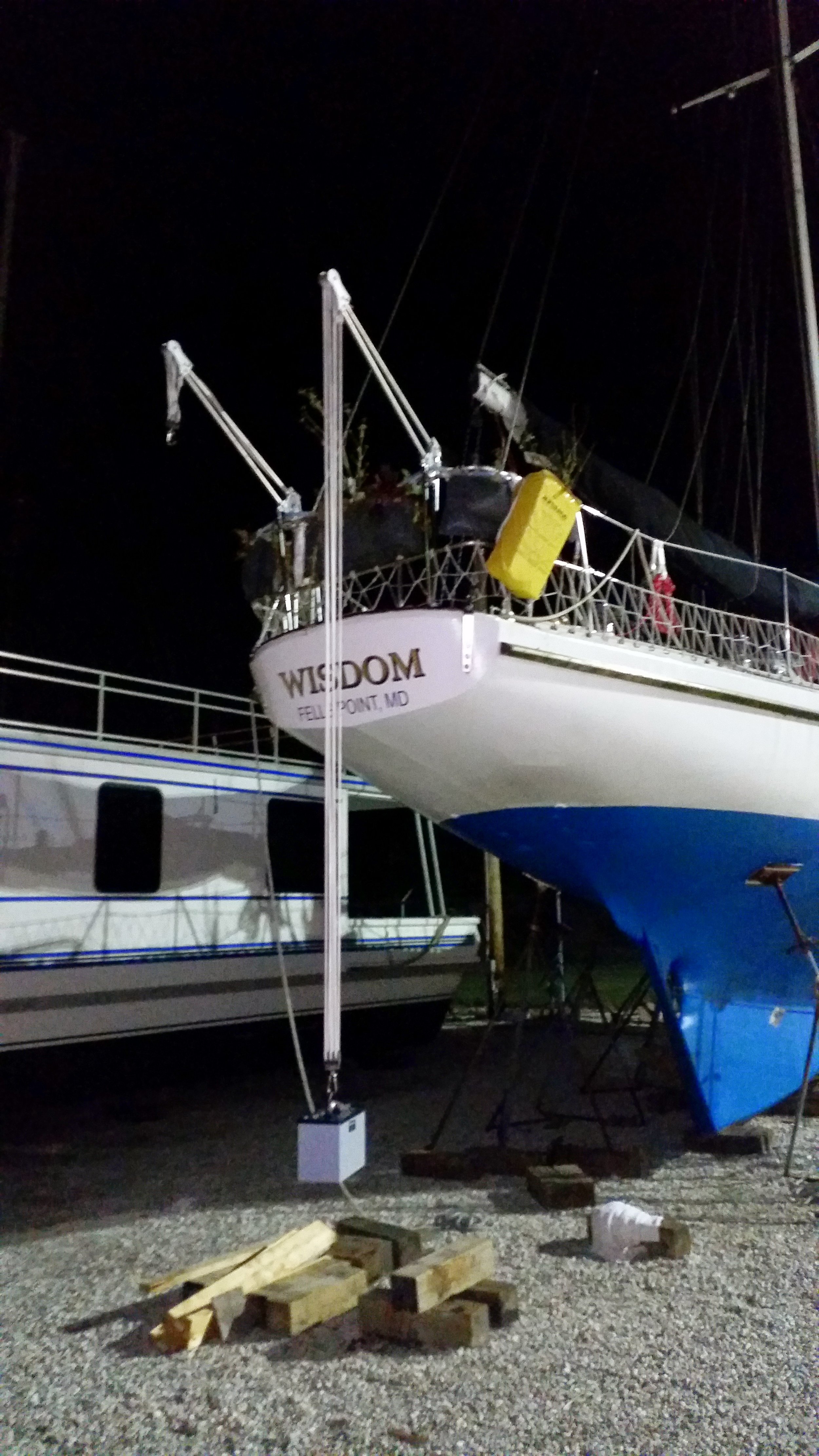
The wind vane needs to have access to swing and move without obstruction. This means that all our clutter and gear needs to be relocated and moved away from the transom. The big things that need to go are the stern anchor, davits, and wind sensor pole. 

I cleared off the large components, but left the stern light mounted below the rail. This too had to be removed as it interfered with the counterweight movement. If the Monitor were set on a starboard tack and close reach, the lead weight would bump into the stern light and make the unit get stuck.

The stern light was not that major of a problem since the Monitor has a stern light built into the frame. The other equipment was more of an ordeal to remove and relocate. The stern anchor for instance is frequently used to position our yacht with an East/West orientation. This orientation keeps the cockpit shaded and the solar panels in full sun all day long. 

The davits on the transom were of a different use. They were a royal pain in the stern to use, so I rarely every used them for their intended purpose. I purchased them to hoist the dinghy up and bring it along as we sailed, but it was very inconvenient. The dinghy needed to be tied up well to avoid it from sloshing side to side as we heeled over. It also required a bunch of fenders to avoid damage to the lettering on the stern. This was the first and last time I ever raised the dinghy on the davits!

From then on, the davits served other purposes, like storing our spare lines or raising batteries into the boat while on the hard. 

The davits were removed and disassembled, but they will be stored in a locker. Should we find ourselves on the hard and in need of lifting many heavy items into the boat, we can always assemble and install the davits temporarily. Rope storage will be relocated to another location on the boat, possibly a lazarette organization system for the ropes. Storing the ropes inside a locker fulfills a few tasks: it keeps the ropes away from salt, it keeps the ropes out of the sun, it keeps the rope out of sight.

Salt makes the ropes stiff and harder to use when you need them. The sun eats up the ropes via UV degradation. Keeping the ropes out of sight makes the boat look neater and also reduces the risk of someone else using the rope for their projects on their boat.

The Monitor Wind Vane is the most important piece of equipment on the transom, so its mounting requirements take top priority. If anything impairs its ability to function, that thing must be removed and relocated. Storing ropes or lifting batteries is not the priority while sailing across an ocean! Keeping these priorities in line allows us to maintain the yacht in the most functional of methods and will allow us to sail in the safest method possible.