
Life Aboard

Dyneema Lifelines

Synthetic Lifelines have many advantages over steel lifelines:

No rust
Easy to inspect
Never cut your hand
Easy to install yourself

Dyneema is the material of choice for synthetic lifelines. Dyneema is soft on the hands, easy to splice, and stronger than steel with just a fraction of the weight.

Dyneema is a modern fiber made of High Modulus Polyethylene (HMPE) which offers incredible strength for its weight and size. They offer a strength greater than steel without any of the corrosion issues. 

Synthetic lifelines offer a clear advantage in inspect-ability over coated steel lifelines. Steel lifelines live hidden in a plastic casing, slowly rusting away without giving any signs. When I replaced my steel lifelines, the cable was actually broken in several places inside the plastic casing. I only learned of this when I was coiling the old lifeline to recycle it. For two years, it had escaped my inspecting eye! When dyneema begins to wear, it will show clear signals in the form of chafe and fuzzing. There are also easy ways to rate how much residual strength is present based on the visual condition of the dyneema. 

This link outlines how to inspect and assess dyneema

How much chafe is too much?
The mainsheet chafes on this part of the lifeline when on a broad reach.

The mainsheet chafes on this part of the lifeline when on a broad reach.

Steel lifelines don't have to live in a plastic covering making them impossible to inspect. The plastic covering can be stripped away leaving the wires exposed to the elements (which will accelerate their deterioration). As the steel wires weaken with time and use, they will begin to part. When you find the parted wire with your hand, you will learn why they call parted wires "Meat Hooks"! The wires tend to form little hooks on them as the wires break. Thanks to the ease of inspection, you are able to see that the lifeline needs replacing and have a very painful cut on your hand where the meat hook took a chunk out of you. Dyneema on the other hand offers the same ease of inspection as un-coated steel but while never forming meat hooks. The line is perfectly smooth to the touch and feels comfortable in your hand. I know I can hold onto the lifeline as I climb forward on the deck in rough weather without fear of injuring my hand.

The best part of synthetic lifelines is the ease of installation. All you need to do is make a few easy to complete splices. Simply run the line off the spool through all the stanchions until you reach the point where it will attach. Make an eye splice with a thimble and tie a lashing to the attachment point. Then cut the other end off the spool and make the same eye splice. I prefer the Mobius Brummel Eye Splice because it is very secure and will not slip.

How to make a mobius brummel eye splice

Once the ends are eye spliced, you can use the mechanical advantage of the lashings to tighten the lifelines. The lifelines don't have to be cut to perfect lengths because you are not limited by the adjust-ability of a turnbuckle. If you are a little too close, you can simple move the splice further into the line. If you are too far, simply make the lashing a little longer. I personally prefer to make the lifelines a little short because they will stretch while settling in.
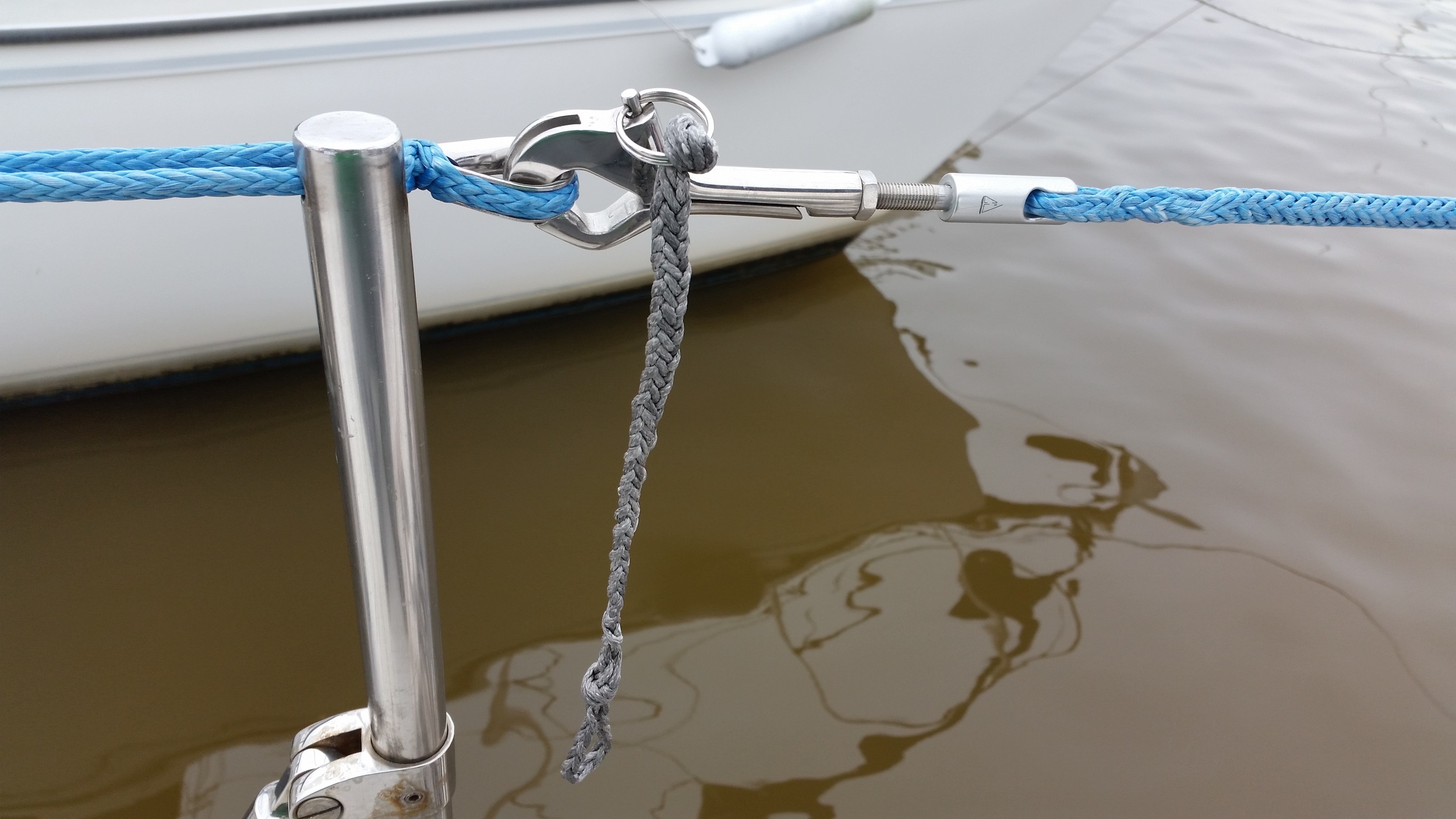
The gates are also very easy to make, simply splice the gate latch directly to the dyneema. The gate latch is perfectly happy connecting to a stainless steel thimble. I wove a lanyard onto the gate latches to make operation easier.

Synthetic lifelines are very forgiving to install. The process progresses quickly which can keep morale high during the installation. The most important thing to keep an eye on is when the lifeline passes through the shrouds. Usually the lifeline will pass inboard of the cap shroud and outboard of the lowers, but make sure there is a fair path for the lifeline before you put in the eye splice.

Overall, synthetic lifelines offer unmatched advantages over steel lifelines and truly are the superior material for lifelines on boats.

Laundry

It needs to be done; but how do you do your laundry while living on a sailboat?

Being in a marina has its advantages, you have somewhere to park your car and you have access to appliances, but what about when you're cruising?

They actually make small washing machines that do not use electricity. I have a small one called "Wonder Wash" that I bought on Amazon. It will wash a small load relatively quickly and while using a minimal amount of water (the real important part). 

To operate the washer, you simply load the clothes into the can, add enough water so that all the clothes are floating, add a very small amount of detergent to the wet mix, and then screw the lid back on tightly. Now the clothes and soapy water are contained and ready to wash. I would sit and turn the crank for around 5 min, letting the clothes agitate as they sloshed around in the can. The washer comes with a drain pipe to let the water out, but it takes too long in my opinion. I simply open the lid and pour out the water. 

After you complete the wash cycle, add some fresh water and close the lid again. Now take a few minutes to crank the arm once more as you rinse out the soap from the clothes. If I had plenty of water handy, I would do two rinses to get all the soap out; but if I'm trying to conserve water, one rinse is good enough.

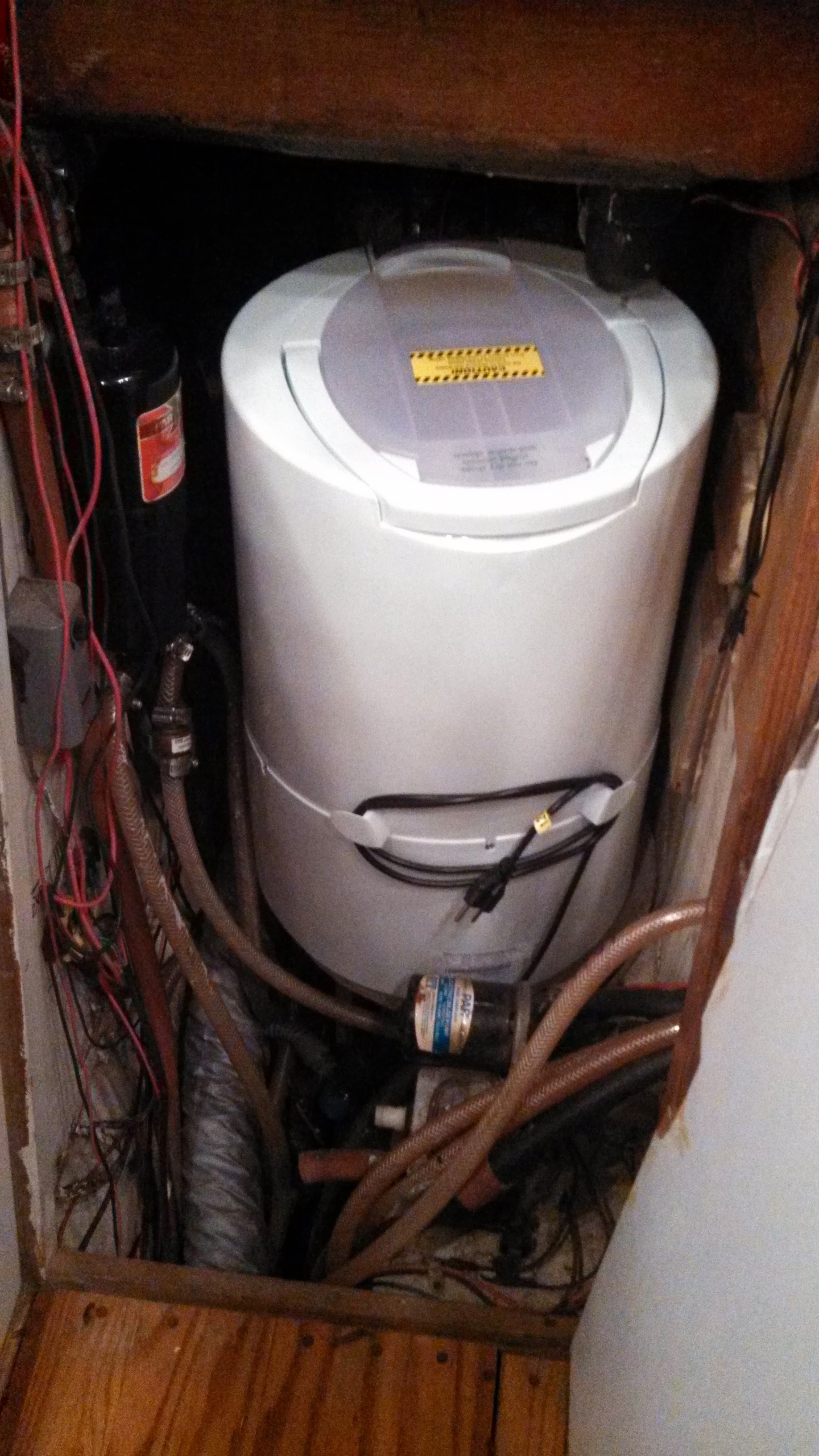
Now that the clothes are clean, we need to dry them! When anchored out, all my lifelines turn into clothes lines, but this is frowned upon in the marina, so I had to find another way. I used to use an electric clothes spinner (just like a salad spinner) to spin the water out of the clothes. This worked pretty well, but if the clothes were off balance, the machine would make horrible noises.

When the clothes would emerge from the machine, they were no longer dripping but still damp. I have a clothes line set up in the V-berth where they would hang out to dry all the way. 

This worked well while I lived alone, but when Maddie moved in, the laundry piled up way too fast for me to wash and dry this way. I asked other liveaboards in the marina and found a guy close by that would wash, dry, and fold all our clothes for $0.90 per pound. 

This has been our solution for the past year and I can't be happier! We still carry the clothes washer on board for doing laundry while cruising, but the spin drier has been removed from the boat. I took up a lot of space and needs 110V AC to run. When we are in port, we use the "Wash and Fold", and when we are cruising, we can hang the clothes from the lifelines. 

It is very important to keep the things you need on board, but be sure to remove things that you don't need. Space is a premium, and if something has no purpose, it is costing you valuable space!

As a dentist, I get rather close to people, so if my clothes were not clean, my patients would let me know rather quickly! When I lived alone, I used this machine every weekend for a year (when I would do my weeks worth of laundry) and no one ever mentioned my clothes smelling. 

I think the "Wonder Wash" is a wonderful tool to have on board. It disassembles easily, letting you store it in less space and it actually cleans the clothes well!

How do you guys do your laundry?

Manual Bilge Pump Backups

On a boat, anything that can fail, will at the most inopportune time! This is why it is crucial to always have a backup. 

Today, everything on a boat is switching over to the convenience of electronics. This is great until you consider the marine environment. The boat is a corrosion haven, constantly exposed to salts and humidity. Electrical components eventually will give way to corrosion and fail.

I'm not saying that we should negate all electronic conveniences from our boats to avoid the fatalities of corrosion. Instead I'm saying that it is important to remember to keep a backup, and preferably a manual backup on board for anything that you really need.

If we were holed and our electric bilge pump were to stop working we would have problems. We have two electric bilge pumps, one in the sump, the other mounted higher (the high water pump). The idea is that bilge scum and dog hair will likely foul the primary bilge pump, but the highwater pump will still be clean and ready to pump. 

Such a wonderful theory, but the reality is that if we are taking on water, the batteries might run down and the pumps would stop working. Worse yet, if the batteries get submerged by the rising water, we will instantly lose our electric pumps. 

This is why a manual bilge pump in a necessity. It will flow a large volume of water with each stroke. It does not depend on electrical connections or battery charge, but instead it works on you. They say "Nothing pumps faster than a scared man with a bucket". This is a little more sophisticated than a bucket, but as your fear builds, it pumps water out faster. 

Can a manual bilge pump flow enough water? I found out when I was cleaning my bilge. My method for cleaning the bilge is to pour "Simple Green" into the bilge and let a hose run to fill it up. The soap will foam and the running water will eventually flush out all the bilge scum and dust that has accumulated over the past year. The manual bilge pump was able to keep up with the flow of a garden hose running full blast. I do feel confident that if we had a leak, we would be able to pump the boat dry (once the hole has been plugged).

If nothing else, having a manual bilge pump makes you feel like you are involved in your survival. If you stand around watching the water rise in the bilge, you might begin to panic. But if you are busy pumping your heart out, you will be kept occupied in your survival.